


You’ve probably done this before. It’s late, the shop is shut or the last job is done, and instead of switching off, you’re staring at receipts, bank transactions, payroll notes, and a BAS deadline you meant to deal with last week. If you run a small business in Ashfield, the Inner West, Belrose, or the Northern Beaches, that kind of financial backlog isn’t unusual. But it does become expensive when it keeps you from seeing cash flow clearly, claiming deductions properly, or lodging on time.
Good bookkeeping help for small business isn’t just about entering numbers into Xero, MYOB, or QuickBooks. It’s about building a system that keeps your records clean, your tax position visible, and your stress level under control. For Sydney business owners, especially tradies, cafes, consultants, and local retailers, its core value is simple. You stop guessing and start managing.
Are Your Books Holding Your Business Back
A plasterer in Ashfield finishes a long day on site and promises himself he’ll sort the invoices after dinner. A café owner in Belrose prints supplier statements, checks the till totals, then leaves the paperwork in a folder because there’s no time left. A consultant in the Inner West has money coming in, but still can’t say with confidence which clients are profitable.
That’s what bad bookkeeping looks like in real life. It’s rarely dramatic at first. It starts as a delay, then turns into confusion, and eventually becomes a tax, cash-flow, and decision-making problem.

Support is normal, not a failure
Plenty of owners think they should be able to handle everything themselves. That idea causes more mess than the bookkeeping itself. In Australia, about 35% of small businesses with 1 to 19 employees engage external providers for accounting or bookkeeping services, according to this accounting statistics roundup citing ABS small business data. That tells you something important. Getting help is common, and it’s often the smarter move.
If you’re still setting up or tightening the foundations of your business, Wise Web’s business startup guide is a useful read because it puts the admin side of running a business in plain English. Bookkeeping sits right in the middle of that setup.
Practical rule: If your books only get attention when a BAS is due, your bookkeeping system isn’t supporting your business. It’s chasing it.
What bookkeeping changes day to day
When books are current, you can answer basic but critical questions quickly:
- What’s available to spend: Bank balance and real cash position aren’t always the same thing.
- Which jobs or products are worthwhile: Revenue alone doesn’t tell you where profit is coming from.
- What the ATO will expect next: Clean records make BAS, payroll, and tax planning far less reactive.
Messy books also create silent risk. Personal spending slips into business accounts. Supplier bills sit unpaid because no one has a clean payable list. Income gets recognised late. Small issues stack up.
If that sounds familiar, the first step isn’t perfection. It’s getting the records under control and keeping them clean, which is exactly why keeping your books clean matters for tax compliance.
When to Call for Bookkeeping Reinforcements
Some business owners wait too long because they think bookkeeping help is only for larger operations. It isn’t. The right time to bring in support is when poor records start affecting decisions, compliance, or sleep.
The warning signs are usually obvious
Use this as a practical checklist.
- You avoid opening your accounting software: If Xero or MYOB makes you tense because the figures don’t look right, that’s already a business risk. You can’t manage what you don’t trust.
- Bills get paid late even when revenue looks fine: This often means your accounts payable process is weak, not that the business is failing.
- You don’t know your cash position until the bank account feels tight: That usually points to missing reconciliations, uncleared transactions, or poor follow-up on debtors.
- BAS deadlines create panic every quarter: If each lodgement means a scramble for receipts and explanations, the system is broken.
- You can’t tell which jobs made money: This is common for tradies, agencies, and service businesses that price work tightly but don’t track labour, materials, and overhead cleanly.
- Your payroll records feel separate from the rest of the business: When payroll sits in one place and your books sit in another, errors creep into reporting and planning.
- You mix personal and business spending: This creates classification issues, weakens reporting, and makes tax prep harder than it needs to be.
Good bookkeeping support should remove uncertainty, not just process transactions.
Confidence is a real business outcome
The stress side of this matters. It’s hard to run a business well when the numbers always feel one step behind. Among Australian small business owners who outsource their bookkeeping, over 70% feel more confident about meeting tax obligations and managing cash flow, compared with only 45% of those who handle it themselves, according to Rippling’s bookkeeping for small business guide.
That gap makes sense in practice. Owners don’t usually need more software. They need someone to keep the data accurate, current, and explainable.
What happens when you leave it too long
A backlog doesn’t stay a backlog. It spreads.
| Symptom | What it usually means | Why it matters |
|---|---|---|
| Old unreconciled transactions | No regular month-end process | Reports become unreliable |
| Missing receipts | Weak record capture | Deductions become harder to support |
| BAS anxiety | Incomplete coding or GST errors | Lodgements slow down and corrections increase |
| No job-level visibility | Poor category setup | Pricing decisions become guesswork |
If any of that sounds familiar, you don’t need more DIY articles. You need a decision on what kind of support fits your business, and how to find an accountant is a good place to start if you want to choose carefully rather than rush.
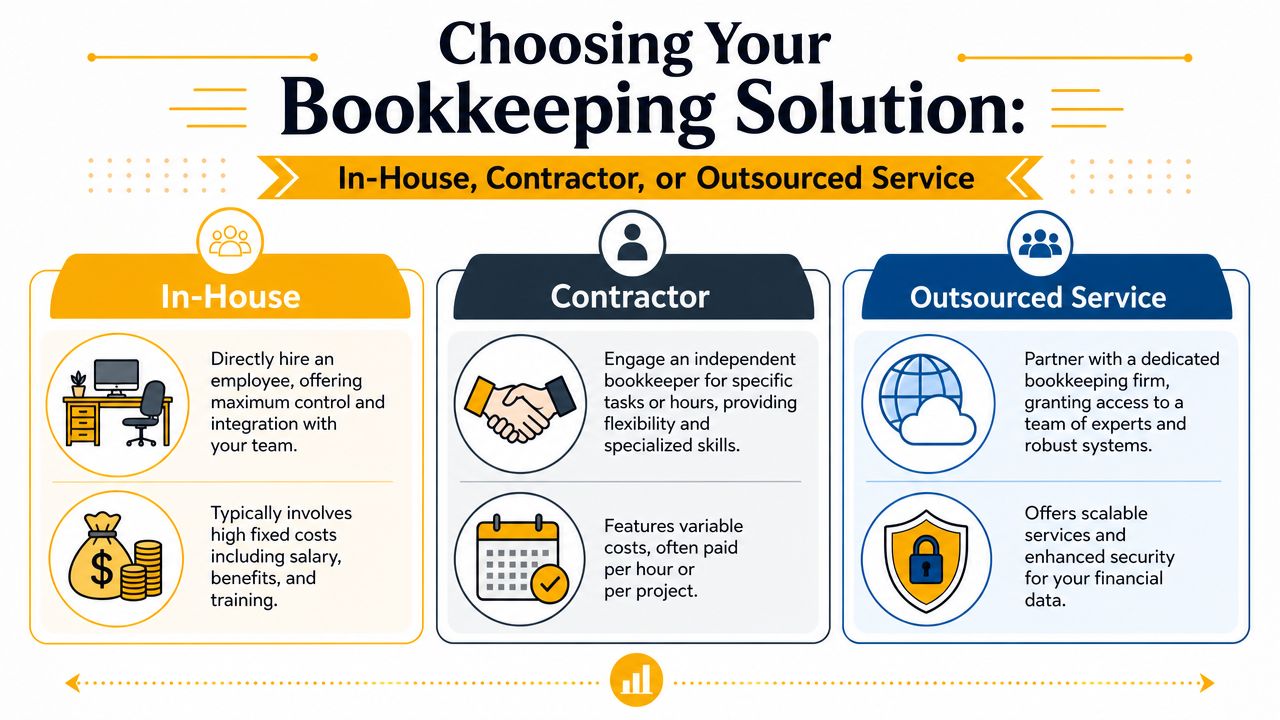
In-House vs Contractor vs Outsourced Service
There isn’t one correct model for every business. The right choice depends on transaction volume, payroll complexity, industry risk, and how much oversight you want. A solo electrician in the Northern Beaches doesn’t need the same setup as a growing retailer in the Inner West.
In-house gives control
An in-house bookkeeper can work well when your business has constant transaction flow, frequent supplier payments, regular payroll, and a genuine need for someone embedded in the day-to-day.
What works
- Immediate access to records and staff
- Strong operational context
- Easier follow-up on missing paperwork
What doesn’t
- Fixed employment cost even in quieter periods
- More training and supervision responsibility
- Greater disruption if that one person leaves
For some businesses, especially those with stock, rostering, and heavy admin, this model is practical. But for many smaller operators, it’s more structure than they need.
A contractor brings flexibility
A freelance or contract bookkeeper suits businesses that need regular help but not a full internal hire. This can work well for consultants, trades, and service businesses with moderate transaction volume.
A good contractor can clean up reconciliations, process payroll, and maintain month-end discipline. The risk is inconsistency. Some contractors are excellent. Others are stretched, slow to respond, or limited when the work moves beyond straightforward data processing.
Outsourced service suits owners who want a system
An outsourced bookkeeping service usually makes sense when you want more than data entry. You want process, review, continuity, and clear handover between bookkeeping and tax compliance.
This model often works best when:
- the books are already behind
- multiple software tools need to talk to each other
- BAS, payroll, and reporting need to stay aligned
- the owner wants regular visibility without hiring internally
A strong outsourced setup should feel organised, not distant. If communication is slow or unclear, the model isn’t the problem. The provider is.
A hybrid model is often the best fit for micro-businesses
This is the option many small Sydney businesses overlook. For micro-businesses with under 10 employees, a hybrid model using a part-time bookkeeper for daily transactions plus a registered tax agent for BAS and year-end tax can reduce compliance errors by 30 to 40% compared with a fully DIY approach, according to this small business accounting reference.
That setup is often ideal for:
- tradies with payroll and subcontractors
- small professional firms
- local businesses with steady sales but limited admin time
A simple way to compare the options
| Model | Best for | Main advantage | Main trade-off |
|---|---|---|---|
| In-house | Larger admin workload | Control and proximity | Fixed cost and staff dependency |
| Contractor | Moderate ongoing needs | Flexibility | Varies by individual capability |
| Outsourced service | Owners wanting structure and oversight | Systems, continuity, scalability | Less physical presence onsite |
| Hybrid | Micro-businesses | Practical balance of cost and expertise | Requires clear division of roles |
If you’re choosing between these, don’t start with price alone. Start with how your business runs week to week.
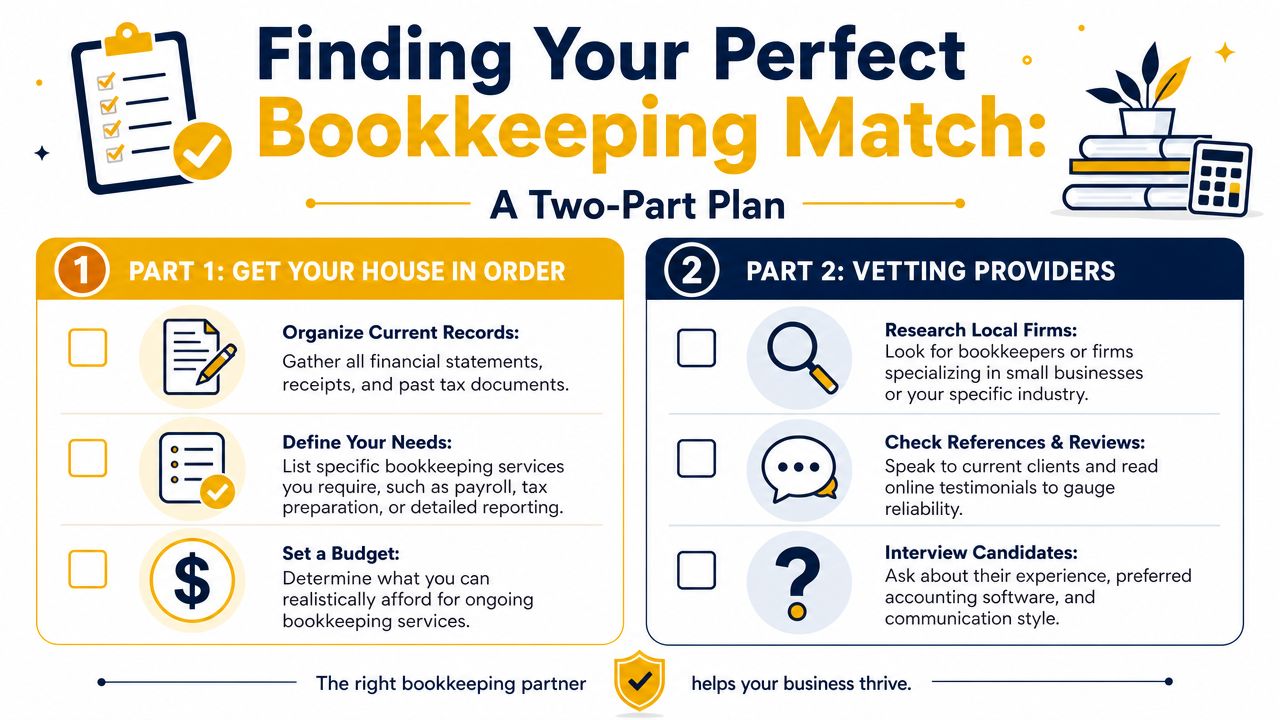
Finding Your Perfect Bookkeeping Match
Most owners start the search too early on the wrong question. They ask, “How much do you charge?” before they’ve worked out what shape of help they need. Better results come from preparing your records first, then vetting providers properly.
Get your house in order first
Before speaking to anyone, gather the information a competent bookkeeper will need to assess the job properly.
Start with these documents and access points:
- Bank statements and credit card statements: Include all active business accounts.
- Accounting software access: Xero, MYOB, QuickBooks, or whatever you currently use.
- Prior BAS and tax returns: These help identify reporting history and any carry-forward issues.
- Payroll records: Include employee setup, pay runs, and super records if relevant.
- Unpaid sales invoices and supplier bills: These show whether debtor and creditor records are current.
- Loan and finance statements: Important for correct treatment of repayments and interest.
- Receipts and source documents: Even if they’re messy, collect them before the first meeting.
The ATO requires businesses to keep most records for at least five years, as noted in QuickBooks’ summary of Australian record-keeping requirements. That rule matters because a weak record trail creates problems long after the quarter has passed.
For the underlying ATO rules, review the ATO record keeping for business guidance.
Define the actual job
Don’t say, “I need a bookkeeper,” and leave it there. Be specific.
Maybe you need:
- weekly transaction coding
- payroll processing
- BAS-ready reconciliations
- catch-up bookkeeping
- monthly reporting
- help separating personal and business transactions
- support for tradie job-costing or café supplier tracking
When owners define the job clearly, providers can scope properly. That reduces surprise costs and vague expectations.
What to ask yourself: Do I need data entry, clean-up, reporting, tax coordination, or all four?
Vet providers like a business owner, not a desperate one
Once your records are gathered, ask direct questions.
Questions worth asking
- Are you registered for the work you’ll perform? If BAS work is involved, registration matters.
- Which software do you work in most often? You want fluency in Xero, MYOB, or QuickBooks, not vague familiarity.
- How do you handle messy historical data? A good provider should explain the clean-up process calmly and clearly.
- What does your month-end process look like? You’re listening for discipline, not buzzwords.
- How do you communicate missing information? If their answer sounds ad hoc, expect delays later.
- Have you worked with businesses like mine? Industry context matters. Construction, hospitality, consulting, and retail all have different pressure points.
Red flags to take seriously
- They promise instant fixes without reviewing your file.
- They can’t explain how reconciliations are checked.
- They rely heavily on software automation but don’t mention review.
- They speak only about price and never about process.
- They avoid clear turnaround times.
A provider should make your books more understandable, not more mysterious.
Connecting Your Tools for Seamless Compliance
Modern bookkeeping works best when the software and the person behind it are doing different jobs well. The software captures and organises. The bookkeeper reviews, corrects, and interprets. When both parts are working together, BAS preparation becomes much smoother.
What the workflow should look like
At a practical level, the system is straightforward.
- Bank feeds import transactions into Xero, MYOB, or QuickBooks.
- Rules help categorise recurring items such as fuel, software subscriptions, merchant fees, and supplier payments.
- A bookkeeper reviews the coding instead of assuming the software got it right.
- Accounts are reconciled regularly so the reports reflect reality.
- GST and BAS positions are checked before lodgement, not guessed at the last minute.
A common pitfall for many businesses is to install cloud software, connect the bank feed, and then assume the rest takes care of itself. It doesn’t. Automation reduces manual work, but it doesn’t replace judgement.
Why cloud tools matter when they’re set up properly
An IPA study of NSW small businesses found that 72% of firms using cloud tools with bank-feed integration detected and corrected errors within 72 hours, versus 38% of non-automated users, according to this overview of small business bookkeeping technology. The advantage isn’t just speed. It’s the ability to spot mistakes before they flow into BAS, payroll, or management decisions.
If you’re weighing platforms, this bookkeeping software comparison can help you think through the differences between common options without treating them as interchangeable.
Software should shorten the path to accurate numbers. If it’s only helping you create faster errors, the setup needs work.
Compliance starts with clean coding
A clean chart of accounts matters more than most owners realise. If every purchase ends up in a generic “expenses” bucket, the reports stop being useful. You can’t monitor margins properly, and tax prep becomes slower.
For BAS obligations and reporting expectations, the ATO guidance on business activity statements is the right starting point.
A healthy system usually includes:
- separated business and personal transactions
- consistent expense categories
- regular review of GST treatment
- clear handling of wages, super, and loan movements
- timely follow-up on coding exceptions
That’s how bookkeeping turns into compliance support rather than admin clutter.
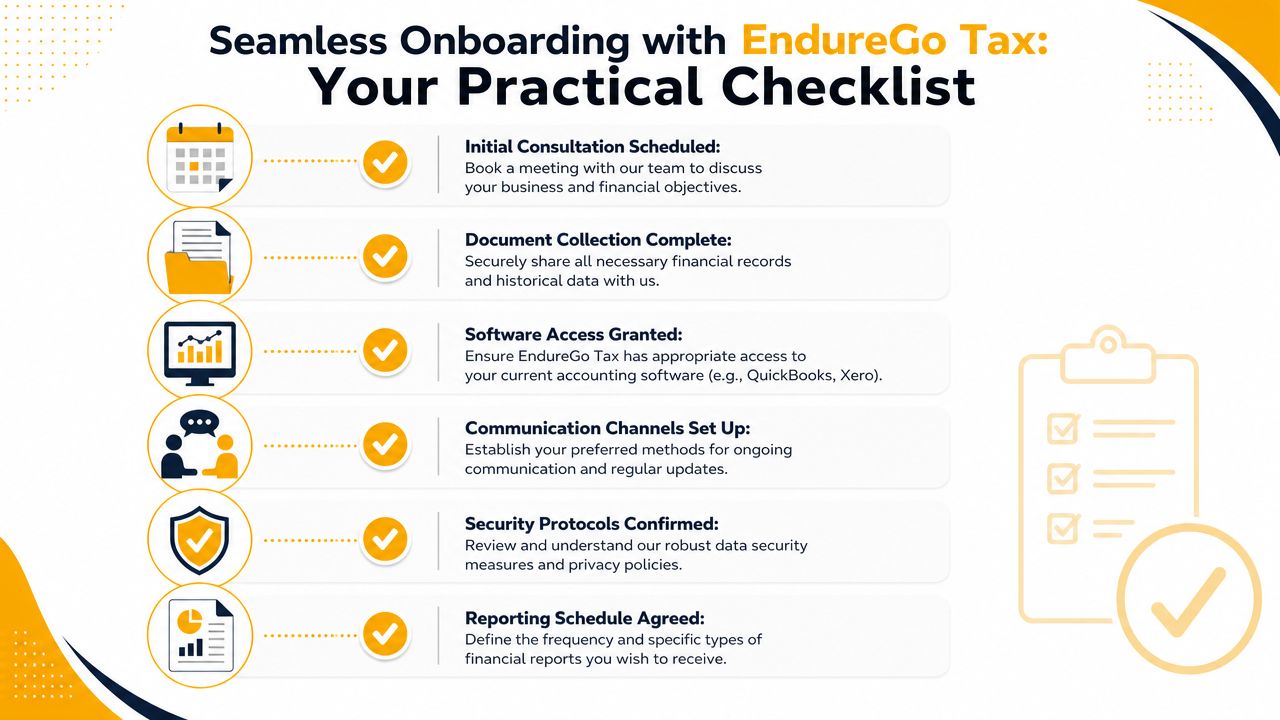
Your Onboarding Checklist with EndureGo Tax
Changing bookkeepers or getting help for the first time can feel disruptive. It doesn’t need to be. The smoothest onboarding process is the one that removes uncertainty early, gets access sorted quickly, and establishes a reporting rhythm you can use.
What a clean handover looks like
A practical onboarding checklist should cover the basics first.
- Initial consultation: Clarify the business structure, current pain points, software stack, and upcoming deadlines.
- Document collection: Gather statements, prior lodgements, payroll data, and any outstanding queries.
- Software access: Confirm access levels to Xero, MYOB, QuickBooks, payroll, and document storage.
- Catch-up review: Identify unreconciled periods, duplicate entries, missing source documents, or GST coding issues.
- Communication setup: Agree on who sends what, how often, and where missing items will be uploaded.
- Reporting rhythm: Lock in the cadence for reconciliations, BAS preparation, and management reporting.
Support works best when it’s predictable. Owners don’t want to chase updates. They want to know what happens next and when.
Why the bookkeeping relationship should go beyond data entry
The strongest small business setups treat bookkeeping as part of tax and cash-flow planning, not a separate back-office chore. Small businesses using cloud accounting tools linked to BAS agents are 1.5 times more likely to lodge on time, according to this small business accounting services reference. That’s a useful reminder that connected systems improve compliance.
For busy firms that also want tighter admin follow-up and client communication processes, tools such as My AI Front Desk are worth exploring because they can support lead handling and workflow consistency around service businesses.
The best bookkeeping relationship gives you clean records, earlier warnings, and fewer surprises when tax deadlines arrive.
For Sydney businesses in Ashfield, the Inner West, Belrose, and the Northern Beaches, the key advantage is peace of mind. You know your books are current. You know what the ATO position looks like. And you’re not trying to reconstruct months of transactions the week a BAS is due.
If you want practical bookkeeping help for small business from a local team that understands Ashfield, Belrose, the Inner West, and the Northern Beaches, book a consultation with EndureGo Tax. We help business owners clean up messy books, stay compliant, and use real-time financial data for better tax and cash-flow decisions.
