


You’ve probably seen the pattern already. A client has a solid super balance, wants more control, and starts asking whether a self-managed super fund could give them better outcomes than a mainstream fund. The underlying question isn’t just control, though, it’s whether they’re ready to take on the legal, tax, and record-keeping work that comes with it.
That’s a common sticking point. An SMSF can be a powerful structure, but it’s also a trustee-run retirement vehicle with fixed costs, annual compliance, and personal responsibility for every decision. For accountants, advisers, and clients in Australia, the value sits in understanding the trade-off before anything is signed.
Introduction to SMSF Control and Responsibility
A common first conversation goes like this. A mid-career professional has accumulated a decent balance, feels boxed in by preset fund options, and wants to buy specific assets or coordinate super with a spouse. They like the idea of a structure they can steer themselves, but they’re not sure what happens after the fund is set up.
That hesitation is healthy. A self-managed super fund isn’t a casual investment account, it’s a retirement structure where the members are also the trustees, and the trustees carry the responsibility for compliance, administration, and investment decisions. In other words, the attraction is control, but the cost is accountability.
For Australian tax and accounting firms, that distinction matters because clients usually ask about the exciting part first, then discover the boring part later. The boring part is where SMSFs succeed or fail. If the fund is right for the client, it should fit their balance, time, discipline, and long-term goals, not just their curiosity.
Practical rule: if a client mainly wants the feeling of control, but not the work that comes with it, an SMSF is probably the wrong fit.
That’s why the smartest advice starts with a simple question, what is the fund for, and who is prepared to run it properly?
Understanding Key Concepts of SMSF
A self-managed super fund is a privately run superannuation trust in Australia where the members control the fund as trustees. It can have between 1 and 6 members under the data set you’ve provided, and each trustee or director is responsible for how the fund is run, reported, and kept compliant. For a plain-language definition, think of it as a retirement trust with a very small group of decision-makers and a very large compliance footprint.
The scale matters. As at September 2025, Australia had 661,384 SMSFs with 1.22 million members holding $1.07 trillion in assets, which is about one quarter of Australia’s total superannuation pool ScaleSuite SMSF statistics 2025. That tells you SMSFs are not a fringe option. They’re a major part of the super system, so mistakes aren’t just personal problems, they can become compliance and governance problems.
The core moving parts
A useful way to understand SMSFs is to separate the people, the legal wrapper, and the regulator. The members are the beneficiaries. The trustees are the decision-makers. The trust deed is the rulebook. The ATO is the main regulator watching the fund’s conduct. For setup and administration, the fund also needs its own identity, including a bank account, TFN, and ABN, so it stays separate from personal money and remains auditable SMSF structure and setup guide.
The ATO describes an SMSF as a trust set up for the sole purpose of providing retirement benefits to members ATO SMSF purpose guidance. That’s the key conceptual anchor. SMSF money isn’t a general-purpose investment pool, and it’s not personal cash. Every decision has to sit inside the retirement framework.
If you’re advising clients, this is also where contribution planning and fund strategy start to matter. A practical starting point is to check super contribution settings before anything is moved, which is why firms often keep a dedicated reference point such as superannuation contribution limits nearby when discussing setup.
Why trustees matter so much
Trusteeship isn’t a title for show. It means the people controlling the fund are also legally exposed if they get the structure wrong. That’s one reason SMSFs suit clients who want agency and are comfortable with responsibility. It’s not enough to like the idea of investment flexibility. The trustees have to maintain the legal form, the records, and the separation between fund and personal affairs.
How SMSFs Work in Australia
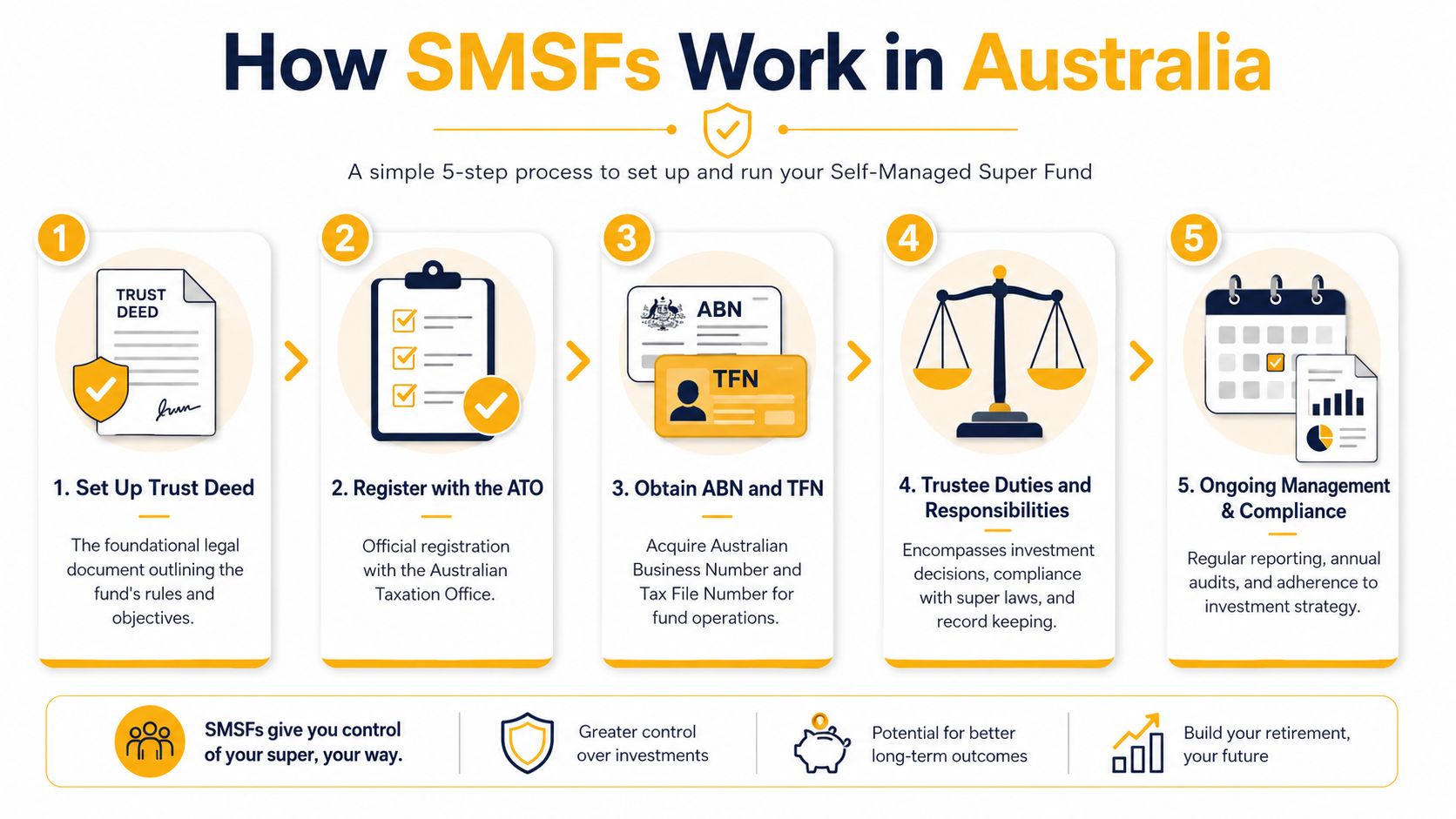
The mechanics are simple to describe and easy to get wrong in practice. An SMSF starts with a trust deed, then it gets registered with the ATO, then it needs its own ABN and TFN, and then the trustees manage money through the fund’s own bank account. That sequence matters because each step builds the evidence trail that keeps the fund compliant and defensible.
Separate the fund from personal money
The cleanest mental model is to treat the SMSF like a small company with retirement rules. Contributions, rollovers, expenses, and investments should flow through the SMSF’s own bank account, not a personal account. That separation protects auditability and avoids confusion when you later need to show where money came from, where it went, and why it was used.
A client might, for example, roll over an existing super balance, pay the annual accounting and audit costs from the fund account, and then purchase investments in the name of the fund. That sounds routine, but if someone pays an SMSF expense personally and never records it properly, the paper trail starts to fray. Once records blur, compliance risk rises fast.
Trustees do the work, not the regulator
The trustees make the investment choices, maintain the records, ensure the fund follows superannuation law, and keep the fund aligned with the trust deed. The ATO and the audit process check whether those responsibilities were carried out correctly, they don’t do the work for the trustees. That’s why SMSFs are so different from APRA-regulated retail or industry funds.
Good governance beats clever investing. A fund with tidy records and a sensible strategy is usually easier to defend than a fund chasing complicated assets without proper documentation.
The structure can be flexible, but that flexibility only works if the trustees stay disciplined. Heffron notes that almost everything about an SMSF can be changed without moving to a new fund, which is why many people describe it as a fund for life Heffron SMSF overview. That flexibility is useful, but it doesn’t reduce trustee liability. It just gives the trustees more room to adapt.
The infographic version of the process
The process is straightforward on paper. Set up the deed, register with the ATO, obtain the fund identifiers, run the investment and compliance duties, then keep the annual administration moving. If any of those parts go missing, the whole structure becomes harder to defend.
The main point for advisers is this. An SMSF works best when the client understands that it’s not just a container for assets, it’s a controlled legal structure with ongoing responsibilities. That’s why the setup stage is only the beginning.
Benefits and Risks of Managing Your Own Fund
A lot of clients are drawn to SMSFs for the same reason they buy active software or professional tools, they want control over the inputs and outputs. That instinct can be sensible. It can also create expensive mistakes if the client ignores the obligations that come with the control.
What the upside really looks like
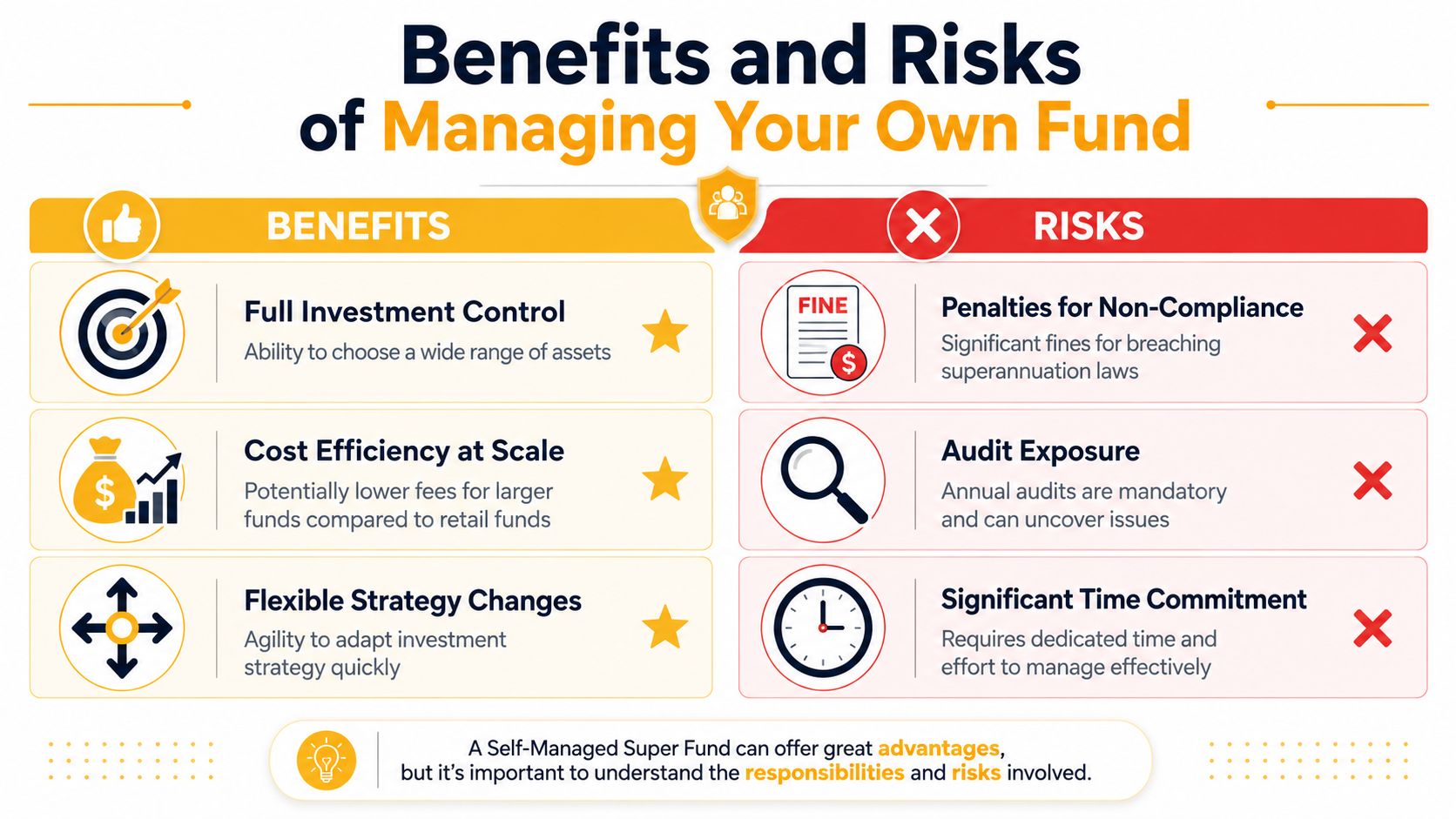
The biggest benefit is full investment control. Trustees choose the assets, the timing, and the strategy, instead of relying on a menu inside a mainstream fund. For some households, that means they can align super with property, cash flow, or a specific retirement plan.
The second benefit is flexibility. If a couple’s circumstances change, the trustees can adjust the investment approach without moving to a new fund, provided the changes still fit the deed and the law Heffron SMSF overview. That can matter near retirement, when growth, liquidity, and defensive positioning need to change more quickly than a standard fund design allows.
The third advantage is cost efficiency at scale. The value isn’t in being cheap by default, it’s in spreading fixed administration across a larger balance. That’s why higher-balance SMSFs often look more attractive than lower-balance ones.
Where the risks hide
The risk side is less glamorous, but it’s where advice earns its keep. Trustees carry legal responsibility for every decision and every compliance obligation. If they miss a reporting requirement, fail to keep records, or handle investments carelessly, the issue doesn’t sit with an external fund manager. It sits with them.
The hidden issue most beginners miss is ongoing governance. Many “what is an SMSF” pages explain the concept but understate the likelihood of audit problems, penalty exposure, and administrative failure when trustees treat the fund casually AMP SMSF guidance. That’s a problem because the danger usually isn’t dramatic fraud, it’s ordinary neglect.
A practical example helps. A client wants the fund to buy a property because they’ve heard SMSFs can do that. If the purchase doesn’t fit the retirement purpose and legal framework, the convenience of the idea won’t save it. The fund has to stay focused on retirement outcomes, not personal preference, ATO sole purpose guidance.
The adviser’s balancing question
The right question isn’t whether SMSFs are good or bad. It’s whether the client values control enough to accept the work, the cost, and the liability. If the answer is yes, the structure can be useful. If the answer is vague, the fund often becomes a burden.
For a plain explanation of the practical trade-offs, see benefits of a self managed super fund.
Comparing Costs and Features with Other Funds
SMSFs compare differently from retail and industry funds because the cost structure is different. An APRA-regulated fund usually bundles administration into a percentage-style fee model, while an SMSF has more visible line items and separate compliance tasks. That doesn’t make one model better in every case; it just means the comparison has to be done properly.
The ATO-reported median total cost to run an SMSF in 2020–21 was $8,611 per year, and that figure includes accounting, audit, legal advice, insurance, and the supervisory levy Moneysmart SMSF guide. That cost profile matters because fixed expenses weigh more heavily when the balance is smaller, while larger balances spread the burden more efficiently.
| Feature | SMSF | Retail/Industry Fund |
|---|---|---|
| Control | Trustees choose and manage the investments | Members choose from the fund's options |
| Administration | Trustees are responsible for records, audit, and compliance | The fund handles most administration |
| Cost structure | Separate compliance and running costs | Fees are usually bundled within the fund model |
| Audit | Annual audit required | No member-managed annual audit process |
| Flexibility | Can adapt strategy without moving funds, subject to the deed and law | Changes depend on the fund's product design |
| Suitability | Often stronger where control and balance size justify the structure | Often simpler for people who want less admin |
Why cost alone can mislead
Low fees on paper don’t always mean a better outcome. If a client doesn’t want to manage records, coordinate with accountants, or monitor trustee obligations, then the time cost is real even if the investment fees look low. A cheap structure that causes repeated compliance issues isn’t cheap for long.
An SMSF becomes more appealing when the client has a meaningful balance and a clear reason for wanting control. It becomes less appealing when the balance is small, and the motivation is just that the structure sounds advanced. The fixed compliance load doesn’t care about the story; it still has to be done.
What firms should watch for
For accounting and tax firms, expectation-setting becomes particularly important. Clients often compare only investment fees and ignore annual compliance, audit, and the effort required to stay organised. They also underestimate how much record quality affects the entire experience.
A good adviser doesn’t oversell the structure. They show the cost profile, explain the admin, and make sure the client understands the difference between saving money and taking on work. That’s the comparison that matters.
Setting Up and Ongoing Obligations
Setting up an SMSF is a checklist exercise, but the checklist only works if it’s followed in order. The most common problems stem from rushing the early steps or assuming the fund will run on its own once it has a bank account. It doesn’t.
The setup sequence that keeps things clean
Start with the trust deed. This is the fund’s rulebook, and it should match the members’ intended use of the fund. Once that’s signed, register the fund with the ATO, then arrange the fund’s own ABN, TFN, and bank account so the money flow stays separate from personal finances SMSF setup guide.
After that, make sure the fund has the right electronic service address so rollovers and contributions can move properly. Then roll over existing balances only when the fund is ready to receive them. If members have insurance in another fund, check the cover first, because moving too quickly can affect what they already hold.
Practical rule: don’t let contributions or rollovers start until the fund is fully operational, documented, and ready to receive money cleanly.
Ongoing obligations don’t disappear
Once the SMSF is live, the trustees need to keep the annual process moving. That means record-keeping, financial statements, tax return preparation, audit readiness, and evidence that the fund still follows its investment strategy. The trustees also need to keep the fund focused on its retirement purpose and review whether the strategy still suits the members.
Members should also watch contribution settings carefully. If money is deposited into the fund without first checking the current rules, clients can create avoidable compliance issues. That’s why many firms maintain a standing review point for fund settings, contribution limits, and strategy changes, especially when the client is moving money across multiple super accounts.
For a practical rules reference, firms often keep self managed super fund rules close at hand during setup and annual review discussions.
A simple annual discipline
A clean SMSF process usually looks like this.
- Review the deed and strategy: Make sure the fund’s rules still fit the members’ goals and any asset changes.
- Reconcile the bank account: Keep every contribution, rollover, fee, and investment transaction traceable.
- Prepare for audit early: Don’t leave documents scattered across emails, statements, and personal folders.
- Lodge on time: The annual return and tax obligations should be treated as a calendar event, not an afterthought.
- Document trustee decisions: Minutes and notes matter when the fund is reviewed later.
The better the records, the less painful the audit trail. That’s the point many first-time trustees miss.
Frequently Asked Questions
What balance makes an SMSF worthwhile?
There isn’t one magic number in the data set you’ve provided, but the key issue is whether the fund’s size and purpose justify fixed compliance costs. The ATO-reported median annual cost of $8,611 in 2020–21 helps explain why smaller balances can struggle to absorb the overhead Moneysmart SMSF guide. In plain terms, the bigger and more complex the fund, the more important it becomes to confirm the structure is earning its keep.
Can an SMSF borrow to buy property?
Yes, SMSFs can use borrowing arrangements in limited circumstances, but the investment still has to fit the fund’s retirement purpose and legal framework. That’s where trustees often get into trouble, because the asset choice has to be defensible under the sole purpose rule and ATO sole purpose guidance. If a client is considering property, the legal and cash flow consequences need to be reviewed before anything is signed.
Should the fund hold insurance for members?
Often, yes, but it depends on each member’s circumstances. The fund’s investment strategy should consider whether insurance is relevant, and the trustees should review how cover sits inside or outside super before moving money around. The important point is that insurance shouldn’t be an afterthought, because rollover decisions can affect cover and leave members exposed.
Do trustees need their own insurance?
They should at least consider it. Trustee liability is real, and the ATO and broader guidance stress that trustees are personally responsible for decisions and compliance AMP SMSF guidance. Professional advice, good record-keeping, and appropriate governance reduce risk, but they don’t remove responsibility. That’s why many advisers treat trustee risk management as part of the setup conversation, not something to raise later.
Conclusion and Local Call to Action
A self-managed super fund gives Australians more control over their retirement savings, but that control comes with fixed costs, annual obligations, and serious trustee responsibility. The decision isn’t whether SMSFs are popular; it’s whether the structure fits the client’s balance, goals, and appetite for compliance work.
For accounting and tax firms, the smartest approach is to treat SMSF advice like a governance question first and an investment question second. If the fund is set up properly and managed with discipline, it can be a strong long-term structure. If the client wants control without the admin, it usually creates more problems than it solves.
If you’re in Inner West Sydney, the Northern Beaches, or Adelaide and need help with SMSF setup, administration, or audit support, contact EndureGo Tax on 1800 841 312 or book online for a direct review of your fund needs.
A CTA for EndureGo Tax.
