


If you've searched instant tax rebate in Australia, the most common advice online points you in the wrong direction.
A lot of “instant” offers aren't ATO concessions at all. They're fast-cash products, refund advances, or marketing hooks dressed up to sound like a government tax benefit. That matters, because an early cash product and a legitimate tax deduction are not the same thing, and confusing the two can cost you money.
For Sydney tradies, sole traders, and small business owners, the actual question isn't “How do I get cash instantly?” It's “What can I legally claim, what needs receipts, and when does the shortcut save time without shrinking my refund?”
That's where the new proposed $1,000 instant tax deduction comes in. It's the closest thing Australia has to a genuine “instant tax rebate” conversation right now, but even that phrase is a bit sloppy. It's not a separate cash handout. It's a simpler way to claim certain work-related deductions if the law passes.
The Truth About the Instant Tax Rebate in Australia
When people say instant tax rebate AU, they usually mean one of three things.
- A real tax outcome from the ATO. This is the legitimate category, where your tax return produces a refund or tax saving based on the law.
- A proposed simplified deduction. Right now, that's the government's proposed $1,000 instant deduction for eligible work-related expenses.
- A private finance offer. These are the services that promise money fast against your expected refund.
Only the first two sit inside the tax system. The third sits outside it.
What most ads get wrong
The phrase instant tax rebate sounds like the government is handing over cash on the spot. That's not how Australian tax usually works. You lodge. The return is assessed. Then any refund is issued if you're entitled to one.
If someone is promising “instant” money before assessment, you should assume you're dealing with a product, not a tax concession.
Practical rule: If the money arrives before your return is properly processed, it's not the same as a tax refund.
What is actually real
The primary policy development here is the Australian Government's proposed $1,000 instant tax deduction. Treasury says it would start from the 2026 to 2027 income year, and it's designed as a simplified no-receipt option for eligible taxpayers with lower work-related expenses under changes to the Income Tax Assessment Act 1997 (Treasury's instant tax deduction announcement).
That's worth paying attention to. But don't confuse simple with best.
For an office worker with modest annual expenses, the shortcut may be handy. For a tradie carrying genuine costs for tools, uniforms, vehicle-related work expenses, tickets, licences, and other deductible outgoings, taking the shortcut blindly can leave money on the table.
That's the trap I'd be warning any Ashfield or Belrose client about over a coffee. Fast isn't always better. Easy isn't always cheaper.
What Is the New $1000 Instant Tax Deduction
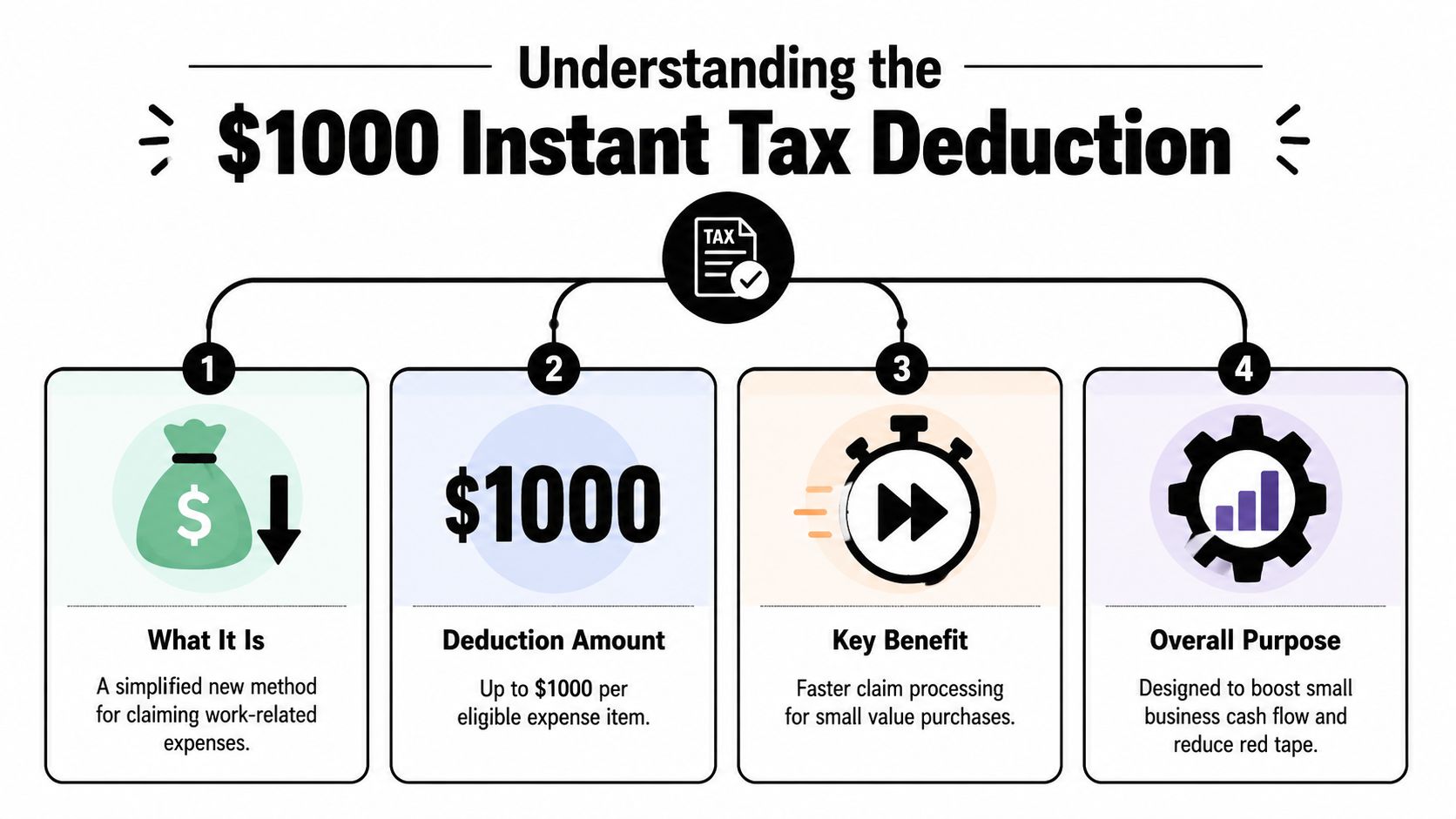
The proposed $1,000 instant tax deduction is a new optional way to claim work-related expenses without the usual receipt trail for that amount. It's aimed at individuals, not as a replacement for small business asset write-off rules, and it sits in a very different part of the tax law.
Treasury describes it as an elective flat-rate deduction for eligible taxpayers with employment or business income, proposed to apply from 1 July 2026 for the 2026 to 2027 income year, with 6.2 million Australians projected to benefit (Treasury's exposure draft announcement on the $1,000 instant tax deduction).
How it works in plain English
If the measure becomes law, an eligible taxpayer could choose the flat $1,000 deduction for work-related expenses instead of substantiating smaller claims line by line.
That doesn't mean every expense disappears into one bucket. It means the law would allow a simpler claiming path for that category of work-related deductions. If your actual deductible work expenses are higher and you can substantiate them, you'd still have the option to itemise instead.
That choice is the whole game.
What it is not
This proposal is not:
- An instant cash payment from the government
- The instant asset write-off for small business purchases
- A guarantee of a bigger refund
- A blanket deduction for everything you spent
It's also not currently something you can assume is available for returns before the proposed start date. Treasury has released exposure draft legislation, which is the right place to look if you want the technical detail behind the headlines. If you want the broader ATO view on deductible expenses, the rules still come back to what counts as deductible under tax law, and that's where a plain-English guide to what is tax deductible in Australia helps separate genuine claims from wishful thinking.
The shortcut only helps if your actual claim is around that level or lower. Once your real deductible expenses go past it, simplicity starts to have a price.
Why this matters for tradies and sole traders
For workers who hate admin, the attraction is obvious. Fewer receipts. Less paperwork. Faster return prep.
But if you're self-employed or working across jobsites, the better move is often to keep a proper record system anyway. A clean digital trail gives you a real choice later. If you want a practical starting point, managing business receipts with Snyp is a useful example of how to keep records without living in a shoebox full of faded Bunnings slips.
Who Is Eligible for the Instant Deduction
Eligibility matters more than the headline.
The proposed instant deduction is aimed at Australian tax residents who earn income from employment or business, and it's designed as an optional claim method rather than a compulsory one. That optional piece is important because it means you'd need to choose between convenience and a traditional itemised claim, depending on what gives you the better tax result.

The quick eligibility check
You're broadly in the target group if all of these apply:
- You're an Australian tax resident for tax purposes.
- You earn employment income or business income.
- Your work-related expenses are relatively modest, so a flat claim may be easier than itemising.
- You prefer a simplified tax return process over collecting and storing receipts for smaller amounts.
- You understand it's elective, so you're not locked into using it.
That last point is where many taxpayers will either save time or lose money.
Who is most likely to benefit
Treasury modelling reported through eTax says 3.3 million female beneficiaries, representing 54% of the projected 6.2 million people expected to benefit, would on average save $200 under the proposed measure (eTax summary of the $1,000 instant tax deduction).
That tells you something useful. This measure appears well suited to people with lower annual work expenses who still want a legitimate claim without the paperwork headache.
For many tradies, that profile may not fit.
If you're in Belrose and spend real money on tools, protective gear, union fees, licences, or other deductible costs, the simplified option may be less attractive than it first looks. If you're a PAYG worker in Ashfield with lighter annual expenses and no interest in tracking every small purchase, the instant deduction may be a clean solution if enacted.
The practical split
Here's the simplest way to think about it.
- Good fit. Employees or workers with smaller annual work expenses and weak record-keeping habits.
- Maybe fit. Sole traders and subcontractors with a mix of minor and moderate expenses.
- Poor fit. High-expense tradies who can substantiate more than the flat amount.
If your tax return usually includes a decent stack of work-related deductions, don't assume the instant option was designed for you.
The people who benefit most are often those who value lower admin more than the possibility of squeezing out a larger itemised claim.
Instant vs Itemised A Tradies Showdown
The “instant tax rebate” concept requires a reality check.
The instant deduction is about convenience. Itemising is about precision. Sometimes convenience wins. Sometimes precision puts more money back in your pocket.
For tradies, the answer often comes down to one dull but very profitable habit. Keep the receipts.
One example says a lot
eTax gives a useful illustration. For a tradie with $1,200 in tool expenses, itemising could produce a ~$650 refund, compared with about ~$540 in tax saving from using the $1,000 instant deduction plus other stackable claims. That's described as a 20% uplift from substantiation over simplicity (eTax example of instant deduction versus itemising).
You don't need to be tax-obsessed to understand the lesson. If your real claim is higher, the shortcut can cost you.
Instant Deduction vs. Itemised Claim A Comparison
| Scenario | Claim Method | Deductible Amount | Estimated Tax Refund |
|---|---|---|---|
| Belrose tradie with higher genuine work costs | Instant deduction approach | $1,000 plus eligible stackable non-work claims where applicable | Lower than a full substantiated claim |
| Belrose tradie with $1,200 in tool expenses and other stackable claims | Itemised claim | Higher actual deductible amount based on substantiation | ~$650 |
| Ashfield office worker with modest annual work costs | Instant deduction approach | Up to $1,000 for eligible work-related expenses | May be better for simplicity if actual expenses are below the cap |
| Ashfield office worker with modest annual work costs | Itemised claim | Actual receipted amount only | May be lower than the instant option if actual expenses are below the cap |
What works and what doesn't
What works:
- Adding up your real expenses first. This tells you whether the shortcut is helping or hurting.
- Using software that keeps records tidy all year. If you want a practical operations fix, it's worth taking time to compare contractor accounting software options so your receipts, invoices and categories don't become a mess at tax time.
- Knowing the difference between personal spending and deductible spending. A neat spreadsheet won't save a bad claim.
What doesn't work:
- Taking the instant deduction just because it sounds easier
- Guessing your expenses
- Trying to rebuild a year of receipts from bank statements after EOFY
- Confusing this proposal with the small business instant asset write-off, which is a separate rule entirely. If you need that distinction, the Australian position on instant asset write-off changes for small business sits in a different lane.
For a lot of tradies, the winning strategy is boring. Track expenses properly, then compare both methods before lodging.
A practical rule for Sydney tradies
If your year includes recurring tool purchases, protective clothing, training, memberships, and other legitimate work costs, don't default to the flat claim. Run the numbers.
If your expenses are light and your records are patchy, the instant deduction may be exactly what it was built for. But that's a decision, not a reflex.
Common Rebate Mistakes and Scams to Avoid
The first mistake is simple. People hear instant tax rebate and stop reading after the word “instant”.
That's how taxpayers end up choosing a faster-looking option that isn't better, or worse, handing personal details to a scammer who knows exactly what wording gets attention in late June and early July.

Mistake one, not checking whether itemising pays more
This is the big one for tradies. If you've got real deductible expenses and can support them, don't hand away the value of those deductions for the sake of speed.
The shortcut was built for simplicity. It was not built to outperform every substantiated claim.
Mistake two, treating refund advance marketing like tax advice
Private “get your refund now” offers can sound official when they're anything but. They may still be lawful products, but they're not the same as an ATO refund or a government deduction.
That distinction matters because your decision-making changes. With a tax deduction, the question is whether you're entitled. With a finance product, the question is what you're signing up for and whether you even need it.
Mistake three, falling for crypto and CGT refund scams
This problem isn't niche anymore. The ACCC reported 2,450 crypto-related tax scams in Australia between July 2025 and April 2026, with $45 million in losses, and 40% of those losses occurred in NSW (warning on crypto-related scam risks).
A lot of these scams promise some version of an immediate capital gains tax refund, rebate, or recovery. That should set off alarms straight away.
Watch for these red flags:
- Urgent refund language. “Claim today” or “limited-time ATO release” is classic pressure wording.
- Requests to connect wallets or share myGov details. No legitimate adviser should need access set up in a sloppy or rushed way.
- Claims that losses automatically produce an instant rebate. Tax losses and offsets don't work like a cashback promotion.
- No clear paper trail. If the person can't explain the legal basis of the claim, walk away.
For general record-keeping habits, even a US-focused guide like this IRS deduction guide for freelancers is still useful for one reason: it reinforces the universal truth that clean records beat panic every time.
A scam usually sells certainty, speed and secrecy. Real tax work involves records, eligibility and review.
Get Expert Advice for Your Tax Return in Ashfield and Belrose
The proposed $1,000 instant tax deduction could be useful. For the right taxpayer, it may cut paperwork and make tax time less painful.
But it won't replace judgement.
A tradie with substantial deductible costs needs a different answer from an employee with light annual expenses. A small business owner with cash flow pressure has a different risk profile again, especially if refunds may be offset against existing debts. That's not theoretical either. Data linked to refund offsets shows over 120,000 NSW small businesses had refunds offset against other debts in 2024 to 2025, and many didn't realise hardship relief could be available (refund offset hardship context for affected businesses).
Where local advice matters
A generic article can tell you the rule. It can't tell you whether:
- Your tool and equipment spend is high enough to make itemising the smarter move
- Your prior deductions create a review risk if you suddenly switch approach
- Your refund may be reduced by debt offsets
- Your crypto, CGT or property position makes a “quick claim” especially dangerous
That's why local context matters. Ashfield and Belrose clients don't come with identical tax profiles. One may be a PAYG worker with a straightforward return. Another may be a sole trader juggling BAS, vehicle records, equipment purchases, crypto activity and a property sale in the same year.
The sensible approach before lodging
Before you lodge, do three things:
- Total your real work-related expenses.
- Check whether the simplified deduction is even available for that income year.
- Compare the shortcut against a full itemised claim before pressing submit.
If you want help from a local adviser rather than a call centre script, it makes sense to find an accountant near you in Ashfield or Belrose who can look at the whole return, not just one label on the form.
The best tax outcome usually comes from one unglamorous habit. Slow down, verify the rule, and choose the method that leaves you better off.
If you want clear advice on the proposed instant tax deduction, work-related claims, crypto tax issues, BAS, CGT, or refund offset problems, talk to EndureGo Tax. With offices in Ashfield and Belrose, they help tradies, sole traders, investors and small business owners work out what's legitimate, what's risky, and what puts the best result in your back pocket. Book a consultation before you lodge so you don't leave money on the table.
