


It’s usually around tax time that the question lands. You’re at the kitchen table in Ashfield or Belrose, receipts spread out, bank statements open, and you’re asking the same question commonly asked. What is tax deductible? Not in accountant-speak. In plain English.
Maybe you’re a tradie trying to work out whether your ute costs, tools and steel-capped boots count. Maybe you work from home a few days a week and want to know if internet, power and your desk setup can reduce your tax bill. Maybe you’ve got shares, crypto or a rental property and you’re worried about claiming the wrong thing and waving a red flag at the ATO.
The good news is that tax deductions aren’t random. There’s a logic behind the rules. Once you understand that logic, the whole thing gets easier. You stop guessing, stop relying on pub advice, and start making cleaner decisions during the year instead of scrambling in June.
What Does 'Tax Deductible' Actually Mean
A tax deduction is an expense that reduces the amount of your income the ATO taxes. That’s the simplest way to think about it.
A lot of people confuse a deduction with getting the full amount back. That’s not how it works. If you buy something for work and it’s deductible, the expense usually reduces your taxable income, not your tax bill dollar for dollar. Instead, it trims the slice of income the ATO can tax, rather than getting a reimbursement for your shopping.
A simple way to picture it
If your income is the whole pizza, a deduction cuts down the size of the pizza the tax applies to. It doesn’t mean the ATO shouts you the whole meal.
That’s why two people can claim the same kind of expense and still get a different tax result. Their incomes, structures and circumstances may be different.
A deduction only helps if the expense is genuinely connected to earning income and you can prove it.
Deductions versus offsets
This trips people up all the time.
- Deductions reduce taxable income.
- Tax offsets reduce the tax payable itself.
They’re not the same thing, and treating them like they are is where confusion starts. If you remember one point from this article, remember that.
For individuals searching what is tax deductible in Australia, the key challenge isn’t the definition. It’s knowing why the ATO allows some expenses and knocks back others. The answer is simple. The tax system is trying to separate income-producing costs from private living costs.
Your morning coffee on the way to work is private. Tools you use on-site may be deductible. Internet used for work may be partly deductible. A family holiday isn’t, even if you answered a few emails by the pool.
That “why” sits underneath nearly every deduction rule.
The Three Golden Rules of Claiming a Deduction
If you want the shortest version of Australian deduction rules, it comes down to three filters. Every claim should pass all three.
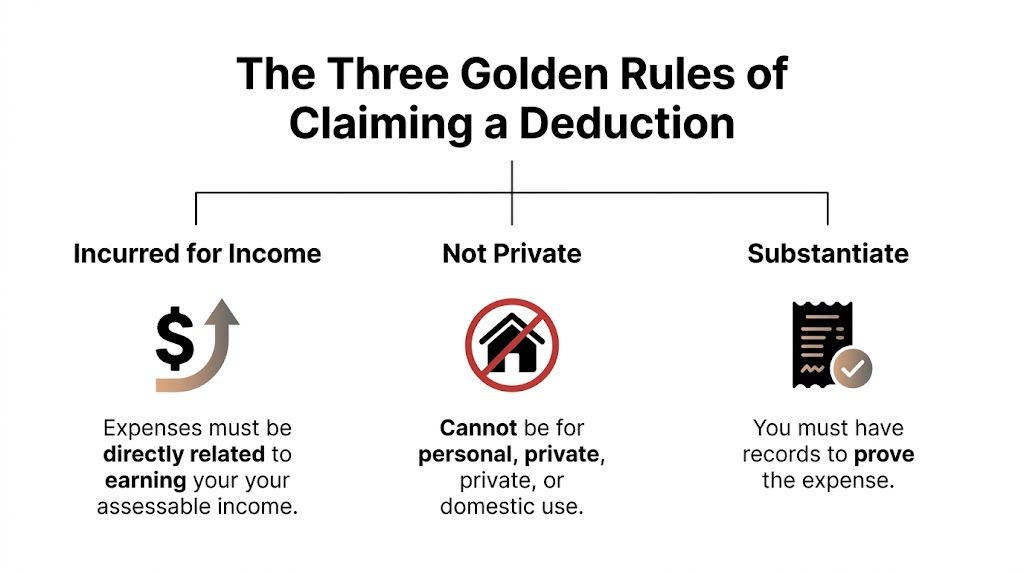
The three golden rules are
1. The expense must relate to earning your income.
2. It can’t be private, domestic or capital in nature unless specific rules allow it.
3. You need records to back it up.
The legal backbone for the general deduction rule sits in Division 8-1 of the Income Tax Assessment Act 1997, which you can read through the ATO’s guidance on general deductions and the law.
Rule one relates to earning income
This is the big one. The expense needs a real connection to the way you earn assessable income.
If you’re an electrician in the Inner West and you buy testing gear for jobs, that has a direct work link. If you’re an employee and pay for a course that maintains or improves skills used in your current role, that may also fit. But if the expense is only loosely connected to work, the ATO usually won’t allow it.
What this means in practice is simple. Ask yourself, would I have paid this cost if I weren’t earning this income?
Rule two can’t be private
For this reason, many claims fall over.
Private expenses stay private, even if they make life easier for work. Regular clothes are the classic example. They might be worn to work, but that doesn’t automatically make them deductible. Protective clothing can be different because it serves a work-specific function.
Mixed-use costs are where things get messy. Your mobile phone, home internet, laptop or car might be used for both work and personal reasons. In that case, you can usually only claim the work-related portion.
A quick apportionment example
If you use your mobile for work calls, supplier texts and job photos, but you also use it personally, you don’t claim the whole bill unless it’s entirely all work use.
A sensible process is:
- Review a representative period.
- Work out the work-related share.
- Apply that percentage consistently.
- Keep notes showing how you reached it.
That’s the ATO’s basic logic. Claim what’s work-related. Leave the private part out.
Rule three needs proof
No records, no confidence. And often, no deduction.
Records can include receipts, invoices, logbooks, diary notes, bank statements and digital records. The point isn’t paperwork for paperwork’s sake. The point is that if the ATO asks, you need to show what you spent, when, who it was paid to, and why it was work-related.
Here’s the practical version:
- Receipt present: easier to support.
- Bank transaction only: sometimes helpful, but often not enough on its own.
- No record at all: risky.
Practical rule: if you can’t explain the expense in one sentence and prove it with a document, don’t assume it’s safe to claim.
Common Deductions for Individuals and Sole Traders
A lot of people in Ashfield, Marrickville and the Northern Beaches know they can claim “something” for work, but the trouble starts when they try to work out how much, and why the ATO allows one expense but knocks back another.

The useful categories are usually familiar. Car use, home office running costs, tools, training, phones, and some clothing. The key skill is knowing where private use creeps in, because that is where claims often go wrong.
Vehicle expenses for employees and sole traders
Car claims confuse plenty of people because the ute or hatchback often gets used for both earning income and ordinary life. The ATO’s logic is simple. Travel that helps you earn income can be claimable. Travel that gets you from home to your usual workplace is often treated as private, even if it feels work-related.
A Belrose tradie gives a good example. Driving from home to the first regular site is usually private. Driving from that site to Bunnings, then to a second job, then to a supplier in Brookvale is a different story. Those day-to-day work trips are more closely tied to earning income.
You generally need to choose a method that matches your situation:
| Method | Best for | What it suits |
|---|---|---|
| Cents per kilometre | Lower-volume claims | Useful if your eligible work travel is modest and you have a reasonable record of kilometres |
| Logbook method | Higher work use | Better if you use the car heavily for work and want to claim a share of actual running costs |
The trap is guessing. If your estimate appears rounded, inflated, or written down months later from memory, it can stand out in a review.
Home office claims that make sense
Home office deductions became common fast, but people still mix up running costs with occupancy costs. For most employees and many sole traders, the more realistic claim is the cost of working from home. Power, internet, phone use, stationery, and similar items. Claiming part of the rent or mortgage is a different issue and can create bigger tax consequences later, especially if the home is sold.
The reason for the rule is fairness. Your home is still your home. The ATO expects you to separate the work slice from the private slice, much like splitting a shared pizza bill. If one person ate three slices and another ate five, you would not divide it 50-50 just because that is easier.
An Ashfield employee working from the dining table three days a week might claim a home office amount using the ATO’s accepted method for that year, provided their records support the hours worked. A sole trader with a dedicated study may also claim, but only for the work-related portion of eligible costs.
A common audit red flag is claiming a neat, high weekly amount with no diary, roster, timesheet, or work-from-home record to back it up.
If you cannot show when you worked from home and how you calculated the claim, the deduction is on shaky ground.
Tools and equipment
For tradies, tools are often the easiest deductions to understand because the link to income is obvious. A multimeter, laser level, drill, or work laptop helps you do the job. But the tax treatment still depends on cost, use, and whether the item is part of a larger set.
Items that cost $300 or less can often be claimed straight away if they are used to earn your income and are not part of a set that pushes the total over the threshold. Higher-cost items are usually claimed over time.
Here is the practical version. If a sole trader electrician in Belrose buys one low-cost testing tool used only for jobs, that is usually straightforward. If the same person buys a laptop used for quoting, invoices, Netflix, and the kids’ homework, only the work-related share is relevant. The laptop may also need to be claimed over more than one year.
People also miss related costs that can be deductible:
- repairs to work-used tools
- insurance on equipment
- batteries, accessories, and consumables
- software or apps used for quoting, invoicing, or site reporting
The “why” matters here. The ATO is not rewarding shopping. It is allowing a deduction for the part of the cost that helps produce income.
Self-education and licences
Self-education is another area where intent matters. A course that sharpens the skills you already use in your current work can have a stronger basis than a course aimed at changing careers entirely.
For example, a sole trader bookkeeper in the Inner West doing software training to improve client work is in a different position from someone studying for a completely new profession. Likewise, renewing a licence, ticket, or certificate required to keep working often sits on firmer ground than a qualification for a future role.
This is one of those categories where the “why” behind the expense needs to be easy to explain in plain English.
Clothing and phone expenses
Clothing claims are narrower than many people expect. Protective gear and occupation-specific items are usually easier to justify because they have a clear work purpose. Steel-capped boots, high-vis gear, safety glasses, chef’s checks, or branded uniforms are very different from ordinary black pants, plain shirts, or a warm jacket you could wear anywhere.
Phone claims follow the same mixed-use pattern we talked about earlier, but they deserve a fresh look because so many people understate or overstate them. If you use your phone to call clients, confirm jobs, send photos, manage supplier messages, and run business apps, part of the bill may be deductible. If half the use is personal, half is private. Simple.
A sensible sample period can do a lot of heavy lifting here. Review your usage, work out a fair percentage, then apply that method consistently.
Common deduction mistakes that attract attention
Some claims get noticed because they do not match the type of work being done. Others get noticed because they are too neat.
Keep an eye on these problem areas:
- claiming the full cost of a phone, laptop, or internet plan with obvious personal use
- treating daily home-to-work travel as deductible without a specific exception
- claiming ordinary clothing as workwear
- forgetting to reduce a claim after reimbursement from an employer or client
- rounding up work-use percentages without notes, diaries, or records
For more occupation-based examples, this guide on what tax deductions can I claim gives a helpful starting point.
If you come across overseas tax content while researching, treat it as background only. Articles about federal solar tax credits and incentives may explain how tax relief works in another country, but Australian claims still have to fit ATO rules, local records, and the work-related portion of the expense.
Essential Deductions for Your Small Business
A lot of small business owners in Ashfield, Marrickville, and the Northern Beaches make the same mistake. They treat the business bank account like a giant deduction basket. If the money went out for the business, they assume it must be claimable.
The ATO does not see it that way.
For a small business, deductible spending usually falls into three practical buckets. Day-to-day running costs, staff and contractor costs, and assets that may need to be claimed over time rather than all at once. Once you sort expenses into those buckets, the rules stop feeling like tax jargon and start feeling more like common sense.

Running costs that usually pass the test
If an expense helps you operate the business and has a clear link to earning income, it will often sit on safer ground.
A café in Belrose might claim merchant fees, point-of-sale software, cleaning supplies, public liability insurance, and commercial power. A builder in the Inner West might claim scheduling software, ute lease costs apportioned for business use, tool repairs, safety gear, and subcontractor payments. A design studio in Ashfield could be paying for Adobe, web hosting, bookkeeping, and a coworking desk.
The why matters here. The ATO is trying to separate real business costs from private consumption. That is why categories like meals, mixed-use vehicles, phones, and home internet need extra care. If part of the expense is private, you only claim the business slice. It works like splitting a shared dinner bill. You only pay for what you ordered, and you only claim the part tied to income.
Buying equipment. Claim it now or over time?
Timing can save cash flow.
Some business purchases are immediately deductible under the rules that apply for that year. Others are claimed over several years through depreciation. The difference changes when the tax benefit lands, which matters if you are managing stock, wages, BAS, and supplier payments all at once.
Take a café buying a coffee machine, or a tradie replacing a laser level and a laptop in the same quarter. One purchase may qualify for a faster deduction. Another may need to be written off over its effective life. The rule is not there to make life difficult. It is there to match the tax claim to how long the asset helps the business earn income.
That is also why asset timing deserves attention. Buying in June and installing in July can produce a different result from buying and using the asset before year end. For many Sydney small businesses, that timing difference affects tax payable and cash in the bank.
The 120 percent boosts that caught some businesses by surprise
A temporary concession gave some eligible small and medium businesses an extra deduction for certain technology spending and external staff training. The key point was simple. Eligible businesses could claim more than the base cost, but only if the spending fit the rules and happened within the qualifying period explained in this guide to the 120 percent deduction for skills training and technology costs.
That concession did not cover everything. Salary and wage costs were not included. Eligibility also depended on the type of entity, turnover, the kind of expense, and in some cases whether an asset was first used or installed ready for use by the required date.
For business owners, the practical lesson is broader than the concession itself. Temporary tax measures often reward action taken in a specific window. If you hear about a bonus deduction after you have already lodged, or after the deadline has passed, the chance is gone. Good advice is often about spotting these timing opportunities early.
Wages, super, and expenses that get reviewed closely
Wages and contractor costs are common deductions, but they are also common review areas.
Why? Because classification errors are everywhere. A business owner might call someone a contractor, but the working arrangement looks more like employment. Super can be deductible, but timing and payment rules still matter. Late super creates problems quickly. The same goes for director payments, family members on payroll, and reimbursements with weak records.
Then there is apportionment. It turns up constantly in small business.
If you use your car for both quoting jobs and school drop-off, only the business portion belongs in the claim. If you run your business from home in Dee Why or Five Dock, part of your internet, electricity, or occupancy-related costs may need to be split carefully depending on your setup and business structure. The biggest audit red flags are often not wild claims. They are ordinary claims with no working papers behind them.
A cleaner set of records usually beats a bigger deduction.
For a practical category-by-category reference, this guide to small business tax deductions is a useful starting point. If you also read broader overseas material such as real estate investment tax benefits, treat it as background only and bring the idea back to Australian rules, entity type, and evidence.
Advanced Deductions for Investors
Investors often know the broad idea of deductions, but the details are where the money is won or lost. The same core rule still applies. The expense needs to connect to income production. The difference is that with investments, the line between an immediate deduction, a capital cost, and a cost base adjustment can get blurry fast.
Rental property deductions and the repair trap
Property investors regularly ask whether a cost is a repair or an improvement. That distinction matters.
A repair usually points to restoring something to its original condition. An improvement points to making it better, replacing it more substantially, or changing its character. In plain terms, fixing a damaged part is one thing. Upgrading the whole thing is another.
Typical rental property expenses that are often discussed include interest on investment loans, council rates, agent fees and maintenance-related costs. But each claim still needs to be tested against the nature of the expense and when it was incurred.
Investors get into trouble when they treat every property cost as immediately deductible. Some costs belong in the year’s return. Others belong in depreciation schedules or capital treatment.
If you’re comparing broad education material, some international explainers on real estate investment tax benefits can help frame the concepts, but Australian property deductions still need to be applied using local rules and records.
Charitable donations
Donations are one of those areas where people either assume too much or miss valid claims.
The verified data states that donations to Deductible Gift Recipients can be deductible in Australia, with $4.1 billion in claims for 2021-22, and that 12% of taxpayers donated, averaging $632 each. It also notes that workplace giving has a $2 minimum threshold and that digital records are accepted post-2019, based on the source details supplied in the verified data.
The practical point is this. A gift only becomes a tax deduction if it satisfies the donation rules. Buying a raffle ticket, attending a fundraising dinner, or receiving something substantial in return can change the tax outcome.
Crypto deductions and why so many people underclaim
Crypto is one of the most misunderstood areas in tax. It’s also one of the areas where sloppy records cause the biggest headaches.
The verified data says there were 450,000+ crypto taxpayers, but only 28% claimed allowable deductions such as exchange fees or wallet costs, forfeiting about $450m in refunds. It also says Australia’s 50% CGT discount can apply for assets held more than 12 months, and that audits increased by 40% after the post-2023 compliance push, as set out in the verified data supplied for this article.
That tells you two things. First, a lot of investors are leaving money on the table. Second, the ATO is paying attention.
Common crypto areas people miss
- Exchange fees: These may be relevant to the tax calculation.
- Wallet costs: Often overlooked.
- Professional advice: Can be relevant where it relates to managing tax affairs.
- Education: The verified data notes ATO-approved courses may be deductible in the right context.
The verified data also notes that Australia allows immediate losses on crypto disposals to offset gains, unlike US wash-sale rules, and refers to TR 2024/1 in that context. It further states that 65% of audited cases underclaim, and that mandatory crypto reporting starts from January 2026, based on the verified data supplied.
The high-level lesson is that investors should stop treating crypto as a side hobby from a record-keeping perspective. If you’re trading across exchanges, wallets or borders, your documentation needs to be cleaner than your memory.
Mastering Your Records to Avoid ATO Audits
Most deduction problems aren’t caused by a lack of expenses. They’re caused by a lack of proof.
If you want to avoid ATO trouble, treat record-keeping as part of the claim itself. The deduction isn’t just the expense. It’s the expense plus the evidence.
What good records actually look like
A useful record usually shows:
- Who you paid
- What you bought
- When you paid
- How much you paid
- Why it was work-related or business-related
That could be a tax invoice, a receipt, a supplier invoice, a diary note, a logbook entry, or a digital file that ties the story together. If the expense is apportioned, your working should show how you calculated the work-use share.
For practical filing habits, a guide on how to organize receipts for taxes can help you build a system that’s easier to maintain during the year than trying to reconstruct everything at the end.
Tradie audit red flags
The verified data highlights a few issues that matter particularly for tradies. For FY2024-25, it states tradies can claim up to $1,000 in tools without records, plus car expenses using 88c/km up to 5,000km or the logbook method. It also says only 62% of eligible sole traders fully claim work-related expenses, missing about $300 average per return, and that the ATO flagged 15,000+ discrepancies in tradie claims last year, based on the verified data supplied.
Those figures matter because they show two sides of the same problem. Some tradies underclaim. Others overreach and get attention for the wrong reasons.
Claims that often trigger scrutiny
| Red flag | Why it can be a problem |
|---|---|
| Claiming the full mobile phone bill | Phones usually have private use |
| Claiming boots or clothing without checking whether they’re protective or compulsory | Ordinary clothes are different from protective gear |
| Relying on memory for car use | Vehicle claims need support |
| Writing off an asset that isn’t primarily for business use | The ATO looks closely at mixed-use assets |
The verified data also notes that mobile phone apportionment around 75% work use is common for tradies, and that over-reliance on the $20k instant asset write-off can create trouble if the asset isn’t primarily business use.
The ATO usually isn’t bothered by a well-supported claim. It’s bothered by a claim that looks copied, rounded, inflated or impossible to explain.
A simple apportionment habit
For mixed-use expenses, don’t aim for perfection. Aim for a reasonable method you can defend.
Try this:
- Pick a representative period.
- Track actual business use.
- Convert that into a percentage.
- Apply the percentage to the expense.
- Save the working paper with the receipt.
If you want a stronger system, the ATO-facing habits outlined in this guide to record keeping requirements in Australia are worth following.
Turn Your Deductions Into a Financial Strategy
The smartest taxpayers don’t treat deductions as a once-a-year scavenger hunt. They treat them as part of how they run their work, business or investments all year round.
That’s the answer to what is tax deductible. It’s not just a list of things you might be able to claim. It’s a framework for deciding what belongs to income production, what needs to be apportioned, what must be depreciated, and what should stay out of the return entirely.
Good strategy is usually boring
It looks like keeping receipts as you go. Logging vehicle use properly. Separating private and business spending. Checking whether an asset should be deducted immediately or over time. Reviewing major purchases before 30 June instead of after.
That kind of planning won’t feel flashy. But it usually produces cleaner returns, fewer errors and far less stress if the ATO ever asks questions.
The local angle matters
Sydney taxpayers in the Inner West and Northern Beaches often have mixed patterns of work. Tradies move between sites. Business owners use cars, phones and tools for both work and personal life. Investors hold property, shares and crypto side by side. That mix creates opportunity, but it also creates grey areas.
Grey areas are exactly where advice matters most. A deduction strategy that suits an Ashfield employee may be completely wrong for a Belrose sole trader or a Northern Beaches investor with digital assets.
Frequently Asked Questions About Tax Deductions
A lot of deduction questions sound simple until you test them against the ATO rules. The underlying issue is usually not “can I claim it?” but “why does the ATO treat it that way?”
Can I claim my trip from home to work
Usually, no. Your normal commute to a regular workplace is treated as private, even if you need your car to get there.
The ATO’s reasoning is fairly practical. Getting yourself from your front door in Ashfield or Dee Why to your usual place of work is seen as a personal choice about where you live, not part of earning the income itself. Once you are travelling between job sites, between workplaces, or carrying bulky tools in limited circumstances, the answer can change.
That’s where tradies often get caught out. Driving from home to a site is not automatically deductible just because you wear boots and carry gear. The facts matter.
Are fines and penalties tax deductible
No.
Parking fines, speeding fines, and other penalties are generally not deductible, even if they happened while working or running a business. The rule exists for a simple reason. The tax system does not allow a business or worker to soften the cost of breaking the rules by claiming it back at tax time.
What’s the difference between a repair and an improvement on an investment property
A repair fixes something and brings it back to its previous condition. An improvement makes it better, more modern, or more valuable than it was before.
That difference matters because the tax treatment often changes. If your rental in Marrickville had a broken window and you replaced the damaged glass, that is closer to a repair. If you replaced all the old windows with higher-spec double glazing throughout the property, that starts to look more like an improvement.
Investors get into trouble when they label renovation work as repairs just because the invoice says “maintenance”. The ATO considers what was done, not just the wording on the bill.
Can I claim small work expenses without a receipt
Sometimes a small expense may still be claimable, but treating “no receipt” as a shortcut is asking for trouble.
The safer habit is simple. Keep the receipt, bank record, invoice, or diary note at the time you spend the money. For tools and equipment, small-cost items may be claimed straight away in some cases, while more expensive items may need to be claimed over time and adjusted for private use, as noted earlier in the article.
If you are a sole trader on the Northern Beaches using the same drill, phone, or ute for both work and private life, apportionment is the key issue. You are only claiming the work-related share. That is one of the first areas the ATO will test if your return looks high for your income.
A good rule of thumb is this. If you would struggle to explain the expense clearly over a coffee, with the receipt in front of you, it probably needs a closer look before it goes into the return.
If you want clear advice specific to your situation, whether you’re a tradie in the Inner West, a small business owner in Belrose, or an investor juggling property and crypto, speak with EndureGo Tax. We help clients in Ashfield and the Northern Beaches turn confusing deduction rules into practical, compliant tax strategies. Book a consultation and get advice that fits the way you earn your income.
