


Let's get one of the most common tax questions out of the way first. The Australian tax season officially kicks off on 1 July, but for most people handling their own tax return, the date to circle in your calendar is 31 October. This is the hard deadline if you’re lodging yourself using myTax. As expert tax advisors, we stress that understanding when to lodge is a critical component of sound financial management.
Understanding Key Australian Tax Return Deadlines
Here’s a tip from the pros: knowing when you can lodge is different from knowing when you should lodge. While you can technically file your return from the first day of the new financial year, lodging early isn't always the smartest move. The key is to strike a balance between lodging promptly and lodging accurately.
Why Patience Pays Off at Tax Time
Picture this: it’s early July 2025. The 2024-25 financial year has just wrapped up on 30 June, and the Australian Taxation Office (ATO) has opened the floodgates for tax returns. The problem? Your critical financial data from employers, banks, and health funds is still being processed.
This automated data-matching process is known as pre-filling. By late July, most of this crucial data—like your salary, any interest you’ve earned, and private health insurance details—will be automatically loaded into your return and marked as 'Tax ready'.
Jumping the gun and lodging before this happens is a common but costly mistake. It can lead to errors that require you to amend your return, potentially causing delays and attracting ATO scrutiny. For example, if you lodge on 5 July before your bank has reported your annual interest income, you've submitted an incorrect return. The ATO's data matching will eventually find this, forcing you to lodge an amendment and possibly pay extra tax plus interest.
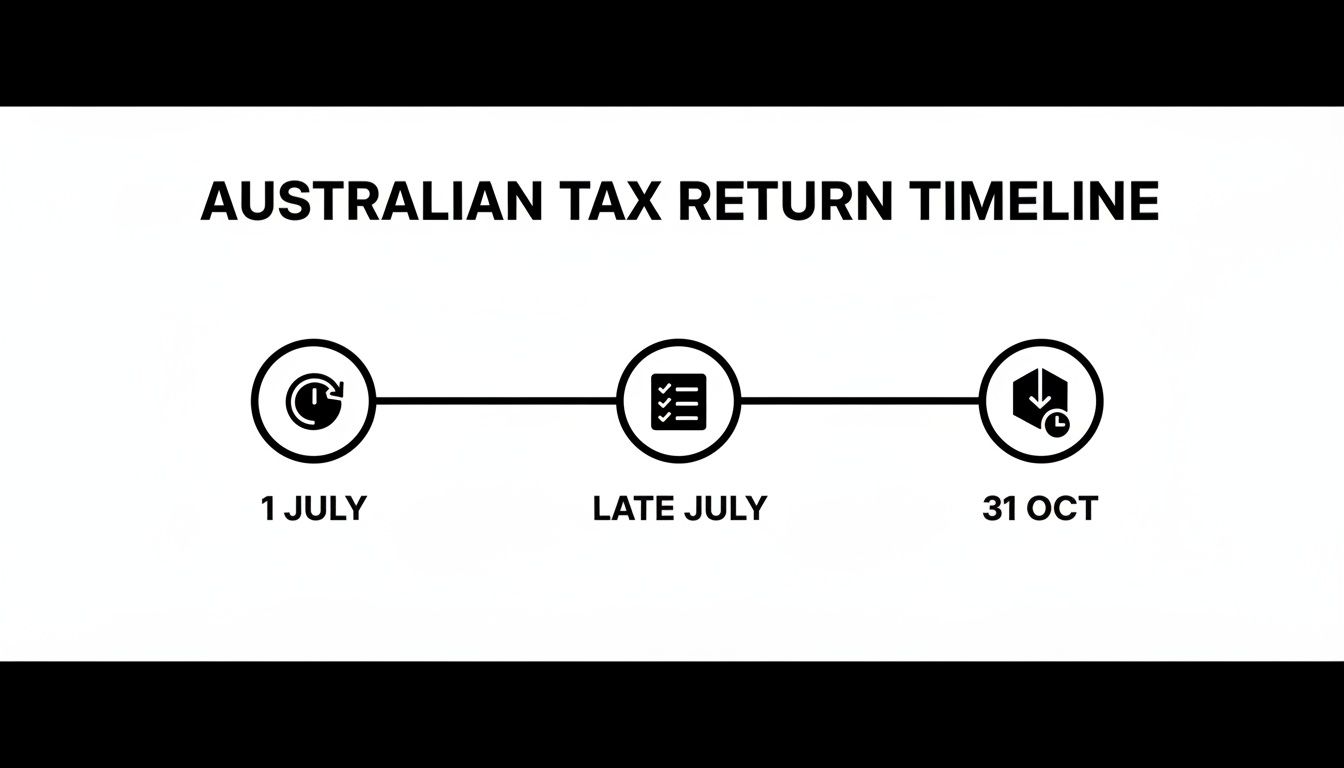
As you can see, the window to lodge is quite generous. The sweet spot is waiting until your information is pre-filled, giving you plenty of time before that final 31 October deadline.
To help you keep track, here’s a simple breakdown of the most important dates for the upcoming tax year.
Key Australian Tax Return Dates at a Glance (2025-2026)
| Event | Key Date | Who It Affects |
|---|---|---|
| Start of Tax Season | 1 July 2025 | All taxpayers. You can begin preparing your return. |
| Pre-fill Data 'Tax Ready' | Late July 2025 | Most individual taxpayers. Key data from employers, banks, etc., is available for accurate lodging. |
| Self-Lodgement Deadline | 31 October 2025 | Individuals lodging their own tax return without a registered tax agent. |
| Tax Agent Lodgement Deadline | 15 May 2026 | Individuals using a registered tax agent (subject to criteria, some exceptions apply). |
This table covers the main deadlines, but remember that business and SMSF dates can differ. The key takeaway for individuals is simple: wait for your data to be ready, then lodge before the Halloween deadline.
Getting your tax return right is about more than just avoiding a penalty; it’s about making sure you get every dollar you’re entitled to. For a deeper dive, check out our complete guide on the tax due date in Australia.
Don’t leave your lodgement to chance. Contact the expert accountants at EndureGo Tax today to develop a tax strategy that ensures compliance and maximises your outcome.
Self Lodgement vs Using a Tax Agent
So, when it comes to lodging your tax return, you have two primary options: lodge it yourself through myTax, or engage a registered tax agent. The path you choose directly impacts your deadline and can significantly affect your financial outcome.
Going It Alone: The DIY Approach
For Australians with straightforward financial affairs, lodging your own tax return through the ATO’s myTax portal can seem like the easiest option. If your income consists solely of a salary, some bank interest, and a few standard deductions, the process is relatively quick.
But here’s the critical point: there’s a non-negotiable deadline. You must lodge your tax return by 31 October. No exceptions.

This is where engaging a professional tax expert becomes a strategic advantage.
The Power of Professional Guidance and Extended Deadlines
When you partner with a registered tax agent like EndureGo Tax, the rules of the game change. It’s not just about offloading paperwork; it fundamentally alters your timeline.
Once you’re on our client list, you typically receive an automatic extension to lodge, often as late as 15 May of the following year.
This extra time isn’t for procrastination; it’s a strategic window. It allows us to conduct a thorough analysis of your finances, identify every legitimate deduction, and structure your return for the best possible tax outcome. For anyone with a more complex financial life, this is invaluable.
The other crucial component is expertise. A qualified tax agent possesses a deep understanding of tax law and is legally bound to act in your best interests, a principle enshrined in legislation like the Tax Agent Services Act 2009. This expert knowledge often translates into a significantly better tax position than you could achieve alone.
A Tale of Two Taxpayers: A Practical Example
To see how this plays out, let’s compare two scenarios:
- The DIY Office Worker: An office worker in Ashfield earns a salary and has some bank interest. Their tax situation is simple, so using the pre-filled data in myTax is efficient. That 31 October deadline is easily met.
- The Tradie with an Agent: A self-employed plumber from the Northern Beaches has a more complex tax profile. They have income from various contracts, a work ute with extensive running costs (fuel, insurance, depreciation), and a long list of tool and equipment purchases. Without an expert, they could easily miss thousands in deductions—like correctly applying depreciation rules for their ute or claiming the instant asset write-off for their tools.
For the plumber, using an agent isn’t just about a later deadline. It’s about ensuring all complex deductions are calculated correctly to maximise their refund and maintain full compliance with the ATO. It transforms tax time from a compliance chore into a strategic financial review.
If you’re weighing up your options, knowing how to choose the right professional is crucial. For more on that, our guide on how to find a tax accountant near you is an excellent starting point.
Don’t risk missing valuable deductions or receiving a “please explain” letter from the ATO. Contact EndureGo Tax today to ensure your tax return is prepared with expert precision.
Tax Deadlines for Businesses Companies and Trusts
If you’re running a business in Australia, the 31 October tax deadline is often just a footnote in a far more complex compliance calendar. For companies, trusts, and other business structures, knowing when to do a tax return involves navigating a staggered and conditional lodgement program.
Your specific timeline hinges on your business type, its financial year-end date, and your lodgement history with the Australian Taxation Office (ATO). Getting this right isn’t just about good bookkeeping; it’s about avoiding costly penalties and maintaining a positive compliance record. You’re juggling ongoing obligations like Business Activity Statements (BAS) with your annual income tax return, and the ATO enforces these deadlines strictly.
How Different Business Structures Affect Your Lodgement Date
The ATO’s staggered lodgement program is designed to manage the flow of returns and acknowledges the varying complexity of different entities.
Here’s a general guide:
- Sole Traders: As a sole trader, you report business income on your personal tax return. Lodging it yourself means you face the standard 31 October deadline. However, using a tax agent grants you access to the extended lodgement program.
- Partnerships, Trusts, and Companies: Here, due dates vary significantly. Your deadline can depend on total income, prior-year tax liability, and whether you are a new registrant. Deadlines can fall anywhere from October through to May of the next year.
- Self-Managed Super Funds (SMSFs): An SMSF’s annual return has its own rules. For newly registered funds, the deadline is typically 28 February. For established funds with a good compliance history, the date often aligns with the tax agent lodgement program.
For a full, official breakdown, the ATO provides detailed legislative guidance on its page for due dates for lodging and paying.
Business Deadlines: A Practical Example
Let’s look at a practical example. Imagine a small marketing agency operating as a company in Belrose. Because its tax affairs are separate from its owners, it has its own lodgement obligation. If it maintains a good compliance history and works with a tax agent, its deadline might be extended to 15 May. This gives their accountant ample time to finalise the books, reconcile payroll, and ensure all corporate tax rules are correctly applied.
Contrast this with a family trust set up to manage investment properties. The trust must lodge its own tax return, and its deadline could be 28 February, depending on its lodgement history and whether it was newly established. Critically, the trust’s income is distributed to beneficiaries, who must then declare that income on their own individual tax returns.
The key takeaway is that business tax compliance is an interconnected ecosystem. Your BAS lodgements, the timing of your entity’s return, and the subsequent impact on your personal return all need to be managed with expert oversight.
Trying to navigate these deadlines alone as a company, trust, or SMSF is a significant risk. The probability of error is high, and the financial consequences can be severe.
Don’t leave your business compliance to chance. Book a consultation with our expert accountants to gain clarity on your specific deadlines and implement a proactive compliance strategy.
What Really Happens When You Lodge Your Tax Return Late?
Missing the tax deadline is not a minor administrative oversight. It is an act that can trigger immediate and escalating financial penalties from the Australian Taxation Office (ATO).
The moment you fail to lodge on time, you risk triggering the ATO’s ‘Failure to Lodge’ (FTL) penalty system. This is a structured system designed to enforce compliance. For individuals and small businesses, the penalties begin to accrue once a return is 28 days overdue.
How ATO Penalties Add Up
The ATO calculates these fines using a system of penalty units. For the 2024-2025 financial year, one penalty unit is valued at $330. The total penalty depends entirely on the period of delay.
Here’s how quickly it escalates:
- 1 to 28 days late: 1 penalty unit ($330)
- 29 to 56 days late: 2 penalty units ($660)
- 57 to 84 days late: 3 penalty units ($990)
- 85 to 112 days late: 4 penalty units ($1,320)
- 113 days or more late: 5 penalty units ($1,650)
Let’s put that into perspective. A sole trader gets busy and finally lodges their return three months late. They could face a $990 penalty, and that’s before paying any tax owed or General Interest Charge (GIC).
Beyond the Financial Sting: The Bigger Risks
The fines are only part of the story. A far greater risk is the ATO issuing a default assessment.
If you consistently fail to lodge, the ATO is empowered to estimate your tax liability using the data they hold. This figure is almost never in your favour. It will not include any deductions you are entitled to, potentially leading to a grossly inflated and inaccurate tax bill.
This also acts as a significant red flag, increasing the likelihood of a more intensive review or a full audit of your financial affairs. Proactive, timely lodgement is always the most prudent and cost-effective path.
To get the full picture, it’s worth understanding the potential penalties for a late tax return and how to maintain a clean compliance record with the ATO.
Don’t let a missed deadline spiral into a major financial problem. Contact the experts at EndureGo Tax today and let’s ensure your lodgement is handled correctly and on time.
Your Practical Checklist for a Stress-Free Tax Time
Knowing when you need to lodge your tax return is only half the battle. The true secret to a smooth and effective tax time is meticulous preparation.
Organising your documents beforehand is the single best action you can take to maximise your refund and avoid errors. Think of it as a pre-flight check; no pilot would attempt take-off without a clear plan, and you shouldn’t face the ATO without your financial records in order.
This checklist is your roadmap to gathering everything you need, whether you’re lodging yourself or partnering with an expert like us.

To make things even easier, we’ve organised everything into a simple table. This is your essential guide to ensuring nothing is missed.
Your Essential Tax Return Preparation Checklist
| Category | Documents & Information to Gather | Expert Advice |
|---|---|---|
| Income Records | • Income statements from all employers (check they’re ‘Tax ready’ in myGov). • Bank statements showing all interest earned. • Centrelink payment summaries. • Dividend and managed fund annual statements. • Records for rental properties, ride-sharing, or foreign income. | Do not lodge before all income sources are marked 'Tax ready'. This is a primary cause of amendments and delays. |
| Deductions & Expenses | • Receipts for all work-related costs (uniforms, tools, home office expenses). • Logbooks for car expense claims. • Proof of donations to registered charities. • Statements for investment loan interest and financial advisor fees. • The invoice from your tax agent for last year's return. | The golden rule: if you cannot substantiate it, you cannot claim it. Use a digital app or a dedicated folder to track receipts year-round. |
| Personal Details | • Your Tax File Number (TFN). • Current bank account details (for your refund). • Details of your spouse and any dependents. | Verify your bank details with the ATO. A simple typographical error can send your refund to the wrong account or delay it by weeks. |
Let's break down those sections further.
Gathering Your Income Records
First, you must account for every dollar of assessable income. This includes your primary salary and all other income streams. For many people, tools that help automate the extraction of data from tax statements can be a huge time-saver here, reducing manual data entry and the risk of errors.
Compiling Your Deductions and Expenses
This is where expert knowledge can significantly improve your tax outcome. Every legitimate, substantiated expense you claim reduces your taxable income, which can lead to a larger refund or a smaller tax bill.
For example, a marketing professional working from home in Belrose needs to have clear records of their internet, phone, and electricity usage to correctly calculate their home office claim. A carpenter in Ashfield must meticulously track every receipt for new tools and ute running costs.
The ATO rule, as per the Taxation Administration Act 1953, is clear: you must retain records to substantiate your claims for five years from the date you lodge your return.
Finally, take a moment to ensure your personal details—your address, name, and bank account—are all current with the ATO. It’s a small step that ensures your refund and important notices arrive without issue.
Feeling overwhelmed by the paperwork? Don’t risk leaving money on the table. Book a consultation with our expert accountants at EndureGo Tax to ensure you claim every deduction you are legally entitled to.
Why Partnering with a Tax Pro Is Your Smartest Move
We've covered the critical lodgement dates, the strategic choice between DIY and professional assistance, and the tangible risks of non-compliance. Knowing the rules is one thing. Leveraging them to your advantage requires expertise.
Now is the time to put that knowledge into action.
Working with the team at EndureGo Tax transforms a tax obligation into a strategic financial opportunity. Our expert accountants ensure you not only meet your deadlines but also achieve the best possible outcome, year after year.
From Tax Time Dread to a Financial Advantage
Lodging your tax return is a legal requirement, but how you do it is a choice that has financial consequences. A small business owner might be grappling with complex Capital Gains Tax calculations, while an investor could be unaware of deductions that could save them thousands. We bridge that knowledge gap.
As registered tax agents, we are legally bound by the Tax Agent Services Act 2009 to act in your best interests. Our role is to manage the complexity of tax law so you can focus on what you do best.
Engaging a tax professional is an investment in your financial well-being. You aren’t just buying compliance; you are securing peace of mind, an optimised tax position, and protection from costly ATO penalties.
This can be your most streamlined and rewarding tax season yet.
Ready to achieve tax compliance and peace of mind? Book a consultation with EndureGo Tax in Ashfield or Belrose today and let our experts take control of your tax affairs.
Your Top Tax Deadline Questions, Answered
When it comes to tax time, deadlines can feel like a moving target. To provide clarity, here are expert answers to the questions we hear most often.
Can I Get an Extension If I Lodge Myself?
No. The 31 October deadline for self-lodgers is absolute. If you are lodging your own tax return via myTax, you cannot get an extension. Lodgement extensions are a specific concession available to clients of registered tax agents. To be eligible, you must be on an agent's client list before the 31 October deadline.
What if I Can't Pay My Tax Bill on Time?
Ignoring a tax debt is the worst possible course of action. The debt will not disappear; it will accrue interest and penalties. The correct approach is to be proactive. If you anticipate difficulty paying, you or your tax agent must contact the ATO immediately to discuss a payment arrangement. The ATO has provisions for those in genuine hardship, but communication is essential.
When Can I Lodge if My Income Statement Is Not Tax Ready?
You must wait. It’s that simple. An income statement marked 'Tax ready' signifies that your employer has finalised their reporting with the ATO. Lodging before this occurs will almost certainly result in an inaccurate return, necessitating an amendment and causing significant delays and potential complications.
I'm a Sole Trader – What's My Deadline?
As a sole trader, you report your business income on your individual tax return. If lodging yourself, your deadline is 31 October. However, managing business accounts adds complexity. This is precisely why most successful sole traders engage a tax agent. It provides not only expert guidance on business deductions but also secures the crucial lodgement extension needed to prepare an accurate and comprehensive return.
Don't let questions about when to do your tax return create unnecessary stress. The experts at EndureGo Tax have the answers and the strategy.
Our accountants provide peace of mind by managing your deadlines and ensuring your return is optimised for the best possible outcome. Book a consultation with us today at https://www.endurego.com.au and make this tax season your most successful yet.
