


For most Aussie business owners, the question "When is my BAS due?" is a constant consideration in financial planning. Your Business Activity Statement (BAS) due dates are determined by your reporting cycle, which for the majority of small businesses is quarterly.
Meeting these deadlines is a non-negotiable aspect of running a business in Australia. The Australian Taxation Office (ATO) sets these dates, and missing them is a surefire way to attract penalties. Understanding your obligations under legislation like the Taxation Administration Act 1953 is the first step to staying compliant.
Your Expert Guide to BAS Due Dates
Think of your BAS lodgment and payment schedule as the foundation of your tax compliance. Let these dates slip, and you could face fines and interest charges—an avoidable business headache.
For most businesses, the ATO simplifies things with a quarterly reporting cycle. This means you have only four key dates to mark in your calendar each year. The predictability of these dates allows you to plan your bookkeeping and manage your cash flow months in advance. Knowing precisely when your BAS is due helps you avoid last-minute panic and ensures funds are available to cover your GST, PAYG withholding, and other tax obligations. Proactively managing these deadlines is simply good business practice.
Standard Quarterly BAS Due Dates
To provide absolute clarity, here is a straightforward breakdown of the deadlines for businesses that lodge their own quarterly BAS. Consider this your go-to reference for the financial year.
An expert tip: The ATO provides a concession where if a due date lands on a weekend or a public holiday, you have until the next business day to lodge and pay. This is a small but welcome buffer when a deadline falls inconveniently.
Here's a quick look at the standard dates you'll want to commit to memory.
Standard Quarterly BAS Due Dates
| Quarter and Reporting Period | Due Date |
|---|---|
| Quarter 1: July, August, September | 28 October |
| Quarter 2: October, November, December | 28 February |
| Quarter 3: January, February, March | 28 April |
| Quarter 4: April, May, June | 28 July |
While these dates are the bedrock of your BAS compliance, they're only part of the story. To get the full picture of your obligations, it’s worth reviewing our complete guide to every major tax due date in Australia, which dives into more than just your BAS.
Decoding Your BAS Reporting Cycle
Ever wondered why your business lodges its BAS quarterly while another does it monthly? The Australian Taxation Office (ATO) doesn't assign these schedules randomly. Your reporting cycle is determined by one key factor: your business’s GST turnover.
Correctly identifying your cycle is the first step to knowing exactly when your BAS is due.
The Standard Quarterly Cycle (Most Small Businesses)
For the vast majority of small and medium businesses in Australia, a quarterly cycle is the standard. This applies to any business with a GST turnover of less than $20 million.
Practical Example: A local cafe in Ashfield with an annual turnover of $800,000 or a tradie servicing the Northern Beaches turning over $350,000 would both fall into this bracket. They would lodge their BAS just four times a year, a rhythm that suits the operational flow of a smaller enterprise.
When Monthly Lodging Kicks In
So, who is required to lodge monthly? Typically, larger businesses. If your enterprise has a GST turnover of $20 million or more, the ATO requires monthly reporting.
Practical Example: A large construction company managing multiple major projects with a combined turnover of $25 million would be required to lodge monthly. The higher turnover means the ATO requires more frequent oversight of their tax obligations.
However, turnover isn't the only trigger. If you withhold more than $25,000 in Pay As You Go (PAYG) tax for your employees each year, you'll likely be moved to a monthly cycle, regardless of your GST turnover. This ensures significant employee tax amounts are remitted to the ATO promptly.
This decision tree breaks it down visually.
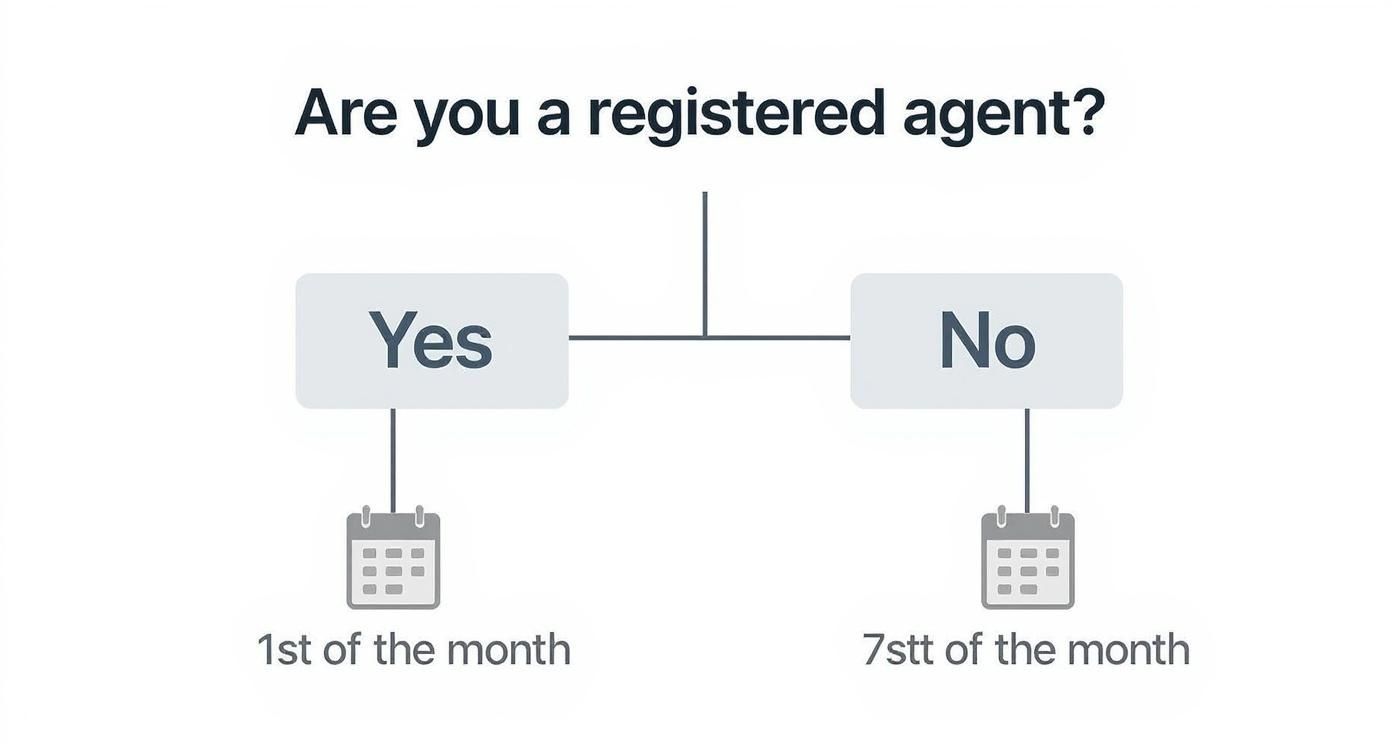
As you can see, there’s a significant advantage to lodging through a registered agent—a generous extension on your due date, which we will detail later.
Making sure you're on the right cycle is fundamental. If you want to delve into the specifics of the figures, our expert guide on how to calculate your BAS breaks down exactly what contributes to your turnover.
Understanding the 'why' behind your due date is half the battle. Our team of expert accountants in Ashfield and Belrose can confirm your reporting cycle and ensure you never miss a deadline. Take control of your compliance—contact us today.
A Breakdown of Quarterly and Monthly Deadlines

Knowing your reporting cycle is one thing, but hitting the specific deadlines set by the Australian Taxation Office (ATO) is the real test. For most businesses lodging quarterly, the rhythm is consistent and easy to plan for. Let’s examine the hard dates you need in your calendar.
Nailing down when your BAS is due is crucial for managing cash flow and avoiding that last-minute scramble. Think of each deadline as a financial finish line you're working towards all quarter.
Standard Quarterly Deadlines Explained
Quarterly BAS deadlines fall on the 28th day of the month following the end of the reporting period. This gives you almost a full month to finalise your accounts, lodge your statement, and settle any payments.
Here’s how the financial year plays out:
- Quarter 1 (July – September): Due 28 October.
- Quarter 2 (October – December): Due 28 February of the next year.
- Quarter 3 (January – March): Due 28 April.
- Quarter 4 (April – June): Due 28 July.
Practical Example: For the period covering 1 January to 31 March, your bookkeeper needs to have all invoices and receipts reconciled so you can lodge and pay by 28 April. However, if 28 April falls on a Saturday, the ATO rule means your actual deadline shifts to the next business day, Monday, 30 April. You are always given a fair opportunity to meet your obligations.
The ATO states that if a due date falls on a weekend or a public holiday, you have until the next business day to lodge and pay without penalty. This valuable safety net is built into the system, as outlined in the Taxation Administration Act 1953.
The Straightforward Monthly Rule
For businesses with a higher turnover or significant PAYG withholding obligations, the monthly cycle is even simpler. The rule is consistent every time.
Your BAS lodgment and payment are due on the 21st day of the following month.
Practical Example: Your BAS for the month of May is due on 21 June. This quicker turnaround demands disciplined, ongoing bookkeeping to ensure you’re always on top of your figures.
Whether you're on a quarterly or monthly schedule, missing these dates can lead to unwanted penalties. If you're finding it difficult to track when your BAS is due or need expert assistance with lodgment, our accountants in Ashfield and Belrose are here to help. Contact us today to keep your business compliant and penalty-free.
How Your Lodgment Method Can Extend Your Due Date

Here is a strategic advantage that can provide your business with much-needed breathing room. Many business owners don’t realise that how you lodge your BAS can change your deadline, often by several weeks. This isn't a loophole; it's an official incentive from the Australian Taxation Office (ATO).
The key is engaging a registered tax or BAS agent. When an agent lodges your quarterly BAS electronically, the ATO generally grants a four-week extension on both the lodgment and payment due dates. For managing cash flow, this simple switch can be a game-changer.
The Agent Advantage Versus Going It Alone
If you lodge your BAS yourself—whether via your myGov account linked to the ATO or by post—you are held to the standard, earlier deadlines. For instance, the September quarter BAS is due on 28 October.
By engaging a registered agent, that same deadline is pushed to late November. That provides a crucial buffer to finalise your accounts and, more importantly, hold onto your cash for an extra month. The ATO offers this concession because agents ensure accuracy and compliance, reducing their administrative burden.
You can learn more about the different submission options in our guide on how to lodge your BAS online.
Let’s examine how this plays out with a practical comparison.
| Reporting Period | Lodging Yourself (Due Date) | Lodging with an Agent (Due Date) |
|---|---|---|
| July – September | 28 October | 25 November |
| October – December | 28 February | 28 February |
| January – March | 28 April | 26 May |
| April – June | 28 July | 25 August |
Note: The December quarter deadline typically remains 28 February for all lodgers.
That extra time isn't just about convenience; it's a strategic tool for superior cash flow management and reduced end-of-quarter stress. If you are tired of the frantic rush to meet BAS deadlines, speak to our expert team in Ashfield or Belrose today to see how we can optimise your lodgment process.
How to Request a BAS Lodgment Deferral
Even the most organised business owner can face unforeseen challenges. A serious illness, a natural disaster, or another major disruption can make meeting a BAS deadline seem impossible.
Fortunately, the Australian Taxation Office (ATO) has a formal process for requesting a lodgment deferral, giving you essential breathing room.
The golden rule is to be proactive. Contacting the ATO before the due date is the single most critical step. A plea after the deadline has passed is significantly less likely to be successful.
What Constitutes a Valid Reason for a Deferral?
The ATO assesses each request on a case-by-case basis but is generally receptive to situations that are genuinely unforeseen and beyond your control. Valid reasons include:
- A serious illness or accident affecting you or a key staff member.
- Natural disasters like bushfires or floods that have damaged your premises or destroyed records.
- The death of a close family member or someone crucial to the business.
- A major system outage or unexpected failure of your accounting software.
It is always wise to have evidence to support your claim, as the ATO may request it.
You can apply for a deferral yourself, or your registered tax agent can manage the request for you. The ATO’s official policy on this is detailed in their guidance on deferrals.
Here’s a crucial point: if you can lodge your BAS on time but are concerned about paying the amount due, you should still lodge it. Once lodged, you can contact the ATO to discuss a payment plan. This strategy helps you avoid failure-to-lodge penalties while you address the payment obligation.
Facing a tough situation? Don't let tax stress add to your burden. Reach out to our expert team in Ashfield or Belrose to manage your ATO communications and secure the breathing room you need.
Your Top BAS Due Date Questions, Answered
Navigating the world of Business Activity Statements can bring up some challenging questions. Gaining clear, straightforward answers is key to feeling confident about your tax obligations and knowing exactly when your BAS is due.
Here are the most common queries we receive from Australian business owners, answered by our experts.
What Happens If I Miss My BAS Due Date?
Missing a BAS deadline has consequences. If you lodge late, the Australian Taxation Office (ATO) can apply a Failure to Lodge (FTL) penalty. This penalty accrues for every 28-day period your BAS is overdue. Additionally, any tax you owe will begin to attract the General Interest Charge (GIC).
Actionable Advice: Lodge your BAS as soon as you realise it's late, even if you cannot pay the amount owed immediately. The FTL penalty applies to late lodgment, not late payment. By submitting the form, you stop the penalty from escalating. For a first-time oversight, a proactive call from you or your tax agent to the ATO may result in the penalty being remitted.
Do I Still Need to Lodge a BAS with No Business Activity?
Yes, absolutely. Even if you made zero sales and had zero expenses for the period, you are still required to lodge your BAS. This is known as lodging a 'nil' BAS.
Filing a 'nil' BAS officially informs the ATO, "I'm still in business, but there was no activity to report this quarter." If you fail to do so, the ATO will assume your lodgment is simply overdue, which can trigger automatic penalties and compliance notices. Lodging a nil BAS is a very quick process online or through your agent.
Where Can I Find My Specific BAS Due Dates?
Your primary source should be the ATO's online services for business portal. Upon logging in, your upcoming due dates are typically displayed on the homepage. If you use a registered BAS or tax agent, they will manage these deadlines and notify you in advance.
You can also find the due date for the next period printed on your current BAS form. For a general guide, the ATO website provides tables with all the standard deadlines based on your reporting cycle, as legislated under the Taxation Administration Act 1953.
Can I Change My BAS Reporting Frequency?
In some cases, yes. The ability to change your frequency depends on your GST turnover. For instance, if your turnover is under $20 million, you can usually elect to switch from monthly to quarterly reporting. Conversely, some businesses voluntarily report more frequently to assist with their cash flow management.
Any changes typically take effect from the start of a new quarter or financial year. You or your tax agent must contact the ATO to request the change. As this is a strategic decision affecting your administrative workload and cash flow, it is always best to discuss it with a tax professional first.
Managing BAS deadlines and ATO compliance can feel like a full-time job. You don't have to do it alone. The experts at EndureGo Tax are here to provide peace of mind by handling your lodgments accurately and on time. Let us manage the compliance burden so you can focus on what you do best—running your business. Book a consultation today.
