


Here in Australia, a tax invoice isn’t just another bill or receipt. It’s the official document that allows GST-registered businesses to claim back the Goods and Services Tax (GST) they’ve paid on purchases. As an expert in Australian taxation, I can tell you that mastering this document is non-negotiable for sound financial management, especially when dealing with complex matters such as a tax audit, a deceased estate trust, or even lodging a tax objection.
Think of it as the golden ticket of the Aussie tax system. Without a valid tax invoice, you can’t claim GST credits, which directly impacts your cash flow and may raise compliance issues if the Australian Taxation Office (ATO) reviews your records during a tax audit.
The Critical Role of a Tax Invoice
For tradies, freelancers, and small business owners, understanding what a tax invoice is—and isn’t—is fundamental. A standard invoice just shows that a sale has happened. A tax invoice, on the other hand, is a specific, legally recognised document packed with all the details the Australian Taxation Office (ATO) demands. Under the A New Tax System (Goods and Services Tax) Act 1999, it is the primary evidence required to substantiate a GST credit claim.
It’s the proof the ATO needs to see before they’ll approve your GST credit claims.
No valid tax invoice? You simply can’t get that GST back on your business buys. This hits your cash flow directly, forcing you to wear the full GST-inclusive cost of your expenses without any way to recoup the tax part. This is exactly why a simple ‘invoice’ often won’t cut it and why getting this document right from day one is essential for your business’s financial health.
For a quick overview, here’s a simple breakdown of what a tax invoice does and why it’s so important.
Tax Invoice at a Glance
| Aspect | Description |
|---|---|
| Primary Purpose | To provide official proof of a taxable sale, allowing the buyer (if GST-registered) to claim a credit for the GST paid. |
| Legal Obligation | A GST-registered business must issue a tax invoice for any taxable sale over $82.50 (including GST) within 28 days of a request by the buyer. |
This table sums it up nicely: a tax invoice is both a tool for claiming GST credits and a legal requirement for sellers.
Why It’s More Than Just a Piece of Paper
Honestly, mastering this one document is a cornerstone of good business practice in Australia. It creates transparency between you and your customers, gives you a clean record for your bookkeeping, and, most importantly, protects you if you ever face an audit. The ATO has strict rules about what makes a tax invoice valid because it’s the primary evidence propping up the entire GST system.
As an expert, I advise clients that a tax invoice is the bridge between your business expenses and your GST credits. It’s the official key that unlocks your ability to lower your GST bill, making it one of the most important documents you’ll handle day-to-day.
Let’s make this real with a practical example. Imagine a plumber buys $550 worth of copper pipes for a job. For the plumber to claim back the $50 GST component on their next Business Activity Statement (BAS), the supplier’s bill must be a valid tax invoice showing that GST amount. A simple docket or receipt without the required details won’t be enough.
The ATO is clear: if you don’t get a proper tax invoice for purchases over $82.50 (GST inclusive), you risk missing out on those vital GST credits. You can dive deeper into the official requirements by checking out the ATO guidelines on tax invoices.
Ultimately, getting your tax invoices right isn’t just about paperwork—it’s a smart financial move that keeps your business stable and compliant.
Actionable Tip: Don’t leave your invoicing process to chance. Contact EndureGo Tax today. Let our experts in Ashfield and Belrose, Northern Beaches, help you set up a flawless, ATO-compliant invoicing system.
The Anatomy of an ATO-Compliant Tax Invoice
Getting the details on your invoices right isn’t just good practice—it’s the law. Think of a tax invoice like a specific recipe from the Australian Taxation Office (ATO). If you miss an ingredient, the whole dish is spoiled. For an invoice to be considered ATO-compliant, it needs seven key pieces of information to validate the transaction for GST purposes.
Without these elements, your customer can’t claim a GST credit, and your own records could be a headache waiting to happen during an audit. This isn’t about the ATO being picky; it’s about keeping the entire GST system transparent and fair. Every single detail serves a purpose, creating a clear, undeniable paper trail of a taxable sale.
The Seven Essential Elements
For any sale of $82.50 or more, your invoice has to tick a few specific boxes to be a valid tax invoice. Let’s break down each component and explain why it’s a non-negotiable. Think of this as your go-to checklist for making sure your invoicing template is up to scratch.
1. It Must Clearly State ‘Tax Invoice’
This sounds blindingly obvious, but it’s one of the most common slip-ups. Your document needs to be labelled “Tax Invoice” loud and clear at the top. A simple “Invoice” or “Receipt” just won’t cut it if you’re registered for GST.
- Why it matters: This title is an official declaration. It signals to your customer and the ATO that GST is involved and that a GST credit can be claimed from this document.
2. Your Identity and ABN
You have to include your business’s legal or trading name, plus your Australian Business Number (ABN).
- Why it matters: Your ABN is your business’s unique fingerprint in the Australian tax system. It proves you’re a legitimate operator registered with the ATO and authorised to charge and collect GST on their behalf.
3. The Date of Issue
The date you create and send the invoice must be on there.
- Why it matters: This little detail is crucial. The date locks in the correct reporting period (e.g., the right BAS quarter) for both you and your customer to account for the GST.
This infographic shows how a tax invoice acts as the critical link between a supplier and a buyer within the tax system.
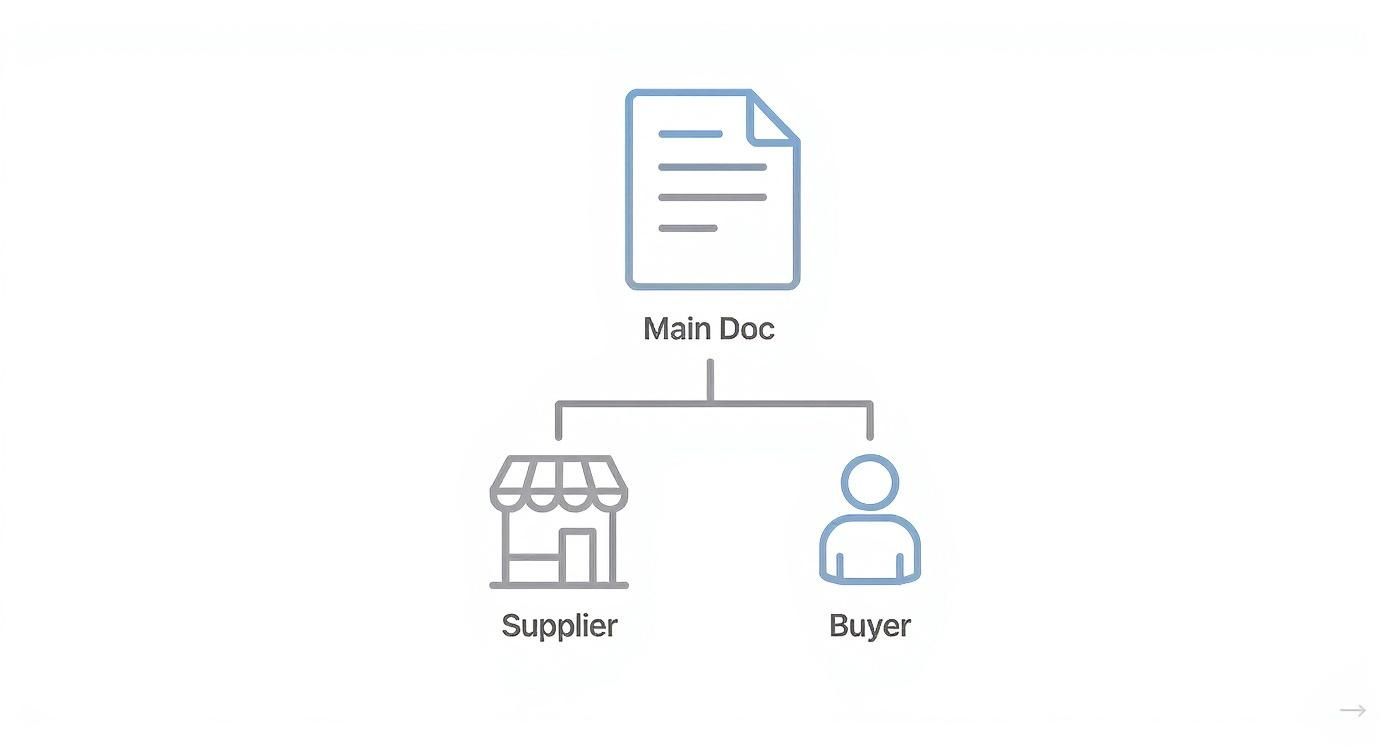
As you can see, the invoice is the central document that formalises the deal and clarifies each party’s tax obligations.
Describing the Sale and the GST
The next few elements get into the nitty-gritty of the transaction, leaving no room for confusion. Vague descriptions are a huge red flag for auditors.
4. A Brief Description of What You Sold
You need to list the goods or services supplied, including the quantity or extent. For example, “5 hours of emergency plumbing services” is perfect. “Services rendered” is not.
- Why it matters: This creates a clear record of the taxable supply. It prevents disputes down the track and confirms the legitimacy of the business expense for your customer.
5. The Price and GST Amount
Your invoice must show the price. You have two ways to do this: show the GST-inclusive price for each item with a statement like “Total price includes GST,” or show the GST amount for each item separately.
- Why it matters: This is the heart of the document. It explicitly states the amount of GST collected, which is the exact figure your customer needs to claim their GST credit.
Extra Rules for Sales of $1,000 or More
Once a sale hits the $1,000 mark (including GST), the rules get a bit stricter. Two more details become mandatory.
6. The Buyer’s Identity or ABN
For these larger transactions, you must include the customer’s business name or ABN.
- Why it matters: This creates a stronger, more verifiable link for high-value sales, making the audit trail much clearer for both businesses if the ATO comes knocking.
7. The Exact GST Amount Payable
For sales under $1,000, a simple note saying “Total includes GST” is fine. But for sales of $1,000 or more, you must show the exact GST amount for the total invoice. This can be listed separately or written as “Total price includes $X.XX GST.”
This side-by-side table breaks down the key differences between what’s required for a small sale versus a larger one.
Full Tax Invoice vs Simplified Tax Invoice Requirements
| Information Required | Simplified Invoice (Under $1,000) | Full Tax Invoice ($1,000 or more) |
|---|---|---|
| Document Title | Must state ‘Tax Invoice’ | Must state ‘Tax Invoice’ |
| Supplier Identity & ABN | Required | Required |
| Date of Issue | Required | Required |
| Description of Items | Required | Required |
| Total Price (including GST) | Required, with a note like “Total includes GST” | Required |
| Buyer’s Identity or ABN | Not required | Required |
| Exact GST Amount | Not required | Required (e.g., “Includes $150.00 GST”) |
As you can see, the main change for larger invoices is the need to identify the buyer and spell out the exact GST amount. It’s a simple distinction but a critical one for compliance.
You can find the definitive rules in the official legislation, the A New Tax System (Goods and Services Tax) Act 1999. Getting these seven elements right is the first step to making sure every invoice you send is legally sound and ready for scrutiny.
How to Issue Tax Invoices Correctly
Knowing what goes on a tax invoice is half the battle. The other half—knowing exactly when and how to send it—is just as critical for keeping your cash flow healthy and the tax office happy.
The Australian Taxation Office (ATO) doesn’t leave much room for guesswork here. For any taxable sale over $82.50 (including GST), you are legally required to provide a tax invoice within 28 days of your customer asking for one.
This isn’t just a friendly suggestion; it’s a hard-and-fast rule. Getting it wrong doesn’t just annoy your customers (who need that invoice to claim their GST credits), it can also damage your professional reputation and create a paperwork nightmare you don’t need.
From Theory to the Tools: Real-World Scenarios
So, what does this look like on a typical workday for a small business owner or a tradie? Let’s get practical.
- You’re a plumber: The moment that leaky pipe is fixed and you’re packing up, the job is done. The best move? Whip out your phone, generate an invoice using your accounting software, and email it to the client before you even drive away. Waiting a few weeks is a guaranteed way to slow down your cash.
- You’re a consultant: Your trigger for invoicing might be hitting a project milestone or delivering the final report. Your service agreement should spell this out clearly—something like, “Invoice to be issued upon submission of the final report”—so nobody is left wondering.
- You’re a retailer: In a shop, the tax invoice is usually the receipt you hand over at the counter. As long as that cash register receipt has all the must-have details (like your ABN and the GST amount), it often doubles as a valid tax invoice for smaller buys.
Modern vs. Old-School Invoicing Methods
How you actually send the invoice matters. While attaching a PDF to an email still works, modern accounting software has made the whole process faster, easier, and much harder to mess up.
The real goal here is to build a system that’s efficient and bulletproof. Whether you use automated software or stick with manual PDFs, your choice directly affects how quickly you get paid and how clean your books are for the ATO.
Automated systems can create and fire off invoices, keep an eye on who has paid, and even send out polite (or not-so-polite) reminders for you. It’s not just a time-saver; it gives your billing a consistent, professional edge.
The Unbreakable Rule of Sequential Numbering
No matter what method you choose, one rule is absolutely non-negotiable: sequential numbering.
Every single tax invoice you create must have its own unique number, and those numbers need to follow a logical order (e.g., INV-001, INV-002, INV-003, and so on).
Why? It creates a perfect, unbroken audit trail. This makes it simple for you, your accountant, and the ATO to track every dollar that comes in. Gaps in your invoice numbers are a massive red flag for the tax office—it can look like you’re trying to hide income.
When sending invoices, it’s also important to be clear on who is legally responsible for the sale. This is known as the Merchant of Record (MoR), the entity that takes on the liability for the transaction. Getting this right is fundamental to issuing a compliant, legally sound invoice.
At the end of the day, issuing a tax invoice is more than just asking for money. It’s a core business process that, when done right, strengthens your finances and keeps you on the right side of the law. Of course, before you can issue a tax invoice, you need to be registered for GST. If you’re just starting out, our guide explains how to register for GST.
Actionable Tip: Don’t let simple invoicing mistakes trip up your business. Book a consultation with EndureGo Tax, and let our experts in Ashfield and Belrose, Northern Beaches, help you set up a flawless invoicing system.
Understanding Recipient Created Tax Invoices
Normally, if you’re a business owner or a tradie, you’re the one sending out the invoices. Simple, right? You do the work, you issue the invoice. But in some Aussie industries, the whole process gets flipped on its head.
This is where a Recipient Created Tax Invoice (RCTI) comes in. It’s exactly what it says on the tin: a tax invoice that your customer (the recipient) creates and gives to you, the supplier. It might sound backwards, but it’s actually a super practical system when the buyer is in a better position to figure out the final value of what you’ve sold them.
When Are RCTIs Actually Used?
You can’t just start using RCTIs whenever you feel like it. They’re common in industries where the value of a product isn’t known until the buyer gets their hands on it. Think about sectors where goods are sold in bulk and need to be graded or weighed.
Here are a few real-world scenarios:
- A farmer sells a truckload of grain to a big food manufacturer. It’s only when the manufacturer receives, weighs, and grades the grain that they can calculate the final price.
- A scrap metal dealer sells a heap of recycled materials to a refinery. The refinery has to test and weigh the metal to work out its true value.
- Government agencies issue grants or payments to organisations. To keep things clean, the agency often creates the invoice on behalf of the grant recipient.
In these cases, it’s just far more efficient for the buyer, who has all the final numbers, to generate the invoice. It cuts down on the back-and-forth and gets the supplier paid faster.
The Strict ATO Conditions for RCTIs
Because this flips the normal invoicing process, the Australian Taxation Office (ATO) has some very strict rules you must follow. You can’t just wing it; a formal agreement has to be in place that ticks all the legal boxes.
These conditions are non-negotiable:
- A Written Agreement: You and your customer must have a current, written agreement that allows them to issue tax invoices for your supplies. This has to be sorted before any RCTI is issued.
- Both Parties Must Be GST-Registered: At the time the RCTI is created, both the supplier (you) and the recipient (your customer) must be registered for GST.
- Supplier’s ABN: The RCTI has to clearly show your Australian Business Number (ABN).
- No Supplier Invoice: You must agree not to issue your own tax invoice for that same sale. Having two tax invoices floating around for one transaction is a massive compliance no-no.
An RCTI isn’t a casual shortcut. It’s a formal, legally binding arrangement governed by strict ATO rules. If you don’t meet these conditions—especially having that written agreement—the document could be invalid, putting the buyer’s GST claims at risk.
For the definitive guide on these obligations, the ATO’s legislative determination is detailed in the A New Tax System (Goods and Services Tax) Act 1999.
A Real-World Example in Action
Let’s make this crystal clear. Imagine a small vineyard in the Hunter Valley supplies grapes to a major wine corporation. The final price tag depends on the tonnage and sugar content of the grapes, which can only be measured once they arrive at the winery.
Instead of the vineyard sending an invoice with a guesstimate, the wine corporation (the recipient) uses an RCTI. After crushing and testing the grapes, they calculate the total value is $11,000 (including GST).
They then issue an RCTI to the vineyard for this amount, which clearly shows the $1,000 GST component. The vineyard uses this document for its BAS, and the winery uses it to claim the GST credit. It’s a clean, efficient process that works for everyone.
Actionable Tip: Need to figure out if an RCTI arrangement is right for your business? Talk to the experts at EndureGo Tax. Our Ashfield and Belrose Northern Beaches teams can make sure you stay compliant.
The Future Is Here: Understanding e-Invoicing
The way Aussie businesses handle tax invoices is getting a serious upgrade. We’re moving on from the days of manually typing up documents or chasing PDF attachments in overflowing inboxes. The next step is e-invoicing, and it’s a whole lot more than just sending a digital file.
Think of it like this: emailing a PDF invoice is like sending a digital photo of a letter. Your customer’s accounting software can’t actually read the photo. Someone on their end still has to manually punch in all the details—the ABN, the date, the amounts. It’s a recipe for mistakes.
E-invoicing, on the other hand, is like sending the data itself.
It’s the secure, direct exchange of invoice information between your accounting system and your client’s. This digital handshake happens through a super-secure network called Peppol (Pan-European Public Procurement Online), which the Australian government has adopted to make sure everyone’s software speaks the same language.
Why Should Small Businesses and Tradies Care?
Jumping on the e-invoicing train isn’t just about keeping up with new tech; it delivers real, tangible benefits that hit your bottom line. It’s specifically designed to fix some of the biggest headaches that come with old-school invoicing.
For a busy tradie or a small business owner, the advantages are massive. The ATO estimates that businesses can slash the cost of processing an invoice by up to 70% just by switching to e-invoicing. That’s real money and time you can pour back into growing your business.
Here’s what you stand to gain:
- Get Paid Faster: Because your invoice data lands directly in your client’s system, ready for approval, the whole payment cycle speeds up. No more “lost invoice” excuses. This is a game-changer for your cash flow.
- Wipe Out Errors: Let’s face it, manual data entry leads to mistakes—a wrong ABN here, a transposed number there. E-invoicing kills this risk by transferring data directly, ensuring everything is spot on.
- Boost Your Security: E-invoices are sent over the secure Peppol network, which massively reduces the risk of scammers intercepting and faking your invoices—a common and costly problem with email.
The Government Push and What It Means for You
The Australian government is throwing its weight behind this shift, and it’s happening fast. The e-invoicing market in Australia has already hit USD 445.2 million and is set to grow even bigger. This isn’t just a suggestion; it’s becoming a requirement. For example, by mid-2026, 30% of supplier invoices sent to Commonwealth agencies must use Peppol e-invoicing. You can dig into more data on Australia’s e-invoicing market trends.
E-invoicing is a fundamental shift from exchanging documents to exchanging data. It’s about making your financial processes smarter, faster, and safer, setting your business up to win in a more connected economy.
This isn’t some passing fad. Getting your business ready for e-invoicing now shows your clients and partners that you’re efficient, secure, and easy to work with. The good news? Most modern accounting platforms like Xero, MYOB, and QuickBooks are already Peppol-enabled, so making the switch is probably simpler than you think.
Actionable Tip: Ready to future-proof your invoicing and get your cash flowing faster? Schedule a call with EndureGo Tax. Our expert accountants in Ashfield and Belrose, Northern Beaches, can walk you through setting up e-invoicing and make sure your business stays ahead of the curve.
Common Tax Invoice Mistakes to Avoid
Even the most organised business owners can slip up, but when it comes to tax invoices, little mistakes can create massive headaches. A dodgy invoice can stall payments, annoy your clients, and—worst of all—catch the unwanted eye of the Australian Taxation Office (ATO). Nailing this is a non-negotiable part of staying compliant.
Think of this as your final check before you hit ‘send’. Running through these common blunders can save you a world of pain and protect your cash flow. A single error can make the whole document invalid, stopping your client from claiming their GST credit and putting a dent in your professional reputation.
Forgetting the Magic Words ‘Tax Invoice’
This is hands down the most common mistake, and thankfully, the easiest to fix. If your document is just labelled ‘Invoice’ or ‘Bill’, it’s not a valid tax invoice in the ATO’s books. Your client’s accounts team will probably reject it on the spot because they can’t legally use it to claim a GST credit.
Practical Example: A freelance graphic designer sends a beautifully crafted bill for a big branding project. It’s got her ABN, the date, and the total cost, but it’s titled ‘Invoice’. The client’s bookkeeper immediately flags it as non-compliant, holding up the designer’s payment for weeks until she sends a corrected version.
Using an Incorrect or Missing ABN
Your Australian Business Number (ABN) is your unique ID in the tax system. It absolutely must be on every single tax invoice you issue, and it must be correct. A missing or wrong ABN is a huge red flag for both the ATO and your clients, casting doubt on the legitimacy of the whole transaction.
If the ABN is wrong, the ATO’s systems can’t verify your business, which means your client’s GST claim will be knocked back. A simple typo can cause a serious domino effect for everyone involved.
Every tax invoice is a legal document. An error isn’t just a typo; it’s a compliance failure that can disrupt your customer’s bookkeeping and delay your payment. Treat each element on your invoice with the same care you put into your work.
Miscalculating or Omitting GST
The whole point of a tax invoice is to correctly account for the Goods and Services Tax. You have to clearly show either the total price with a note like ‘Total includes GST’ (for sales under $1,000) or list the exact GST amount separately (which is mandatory for sales over $1,000).
- Common Error 1: Simply tacking on 10% to a subtotal without clearly stating the GST amount.
- Common Error 2: Forgetting to show any GST at all, leaving your client high and dry with nothing to claim.
- Common Error 3: Charging GST when you aren’t actually registered for it. This is illegal and comes with serious penalties.
These slip-ups don’t just create accounting nightmares; they can spark disputes. Beyond ATO penalties, these mistakes can lead to frustrated customers and payment chargebacks. It’s smart to get on the front foot by understanding and avoiding chargeback fees to protect your bottom line, and accurate invoicing is a huge part of that. For a deeper dive into your obligations, check out our guide on the essential record-keeping requirements in Australia.
Actionable Tip: Pull up your invoice template right now. Seriously, do it. Check it against these common mistakes. Does it clearly say ‘Tax Invoice’? Is your ABN right? Is the GST calculation clear and correct? Fixing these things today protects your business tomorrow.
Got Questions About Tax Invoices? We’ve Got Answers
Even when you think you’ve got the hang of tax invoices, a tricky situation can pop up and leave you scratching your head. Let’s tackle some of the most common questions we hear from Aussie business owners, so you can handle these scenarios with confidence and keep the Australian Taxation Office (ATO) happy.
Do I Issue a Tax Invoice if I’m Not Registered for GST?
Absolutely not. This is a big one. If your business isn’t registered for GST, you must not issue a document that says ‘Tax Invoice’ on it. You also can’t show a separate GST amount.
Doing this is a serious misstep because it’s misleading and can get you into hot water with the ATO.
Instead, just issue a standard invoice. Keep it simple and make no mention of GST. The flip side, of course, is that you can’t claim GST credits on your own business purchases.
What If I Make a Mistake on an Invoice I’ve Already Sent?
We’ve all been there. If you’ve sent an invoice and later spot an error, you can’t just delete it and send a new one. The proper way to fix it, according to the ATO, is to issue an adjustment note.
You might know this as a credit note (if you overcharged) or a debit note (if you undercharged).
This new document needs to clearly link back to the original invoice number and spell out exactly what’s being corrected. This creates a clean paper trail, which is crucial for keeping your records accurate and compliant.
A quick heads-up on record-keeping: Australian law requires you to hold onto copies of all tax invoices you issue and receive for a minimum of five years. Make sure they’re in English and easy to find if the ATO ever comes knocking.
Can I Claim GST Without a Tax Invoice?
For any business purchase over $82.50 (including GST), you absolutely need a valid tax invoice from your supplier to claim the GST credit. There’s no wiggle room here. Without that piece of paper, you can’t legally claim the input tax credit.
However, the rules are a bit more relaxed for smaller purchases under that threshold. You can often claim the credit with other proof of purchase, like a cash register docket, as long as it shows the supplier’s ABN.
To get the full picture and make sure you’re maximising your claims correctly, it’s worth getting familiar with the rules around GST input tax credit entitlement.
If you’re ever in doubt, the ATO’s official rules are laid out in the A New Tax System (Goods and Services Tax) Act 1999. It’s the ultimate source of truth for all things tax invoices.
Trying to get your head around tax invoice rules and other compliance headaches can feel overwhelming. The team at EndureGo Tax is here to offer expert guidance and keep your business on the straight and narrow, whether you’re managing a deceased estate trust, responding to a tax audit, or preparing a tax objection. Book a chat with your trusted local accountant in Ashfield or Belrose, Northern Beaches by visiting https://www.endurego.com.au today.
