


At its core, negative gearing is a strategic financial approach where the deductible costs associated with owning a rental property—such as mortgage interest, council rates, and maintenance—exceed the rental income it generates.
This results in a 'net rental loss'. The pivotal element of this strategy is that under Australian tax law, this loss can be used to reduce your overall taxable income, potentially leading to a significant tax refund.
Decoding Negative Gearing For Australian Property Investors

Negative gearing should be viewed not as a tool for immediate rental profit, but as a long-term wealth creation strategy. Investors deliberately accept a calculated, short-term cash flow shortfall. The rationale behind this is twofold: securing immediate tax advantages while positioning for substantial capital growth in the property's value over time.
This investment strategy is fundamentally supported by two financial pillars:
- Immediate Tax Reduction: The annual net rental loss is deducted from your other sources of income (e.g., your salary). This directly lowers your taxable income, which can reduce your tax liability or result in a tax refund.
- Long-Term Capital Growth: This is the primary objective. The expectation is that the property's market value will appreciate to a point where the eventual sale profit significantly outweighs the cumulative annual losses incurred.
How It Works: A Practical Example
Let's illustrate with a clear example. An investor, Alex, owns a property that generates $30,000 in gross rental income for the financial year. However, the total deductible expenses for the property, including mortgage interest, insurance, and repairs, amount to $40,000.
This creates a $10,000 net rental loss. If Alex's salary is $120,000, this $10,000 loss can be deducted, reducing their taxable income to $110,000. This is the core mechanism of negative gearing.
This is not a fringe strategy; it's a cornerstone of Australia's property investment market. During the 2020–21 financial year, over 2.2 million Australians claimed rental deductions, demonstrating its widespread application. For a deeper dive into the mechanics, this essential guide to negative gearing offers further expert insights.
To clarify the process, here is a breakdown of the key components.
Negative Gearing at a Glance
| Component | Description |
|---|---|
| Rental Income | The total rent collected from tenants over the financial year. |
| Deductible Expenses | Legally claimable costs like mortgage interest, repairs, insurance, and council rates. |
| Net Rental Loss | Occurs when total deductible expenses are greater than rental income. |
| Taxable Income | Your total assessable income (e.g., salary) before deductions. |
| Tax Benefit | The net rental loss is subtracted from your taxable income, reducing the tax you owe. |
This table simplifies the core concept: you are strategically trading a manageable annual cash flow deficit for an immediate tax benefit and the potential for a significant capital gain in the future. Mastering the principles of negative gearing is the first step toward determining if it aligns with your long-term financial objectives and risk profile. It is a calculated financial manoeuvre that requires a sophisticated understanding of both property market dynamics and tax legislation.
How Negative Gearing Reduces Your Tax Bill
Let's move beyond theory to a real-world scenario demonstrating how this strategy directly reduces your tax liability. The essence of negative gearing lies in converting a calculated on-paper loss into a tangible reduction in your personal income tax.
Consider an investor named Sarah, who earns an annual salary of $100,000. She also owns an investment property that generates $25,000 in rental income per year.
However, the property's running costs—including mortgage interest, insurance, council rates, and maintenance—total $35,000 for the year. This means her property operates at a net rental loss of $10,000.
Under the Income Tax Assessment Act 1997, the ATO permits Sarah to deduct this $10,000 property loss from her employment income. Consequently, her taxable income is reduced from $100,000 to $90,000, resulting in a lower tax bill.
This visual representation breaks down the process.
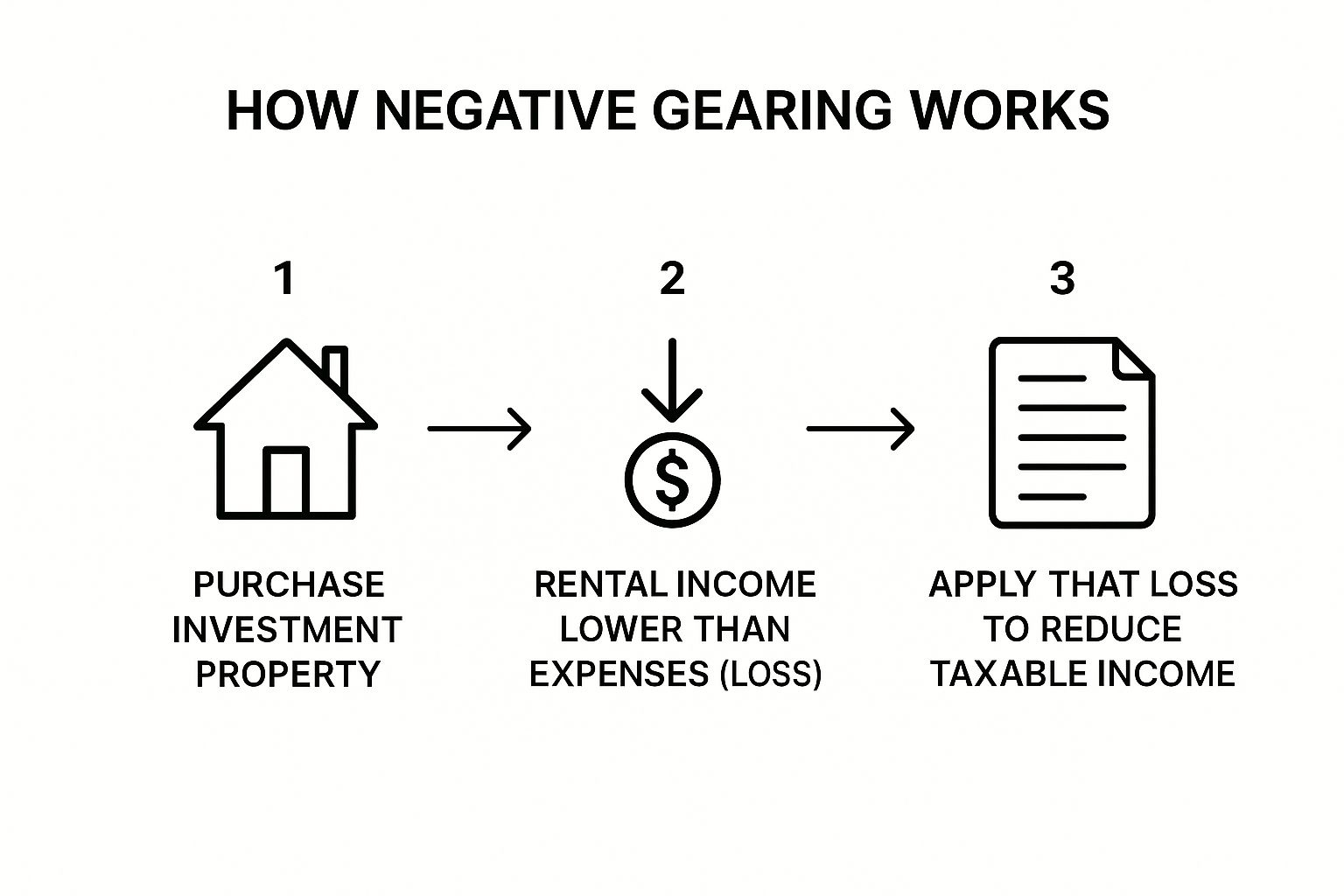
As illustrated, the key is leveraging the property's operational deficit to directly decrease the income on which you are taxed. This is a powerful mechanism for astute property investors.
The Calculation Breakdown
The formula for determining your net rental position is methodical and precise.
- Calculate Total Rental Income: Sum all rent received from your tenants within the financial year.
- Aggregate All Deductible Expenses: Collate every allowable expense incurred in managing and maintaining the property. This includes loan interest, strata fees, repairs, and property management fees.
- Determine Net Rental Profit or Loss: Subtract your total expenses from your total income. A negative result signifies a net rental loss.
- Apply the Loss to Your Taxable Income: This is the critical step. The net rental loss is deducted from your other assessable income, such as your salary.
The entire principle is predicated on the fact that an investment property's running costs can permissibly exceed its rental income, creating a tax-deductible loss.
Actionable Steps for Your Tax Return
To successfully execute this strategy, meticulous record-keeping is non-negotiable. Every dollar expended on your investment property must be documented to substantiate your claims.
To ensure compliance and maximise returns, you must be able to calculate rental income accurately and maintain a comprehensive ledger of all expenses. This level of precision is imperative to claim correctly and remain compliant with ATO regulations.
Claiming these deductions is a critical component of your annual tax return. To fully understand the tax advantages, review our comprehensive guide on negative gearing and tax benefits. This expert knowledge is essential for optimising your investment's performance.
The Long-Term Play: Capital Growth and CGT

While the immediate tax deduction is a compelling benefit, it represents only one facet of the strategy. To truly grasp the rationale behind negative gearing, one must look beyond the annual tax return. The ultimate objective is not a modest yearly refund but long-term capital growth.
The entire strategy is predicated on a single, powerful assumption: that the property's value will appreciate significantly over the holding period.
You are effectively trading small, manageable annual losses for the potential of a much larger financial windfall upon the eventual sale of the asset. The success of this strategy hinges on the capital gain being substantial enough to more than offset the accumulated losses claimed over the years.
The Power of the Capital Gains Tax Discount
This is where the Australian tax system provides another significant advantage for property investors. When an investment property is sold for more than its cost base, the profit is classified as a capital gain and is subject to Capital Gains Tax (CGT).
However, a crucial provision mitigates this tax liability. According to the ATO, if you hold an investment asset for more than 12 months before its disposal, you are eligible for a 50% CGT discount.
This provision means you are only required to add half of the gross capital gain to your taxable income for that financial year. In effect, it halves your tax bill on the profit. For a detailed analysis of this legislation, our guide on Capital Gains Tax for property provides an expert breakdown.
CGT in Action: A Practical Example
Let's apply this to a real-world scenario to demonstrate the financial impact.
Suppose you acquire an investment property for $600,000. Over the next decade, you accumulate a total of $50,000 in net rental losses, which you claim against your salary each year to reduce your tax. After 10 years of consistent market growth, you sell the property for $900,000.
Here is the financial outcome:
- Gross Capital Gain: $900,000 (sale price) – $600,000 (purchase price) = $300,000
- Apply the 50% CGT Discount: As the property was held for over 12 months, this gain is eligible for the discount.
- Taxable Capital Gain: $300,000 / 2 = $150,000
In this scenario, only $150,000 is added to your assessable income in the year of sale. It is this powerful synergy between the CGT discount and successful capital appreciation that transforms negative gearing from a series of minor annual losses into a substantial, tax-effective financial victory.
Understanding the Risks and Cash Flow Demands

While the tax benefits of negative gearing are compelling, a successful strategy requires a clear-eyed assessment of the inherent risks. This is not a guaranteed path to wealth; its viability hinges on one critical factor: long-term capital growth.
If the property market stagnates or declines, you are left holding a depreciating asset that incurs ongoing costs without delivering the anticipated future return. This is the single greatest risk an investor must underwrite. You could find yourself in a scenario where, after a decade of funding losses, the property sells for less than its purchase price, turning a strategic investment into a significant financial liability.
The Critical Role of Cash Flow
The second major challenge is managing cash flow. The tax refund from your negative gearing losses is typically received annually, post-lodgement of your tax return. However, your expenses—mortgage repayments, council rates, insurance, and maintenance—are due on a monthly basis.
This creates a persistent cash flow deficit that you must service from your personal funds. It is imperative that you possess sufficient disposable income to bridge this gap between rental income and ongoing expenses, month after month.
"Investors must have the financial stability to fund the shortfall out of pocket until the property becomes positively geared or is sold. It's a test of financial discipline and planning."
The importance of this cannot be overstated. Before entering into any purchase agreement, you must conduct a rigorous and honest assessment of your personal budget: can you sustain these regular out-of-pocket costs, potentially for many years?
Risk vs Reward in Negative Gearing
Negative gearing is a classic high-stakes financial strategy. The potential rewards are significant, but they are matched by the risks you must assume. A prudent investor weighs these factors carefully before committing.
Here is an analysis of the trade-offs involved.
| Potential Reward | Associated Risk |
|---|---|
| Significant long-term capital gains upon sale. | Market stagnation or decline, leading to capital loss. |
| Annual tax deductions reducing overall tax liability. | Sustained cash flow pressure from funding the monthly shortfall. |
| Building a valuable asset portfolio over time. | Unforeseen costs (vacancies, major repairs) impacting budget. |
| Potential to become positively geared as rents increase. | Rising interest rates dramatically increasing monthly losses. |
Ultimately, a successful negative gearing strategy is one that expertly balances these elements. It demands a strong financial position, a long-term investment horizon, and a degree of favourable market conditions.
External Factors You Cannot Control
Several external variables can significantly impact your investment, amplifying the financial shortfall and placing your strategy under duress. A comprehensive understanding of what is negative gearing necessitates an awareness of these vulnerabilities.
- Rising Interest Rates: When the Reserve Bank of Australia increases the cash rate, your mortgage repayments rise. A manageable shortfall can quickly escalate into a substantial monthly burden.
- Extended Vacancy Periods: If your property remains untenanted, your rental income ceases. However, the mortgage and other property-related bills must still be paid.
- Unexpected Major Repairs: A burst water pipe or major storm damage can result in thousands of dollars in unforeseen expenses that require immediate payment, placing further strain on your cash flow.
As the Australian Taxation Office clarifies, while many repair costs are deductible, you must have the liquidity to pay for them upfront. You can find official guidance on what constitutes an immediate deduction versus a capital works expense in the ATO's detailed information on rental property expenses.
Negative gearing is not a passive, "set and forget" investment. It requires a robust financial buffer, a high tolerance for risk, and a steadfast long-term perspective. If you are considering this path, it is crucial to stress-test your finances against these potential headwinds.
Are you prepared for the cash flow demands of an investment property? Book a consultation with EndureGo Tax today to assess your financial readiness and build a robust investment strategy.
Navigating Your Tax Obligations with the ATO
The operational core of a successful negative gearing strategy is the legal maximisation of tax deductions. Ensuring compliance with the Australian Taxation Office (ATO) is not merely a procedural requirement; it is fundamental to the long-term profitability and security of your investment.
This requires a comprehensive understanding of claimable expenses and the implementation of meticulous record-keeping for every dollar spent.
The ATO permits property investors to claim a wide array of expenses, provided they were incurred while the property was tenanted or genuinely available for rent. Mastering these deductions is the first step toward maintaining control of your tax position.
Your Checklist of Tax-Deductible Expenses
To ensure you are claiming all eligible deductions, you must systematically track all costs. The following are among the most common expenses you can claim against your rental income:
- Loan Interest: This is typically the largest deduction. The interest component of your mortgage repayments is fully deductible.
- Council and Water Rates: Regular charges from local council and water authorities are claimable expenses.
- Property Insurance: Premiums for building, contents, and landlord insurance are deductible.
- Property Management Fees: Fees paid to a real estate agent for managing the property are a deductible expense.
- Maintenance and Repairs: The cost of general upkeep—such as fixing a leaky tap, patching a wall, or repairing a broken window—is claimable.
The ATO provides extensive guidance, including the Income Tax Assessment Act 1997, which underpins these deductions. It is prudent to consult their official resources regularly.
The ATO website should be considered the definitive source for confirming deductions and staying informed of legislative changes.
Repairs vs Capital Improvements
This is a critical distinction that frequently trips up investors. The ATO establishes a clear demarcation between an immediate repair and a capital improvement.
A repair restores an item to its original condition, for example, replacing a few broken roof tiles. This cost is immediately deductible in the financial year it is incurred.
Conversely, a capital improvement enhances the property beyond its original state. A full kitchen renovation or the addition of a new deck are prime examples. These costs are not immediately deductible. Instead, they are classified as capital works and must be depreciated over several years, meaning you claim a portion of the cost annually. For a full breakdown, explore our expert guide on the secrets to maximising negative gearing deductions.
Correctly classifying these expenditures is non-negotiable. Misclassifying a capital improvement as a repair is a common audit trigger and can attract significant penalties from the ATO.
Need expert assistance to ensure your investment property deductions are compliant and fully optimised? Book a consultation with the specialists at EndureGo Tax today.
What's Next for Negative Gearing in Australia?
Negative gearing is one of Australia's most debated and politically sensitive financial policies. It sits at the nexus of housing affordability, private investment, and the national economy, ensuring it remains a topic of continuous public and political scrutiny.
Supporters argue it is a vital incentive for property investors, stimulating the supply of rental housing. Conversely, critics contend that it confers an unfair advantage on high-income earners, inflates property prices, and marginalises first-home buyers. This persistent ideological conflict keeps the policy under constant review.
Potential Reforms on the Horizon
Given the ongoing debate, various reforms are frequently proposed by policymakers. As a long-term investor, it is imperative to monitor this political landscape to avoid being blindsided by legislative changes.
Commonly discussed reform proposals include:
- Capping Deductions: Imposing a ceiling on the total rental losses an investor can claim against their taxable income each year.
- Limiting to New Builds: Restricting negative gearing eligibility to newly constructed properties to stimulate the construction sector.
- Phasing Out: Gradually rescinding the tax concession, potentially for investors with large portfolios or specific property types.
Recent government modelling has explored changes that could generate substantial tax revenue. One official estimate from the Parliamentary Budget Office suggested that reforms to capital gains tax and negative gearing could yield over $23 billion in a decade.
The core of the debate is a balancing act: stimulating private investment in housing versus ensuring equitable access to homeownership. The future of negative gearing will be determined by which of these priorities gains political ascendancy.
For the present, negative gearing remains an integral part of Australia's tax framework, administered by the Australian Taxation Office. However, a prudent investor understands that success requires more than mastering current regulations; it involves anticipating the political climate to make informed, forward-looking strategic decisions.
Is your investment strategy resilient enough to withstand potential legislative changes? Contact EndureGo Tax for expert advice on future-proofing your property portfolio.
Common Questions About Negative Gearing
Embarking on property investment invariably raises practical questions. To provide greater clarity, here are expert answers to the most frequent queries we receive about the day-to-day realities of negative gearing.
Can I Still Claim Deductions If My Property Is Vacant?
Yes, you can claim expenses during vacant periods, provided the property is genuinely available for rent. This means it must be actively advertised at a fair market rate and maintained in a condition suitable for occupancy.
If the property is used for personal purposes, deductions cannot be claimed for that period. Meticulous record-keeping is essential—retain copies of rental listings, correspondence with your property manager, and other evidence to substantiate your claims to the ATO.
Is Negative Gearing Only for High-Income Earners?
No, but the tax benefits are mathematically greater for individuals in higher marginal tax brackets. A larger tax deduction applied against a higher income yields a more substantial tax reduction or refund.
For investors on lower incomes, disciplined cash flow management is paramount. The resulting tax refund will be smaller, making a robust financial buffer to cover the monthly shortfall between rental income and expenses non-negotiable.
Regardless of your income level, the fundamental principle remains: you must have sufficient liquidity to service the investment's cash flow deficit each month until the annual tax refund is received or the property's capital value increases.
What Is the Difference Between Negative and Positive Gearing?
The distinction is determined entirely by the property's cash flow position.
- Negative Gearing: Occurs when the property's deductible expenses (loan interest, rates, maintenance) are higher than the rental income. This creates an on-paper loss, which can be used to reduce your overall taxable income.
- Positive Gearing: Is the inverse scenario. The rental income is greater than all deductible expenses. The property generates a net profit from the outset, resulting in positive cash flow each month (which is subject to income tax).
Ready to explore how negative gearing could fit into your financial strategy? The team at EndureGo Tax provides expert guidance to help you make informed investment decisions with confidence. Book a consultation today by visiting https://www.endurego.com.au.
