


If you’re staring at an invoice and wondering whether to add GST, leave it off, or split the amount somehow, you’re in good company. A lot of small business owners in Ashfield, Belrose, and across the Northern Beaches hit that same moment. The work is done, the customer wants the bill, and suddenly one simple question turns into three others about pricing, paperwork, and BAS.
That’s why what is gst rate in australia is more than a quick tax question. It affects your quotes, your cash flow, your margins, and how confident you feel when the ATO asks for records. A tradie ordering materials, a café owner buying stock, and a consultant issuing service invoices all deal with GST differently depending on what they sell and how their purchases are used.
The good news is that GST becomes much easier once you break it into a few practical rules. If you understand the rate, know when registration is required, and can tell the difference between taxable, GST-free, and input-taxed supplies, most of the confusion disappears.
Getting Started with GST Rate in Australia
A café owner in Ashfield might charge one amount at the till, pay suppliers another amount on invoices, and then wonder which pieces belong in the BAS. A plumber in Belrose might quote a client, buy fittings at the merchant, and then realise the cash sitting in the bank isn’t all business income because part of it is GST collected for the ATO.
That’s where GST trips people up. It looks simple on paper, but in real business life it touches almost every transaction.
Why GST matters in day-to-day business
GST affects more than tax compliance. It changes how you:
- Set prices: You need to know whether your quote is GST-inclusive or GST-exclusive.
- Read supplier bills: The amount you pay may include GST you can later claim back, depending on the purchase.
- Manage cash flow: Money collected as GST isn’t yours to spend freely.
- Prepare BAS: Your sales and purchases need to be classified correctly.
A common mistake is treating every dollar received as revenue. That leads to trouble fast. If you’ve charged GST on a taxable sale, part of that payment is being held on behalf of the tax system, not earned as profit.
Practical rule: If you collect GST from customers, separate it mentally from your business income straight away.
Where people usually get confused
Most confusion starts in one of these spots:
- You’re unsure whether your service even has GST on it.
- You don’t know if the price you quoted already included GST.
- You’ve bought something for the business but aren’t sure if you can claim the GST back.
- You’re close to the registration threshold and don’t know when the obligation starts.
These aren’t minor admin questions. Getting them wrong can distort your margins and create BAS clean-up work later.
For most small businesses, the best approach is simple. Work from the invoice. Identify what was sold, whether GST applies, and whether the price is inclusive or exclusive. Then keep records clean from the start.
Understanding the Key Concepts
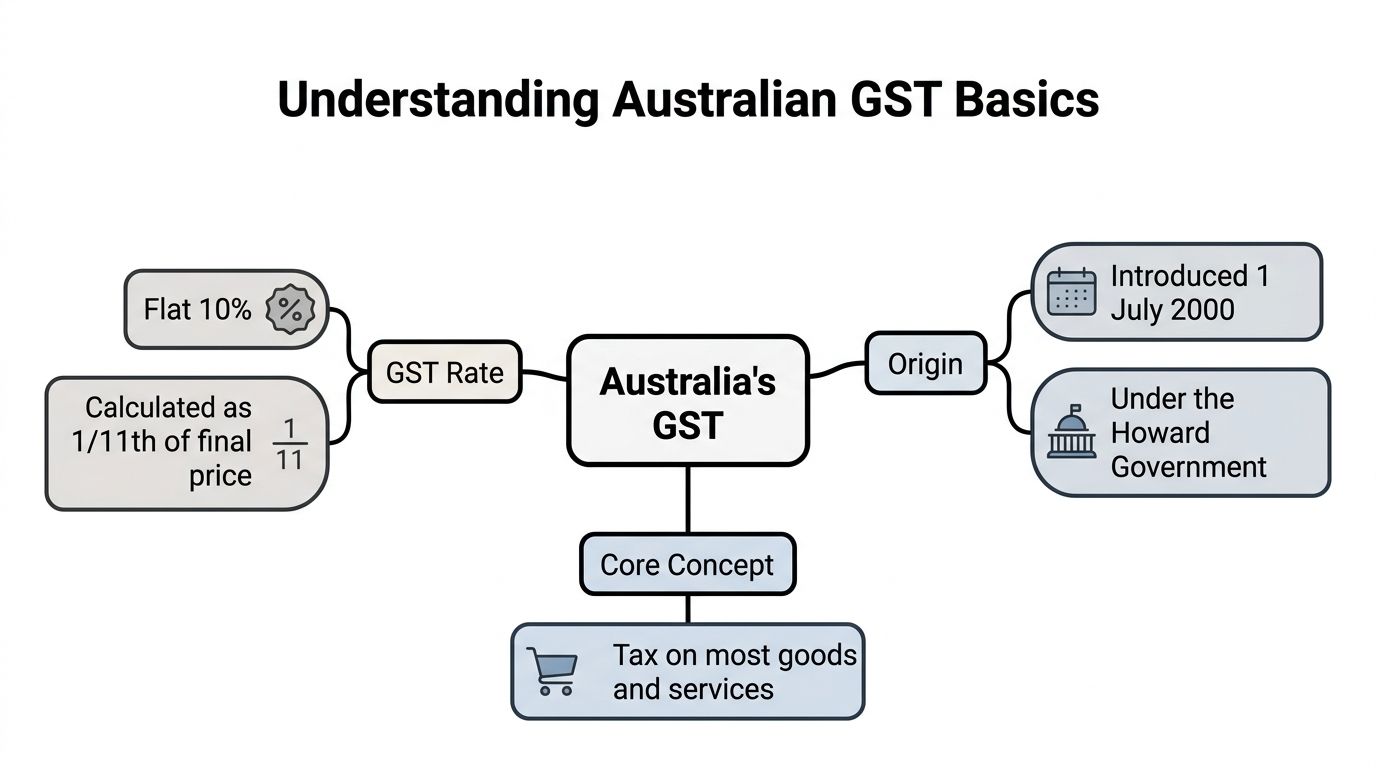
Australia’s GST is a flat 10%. It was introduced on 1 July 2000 by the Howard government, replacing multiple federal and state taxes, and it’s calculated as 1/11th of the total price for taxable sales connected with Australia, according to the ATO’s explanation of how Australian GST works.
The easiest way to think about GST
Think of GST like an extra layer added to a taxable selling price.
If your service price is GST-exclusive, you add GST on top. If your displayed price is GST-inclusive, GST is already built in. That’s why business owners often use two views of the same amount:
| Pricing view | What it means |
|---|---|
| GST-exclusive | Your base price before GST is added |
| GST-inclusive | The final amount the customer pays |
For practical quoting, many businesses work from the GST-exclusive figure first, then add GST. If you want a simple refresher on inclusive and exclusive pricing, this guide on exclusive of GST is useful.
Why the one-eleventh rule matters
People often ask why the GST portion of a GST-inclusive price isn’t found by taking ten per cent of the total. The reason is that GST is added to the pre-GST amount, not calculated backward from the final price in the same way.
That’s why the GST component of a GST-inclusive amount is 1/11th of the total price.
A plain-language way to remember it:
- To add GST: multiply the GST-exclusive price by 1.1
- To remove GST: divide the GST-inclusive price by 1.1
- To find the GST part of a total: divide the total by 11
Why stability helps business owners
One reason GST is easier to work with than many people expect is consistency. The standard rate hasn’t been bouncing around. That makes quoting, software setup, and recurring invoicing much simpler for local businesses.
A café, electrician, or consultant can build repeatable systems because the core rate itself is straightforward. Complexity usually comes from classification, not from the rate.
Who Must Register for GST
Registration isn’t based on whether you feel “big enough” to register. It’s based on turnover rules and, for some activities, the nature of the service itself.
For businesses, GST registration is mandatory when annual turnover exceeds $75,000, or $150,000 for non-profits, and registration is required within 21 days of meeting the threshold. Ride-share and taxi services, and businesses claiming fuel tax credits, must register immediately under the rules outlined in the GST registration requirements.
A practical way to check your position
If you’re unsure whether you must register, work through it in order:
- Add up your business turnover over a rolling period.
- Check whether you’re over the threshold for your entity type.
- Look at your business activity, because some services trigger registration regardless of turnover.
- Act quickly once the threshold is met, because the registration window is short.
This catches a lot of sole traders by surprise. They think in financial years, but turnover issues often arise while the year is still unfolding.
Local example
A Northern Beaches tradie might start the year doing small private jobs, then win several larger contracts in quick succession. The paperwork doesn’t become urgent only when tax time arrives. The GST issue can begin as soon as turnover pushes past the threshold.
That matters because once registration applies, future invoices for taxable sales need to be handled properly. If you leave registration too late, clean-up work becomes far harder.
Keep a close eye on your turnover if your sales are growing unevenly. A busy quarter can change your GST obligations faster than expected.
If you’re still setting up
Plenty of GST mistakes start before the first invoice goes out. The business structure, registration timing, invoicing process, and bookkeeping setup all affect how smoothly GST runs later. If you’re still in the planning stage, this guide to setting up a business in Australia gives helpful context around the broader setup side.
Voluntary registration and caution
Some businesses below the threshold choose to register voluntarily. That can make sense in some cases, especially where business purchases include GST and records are organised well.
But registration also creates reporting obligations. If your systems are messy, voluntary registration can create more pressure than benefit. Before choosing it, make sure your invoicing, receipts, and bookkeeping process are already stable.
Differentiating GST-free and Input-taxed Supplies
Cash flow problems often arise from this. Many business owners hear “no GST” and assume all non-taxable sales are treated the same. They aren’t.
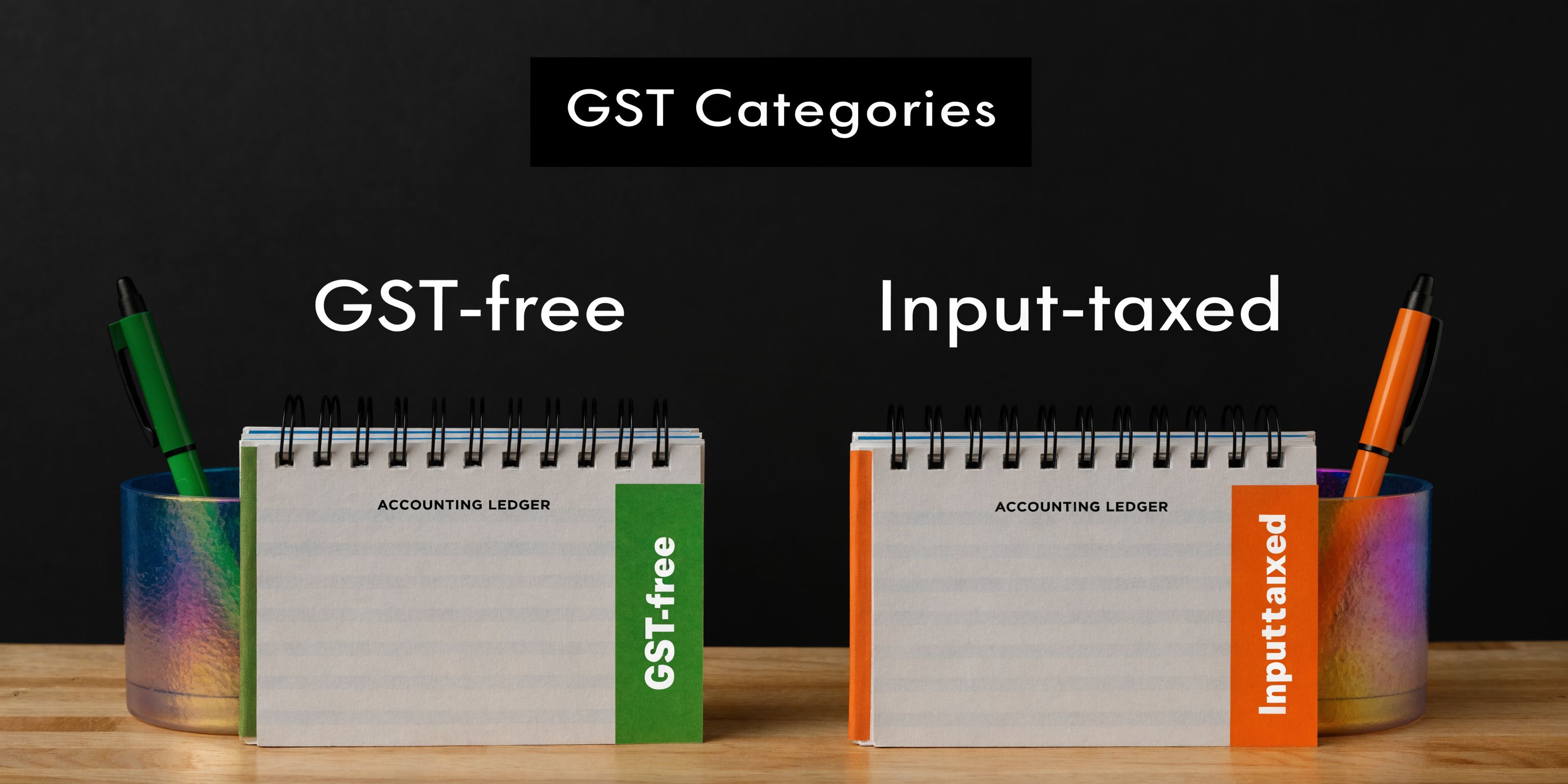
Australia’s GST framework classifies supplies as taxable, GST-free, or input-taxed, and that difference affects whether you can claim input tax credits on related purchases, as explained in this overview of Australia’s GST classifications.
The difference in plain language
Here’s the easiest way to separate them:
| Supply type | GST charged to customer | Can claim input tax credits on related purchases |
|---|---|---|
| Taxable | Yes | Yes, if otherwise eligible |
| GST-free | No | Yes, if otherwise eligible |
| Input-taxed | No | No, for related costs |
That last row is the one people miss.
A GST-free sale doesn’t block input tax credits in the same way an input-taxed sale can. So two businesses may both issue invoices with no GST charged, yet their entitlement on purchases can be completely different.
Common examples people recognise
The verified guidance allows these broad examples:
- GST-free supplies: basic foods, certain medical services, healthcare, and education
- Input-taxed supplies: financial supplies such as interest income
The words look similar, but the financial result isn’t similar at all.
Why this affects cash flow
Suppose two businesses both buy software, pay rent, and use accounting support.
- A business making GST-free supplies may still be able to claim GST credits on those related costs.
- A business making input-taxed supplies may not be entitled to the same credits for costs tied to that activity.
That means the second business can carry a heavier unrecoverable cost base. The sale side might look harmless because no GST is charged, but the purchase side is where the sting appears.
The label on the sale changes the value of the purchases behind it.
A local-style example
Think about a small operator in Belrose. If they provide a supply that falls into the GST-free category, they may invoice without GST and still preserve input tax credit access on eligible business costs. If their activity falls into an input-taxed category instead, those same software and admin expenses can stop producing GST credits.
That’s why classification is never just an invoice issue. It’s a margin issue.
Claiming Input Tax Credits and BAS Reporting
If GST is the amount you collect on taxable sales, input tax credits are the flip side. They let eligible registered businesses claim back GST included in business purchases.
GST-registered entities with turnover over $75,000 must lodge a BAS either quarterly in most small business cases or monthly where turnover is above $20 million, with strict penalties for late lodgement and payment, according to this summary on Australia’s GST update and BAS obligations.
What input tax credits do
If your business buys eligible goods or services for business use and GST is included in the price, that GST may be claimable. In simple terms:
- GST on your sales increases what you owe
- GST on eligible business purchases may reduce that amount
The result is your net GST position for the BAS period.
If you want a practical overview of eligibility, this page on input tax credit entitlement is a helpful reference point.
BAS in working terms
For many owners, BAS feels technical because of the labels and boxes. It helps to think of it in three broad layers:
- Your sales
- GST collected on those sales
- GST paid on eligible purchases
Your records feed those amounts. Clean bookkeeping matters more than last-minute scrambling.
Habits that make BAS easier
These habits save time and reduce errors:
- Use clear invoice wording: Mark whether prices are GST-inclusive or GST-exclusive.
- Keep purchase records organised: Don’t rely on bank statements alone.
- Separate private spending: Mixed-use purchases are one of the fastest ways to create BAS mistakes.
- Review classifications before lodgement: A sale with no GST isn’t automatically GST-free.
A simple monthly discipline
Many small businesses lodge quarterly, but they should still review GST monthly. Waiting until BAS time often means missing supplier invoices, misreading receipts, or forgetting adjustments.
A good routine is to reconcile sales, purchases, and bank transactions every month, even if the BAS itself is less frequent. That keeps surprises small and manageable.
Working habit: BAS is easiest when you treat it as an ongoing record-keeping process, not a once-a-quarter rescue job.
GST Examples for Small Businesses and Tradies
Rules stick better when you can see them in real life. Local businesses usually don’t struggle with the idea of GST. They struggle with applying it while quoting jobs, buying stock, and trying to keep cash moving.
A Belrose plumber quoting a job
A plumber in Belrose gets a call-out for a bathroom fit-off. The client asks for a total price. The first question isn’t the tax return question. It’s the invoice question.
If the plumber is registered for GST and the work is a taxable supply, the quote needs to be clear about whether the amount includes GST.
A sensible workflow looks like this:
- Quote clearly: State if the price is GST-inclusive.
- Track materials separately: Merchant invoices may include GST that could become claimable input tax credits.
- Reconcile job by job: Match customer invoice, supplier bills, and payments before BAS time.
This matters for cash flow. If the plumber treats the full customer payment as available spending money, BAS quarter can feel brutal. The GST collected should already be mentally carved out.
An Ashfield café and the classification trap
A café owner in Ashfield usually has lots of small transactions. That creates a different risk. High volume can hide repeated coding mistakes.
The owner might assume that if an item sounds like food, it must be treated one way every time. In practice, GST treatment depends on correct classification. If the till setup or bookkeeping software is wrong, the same error can repeat across weeks of sales.
That creates two problems:
- Daily pricing may be off.
- BAS reporting may be wrong even if total sales look right.
For cafés, the fix is operational. Review point-of-sale settings, supplier coding, and how sales categories flow into the accounting file. Don’t wait for a review notice before checking.
A consultant paid in crypto
Crypto creates a newer kind of confusion because people mix up payment method with tax treatment.
If a small business sells goods or services and accepts crypto as payment, the GST question usually starts with the underlying sale, not just the technology used to pay. The verified data also notes that the ATO reported over 500,000 crypto transactions declared in 2024–25, and many small businesses miss input credits on crypto mining hardware, which highlights the need to understand GST around digital and crypto-related services, as noted in this report via Trading Economics on Australia’s sales tax rate.
So if a consultant invoices for taxable work and the client pays in Bitcoin, the business still needs to think about GST on the service supplied. By contrast, pure crypto transactions raise different issues and often confuse people because they don’t fit the ordinary invoice pattern business owners are used to.
A better way to check invoices before BAS
For tradies and small businesses, I’d use this short review before every BAS cycle:
| Checkpoint | What to look for |
|---|---|
| Sales invoices | Is GST shown correctly on taxable sales? |
| Supplier bills | Are eligible business purchases recorded properly? |
| Mixed items | Are private or non-claimable portions separated out? |
| Special transactions | Did any crypto, digital, or unusual transactions occur this period? |
The practical lesson
Most GST errors don’t start with complex law. They start with routine business habits:
- quoting without stating whether GST is included
- coding all zero-GST items the same way
- assuming every purchase creates a credit
- treating crypto receipts as if the payment method replaces the tax analysis
If you run a local business in Ashfield or the Northern Beaches, the cleanest approach is simple. Make every invoice easy to read, classify sales carefully, and review unusual transactions before they reach the BAS.
Common Mistakes to Avoid with GST
The most expensive GST mistakes are usually boring ones. They don’t come from obscure legal arguments. They come from rushed admin, poor record keeping, and assumptions.
The mistakes I see most often
- Late registration: A business grows, turnover passes the line, and the owner keeps invoicing as if nothing changed.
- Wrong classification: Sales with no GST get lumped together even though GST-free and input-taxed don’t work the same way.
- Overclaiming on purchases: Private or mixed-use expenses get treated as fully claimable business costs.
- Late BAS preparation: Owners wait until the deadline, then work from incomplete records.
Each one creates stress because it compounds. One missed registration issue flows into invoice corrections. One coding mistake spreads across many transactions. One poor filing habit turns BAS into detective work.
Why early fixes matter
A small GST problem is usually manageable when caught early. Leave it sitting for months and it can affect several BAS periods, customer invoices, and purchase claims all at once.
A clean system is usually built on plain habits:
- Keep one business bank account: Don’t mix family spending with business spending.
- Use consistent invoice templates: Make GST treatment visible.
- Review unusual transactions early: Imports, digital services, and crypto payments deserve a second look.
- Reconcile regularly: Don’t rely on memory at BAS time.
Small corrections made monthly are far easier than large corrections made after a notice arrives.
The safest mindset
Treat GST as part of daily bookkeeping, not a tax-season task. If your sales process and purchase records are accurate during the quarter, BAS becomes a reporting exercise. If they aren’t, BAS becomes damage control.
Next Steps and Getting Personalised GST Advice
If you’ve been asking what is gst rate in australia, the short answer is easy. Applying it properly involves considerable effort.
The practical next steps are straightforward:
Your GST action list
- Check whether you need to be registered
- Review how your invoices show GST
- Separate taxable, GST-free, and input-taxed supplies correctly
- Keep records for eligible business purchases
- Set a regular BAS preparation routine
- Flag unusual transactions early, especially digital or crypto-related ones
If you’re a tradie in Belrose, a café owner in Ashfield, or a small business operator anywhere in the Inner West or Northern Beaches, GST works best when your systems are simple and consistent.
When tailored advice makes sense
You should get personalised advice if any of these apply:
- your turnover is changing quickly
- you sell a mix of different supply types
- your bookkeeping has fallen behind
- you operate through a company, trust, or SMSF
- you deal with crypto, imported digital services, or cross-border transactions
General guidance is useful, but GST decisions often turn on the details of what you sell, how you invoice, and what your records show. That’s where experienced advice saves time and avoids rework.
Good GST management protects cash flow first and compliance second. Both matter, but cash flow is usually where business owners feel the pain earliest.
If you want help sorting out GST registration, BAS, business structures, crypto-related tax issues, or ongoing compliance, speak with EndureGo Tax. With offices in Ashfield and Belrose Northern Beaches, they help tradies, investors, and small businesses get clear advice and real peace of mind.
