


You’re probably staring at a quote right now. Maybe it’s for a kitchen reno on your Ashfield rental, a retaining wall in Belrose, or a workshop upgrade for your trade business. The builder says it’s straightforward. The bank says it adds value. Then tax time rolls around, and the question lands on your desk.
What is capital works, and how does the ATO want you to claim it?
Plenty of investors, tradies, and small business owners often come unstuck. They lump everything together, call it a repair, or assume every improvement is instantly deductible. It isn’t. And if you get it wrong, you can hurt your cash flow, overclaim, or leave legitimate deductions behind for years.
The good news is that the core idea is simple. If you’re fixing something, that usually points one way. If you’re improving, replacing substantially, altering, or building something structural, that usually points another way. The tax outcome changes sharply depending on which bucket the work falls into.
Your Next Renovation Could Be a Tax Goldmine or a Trap
An Ashfield investor might buy an older unit and decide to “freshen it up” before the next tenant moves in. Typically, the work includes a new bathroom, updated cabinetry, fresh tiling, repainting, and electrical upgrades. Before long, the invoices start piling up. By the end of the project, the property looks schmick and ready for the market.
However, this is often where the mistake happens.
The investor hands the entire stack of invoices to the accountant and says, “Just claim it all.”
Unfortunately, that’s how people get burned.
In reality, some of that spending may fall under capital works. Meanwhile, some costs may qualify as repairs, while others could be classified as plant and equipment. Importantly, these categories are not treated the same way by the ATO.
For example, a structural bathroom rebuild is very different from patching a cracked wall. Similarly, a built-in improvement is not the same as a removable appliance. If all three are treated as one category, the risk of incorrect claims increases significantly.
Likewise, Belrose tradies often run into the same issue. A workshop extension, new slab, upgraded roofline, fitted storage, and drainage works may all feel like part of “the job” on-site. However, from a tax perspective, each component may need to be treated differently.
That means understanding what creates a long-term structural asset, what simply restores an existing item, and what belongs in the separate depreciating asset category. By separating these correctly from the beginning, businesses and investors can reduce compliance risks and avoid unnecessary issues if the ATO reviews the claims later on.
Practical rule: If the work changes the structure, layout, or lasting function of the property, stop guessing and classify it properly before lodging.
This matters before the first invoice gets paid, not after. Good records, a clean scope, and proper project documentation make tax treatment far easier. If you’re planning something substantial, it also helps to understand how proper construction project management services can support documentation and cost tracking from day one.
The upside is real. Get capital works right, and you build a deduction stream that can support your tax position over the long haul. Get it wrong, and you create a mess that’s painful to unwind.
Defining Capital Works Under Australian Tax Law
You rip out an old bathroom in Ashfield, move the plumbing, re-tile the lot, install a new vanity, and close up the walls. That is not a quick fix. It is capital works.
Capital works means spending on the building itself, or on fixed structural improvements, where the result lasts and becomes part of the property. That is the rule worth remembering.

What usually counts as capital works
For tax purposes, capital works usually cover the bones of the property and the fixed improvements attached to it. In plain terms, if it stays with the building and changes its structure, function, or layout for years, you are usually in capital works territory.
Common examples include:
- Building additions such as an extension, extra room, studio, or enclosed outdoor area
- Structural renovations, such as a bathroom rebuild, a major kitchen reconfiguration, or internal wall changes
- Fixed building elements, including walls, floors, roofing, doors, windows, stairs, and built-in structural features
- Permanent site improvements, such as driveways, concrete paths, retaining walls, and drainage works, are tied to the property
That matters a lot in Ashfield and Belrose because many jobs sit in the grey area. A tradie might call it one renovation job. The ATO wants to know what part created or improved the structure, what part merely fixed existing damage, and what part falls into the separate bucket for assets that depreciate in Australia.
The test I use with clients
I keep it simple. Ask these three questions before you code the invoice:
- Did the work improve or rebuild part of the property in a lasting way?
- Did it become part of the building or land, not just sit inside it?
- Would a buyer treat it as part of the property sale?
If the answers are yes, you are usually looking at capital works.
Here’s the trap. Invoice labels mean bugger all. “Renovation, “fit-out,”, or “upgrade” does not decide the tax treatment. The actual work does. A quote can be vague, the scope can be messy, and the tax outcome can still turn on whether you replaced a structure, restored an existing item, or installed a separate depreciating asset.
If your invoice says “renovation”, don’t trust the label. Check what was built, replaced, or fixed.
That is why I tell property investors and small business owners to sort this out before lodging, not during an ATO review. Clean scopes, clear invoices, and proper job records save a lot of grief later.
Capital Works vs Repairs vs Plant and Equipment
This is the part that causes the most grief. People hear “property deduction” and assume there’s one set of rules. There isn’t.
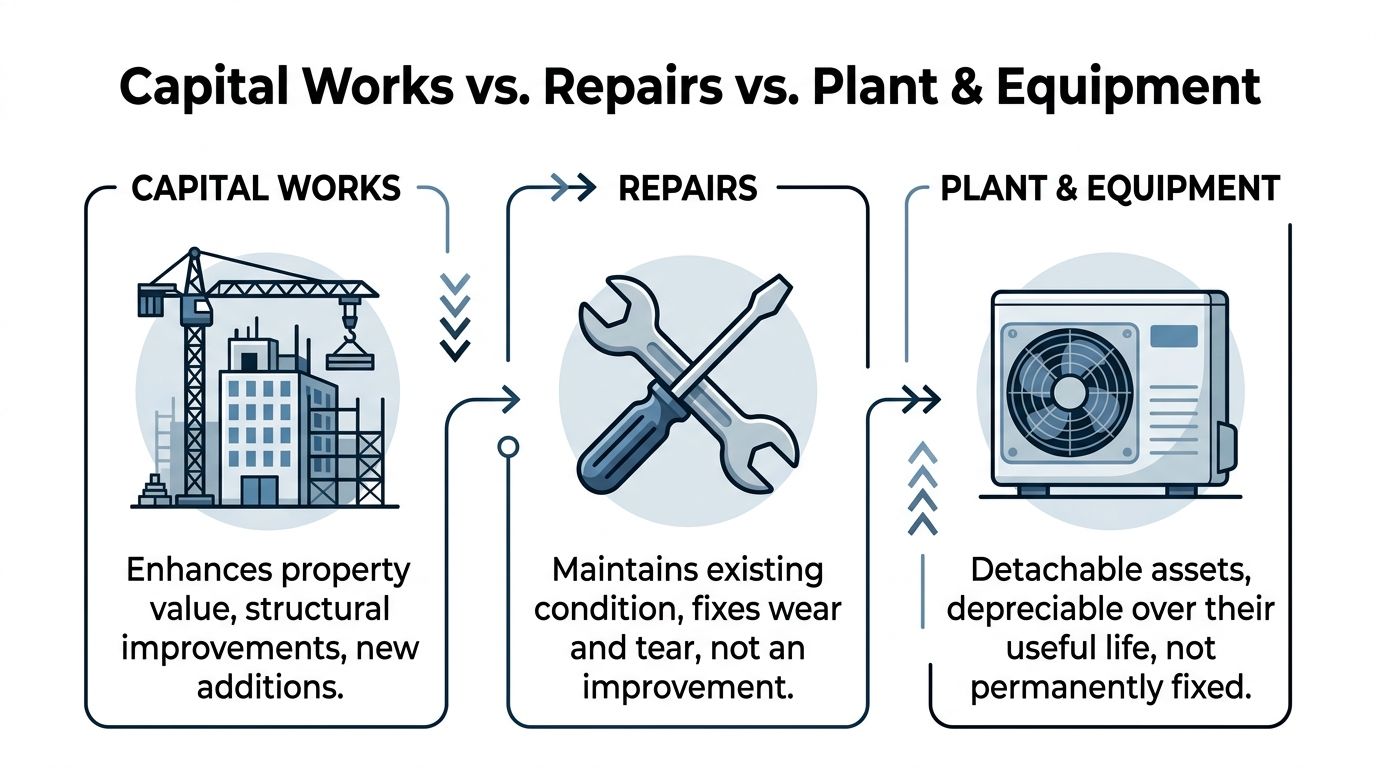
You’ve got repairs and maintenance, capital works under Division 43, and plant and equipment under Division 40. Three buckets. Different tax outcomes.
The simple distinction
A repair fixes damage or wear and tear and restores something to its previous condition.
Capital works improve or replace structural parts in a substantial way.
Plant and equipment covers separate assets that aren’t the building itself. Think of appliances, air conditioners, carpets, and similar depreciating assets.
Tax treatment comparison
| Attribute | Repairs & Maintenance | Capital Works (Division 43) | Plant & Equipment (Division 40) |
|---|---|---|---|
| Core purpose | Restores existing condition | Creates or improves structural asset | Covers separate depreciating assets |
| Typical examples | Patching a wall, fixing a leak, repainting worn surfaces | Extensions, structural renovations, built-in improvements | Oven, dishwasher, carpet, air conditioner |
| Relationship to building | Usually existing item being fixed | Part of the building or structure | Usually identifiable asset within or attached to property |
| Deduction pattern | Often claimed in the year paid if eligible | Claimed over time under Division 43 | Claimed over effective life |
| Risk area | Calling an improvement a repair | Rolling in non-structural items | Forgetting item-by-item asset treatment |
Where people get it wrong
A tradie replaces a few broken roof sheets after storm damage. That may point to a repair.
The same tradie strips the entire roof, changes materials, upgrades the structure, and materially improves the building. That’s a very different tax character.
An investor swaps out a dead dishwasher. That’s not capital works. It’s typically plant and equipment. But if they rebuild the kitchen layout, move plumbing, alter cabinetry and walls, and create a new fixed structure, now capital works enters the chat.
Key takeaway: The bigger and more structural the job gets, the less likely it is to be a simple repair.
A practical issue for small business owners and tradies is where the line sits when a repair starts becoming capital works. The useful test from broader industry guidance is whether the work goes beyond restoring the original state and instead improves the asset, which affects both tax treatment and balance sheet classification, as noted in this capital works guide for project classification.
Quick examples that usually help
Bathroom
- Replacing a cracked tile or fixing a leak: repair
- Complete bathroom rebuild with new waterproofing and layout changes: capital works
Kitchen
- Repairing a cabinet hinge: repair
- New fixed cabinetry and structural rework: capital works
- New standalone or identifiable appliances: plant and equipment
Workshop
- Fixing damaged cladding: repair
- Adding a new slab and frame: capital works
- Installing a separate compressor unit: plant and equipment
That classification work is where tax planning starts. Not after the tax return is drafted. Before.
Calculating Your Capital Works Deduction Under Division 43

Get this part wrong and you either miss money you’re entitled to claim, or you hand the ATO a neat little problem to question later.
Division 43 is about claiming eligible construction costs over time. For Ashfield investors fixing up an older unit, or Belrose tradies adding a workshop, that usually means the building itself and fixed structural improvements. It does not mean you can throw the full reno bill into this year’s tax return and hope for the best. If you need a sharper breakdown before lodging, this capital works deduction guidance is worth reading.
The basic Division 43 rule
Eligible capital works are commonly claimed at 2.5% per year for 40 years.
So if your qualifying structural spend is $500,000, you generally claim $12,500 per year, not the full amount upfront. That’s the bit plenty of owners hate, especially after a big cash outlay. Still, a steady deduction is better than a bungled claim that gets knocked back.
A plain-English example
Say you renovate an investment property in Ashfield and the job includes structural work:
- new internal walls
- built-in cabinetry as part of a full kitchen refit
- bathroom waterproofing and fixed structural work
- replacement of permanent building components as part of the renovation
If those costs qualify as capital works, they are written off gradually under Division 43.
That has a real cash flow impact. You spend the money now. The tax benefit comes through over the years. That’s normal. The smart move is to budget for that upfront instead of expecting a one-year tax windfall.
Don’t guess the construction cost
Plenty of DIY claims go off the rails at this point. The owner has one builder invoice and a vague memory of what was included. That’s no good if the bill mixes structural work, appliances, private-use areas, and later variations.
You need a clean split between:
- capital works
- plant and equipment
- repairs
- private or non-deductible costs
For larger jobs, get proper costings and reports. Don’t rely on a spreadsheet knocked together on a Sunday arvo. Contracts, progress claims, variation documents, final invoices, and depreciation reports carry weight. Memory doesn’t.
If you want background before engaging a specialist, this article on understanding quantity surveyors gives a solid overview.
Good capital works claims are built on records, not guesswork.
What to check before claiming
The property is producing income
Division 43 usually matters when the property or structure is being used to earn assessable income.The work is structural
Builder invoices often bundle multiple tax treatments into one bill. Split them properly.Your evidence is complete
Keep contracts, builder breakdowns, progress payments, variations, and final invoices.The timing stacks up
The claim starts from when the area is ready for income-producing use, not when you first start spending.
If the numbers are material, get advice before the return is lodged. That’s the difference between a clean claim and a mess you have to fix later.
Real-World Scenarios for Investors and Tradies
Theory is nice. Real jobs are better.
Here’s how this plays out for the kind of clients I see around Ashfield, the Inner West, and up toward Belrose.

The Ashfield apartment makeover
An investor buys an older unit and wants better rent. They replace the kitchen, refresh the bathroom, repaint the walls, and install new appliances.
The tax treatment isn’t one-size-fits-all.
- New kitchen cabinetry and fixed structural changes often point toward capital works.
- Dishwasher and oven usually sit in plant and equipment.
- Repainting existing walls may be a repair, depending on the context and whether it’s restoring wear and tear rather than part of a broader capital improvement.
An investor can’t just throw the whole invoice total into one deduction label. The kitchen builder’s invoice may need to be split. The electrician’s invoice may include both structural and asset-related components. The painter’s bill may sit in a different category again.
That’s where people either save themselves grief or create it.
The Belrose tradie’s new workshop
For example, a self-employed builder may add a new workshop at home to support the business. In many cases, the project involves site preparation, slab work, framing, roofing, and fixed fit-outs.
The slab, frame, roofing, and permanent structure are the most obvious capital works components. After all, they create a long-term structural asset rather than a short-term expense. As a result, if the workshop is used for business purposes, those costs may fall under the capital works deduction framework instead of qualifying for an immediate write-off.
However, the analysis doesn’t stop there. There are also additional assets and installations to consider. For instance, a removable tool cabinet is not part of the building itself. Likewise, a standalone compressor is separate from the slab or permanent structure. Meanwhile, lighting can become more complex because it may involve both structural and plant-and-equipment elements, depending on how the fixtures are installed and whether they are permanently attached.
If your job has concrete, framing, roofing, or structural alterations, assume classification matters and get advice before you lodge.
A retaining wall example that people forget
Retaining walls are one of those jobs that owners often underestimate. They see it as “yard work” or “landscaping” and move on. Sometimes it’s much more than that. If the wall is a permanent structural improvement tied to the property, it may need to be looked at through the capital works lens.
If you’re budgeting a project like that, cost planning helps. A practical starting point is this guide to concrete sleeper costs in Australia, which is useful when scoping the job before talking about tax treatment.
The lesson across all three examples is the same. Don’t classify by gut feel. Classify by the nature of the work.
Master Your Record Keeping for ATO Compliance
If you can’t prove it, don’t expect to claim it.
That’s especially true with capital works, because the deduction can run for years, and the ATO can ask what the expenditure is related to. “I think it was part of the reno,” won’t cut it.
What your file should include
For any decent-sized project, keep a proper paper trail from day one:
- Signed contracts that describe the actual works
- Itemised invoices from builders, electricians, plumbers, and suppliers
- Variation documents showing changes to the scope and price
- Proof of payment, so there’s no argument about what was paid and when
- Before-and-after photos to support the character of the work
- Plans, drawings, and approvals were relevant
A strong file does two jobs. It supports the claim amount, and it supports the classification.
Why scope documents matter
A detailed Scope of Work is one of the most underrated tax records in a building project. A properly written scope that links costs to facility enhancement rather than maintenance creates a clear evidentiary trail for the ATO, as explained in this guidance on Scope of Work documentation for compliance.
That matters because broad invoices like “renovation works completed” are weak evidence. They don’t tell anyone which part was structural, which part restored existing damage, and which part related to assets.
My checklist for clients
- Start a dedicated job folder before work begins
- Ask for itemised invoices instead of lump-sum descriptions
- Separate structural costs from asset purchases as bills arrive
- Store digital copies immediately because thermal paper receipts fade
- Keep records for the full claim period and beyond if needed for review
- Review the file before lodging so you don’t discover gaps too late
If you want a baseline on documentation standards, this guide on record-keeping requirements in Australia is a practical reference.
A messy file turns a decent claim into an argument. A clean file turns it into compliance.
Maximise Claims With Your Local Ashfield Accountant
Capital works isn’t just tax jargon. In reality, it affects how quickly you claim deductions, how strong your records are, and how exposed you are if the ATO asks questions later.
For investors, this directly shapes property cash flow and long-term tax planning. Meanwhile, for tradies, it affects how workshops, fit-outs, and premises upgrades are treated for tax purposes. In addition, if you run a small business, capital works also influence financial reporting and, for incorporated entities, broader compliance obligations.
My advice is simple: don’t wait until tax time to work out what the project was. Instead, classify the work while it’s happening. At the same time, keep invoices clear and properly documented. Furthermore, obtain professional reports when the project is substantial. If there’s any uncertainty around repairs versus capital works versus plant and equipment, it’s far better to resolve it early rather than deal with complications later.
For clients who need hands-on support with tax advisory, ASIC compliance, business structures, and project-related tax records, EndureGo Tax provides tailored services for individuals and businesses in Ashfield and Belrose, Northern Beaches.
Ultimately, good tax outcomes usually start before the build finishes — and in many cases, even before it begins.
If you want clear advice on what is capital works, Division 43 deductions, repair versus improvement issues, or record keeping for your rental property or business project, book a consultation with EndureGo Tax. We help Ashfield, Inner West Sydney, Belrose, and Northern Beaches clients get the tax treatment right before small mistakes become expensive ones.
