


When you hear the term “Capital Gains Tax,” or CGT, it might sound like another complicated tax you need to worry about. But in reality, it’s not a separate tax at all. As a core principle of Australian tax law, it’s simply the tax you pay on the profit you make from selling an asset, and it gets bundled into your regular income tax for that year. Understanding what is capital gains tax is fundamental for any investor.
Unpacking Capital Gains Tax in Australia

Whenever you sell an asset and walk away with more money than you spent on it, the Australian Taxation Office (ATO) calls that profit a ‘capital gain’. This gain is then added to your assessable income, which means you’ll need to declare it on your annual tax return. Mastering this concept is the first step for any investor, whether you’re managing properties in Ashfield or trading shares.
Let’s put it into a practical example. Imagine you bought an investment property for $600,000. After a few years of solid market growth, you sell it for $850,000. The profit you made is $250,000, and this is your capital gain. It’s this $250,000 amount that the tax is calculated on, not the entire $850,000 sale price.
What Is a CGT Event?
The entire process kicks off with what’s known as a CGT event. This is the specific moment that triggers a capital gain or loss. While the most common event is simply selling an asset, it can also cover a few other scenarios, such as:
- Gifting an asset to someone else.
- Losing an asset or having it destroyed (for instance, in an insurance claim).
- Receiving a distribution or payout from a company or trust.
A really important date to remember here is 20 September 1985. This is when CGT was introduced in Australia. Why does it matter? Because any asset you owned before this date is generally exempt from CGT. It’s a grandfathering rule that can make a huge difference.
Who Needs to Pay Capital Gains Tax?
From individual investors and small business owners to trusts and Self-Managed Super Funds (SMSFs), anyone who sells a CGT asset needs to think about their tax obligations. While there are some major exemptions—like your main residence in most situations—many common investments like shares and rental properties are squarely in the CGT net.
If you want to get familiar with the specific language used in property and finance, a good financial glossary can be a handy resource.
Key Takeaway: Capital Gains Tax isn’t a separate bill you receive in the mail. Instead, your total net capital gain for the year is added to your income and taxed at your personal marginal tax rate.
To simplify these core ideas even further, here’s a quick table breaking down the essentials.
Capital Gains Tax at a Glance
This table offers a quick summary of the fundamental components of Capital Gains Tax in Australia.
| Concept | Simple Explanation |
|---|---|
| Capital Asset | Pretty much any property or valuable item you own, from real estate and shares to business equipment. |
| Capital Gain | The profit you pocket when you sell or otherwise dispose of a capital asset. |
| Capital Loss | The shortfall you have if you happen to sell an asset for less than what it cost you. |
| CGT Event | The specific transaction that triggers a capital gain or loss, which is usually the sale of the asset. |
| Cost Base | The total amount your asset cost you. This includes the purchase price plus other costs like stamp duty and legal fees. |
Getting these basics down is the first real step toward smart tax planning and making informed investment decisions.
How to Correctly Calculate Your Capital Gains Tax
Alright, so you understand the basic idea of what capital gains tax is. That’s the first hurdle. Now for the really important part: figuring out exactly how much you owe. It might sound daunting, but the Australian Taxation Office (ATO) has a clear process. At its heart, the calculation is surprisingly simple—you just subtract what the asset cost you from what you got for it.
The whole thing hinges on two key numbers: the cost base and the capital proceeds. Getting these figures spot-on is crucial. It’s the difference between paying what you owe and accidentally giving the tax office more than you need to.
This infographic lays out the simple, three-step flow of a capital gains tax calculation.
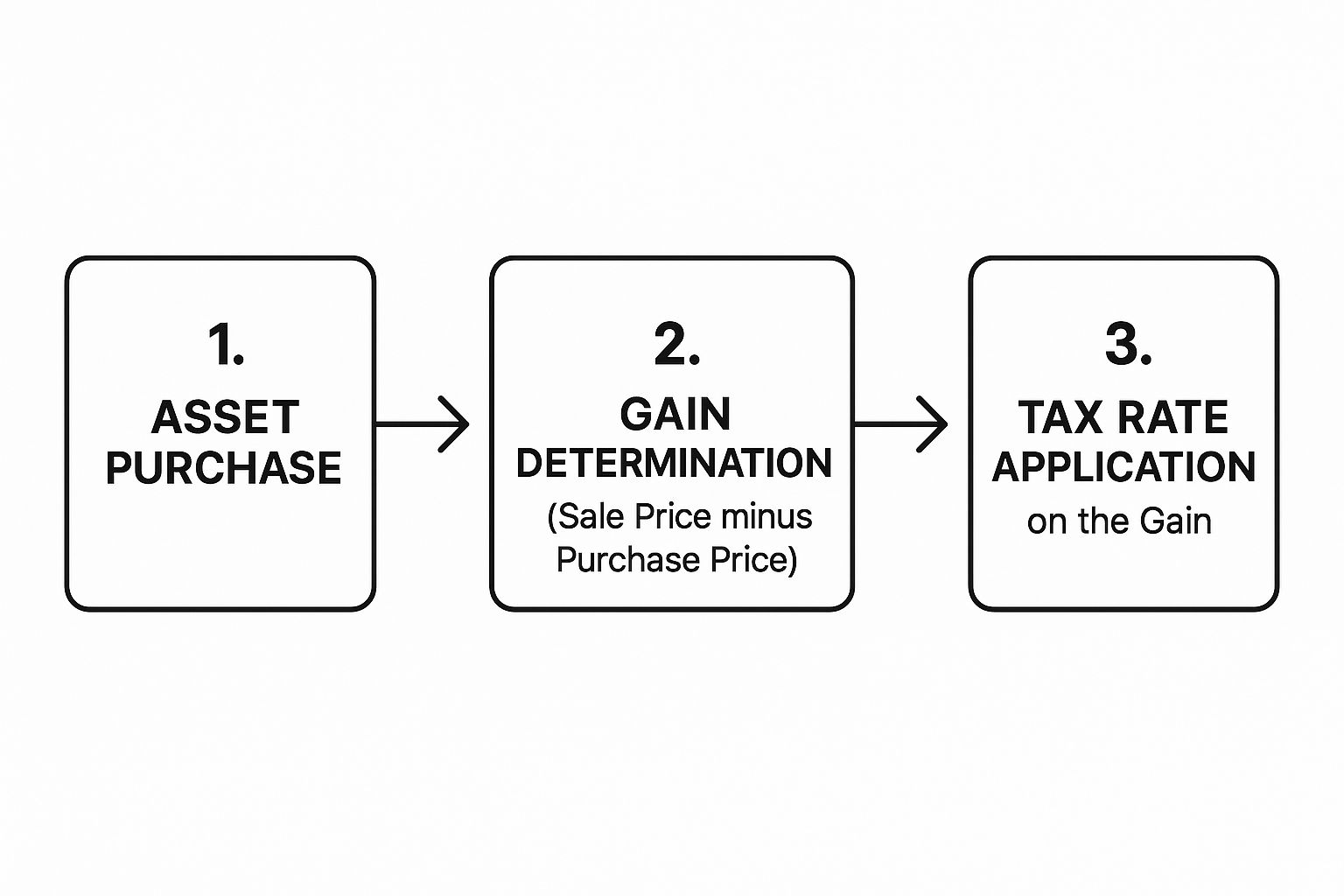
As you can see, it’s a logical path. You start with what you paid, work out your profit, and that profit becomes the figure you’re taxed on.
Defining Your Cost Base and Capital Proceeds
Think of the cost base as more than just the sticker price. It’s the total sum of everything you spent to buy, hold, and eventually sell your asset. It’s the full financial story of your investment.
These costs generally include things like:
- The original purchase price you paid.
- Incidental costs from the buying and selling process, like stamp duty, legal fees, or real estate agent commissions.
- Ownership costs such as council rates and land tax (this one has a catch: it only applies to property bought after 20 August 1991 that wasn’t used to earn income, like a private holiday home).
- Capital improvement costs that genuinely increased the asset’s value, such as a major renovation on a house.
On the other side of the ledger, you have your capital proceeds. This is simply the money or property you received when the CGT event happened. Most of the time, it’s the sale price, but if you gifted an asset, the ATO will look at its market value instead.
Your initial capital gain is just the capital proceeds minus the cost base. If you get a positive number, that’s your gain. A negative number means you’ve made a capital loss.
Choosing Your Calculation Method
Once you’ve confirmed you have a capital gain, you need to figure out the best way to calculate the final taxable amount. The method you’re allowed to use depends on how long you held the asset and when you first acquired it.
Expert Insight: Choosing between the discount and indexation methods isn’t just a matter of process; it’s a strategic decision. Your goal is to pick the one that gives you the lowest possible taxable gain, which directly shrinks your final tax bill.
For assets bought between 20 September 1985 and 20 September 1999, you have a valuable choice. You can either use the discount method (which cuts the gain in half) or the indexation method (which adjusts the cost base for inflation up to 1999). This flexibility allows you to run the numbers both ways and see which one leaves more money in your pocket. You can read up on the history behind these provisions on platforms like Wikipedia.
For most people today, these are the two main methods to know:
The Discount Method: This is the one you’ll use most often. If you’ve owned the asset for more than 12 months, you can slash your capital gain by 50%. That means only half of your total gain gets added to your assessable income for the year.
The Indexation Method: This is an older method that only applies to assets bought before 21 September 1999 and held for over a year. It lets you increase the cost base to factor in inflation, but only up to that 1999 cut-off. It’s usually not as good as the discount, but it’s always worth checking if your asset is old enough to qualify.
Practical Calculation Example
Let’s put this into practice with a practical example. Imagine an investor from Ashfield who recently sold some shares.
- Purchase Date: March 2015
- Purchase Price (Cost Base): $20,000 (this includes brokerage fees)
- Sale Date: April 2024
- Sale Price (Capital Proceeds): $50,000
- Holding Period: Over 9 years
Step 1: Calculate the Gross Capital Gain
$50,000 (Capital Proceeds) – $20,000 (Cost Base) = $30,000 Gross Capital Gain
Step 2: Apply the Discount Method
Because the shares were held for well over 12 months, our investor gets to use the discount method.
$30,000 (Gross Gain) x 50% = $15,000
So, in this case, the investor’s final taxable capital gain is $15,000. This is the figure that gets added to their other income for that financial year.
This example really highlights how powerful that 50% discount can be. Getting these calculations right is fundamental to managing your tax obligations. If you’re juggling multiple assets or have a more complex situation, working with a professional accountant in Ashfield can ensure you stay compliant while making the most of every available concession.
Essential CGT Exemptions and Concessions
Getting your head around what capital gains tax is one thing, but the real power comes from knowing when you don’t have to pay it. This is where smart financial planning truly shines. The good news is the Australian tax system has some powerful, built-in exemptions and concessions to help you reduce or even wipe out your CGT liability altogether.
These aren’t secret loopholes; they’re established rules designed to give everyday investors, homeowners, and small business owners a fair go. By understanding how they work, you can make far better decisions with your assets and legally keep more of your hard-earned money.
Your Main Residence Exemption
For most Aussies, this is the big one. The main residence exemption is the most common and valuable CGT break available. Put simply, when you sell the home you actually live in, any profit you make is generally tax-free. It’s a cornerstone of property ownership in Australia.
Of course, there are a few rules to follow. To get the full exemption, the property must have been your family home for the entire period you’ve owned it. You can’t have used it to generate income, like renting out the whole house while you lived elsewhere.
The ATO also has a handy provision called the ‘six-year rule’. This lets you move out of your home—say, for a work transfer or an extended trip—and still treat it as your main residence for up to six years. As long as you don’t claim another property as your main residence during that time, you can even rent it out without immediately exposing yourself to a future CGT bill. It’s an incredibly practical rule for modern, mobile lifestyles.
To give you a clearer picture, let’s look at how this plays out in a few common scenarios.
Main Residence Exemption Scenarios
Understanding how the Main Residence Exemption applies in different common situations.
| Scenario | Is the Gain Taxable? | Key Consideration |
|---|---|---|
| Standard Sale | No | You lived in the home for the entire ownership period and didn’t use it to earn income. |
| Using the Six-Year Rule | No (for the first 6 years) | You moved out, rented the property for 4 years, and didn’t nominate another main residence. |
| Home Office Use | Partially | You used a distinct part of your home exclusively for business, so that portion of the gain is taxable. |
| Sold After 10 Years (Lived in for 5) | Partially | The gain is pro-rated. Only the 5 years it was your main residence are exempt. |
As you can see, your specific circumstances really matter. The exemption is generous, but it’s not a blanket rule for every situation.
Small Business CGT Concessions
For business owners in suburbs like Ashfield, selling your business is often the culmination of a lifetime’s work. The small business CGT concessions are specifically designed to make this transition more rewarding by offering significant tax relief. There are four different concessions that can help you reduce, delay, or even completely forget about the capital gain on your business assets.
To get access to these, you first need to pass a couple of key tests. You either need to be a small business entity (with an aggregated turnover of less than $2 million) or meet the maximum net asset value test (meaning your net assets are $6 million or less).
If you qualify, these are the four powerful concessions at your disposal:
- 15-Year Exemption: This is the gold standard. If you’re over 55, retiring, and have owned the asset for at least 15 years, you can potentially ignore the entire capital gain. Zero tax.
- 50% Active Asset Reduction: You can slash the capital gain on a business (or ‘active’) asset by 50%. This is on top of the general 50% CGT discount you get for holding an asset for more than a year.
- Retirement Exemption: This lets you disregard capital gains up to a lifetime limit, which is currently $500,000. If you’re under 55, the exempt amount has to be rolled into your super fund. Our guide on understanding eligible termination payments offers more context on financial moves like this.
- Rollover Concession: This lets you put off paying tax on a capital gain. You simply “roll over” the gain into a replacement business asset, and you won’t face the tax bill until you eventually sell that new asset.
Case Study: A Ashfield Cafe Owner
A cafe owner in Ashfield, aged 60, decides to sell her business after owning and running it for 16 years. The sale creates a capital gain of $400,000. Because she meets the 15-year ownership rule and is retiring, she qualifies for the 15-year exemption. The result? The entire $400,000 capital gain is disregarded, and she pays absolutely no capital gains tax on the sale.
Exemptions for Personal-Use Assets
Finally, the tax office recognises that not everything you own is a high-flying investment. Personal-use assets are simply the things you own and enjoy for yourself, not to make a profit. Think about your car, a boat, or the furniture in your home.
If you sell a personal-use asset, you generally only have to worry about CGT if you bought it for more than $10,000. While a gain is taxable, a capital loss on these items is disregarded. You can’t use the loss you made selling your old car to reduce the gain you made on some shares.
Collectibles, like artwork, antiques, or valuable jewellery, have their own special rules. A capital gain on a collectible is only taxed if you originally paid more than $500 for it. And just like personal-use assets, you can only use a loss from one collectible to offset a gain from another collectible.
These commonsense rules ensure that everyday life doesn’t get bogged down in tax paperwork, freeing you up to focus on the assets that really matter.
Using Capital Losses for Strategic Tax Planning
Let’s face it, not every investment is a home run. That’s just the reality of building wealth. But when you sell an asset for less than what you paid, it’s not just a financial sting—it can actually be a useful tool. The Australian Taxation Office (ATO) calls this a capital loss, and knowing how to use it is a key part of smart tax management.
A capital loss is straightforward: it happens when the money you get from selling an asset is less than its original cost base. The golden rule here is that you can only use capital losses to offset capital gains. You can’t, for instance, use a loss from shares to reduce the tax you pay on your salary or business income. This is a critical distinction that shapes all your tax planning.
Carrying Forward Your Capital Losses
So what happens if you have a capital loss but no capital gains to offset it against in the same financial year? Good news. The ATO lets you carry that loss forward indefinitely. It basically sits in your account, waiting for a future year when you do have a capital gain to report.
This gives you fantastic long-term flexibility. A loss you take on one investment can be used to wipe out a gain from a completely different one, potentially years down the track.
Practical Example: Strategic Loss Utilisation
Let’s say an investor in Ashfield bought some shares for $30,000 back in 2021. The market takes a dip in 2024, and they decide to sell the whole lot for $20,000, crystallising a $10,000 capital loss. They didn’t sell anything else for a profit that year, so that $10,000 loss is carried forward.Fast forward to 2027. They sell an investment property and make a nice capital gain of $50,000. Now, they can finally use that banked loss to reduce the gain.
$50,000 (Capital Gain) – $10,000 (Carried-Forward Loss) = $40,000 (Net Capital Gain)
They would then apply any other discounts they’re entitled to (like the 50% CGT discount) to this new, lower figure. The loss from their share portfolio directly minimised the tax they had to pay on their property sale three years later.
Staying Compliant with ATO Rules
While using losses is a perfectly legitimate strategy, the ATO is always on the lookout for people trying to game the system. Their main weapon here is the ‘wash sale’ provision. A wash sale is when you sell an asset to lock in a loss for tax purposes, only to buy back the same or a very similar asset almost immediately. If the ATO believes your main reason was just to get a tax benefit without really changing your investment position, they can cancel the loss entirely.
Good tax planning is about long-term strategy, not short-term tricks. We saw how this works on a massive scale during the Global Financial Crisis. The amount of unused capital losses in Australia shot up from 8.8% to 20.8% of GDP between the 2007-08 and 2008-09 financial years. This shows how the ability to carry losses forward acts as a buffer, encouraging people to hold onto winning assets during a downturn. You can dive deeper into this with a report from the Parliamentary Budget Office.
Actionable Call to Action
Knowing the rules around capital losses is one thing, but applying them correctly to your specific situation is where the real value lies. With some proactive planning, you can make sure you’re not missing out on legal ways to minimise your tax bill. If you want expert guidance on structuring your investments and keeping everything above board, you might be interested in how to reduce your audit risk and maximize your tax refund. Chatting with a tax professional in Ashfield can give you the confidence that your strategy is both effective and fully compliant with ATO guidelines.
How Your Income and CGT Are Connected
One of the biggest misunderstandings I see when explaining “what is capital gains tax” is the rate itself. People often search for a single, flat percentage, but here’s the thing: in Australia, there is no standalone CGT rate.
Instead, your net capital gain for the financial year gets added right on top of your other assessable income. This means your profit is taxed at your marginal income tax rate—the very same rate that applies to the last dollar you earn from your job or business. Understanding this direct link is the key to getting a handle on your total tax bill.
How CGT Merges with Your Income
A simple way to think about it is to picture your annual income as a bucket. Throughout the year, you fill it up with your salary, business profits, and any other money you earn. When you sell an asset and make a profit, that final net capital gain is poured into the very same bucket.
The total amount in that bucket at the end of the financial year determines which tax brackets your income falls into. A large capital gain can easily bump you into a higher tax bracket, which means you’ll pay a higher rate not just on the gain, but on every dollar that tips into that new, higher bracket.
Expert Insight: The fact that CGT is tied to your income means the timing of a sale can be just as important as the profit you make. Selling a major asset in a year when your other income is lower can result in a significantly smaller tax bill.
A Practical Example of Income and CGT
Let’s walk through a real-world scenario for a tradie living in the Inner West.
- Annual Salary: $95,000
- Net Capital Gain: After applying the 50% discount, they have a taxable gain of $30,000 from selling an old investment property.
Here’s how it plays out:
- Assessable Income: We simply add the two together. $95,000 (Salary) + $30,000 (Net Capital Gain) = $125,000.
- Tax Liability: The entire $125,000 is then taxed according to the standard income tax brackets. That $30,000 gain is effectively taxed at the marginal rates that apply between the $95,000 and $125,000 income levels.
This shows exactly why planning ahead is so crucial. If our tradie knew a big bonus was coming, they might have held off on selling the asset to avoid paying an even higher tax rate. If you’re looking for ways to structure these decisions, our guide on a proven effective tax strategy that can save on capital gains tax offers some powerful insights.
CGT Revenue and the Bigger Economic Picture
Zooming out to the national level, the amount of tax collected from CGT is a surprisingly good barometer of the country’s economic health. Since gains come from rising asset prices, CGT collections naturally soar during economic booms and plummet during downturns.
This makes CGT revenue incredibly volatile. In Australia, it usually accounts for about 3% of total tax receipts, but this figure swings wildly depending on how the markets are performing. In fact, this volatility is a huge headache for government budget forecasters, causing over 20% of total forecasting errors in recent years.
The revenue is heavily dictated by asset prices, particularly property and shares. To give you an idea, in the 2010–11 financial year, shares alone were responsible for around 60% of all taxable capital gains. You can dig into this data further in a detailed report from the Australian Parliamentary Budget Office.
For business owners and investors in areas like Ashfield, seeing this connection between your personal tax situation and broader economic cycles just reinforces the need for solid advice to navigate both your own tax obligations and market movements.
Your Guide to Reporting and Paying CGT
So, you’ve wrapped your head around the ins and outs of capital gains tax. The final piece of the puzzle is turning that knowledge into action. Reporting your gains and losses correctly on your annual tax return isn’t just a suggestion—it’s essential. But with a bit of preparation, you can handle it without the stress and make sure you’re square with the Australian Taxation Office (ATO).
When you sit down to do your tax, you’ll need to declare every single CGT event that happened during the financial year. This involves working out your total capital gains and losses and filling out the Capital gains or losses section of your return, along with any other schedules the ATO requires.
Meticulous Record-Keeping Is Your Best Defence
If there’s one habit every investor or business owner needs to master, it’s meticulous record-keeping. Honestly, it’s non-negotiable. Without solid records, calculating your cost base and capital proceeds accurately is nearly impossible. You could end up paying more tax than you need to, or worse, find yourself unable to back up your claims if the ATO comes knocking.
Getting organised from day one is the best thing you can do to avoid future headaches. Think of it as your best defence. When you have all the proof you need right there at your fingertips, calculating your CGT or answering any ATO queries becomes a straightforward task.
Here’s a simple checklist of documents you absolutely must keep for at least five years after the CGT event:
- Contracts of Sale and Purchase: These are the official documents locking in the dates and values of your transactions.
- Receipts for Incidental Costs: Don’t forget proof of payment for things like stamp duty, legal fees, agent commissions, and advertising.
- Records of Capital Improvements: Hold onto every receipt and invoice for renovations or major upgrades that add to the asset’s cost base.
- Valuation Reports: These are crucial if you inherited an asset, gifted one, or first started using your home to earn an income.
The way Australia’s CGT system tracks asset sales actually makes it a pretty good barometer of the country’s economic health. Taxable capital gains tend to rise and fall with economic cycles. For instance, they peaked just before the 2007-08 Global Financial Crisis, right before gains from assets like shares took a nosedive. This cyclical pattern really highlights how tied CGT is to broader economic conditions. For a deeper dive, check out this report from the Australian Treasury.
Take Action: Get Expert CGT Advice
While this guide gives you a solid handle on what is capital gains tax, some situations just need a professional eye. If you’re dealing with multiple assets, navigating the small business concessions, or figuring out the main residence exemption, a small mistake can have big financial consequences.
Don’t leave it to chance. Talking to a qualified tax expert in Ashfield ensures you’re not only compliant but also making the smartest financial moves. An expert can go through your records, double-check your calculations, and often spot planning opportunities you might have overlooked.
Ready to get clarity and confidence on your CGT obligations? Book a consultation today and let our experts handle the complexities, so you can focus on what matters most.
Your Capital Gains Tax Questions Answered
When it comes to capital gains tax, the theory is one thing, but applying it to real-life situations is another. It’s natural to have questions. Here, we tackle some of the most common queries we hear from our clients across Ashfield, giving you straightforward answers to help you navigate your investments.
What Happens if I Inherit a Property?
Good news first: simply inheriting a property doesn’t trigger a CGT bill. The tax side of things only kicks in when you decide to sell that inherited asset.
How you calculate your gain or loss, however, depends on when the person who left you the property originally bought it. If they acquired it before the CGT rules began on 20 September 1985, your starting point (or ‘cost base’) is the property’s market value on the day they passed away. If they bought it on or after that date, you simply step into their shoes and inherit their original cost base.
Do I Pay CGT on Gifts?
It might seem counterintuitive, but yes, giving an asset away is treated as a disposal for tax purposes. Even though you haven’t received a single dollar, the Australian Taxation Office (ATO) works on the basis that you’ve effectively received the asset’s full market value at the time you gave it away.
Let’s say you gift shares worth $25,000 to your child. For tax purposes, it’s as if you sold them for $25,000. You then have to calculate your capital gain or loss against that figure.
Key Insight: This concept is known as a ‘deemed disposal’. The ATO’s market value rule is in place to ensure tax obligations aren’t sidestepped by simply gifting valuable assets instead of selling them outright.
How Does CGT Apply to My Investment Property?
Your investment property is a textbook example of a CGT asset. When you sell it, any profit you make is a capital gain. The key to minimising that gain is having a meticulously calculated cost base. This isn’t just the purchase price; it includes all those extra expenses like stamp duty, legal fees, and the cost of any significant renovations you’ve done over the years.
Did you live in the property before you started renting it out? If so, you might be able to claim a partial main residence exemption. This effectively splits the gain, so you only pay tax on the portion of time it was used to produce income.
Can I Offset a Property Loss Against a Share Gain?
You certainly can. This is one of the most useful features of the CGT system. You’re allowed to balance out capital gains and losses from completely different types of assets within the same financial year.
For example, imagine you made a $50,000 gain from selling shares but also took a $20,000 loss on an investment property. You can use that loss to wipe out part of your gain, bringing your net capital gain down to $30,000 before you even think about applying any CGT discounts.
Understanding the nuances of what capital gains tax is can save you thousands, but applying the rules to complex situations requires an expert eye. Don’t risk paying more than you need to. The team at EndureGo Tax are your trusted local accountants in Ashfield, ready to provide clarity and peace of mind for your tax obligations. Book a consultation today to ensure your strategy is both compliant and optimised for your financial future.
