


Let’s get straight to it. A sole trader is the simplest, most common business structure in Australia. It’s you, running your own show, where you and your business are legally one and the same. It’s an expert-recommended structure for individuals starting out.
Think of it like being a freelancer, a contractor, or a small business owner—just with an official Australian Business Number (ABN) to your name.
So, What Exactly Is a Sole Trader?

In practical terms, being a sole trader means there’s no legal separation between you and your business. You are personally responsible for everything, from the awesome work you do to the debts you might rack up along the way.
This direct link is what makes it the go-to starting point for countless tradies, consultants, and creative freelancers across Australia, from Ashfield to the Northern Beaches. It’s simple and incredibly easy to get off the ground.
To give you a quick snapshot, here are the key features rolled into one place.
Sole Trader at a Glance Key Features
| Feature | Description |
|---|---|
| Legal Structure | You and the business are a single legal entity. |
| Liability | Unlimited personal liability for all business debts. |
| Tax Treatment | You pay tax at your individual marginal tax rate. |
| Setup Cost & Complexity | The cheapest and simplest structure to set up and run. |
| ABN Requirement | An ABN is required to operate. |
| GST Registration | Required if your annual turnover is $75,000 or more. |
This table neatly sums it up, but the most critical detail to wrap your head around is liability. Let’s dive into that.
The Most Important Part: Your Legal and Financial Identity
The one concept you absolutely must understand is unlimited liability. Because you and the business are legally the same, your personal assets—your car, your savings, even your family home—could be on the line if the business runs into financial strife.
All the profits your business makes are treated as your personal income. This has massive implications for how you handle your taxes and manage your money day-to-day.
The Australian Taxation Office (ATO) puts it plainly: a sole trader is an individual running a business. It’s the simplest and cheapest business structure, where you are the only owner in complete control. You can get the full rundown straight from the ATO’s guide on running your business as a sole trader.
The popularity of this model is undeniable. As of 30 June 2023, there were a whopping 822,873 sole traders actively doing business across the country. That’s a solid 2.4% jump from the previous year, proving it’s still the favourite choice for new entrepreneurs. You can dig into more stats in the latest release from the Australian Bureau of Statistics.
How to Get Started as a Sole Trader
To operate legally, you first need an Australian Business Number (ABN). This unique 11-digit number is your business’s official ID. You’ll need it for just about everything:
- Sending proper invoices and getting paid.
- Making sure other businesses don’t withhold tax from your payments (PAYG withholding).
- Claiming back GST credits if you’re registered for it.
- Registering a business name if you don’t want to trade under your own.
Kicking things off as a sole trader is a fantastic way to test a business idea without getting tangled in paperwork. But getting a handle on your obligations around tax, liability, and record-keeping is non-negotiable from day one.
Feeling ready but a bit lost on the next steps? Contact EndureGo Tax today for a no-obligation chat. We’ll help you set up your ABN and make sure you’re compliant right from the start.
Weighing Up the Pros and Cons of Being a Sole Trader
Choosing a business structure isn’t just a bit of paperwork; it’s a decision that genuinely shapes your financial life. The sole trader path is incredibly popular for a reason—it offers a level of simplicity and control you just don’t get elsewhere. But like any major business decision, it comes with some serious trade-offs.
It’s absolutely crucial to look at both sides of the coin before you jump in.
The main attraction is how straightforward it all is. You have total control, the administrative headache is minimal, and the setup costs are practically zero. Your business income is simply treated as your personal income, which makes your first few tax returns feel a lot less intimidating.
The Upside: Simplicity and Full Control
For anyone just starting out, the benefits are clear and immediate. You can get your idea off the ground fast, without the maze of complex paperwork that comes with setting up a company.
- You’re the Boss, Period: Every decision is yours. From what you sell to when you work, you answer to no one. There’s no board to consult or business partner to convince.
- Low Setup and Running Costs: There are no registration fees to become a sole trader. On top of that, the ongoing compliance is far simpler and cheaper than what’s required for a company.
- Simpler Tax and Books: All your profits are taxed at your personal income rate, which keeps things relatively simple. You can get a better handle on this by reading our guide on sole trader tax deductions.
The Big Downside: Unlimited Liability
Here’s the catch, and it’s a big one: unlimited liability. This isn’t just boring legal jargon; it’s a risk you need to take seriously.
Because you and your business are legally seen as one and the same, if your business runs into debt or gets sued, your personal assets are fair game.
Let’s make that real: Imagine you’re a landscaper in Belrose who takes out a $30,000 business loan for a new ute and equipment. If work dries up and you can’t repay the loan, the lender can legally pursue your personal assets—your personal car, your savings, even your family home—to recover the debt.
This isn’t just a theoretical risk. While the freedom is a massive drawcard, recent stats paint a pretty stark picture. Personal insolvencies are climbing, and business-related cases, while smaller in number, make up a staggering 78.8% of the total debt involved. With a three-year survival rate for new businesses sitting at just 43.3%, that lack of legal separation can turn a business hiccup into a personal financial catastrophe. You can dig into the numbers in the latest personal insolvency report from AFSA.
Other potential headaches include finding it harder to raise money, as investors and banks tend to favour more formal structures, and the fact that the business’s existence is tied directly to you.
Sole Trader vs Company (Pty Ltd): A Quick Comparison
Sometimes seeing it side-by-side makes all the difference. To help you get your head around the key distinctions, here’s how being a sole trader stacks up against operating as a Proprietary Limited (Pty Ltd) company.
| Aspect | Sole Trader | Company (Pty Ltd) |
|---|---|---|
| Liability | Unlimited personal liability | Limited liability; protects personal assets |
| Legal Status | You and the business are one entity | Separate legal entity from its owners |
| Tax Rate | Personal marginal tax rates | Fixed corporate tax rate (currently 25%) |
| Cost & Complexity | Low cost and simple to manage | Higher setup costs and more complex compliance |
| Raising Capital | More difficult | Easier to attract investors and secure loans |
Ultimately, the sole trader structure is a balancing act between risk and reward. It’s a fantastic, low-cost way to test a business idea or run a small, low-risk operation. But you have to go into it with your eyes wide open to the personal exposure it creates.
If you’re still on the fence about which path is right for you, book a consultation with EndureGo Tax. We can walk you through the pros and cons for your specific situation so you can move forward with confidence.
Your Essential Tax and Legal Obligations
So, you’ve decided to operate as a sole trader in Australia. Fantastic. But now comes the part that’s non-negotiable: stepping into the world of tax and legal responsibilities.
Getting these things right from day one isn’t just ‘good practice’—it’s the difference between smooth sailing and a world of headaches with the Australian Taxation Office (ATO). Think of it as building the foundations of your business. If they’re solid, you can grow without worrying about things crumbling later on.
It might sound like a lot to take on, from getting an Australian Business Number (ABN) to managing tax payments. But trust me, each obligation is a logical, manageable step towards running a legitimate and successful business.
ABN and GST Registration Essentials
First up, your ABN. This is your unique 11-digit identifier in the business world. You absolutely must have one to operate legally, issue proper invoices, and avoid having a whopping 47% of your income withheld by clients. It’s the official signal to the government and other businesses that you’re a real enterprise.
Next is the Goods and Services Tax, or GST. You are legally required to register for GST once your annual business turnover hits (or you expect it to hit) $75,000. Once you’re registered, you’ll need to add GST to your prices and, on the flip side, you can claim back the GST you pay on your business expenses.
Let’s make that real: Imagine a freelance graphic designer in Ashfield. She starts out earning $60,000 a year, so no need to register for GST. But then she lands a huge client, and her projected annual income jumps to $85,000. At that point, she must register for GST immediately and start including it on her invoices.
Managing Your Tax with BAS and PAYG
Once you’re in the GST system, you’ll become very familiar with the Business Activity Statement (BAS). This is a form you lodge with the ATO—usually every quarter—to report the GST you’ve collected and pay the net amount. It’s also where you’ll handle other tax obligations.
The ATO might also pop you into the Pay As You Go (PAYG) instalments system. Don’t panic—this is actually a good thing. It’s designed to help you prepay your income tax in smaller chunks throughout the year, so you don’t get hit with a massive, unexpected tax bill come tax time. For a deeper dive, our guide explains more about how sole traders pay tax in Australia.
The Golden Rule: Record-Keeping
If there’s one habit to get right from the start, it’s meticulous record-keeping. The ATO legally requires you to keep all records related to starting, running, and even selling your business for at least five years. This is non-negotiable.
This includes:
- Proof of Income: Every single invoice you send out.
- Proof of Expenses: All receipts and invoices for things you buy for the business.
- Bank Statements: Ideally from a dedicated business bank account.
- BAS Lodgements: Copies of every activity statement you’ve submitted.
Think of it this way: good records are your evidence. Without them, you can’t claim deductions. Under the Taxation Administration Act 1953, failing to keep proper records can lead to serious penalties. The smartest move? Keep organised digital copies of everything. It will make your life easier and keep you prepared for any questions from the ATO. And to make sure you’re getting the most out of your deductions, you’ll want to claim your self-employed health insurance deduction if you’re eligible.
Trying to manage these duties while also growing your business can feel like juggling chainsaws. It’s easy to let things slip. Don’t leave it to chance. Book a consultation with EndureGo Tax and let our experts make sure your compliance is airtight from day one. That’s true peace of mind.
How to Set Up as a Sole Trader Step by Step
Ready to take the leap and launch your own business? Setting yourself up as a sole trader is the quickest, most direct way to get started in Australia. This is your roadmap, broken down into simple, manageable steps, so you can kick things off with confidence and stay compliant from day one.
Getting the setup right from the very beginning is absolutely crucial. The sole trader structure is booming—in a recent August alone, a staggering 104,784 new ABNs were registered, and sole traders accounted for a massive 75,268 of them. But here’s the reality check: only 76.5% of new businesses survive their first year. This stat, highlighted in the latest small business insights from ASBFEO, really drives home why a solid foundation is non-negotiable.
1. Choose and Register Your Business Name
First things first, what are you going to call your venture? You’ve got two main paths here. You can either trade under your own legal name (like “John Smith”) or come up with a unique business name (like “John’s Quality Plumbing”).
If you go with a unique name, you’ll need to register it with the Australian Securities and Investments Commission (ASIC). This simple step protects your brand identity and stops anyone else from trading under the same name. Before you get your heart set on something, do a quick search to make sure it’s available and doesn’t step on any existing trademarks.
2. Apply for Your Australian Business Number (ABN)
Next up is your Australian Business Number, or ABN. Think of this as your business’s tax file number—it’s a unique 11-digit identifier you’ll use for everything from sending invoices to dealing with the government. Applying for one is free through the Australian Business Register (ABR).
This isn’t just a piece of admin; it’s essential for operating legally and professionally. For a detailed walkthrough to make sure you get it right, check out our complete ABN registration guide.
3. Figure Out if You Need to Register for GST
Goods and Services Tax (GST) is another key consideration. You are legally required to register for GST if your annual business turnover hits $75,000 or more. The only major exception is if you provide taxi or rideshare services—in that case, you have to register from your very first dollar.
If you’re earning less than the threshold, registering is optional. However, it might still be a smart move if you have significant business expenses, as it allows you to claim back the GST you pay on your purchases.
4. Open a Separate Business Bank Account
This isn’t legally required, but as experts, we advise that it’s one of the best things you can do for your business and your sanity. Opening a dedicated bank account for your business creates a clear separation between your personal and professional finances. It makes bookkeeping a breeze and tax time infinitely less painful.
This simple step is your best defence against messy bookkeeping. It provides a clean, audit-proof trail of all your business income and expenses, saving you from major headaches and potential ATO scrutiny down the track.
5. Check for Necessary Licences and Permits
Finally, depending on your industry and where you operate—from Ashfield to the Northern Beaches—you might need specific licences or permits to trade legally. Don’t skip this step!
These could include things like:
- Trade Licences: A must for tradies like electricians, plumbers, or builders.
- Council Permits: Often required for businesses like cafes or even some home-based operations.
- Industry-Specific Registrations: Essential for fields like child care or financial advice.
Setting up as a sole trader is straightforward, but each step has important implications for your business’s future. If you want to be certain your setup is flawless and compliant from the get-go, book a consultation with EndureGo Tax. We’ll handle the details so you can get back to what you do best: building your business.
Knowing When to Change Your Business Structure
Starting as a sole trader is a fantastic way to get your business off the ground. It’s simple, low-cost, and lets you test your ideas without getting bogged down in paperwork. But what starts as a perfect fit doesn’t always stay that way.
Think of it like a first car. It’s great for getting around town, but as your family grows or you start taking long road trips, you eventually need something bigger and safer. The same goes for your business structure. As your business succeeds and your needs change, sticking with the sole trader model can actually hold you back—or worse, put your personal assets at risk.
Recognising the signs that you’ve outgrown the sole trader setup is crucial. It’s about shifting from a startup mindset to building a sustainable, long-term operation that’s ready for whatever comes next.
This flowchart shows some of the first questions you ask yourself when getting started, like checking your business name and figuring out if you need to register for GST.
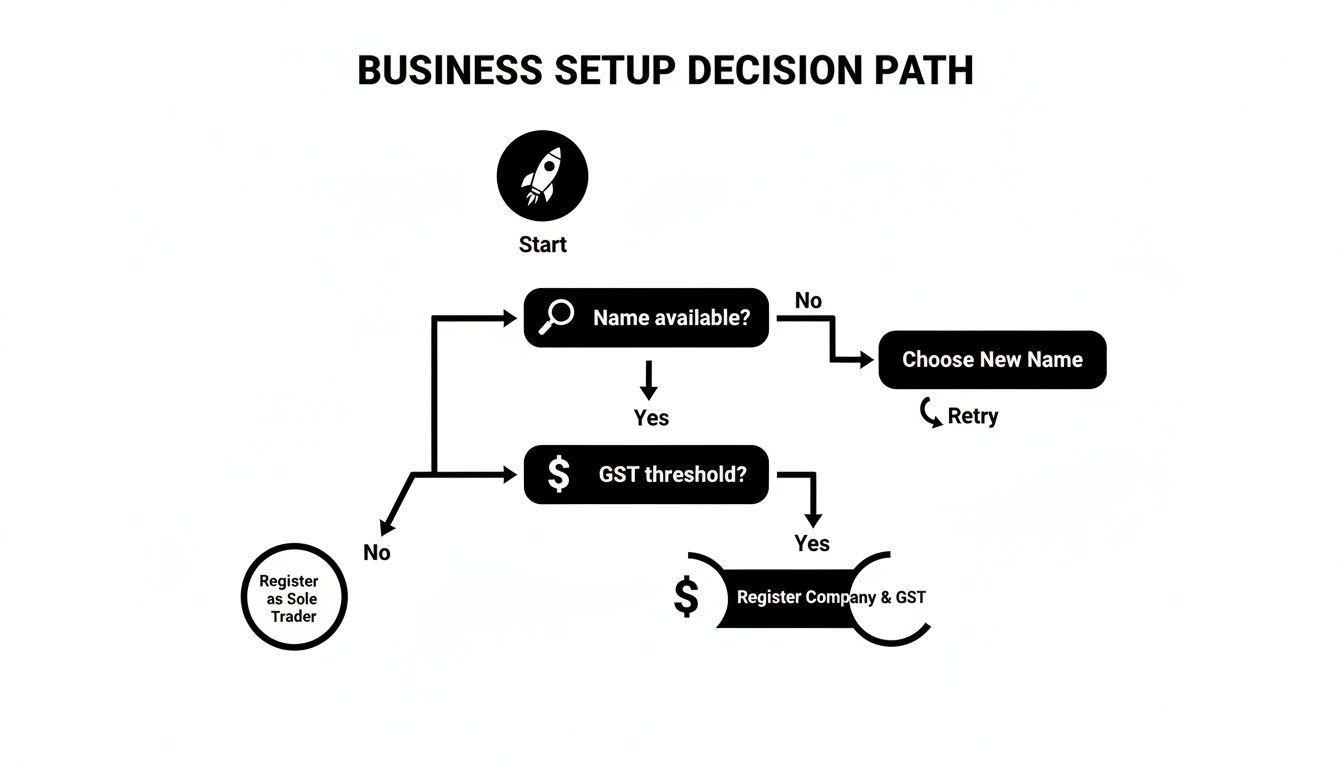
While the initial steps are straightforward, the path gets much more complex as your revenue grows and the stakes get higher.
Key Signs You’ve Outgrown the Sole Trader Model
So, how do you know it’s time to level up? Keep an eye out for these tell-tale signs:
- Your Income Is Climbing: This is the big one. Once your profits start pushing you into the higher personal income tax brackets, the flat 25% corporate tax rate for small businesses suddenly looks a lot more appealing. It’s a simple numbers game—why pay more tax than you have to?
- Your Business Risks Are Increasing: If you’re hiring staff, signing bigger contracts, or taking on projects with more liability, the unlimited personal liability of a sole trader becomes a serious gamble. A company structure acts as a legal shield, separating your business debts from your personal assets, like your family home.
- You Want to Bring on Partners: By definition, a sole trader is a one-person show. If you’re ready to bring a business partner into the fold, you legally must change your structure to a partnership or a company.
- You Need to Secure Larger Contracts: It’s a common hurdle. Many large organisations and government departments will only award contracts to incorporated entities. They see a company as a more stable, professional, and less risky partner to do business with.
Real-World Example: We worked with a successful electrician in Belrose who started out as a sole trader. As his business boomed, he hired two apprentices and bought a new work van. It suddenly hit him that if something went wrong on a job—an accident or a lawsuit—his family home was on the line. By shifting to a company structure, he ring-fenced his personal assets and capped his tax, which freed up more cash to reinvest in new tools and grow the business even further.
Making the switch from a sole trader to a company or trust is a major business decision. It needs careful planning to manage things like capital gains tax and ensure all your assets are transferred correctly.
Don’t wait until you’re forced to make a change. If any of these signs sound familiar, it’s the perfect time for a strategic chat about your future.
Book a consultation with EndureGo Tax and let’s explore whether a company or trust is the right next step for your business journey.
Ready to Get Started? Here’s How We Can Help
Let’s be honest—becoming a sole trader is the fastest way to get your business idea off the ground. It’s simple, direct, and puts you in the driver’s seat. But with that freedom comes the responsibility of handling your own tax, compliance, and personal liability.
For tradies, consultants, and small business owners across Ashfield, the Inner West, Belrose, and the Northern Beaches, juggling these tasks can quickly become overwhelming. It’s easy to feel like you’re guessing your way through it all.
Our message is simple: stop wondering and start doing it right. As you grow, you’ll find that smart tools make a huge difference. For example, some of the best answering services for small businesses can make sure you never miss a client call while you’re busy on a job.
You focus on your craft; we’ll handle the numbers. Think of it as a partnership that gives you the peace of mind to grow your business confidently, knowing you’re meeting all your obligations with the Australian Taxation Office.
Book a consultation with EndureGo Tax to talk about your specific situation. Whether you’re just starting out, getting tangled up in your BAS, or figuring out your next business move, we’re here to give you practical, expert guidance right here in your local area.
Common Questions About Being a Sole Trader
We’ve covered a lot of ground, but let’s be honest—this is where the real-world questions pop up. Here are the answers to the most common queries we get from new sole traders just starting out.
Can I Hire Employees as a Sole Trader?
Yes, absolutely. But the moment you hire someone, you’re not just a business owner anymore; you’re an employer. And that comes with a whole new set of responsibilities.
You’ll need to handle withholding tax from their wages (known as Pay As You Go or PAYG withholding) and pay their superannuation contributions. It’s not optional—it’s the law. The Australian Taxation Office is very clear on these obligations, which are detailed in the Superannuation Guarantee (Administration) Act 1992.
How Do I Pay Myself?
This is one of the biggest perks of being a sole trader. Unlike a company director who gets a formal salary, you simply pay yourself by taking money out of the business. It’s that straightforward.
These payments are called ‘drawings’. Because the business’s profit is legally your personal income, you just transfer the funds from your business account to your personal one whenever you need to. No payslips, no fuss.
Do I Really Need a Separate Bank Account?
While the law doesn’t force you to, consider this non-negotiable. Seriously. A separate business bank account is one of the smartest things you can do from day one.
It creates a clean, clear line between your business and personal finances. This makes tracking income and expenses a thousand times easier and will save you a world of pain (and accounting fees) when tax time rolls around. Don’t skip this step.
What Happens If My Business Fails?
This is the tough part, and it’s crucial to understand. As a sole trader, there’s no legal distinction between you and your business. You are the business.
This means you have what’s called unlimited liability. If your business racks up debts it can’t pay, creditors can legally come after your personal assets—like your car or even your house—to get their money back. It’s the single biggest risk of this structure and something you need to be prepared for.
Getting the details right as a sole trader can feel overwhelming. For personalised advice that gives you peace of mind, it pays to trust a local expert. EndureGo Tax is here to guide you on your journey, from getting set up to celebrating your success.
Book a consultation with EndureGo Tax today and let’s make sure your business is built on a solid foundation.
