


Lost a receipt? It doesn’t automatically mean you’ve lost the deduction. As tax experts, we know the feeling – that crucial docket for a work expense vanishes, fades into oblivion, or was never even provided. The good news is the Australian Taxation Office (ATO) understands this reality. They’ve built in ways for you to claim on tax without receipts, especially for those small, fiddly costs where keeping every single piece of paper is just impractical. This guide provides actionable strategies to ensure you claim everything you’re entitled to.
How to Claim Tax Deductions Without Receipts
So, what can you claim on tax without receipts? The secret isn’t a magic loophole; it’s about providing solid, alternative proof. Even without that physical docket, you must still demonstrate to the ATO three key things: you actually spent the money, it was directly for your job, and it came out of your own pocket.
This is where alternative forms of proof, or ‘substantiation’, come into play. To keep things fair and practical, the ATO has set clear rules and limits for these situations.
The most common rule allows for claims on work-related expenses up to a total of $300. You don’t need receipts for claims up to this total amount, but you do need to show how you calculated the claim and that the spending occurred. You can find the official take on the ATO guidelines for tax claims.
This image breaks down the main areas where you can often claim without a receipt, such as small work costs, certain travel allowances, and home office expenses.
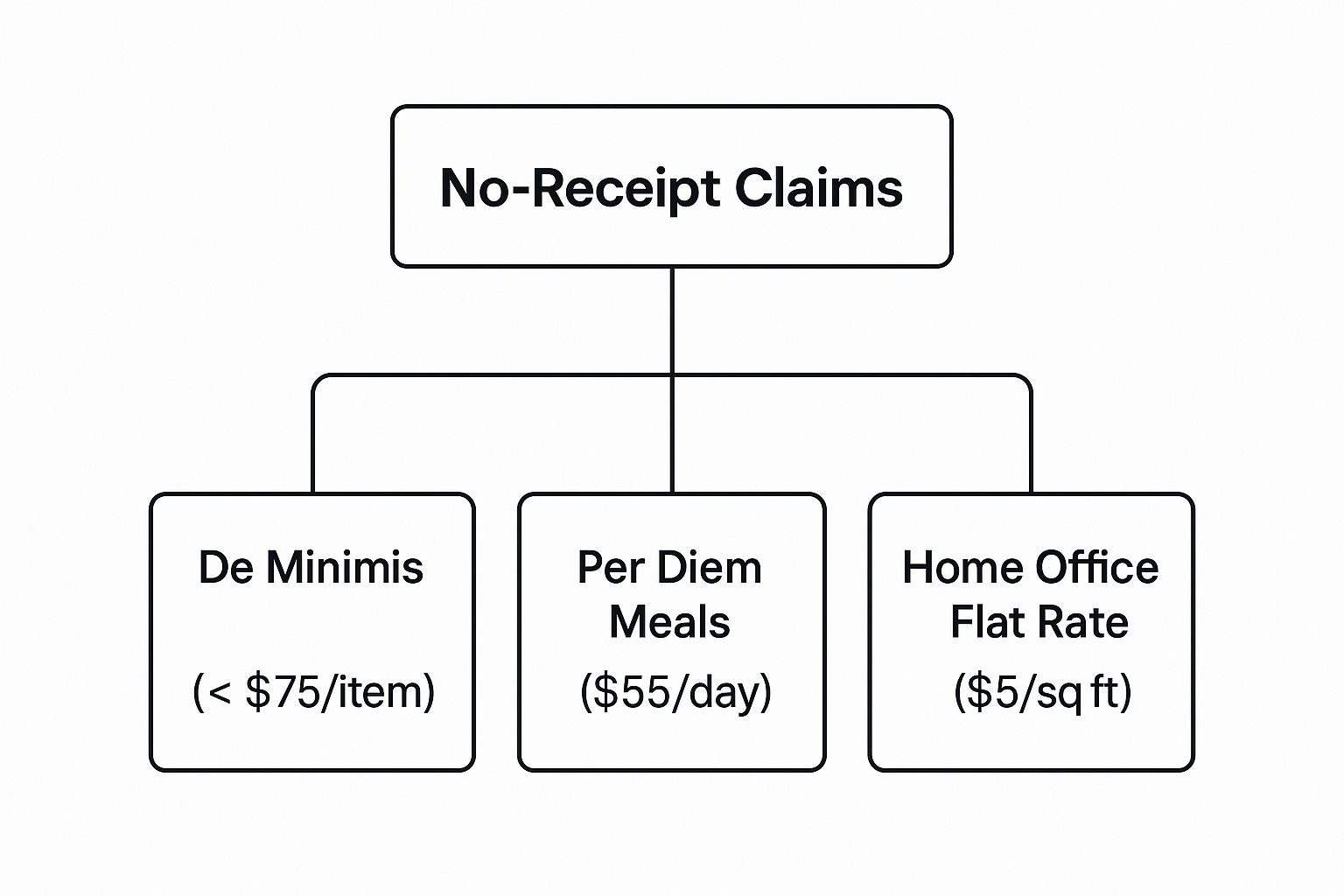
As you can see, it’s not just one blanket rule. The ATO has specific, structured methods for these common claims.
Quick Guide to ATO Claims Without Receipts
To make it even clearer, here’s a quick reference table outlining the key expense types you can claim without receipts, along with their limits and the expert-recommended alternative proof.
| Expense Category | ATO Claim Limit Without Receipt | Required Alternative Proof |
|---|---|---|
| Total Work Expenses | Up to $300 | A diary or log explaining the expenses and how you calculated the total. Practical Example: A bank statement showing a $25 purchase at Officeworks, with a diary note “New work diary & pens”. |
| Laundry/Clothing | Up to $150 | A diary or log showing how you calculated the claim. Practical Example: “Washed compulsory uniform twice this week at $1 per load = $2.” |
| Car Expenses | Up to 5,000 km | A logbook or diary recording your kilometres, dates, and reasons for travel. Practical Example: “15/07 – Trip from office to client site at Parramatta – 30km round trip.” |
| Home Office (Fixed Rate) | 67 cents per hour | A timesheet, roster, or diary showing the hours you worked from home. Practical Example: Kept a spreadsheet logging 10 hours of WFH for the week of July 8th. |
| Travel (Allowances) | Varies by location/income | Proof you received a travel allowance and a diary of your travel. Practical Example: Diary entry: “Sydney to Melbourne for conference, 3-5 August. Stayed at hotel, meals purchased.” |
This table is an excellent starting point, but always remember that strong, consistent record-keeping is your best defence during a tax audit.
Understanding Your Obligations
Let’s be crystal clear: even when you don’t need a receipt, you are never totally off the hook. If the ATO audits your return, you must be able to substantiate your claim. It is your professional responsibility to build a convincing trail of evidence.
So, what does that look like in practice?
- Bank or credit card statements with the relevant purchase highlighted. As a best practice, add a digital or physical note explaining what it was for.
- A detailed diary or logbook. This isn’t just a suggestion; it’s essential for car and travel claims. Log dates, the purpose of your trips, and the kilometres you travelled.
- Photographs. A quick snap of a small tool you bought for work or even a photo of a receipt that’s starting to fade can be a lifesaver.
By building these simple habits, you can confidently claim every single dollar you’re entitled to without the stress of lost paperwork. In the next sections, we’ll dive into expert strategies for applying these rules to boost your tax return.
Using the $300 Limit for Small Work Expenses

The ATO’s $300 limit for small work expenses is one of the most practical tax provisions available, but it’s also frequently misunderstood. Let’s clarify: this is a combined limit for all your small, work-related costs, not a $300 automatic deduction for every item.
Before you can claim a cent, you must satisfy the ATO’s three golden rules. These are non-negotiable.
- You paid for it yourself and were not reimbursed.
- The expense was directly tied to earning your income.
- You have a record to prove it.
This is where the $300 rule comes into play. When your total work expense claims are $300 or less, that “record” doesn’t have to be a shoebox full of receipts. You still need proof, though. This is how experts confidently answer the question of what can you claim on tax without receipts.
What This Looks Like in Practice
Think of your proof as telling the ATO a clear story. Let’s say you’re a graphic designer and bought a $40 technical manual for a new software. A bank statement showing the purchase from the bookstore, paired with a quick diary note explaining “Manual for Adobe Suite update,” is solid gold.
The goal is to create a clear audit trail. Your bank statement confirms the transaction, and your diary note provides the work-related context the ATO needs to see, removing any doubt.
Imagine you’re a tradie who picked up a few minor items over the year:
- Specialist cleaning supplies: $35
- Stationery (pens, notebook): $20
- A new high-visibility vest: $50
Even without the dockets, a bank statement showing these purchases, backed up by a simple log in a diary or a notes app, gives you strong evidence for your $105 claim.
Understanding this rule properly transforms confusing tax law into a practical strategy. If you’re ever unsure how this applies to your specific job, the smartest move is always to consult a registered tax agent. They can help you stay compliant while making sure you get back every dollar you’re entitled to. Take action: Review your bank statements now for small, unreimbursed work purchases and start a log to claim them.
Claiming Car and Laundry Costs Without Receipts
Keeping every single paper receipt is a hassle. The good news is the ATO understands this, especially for common expenses like work-related car trips and laundry. For some of the most frequent deductions, the rules are different, and you don’t always need a shoebox full of dockets to make a claim. Mastering these methods is an expert strategy to ensure you’re claiming every dollar you’re rightfully owed.
The cents per kilometre method for car expenses is a game-changer for many taxpayers. It allows you to claim up to 5,000 business kilometres each year without needing to provide fuel receipts or service invoices. It’s a much simpler approach, perfect if you use your personal car for regular but shorter work-related journeys.
How to Prove Your Car and Laundry Claims
So, if you don’t need receipts, what do you need? The key is shifting your focus from collecting paper to keeping a clear and consistent record. Instead of receipts, your proof comes from a well-maintained diary or logbook.
- For Car Expenses: Your logbook is your most critical tool. For each trip, you must log the date, the total kilometres driven, and the reason for the journey (e.g., “Client meeting at 123 Smith St” or “Site visit to Ashfield project”). This detailed record is what substantiates your claim. Practical Example: A salesperson logs “25/07: Travel to meet new client, ABC Corp, in Chatswood – 45km”. If you’re a rideshare driver, get more specific advice in our guide to Uber driver tax deductions.
- For Laundry Expenses: Do you have to wear a compulsory uniform, protective gear, or occupation-specific clothing for your job? If so, you can claim up to $150 for laundry costs without receipts. The ATO expects a reasonable basis for your calculation. The approved method is claiming $1 per load for washing only work clothes, or 50 cents per load for a mixed wash. A simple diary note like, “Washed uniform twice this week,” is all you need to back it up.
By using these specific, receipt-free methods, you can confidently claim what you’re owed. The focus moves away from chasing paper and towards creating a logical, easy-to-follow record of your work activities.
It’s not about finding loopholes; it’s about using the approved ATO methods correctly. The system is designed to make claiming small, frequent expenses easier, as long as you can show a reasonable pattern of use.
For a different perspective on tracking travel, you might find this a comprehensive guide to UK business mileage claims interesting, as it offers other insights into good record-keeping practices.
Take action now: If you regularly incur these costs, start a logbook or a simple diary today. It’s a small habit that ensures you have all the proof you need at tax time, turning missed deductions into real savings.
Creating Your Alternative Proof System

Claiming a deduction without a receipt doesn’t mean claiming without proof. Think of it less as a loophole and more as building a different kind of evidence trail—one that the Australian Taxation Office (ATO) will accept. It’s all about creating a clear financial story for every single deduction.
This is where you move from theory to practical, day-to-day habits. Your new best friends are your bank statements and a pen. When you spot a work-related purchase, simply highlight it and jot down a quick note explaining what it was for. That tiny step adds crucial context that a simple transaction line just lacks. Practical Example: A line on your statement says “Kmart $15”. You add a note: “Purchase of plain black trousers for waiter uniform.”
Likewise, digital records from finance apps or even just a quick photo of an item (or the receipt before it fades) are powerful tools. Capturing this proof in the moment means you won’t be scratching your head trying to remember the details months later.
Your Most Powerful Record-Keeping Tools
Your most effective tool can be as simple as a diary or as modern as the ATO’s free myDeductions app. The key is to treat every entry as a piece of a puzzle, building a complete picture to support your claim.
- A Detailed Diary: Make a habit of logging the date, the expense amount, and a short, clear description of its purpose for your work.
- Annotated Statements: Regularly go through your digital or paper bank statements and make those all-important notes next to relevant purchases.
- Photo Evidence: Snap a quick picture of new tools, protective gear, or any small work-related item you buy on the go.
For specific ongoing costs like laundry, knowing exactly how to calculate and record them is essential. Get the full rundown in our detailed guide on claiming washing on tax.
Adopting these habits transforms record-keeping from a chore into a powerful tool for tax optimisation. It ensures you can confidently defend every deduction you make.
As you build out your alternative proof system, staying organised is what makes it all work. It’s also worth exploring how modern AI tools for comprehensive financial monitoring can help create the detailed records you need, even when a traditional receipt is missing. Take action: Choose one method—a diary, app, or annotated statements—and implement it this week.
A $1,000 Instant Deduction Could Be on Its Way
A significant shake-up in how Australians handle tax deductions might be just around the corner, designed to make life simpler. The government has proposed a $1,000 instant tax deduction, a move aimed at cutting through the red tape for both everyday taxpayers and the ATO.
If this policy is enacted, it would give eligible workers the choice to claim a standard, flat-rate deduction. No more shoeboxes full of receipts, no more itemising every small expense. It’s a straightforward answer to the age-old question, “what can I claim on tax without receipts?” for those smaller, everyday costs.
How Would This Affect Your Tax Return?
While it sounds like a dream at tax time, it introduces a new strategic decision. Do you take the easy $1,000, or are you better off meticulously tallying up every single expense with detailed records? The answer depends entirely on your personal spending habits.
- Who comes out on top? This is a game-changer for workers whose real costs hover around or under the $1,000 mark but who find keeping records a nightmare. The flat rate is a gift, offering a solid deduction without the usual stress of substantiation.
- When is it better to itemise? Simple. If your work-related expenses consistently exceed $1,000 a year, you must keep tracking everything. Choosing the standard deduction would literally mean leaving your own money on the table.
This proposal signals a real shift towards simplifying our tax system. As highlighted in a report about how the instant tax write-off would work on SBS News, experts believe it could encourage many people who previously claimed around the $650 mark to confidently claim the full $1,000.
So, what should you do right now? Keep your records as diligently as ever. The only way you’ll know for sure which path is smarter for you when this policy rolls out is by having a clear picture of what you actually spend each year. Take action: Continue tracking your expenses meticulously so you can make an informed choice if this proposal becomes law.
Your Action Plan for a Smarter Tax Return
Expert knowledge is only powerful when you use it. Let’s distill everything into a simple, actionable plan. This is how you turn what you’ve learned about what can you claim on tax without receipts into a solid, wealth-building strategy.
First, commit these key thresholds to memory:
- The $300 general limit for small, ad-hoc work costs.
- The $150 laundry allowance for eligible uniforms and protective gear.
- The 5,000 km annual car travel limit when using the cents per kilometre method.
Next—and this is the most crucial step—commit to a record-keeping system today. Don’t put it off. Your very next step should be to download the ATO’s myDeductions app, create a dedicated folder on your cloud drive, or simply buy a notebook. Start saving and annotating bank statements and logging those car trips now.
This year-round habit is the real secret to a stress-free tax time. A few minutes each week prevents the last-minute scramble and ensures you don’t leave any money on the table.
For anyone with a more complex income situation or who simply wants to maximize your tax refund, the best move is clear: engage a registered tax agent. Their expertise is often the smartest investment you can make in your financial wellbeing. If you’re looking to explore broader financial planning strategies, there are excellent resources available to guide you.
Your final call to action: Don’t just read this guide—implement it. Choose one record-keeping strategy from this article and start it today. Your future self will thank you at tax time.
Let’s face it: keeping track of every single receipt for your tax return is a nightmare. Most of us have that shoebox or envelope overflowing with faded papers, hoping we haven’t lost the important ones.
But what if I told you that you don’t always need a receipt to claim an expense?
It’s true. The Australian Taxation Office (ATO) has specific rules—often called “substantiation exceptions”—that allow you to claim certain work-related expenses without holding onto every piece of paper. As tax professionals in Inner West Sydney, this is one of the most common questions we address.
Let’s break down exactly what you can claim, no receipt required.
What Expenses Can I Claim Without Receipts?
The ATO has set a clear limit for claims made without detailed records. This is designed to cover those small, hard-to-track cash expenses you make throughout the year.
You can claim a total of $300 for all your work-related expenses without needing to provide receipts. This isn’t a free-for-all, though. It’s a collection of individual claims that add up to this amount.
So, what falls under this umbrella?
- Work-Related Expenses Under $10: You can claim any single work-related purchase that costs $10 or less, as long as the total of these small claims doesn’t exceed $200. Practical Example: Buying a cup of coffee for a client meeting, a new pen for the office, or a bus ticket to a work event.
- Laundry Expenses: If your work clothes are tax-deductible (like a compulsory uniform or protective gear), you can claim laundry costs. The ATO allows a claim of up to $150 for laundry expenses without needing written proof.
- Travel Allowance Expenses: Did your employer provide a travel allowance? If the amount is within the ATO’s reasonable limits, you don’t need to keep every single receipt for your accommodation, food, and incidental costs. You just need to show you were travelling for work and incurred the expenses.
Important: These rules are not a “free pass” to claim $300. You must have actually spent the money, and it must be directly related to earning your income. If the ATO asks, you need to be able to explain how you calculated the claim.
How to Calculate Claims Without Receipts
So, how do you work out these claims if you don’t have the docket? The ATO expects you to use a reasonable basis for your calculations. Guessing isn’t good enough.
Here are the methods the ATO accepts:
- Using a Diary: For expenses like car travel (if you’re not using the logbook method), you can keep a diary for a representative 4-week period. This helps establish a pattern of use you can apply to the whole year. For laundry, you can note down how many loads of work clothes you wash each week.
- The ATO Rate for Laundry: This is the easiest one. You can claim $1 per load if it only contains work clothes, or 50 cents per load if it’s a mixed load with personal items. Remember, the total claim can’t be more than $150 without receipts.
- Cents Per Kilometre Method for Cars: This is a lifesaver for many. You can claim up to 5,000 business kilometres per car per year without a logbook. You just need to show how you calculated the kilometres (e.g., a diary of work-related trips). For the 2023-24 financial year, the rate is 85 cents per kilometre.
Record-Keeping Alternatives When You Lose a Receipt
We’ve all been there. You buy something for work, and the receipt disappears into thin air. Don’t panic! All is not lost.
If you’ve lost a receipt for an expense over $10, the ATO may still accept other forms of evidence.
Here’s what you can use as a substitute:
- Bank or Credit Card Statements: A line item on your statement showing the date, amount, and who you paid is often excellent proof.
- Digital Copies: A photo of the receipt on your phone is just as good as the original paper copy.
- Email Confirmations: That “order confirmed” email for an online purchase works perfectly as a receipt alternative.
- A Handwritten Receipt: If you paid someone in cash, a note from them detailing the sale can work. It should include the seller’s name, ABN (if they have one), the date, what was purchased, and the amount.
The key is to have some kind of proof that you genuinely incurred the expense for work. The more evidence you have, the safer your claim will be if the ATO ever comes knocking. Take action: Scan your bank statements today for lost receipt purchases and save them to a dedicated tax folder.
