


If you use your car for work, you could be sitting on one of the most significant vehicle tax deductions available to Australian professionals and tradespeople. Claiming your vehicle’s running costs is a fantastic way to boost your tax return, but it’s also one of the most scrutinised areas of tax law. Getting it right is crucial to maximising your refund and staying compliant.
As tax experts, we’ll break down precisely what you can—and can’t—claim, providing actionable examples to ensure you’re confident this tax season.
Can You Claim Your Car Expenses? Here’s How to Know

Before you even think about logbooks or cents-per-kilometre, the first question is always: what does the Australian Taxation Office (ATO) actually consider a “work trip”?
Here’s a common trap: many people assume their daily drive to the office is claimable. It’s not. The ATO sees the trip from your home to your main workplace as a private expense, even if you’re taking work calls or mentally prepping for a big meeting on the way.
So, what kind of travel does qualify?
- Driving between separate jobs: Got a second job? The trip directly from your first workplace to your second is deductible.
- Travel during your workday: If you drive from your office to meet a client, visit a supplier, or pop over to another branch, those kilometres are claimable.
- Home to an alternative workplace: When you skip the main office and drive from home straight to a different work location (like a client’s site for a project), that journey is also deductible.
What Makes a Journey Claimable?
It all boils down to one simple question: was the travel a fundamental part of earning your income, or was it just about getting you to your regular place of work?
Practical Example:
Think of it this way. A project manager driving from her office in Ashfield to a construction site in Inner West Sydney is performing a core work duty. That trip is 100% claimable. The same goes for a mobile therapist who travels between clients’ homes across Sydney’s Inner West—each trip is part of earning their income.
This distinction is why the ATO pays such close attention to vehicle claims. Their guidelines are firm: normal travel between your home and a regular workplace is private. The legislative basis for this is detailed in the Income Tax Assessment Act 1997, which outlines the rules for work-related deductions.
The only real exceptions are if you’re required to transport bulky tools essential for your job or if you’re travelling between multiple work sites for the same employer. For a deeper dive, you can review the complete guide to claiming car expenses in Australia.
Expert Tip: The ‘bulky tools’ exception is harder to meet than you’d think. You have to prove the tools are essential, too heavy or awkward for public transport, and that your employer provides no secure storage at the workplace. Just choosing to bring your tools home isn’t enough to make the trip deductible.
To help you get a clearer picture, here’s a quick reference guide on what the ATO typically views as claimable versus private travel.
Claimable vs Non-Claimable Car Trips
| Scenario | Is it Claimable? | ATO Rationale |
|---|---|---|
| Daily commute from home to your regular office. | No | This is considered private travel, just like choosing where to live. |
| Driving from your office to a client meeting. | Yes | The travel is part of your work duties for that day. |
| Travelling directly from Job A to Job B. | Yes | This is travel between two separate places of employment. |
| Driving from home to an alternative workplace (e.g., a client site). | Yes | You are travelling to a temporary workplace, not your regular one. |
| Picking up office supplies on the way home from work. | No | The primary purpose of the trip is your private commute home. |
| A tradesperson transporting bulky tools to a worksite because there’s no secure storage at the depot. | Yes | This meets the ‘bulky tools’ exception as it’s a requirement of the job. |
Ultimately, your eligibility hangs on proving a direct link between the car journey and how you earn your income. Nailing this foundation is the first step to a successful and stress-free claim.
Feeling unsure about your specific situation? Our team of tax experts can provide personalised advice to ensure you claim every dollar you’re entitled to. Book a consultation today to get clarity on your vehicle tax deductions.
Choosing the Right Method for Your Situation
Picking the right way to claim your vehicle tax deductions is probably the most important decision you’ll make in this whole process. The Australian Taxation Office (ATO) gives you two distinct options, and each comes with its own set of rules and benefits. Your choice between the cents per kilometre and logbook methods will directly impact your bottom line come tax time.
Getting your head around which one fits your driving habits and record-keeping style is key to maximising your refund while keeping everything above board.
Let’s break them down from an expert perspective.
The Cents Per Kilometre Method Explained
The cents per kilometre method is the streamlined option. It’s built for people who only use their car for work occasionally or for moderate distances.
This method lets you claim a set rate for every business kilometre you travel, but it’s capped at a maximum of 5,000 kilometres per car, per financial year.
For the 2023–24 income year, the ATO has set the rate at 85 cents per kilometre. This figure is designed to cover all your running costs—fuel, registration, insurance, depreciation, and maintenance. You don’t need a shoebox full of receipts, but you do need to show the ATO how you worked out your kilometres. A simple diary or calendar of your work trips is sufficient.
This image gives a great visual cue for figuring out which path is likely best for you.
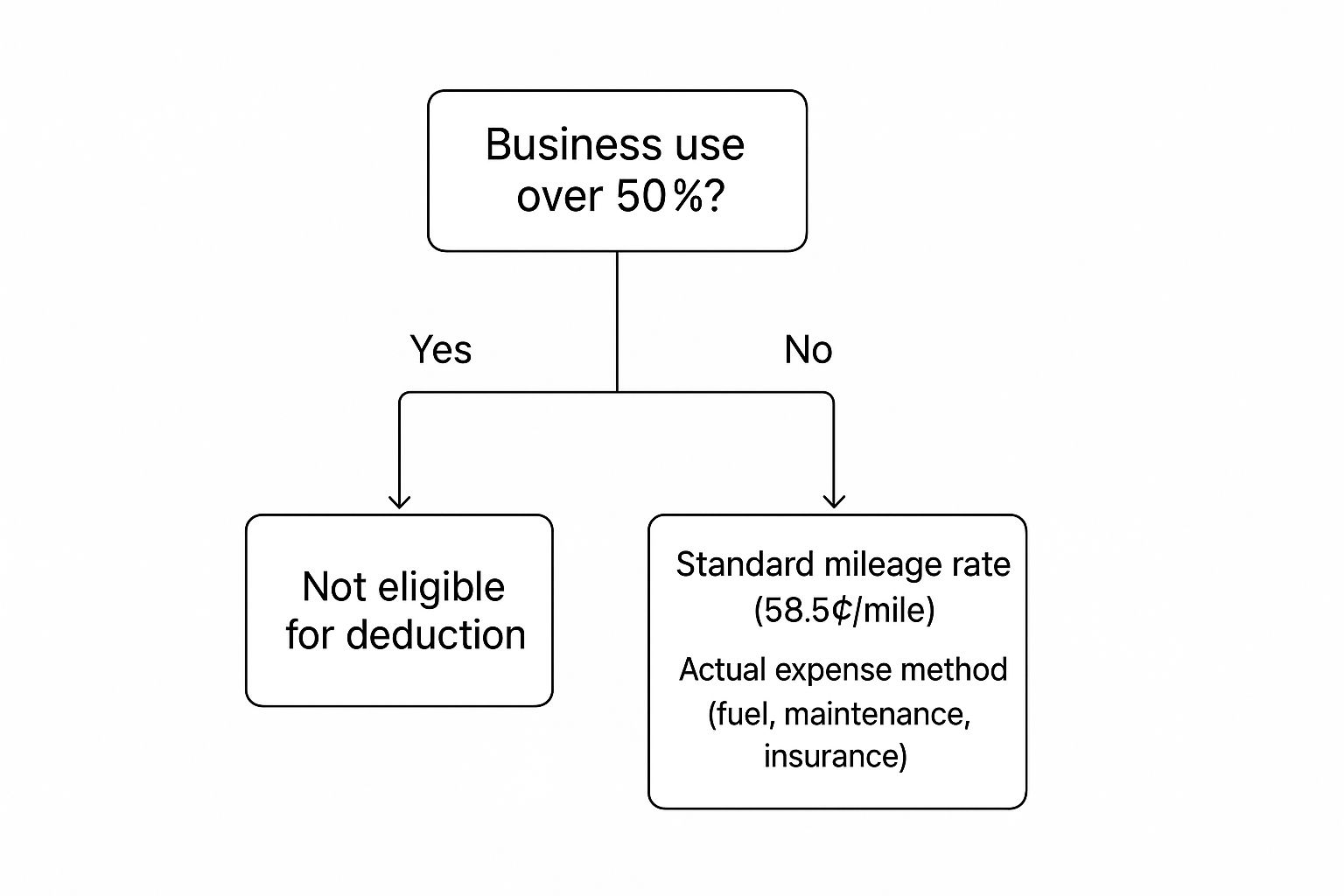
As you can see, the moment your business use starts climbing, the logbook method (what the ATO sometimes calls the ‘actual costs’ method) becomes a much more attractive option to capture what you’re really spending.
The Logbook Method Explained
On the flip side, the logbook method demands meticulous records but can deliver a much bigger deduction, especially if your job keeps you on the road. Instead of a flat rate, you get to claim the actual costs of running your car, based on what percentage you use it for business.
To go down this route, you’ll need to keep an ATO-compliant logbook for a continuous 12-week period. This logbook tracks every single trip—business and private—to lock in a credible business-use percentage. You can then apply that percentage to all your eligible car expenses for the year, including fuel, oil, servicing, insurance, rego, loan interest, and even depreciation.
Here’s the crucial bit: your logbook is valid for five years, as long as your driving patterns don’t drastically change. That means one solid 12-week stint of tracking can set you up for half a decade of accurate claims.
Cents Per Kilometre vs Logbook Method A Detailed Comparison
Deciding between these two methods can feel a bit abstract, so let’s put some numbers to it. A clear comparison shows just how different the outcomes can be based on your circumstances. Below, we break down the key features of each approach to help you see which one aligns better with your work-related driving.
| Feature | Cents Per Kilometre Method | Logbook Method |
|---|---|---|
| Record-Keeping | Simple diary of work trips needed to justify kilometres. No receipts required. | Must keep a detailed 12-week logbook and receipts for all car expenses. |
| Kilometre Cap | Capped at 5,000 business kilometres per year. | No limit on business kilometres claimed. |
| Deductible Expenses | The 85 cents/km rate is all-inclusive (covers fuel, rego, depreciation, etc.). | Claim the business-use percentage of all actual car expenses. |
| Best Suited For | Individuals with low to moderate work-related driving who prefer simplicity. | High-kilometre drivers or those with expensive cars where depreciation is significant. |
| Potential Return | Lower, capped deduction. Max claim for 2023-24 is $4,250. | Often a much higher deduction that truly reflects your work usage. |
As you can see, the logbook method requires more admin but offers a far greater potential reward for those who drive a lot for work. The cents per kilometre method is all about convenience for less frequent work travel.
A Head-to-Head Comparison
To see the difference in action, let’s consider a practical example.
- Scenario: Maria is a sales representative who drives 15,000 km a year for work meetings across the Inner West. Her total car expenses (fuel, insurance, registration, maintenance, and depreciation) for the year are $12,000. Her logbook shows her business use is 75%.
Here’s how her deduction would stack up under each method:
Cents Per Kilometre Method:
- Calculation: 5,000 km (the cap) x $0.85/km
- Total Deduction: $4,250
Logbook Method:
- Calculation: $12,000 (total costs) x 75% (business use)
- Total Deduction: $9,000
- The Difference: Maria claims an extra $4,750!
As the example shows, while the cents per kilometre method is a breeze, Maria would be leaving a serious amount of money on the table. The logbook method, although it takes more effort upfront, reflects her high work usage and gives her a much better tax outcome. You can dive into the nitty-gritty of these calculation rules directly on the ATO website.
Ultimately, the right choice is all about your personal situation. If you drive less than 5,000 business k’s a year and value simplicity, the cents per kilometre method is a solid fit. But if your work has you living on the road, investing time in a logbook is almost certainly the smartest financial move you can make.
If you’re still scratching your head, our experts are here to help. Book a consultation today and let us perform a detailed analysis to ensure you claim every single cent you’re entitled to.
How to Master the Logbook Method
If you find yourself driving a lot for work, the logbook method is almost certainly your ticket to a much bigger tax refund. Sure, it demands a bit more discipline than the cents-per-kilometre option, but getting it right means you can claim the business portion of all your actual car running costs.
The payoff for that extra diligence? It can easily be thousands of dollars back in your pocket.

This screenshot, pulled straight from the ATO’s car expenses page, shows the two paths you can take. The key takeaway here is how the ATO separates the simple cents per kilometre method from the more detailed logbook, or ‘actual costs’, method—which is what we’re digging into now.
Creating an ATO-Compliant Logbook
The heart of this method is keeping a detailed logbook for a continuous 12-week period. Think of this as a snapshot of your driving habits. This 12-week record establishes your business-use percentage, a figure you can then use for up to five years, as long as your job and driving patterns don’t drastically change.
Your logbook needs to capture specific details for every single trip you take during these 12 weeks—both work and private.
For each work-related journey, you must record:
- The date the trip started and finished.
- The odometer readings at the beginning and end of the trip.
- The total kilometres you travelled.
- A clear reason for the journey. For example, “Client meeting with ABC Pty Ltd in Parramatta” or “Site visit to Ashfield construction project”.
Be specific. Vague entries like “work trip” or “meeting” are a red flag for the ATO and just won’t fly in an audit. You need to prove the trip was directly tied to earning your income.
Expert Tip: While a paper logbook from the newsagent gets the job done, digital logbook apps are a complete game-changer. They use your phone’s GPS to track everything automatically, saving you a heap of time and cutting out the risk of human error. Many are designed to be ATO-compliant right from the get-go.
Calculating Your Business-Use Percentage
Once your 12-week logbook period is done and dusted, it’s time for some simple maths. This one calculation will be the foundation of your car expense claim for the next five years.
Here’s how to work it out:
- Add up the total kilometres you drove for work during the 12 weeks.
- Add up the total kilometres you drove for all trips (work and personal) in that same period.
- Divide your work kilometres by the total kilometres.
- Multiply that result by 100 to get your business-use percentage.
Practical Example: A Tradie’s Logbook
Imagine David, an electrician based in the Inner West, completes his 12-week logbook.
- Total Work Kilometres: 4,200 km (driving between jobs, picking up supplies, and quoting new work).
- Total Kilometres Driven: 6,000 km (this includes his weekend trips and personal errands).
- Calculation: (4,200 ÷ 6,000) x 100 = 70%
This means David can now claim 70% of his total eligible car expenses for the entire financial year. Simple as that.
Applying Your Percentage to Running Costs
Now for the rewarding part. With your business-use percentage locked in, you can apply it to a whole range of car running costs. This is where keeping good records of your expenses really pays off.
You can claim your business-use percentage of the following:
- Fuel and Oil: Keep every receipt, or use your bank statements to track these costs.
- Registration and Insurance: This includes both your CTP and comprehensive insurance policies.
- Repairs and Servicing: Everything from new tyres to your regular logbook service is claimable.
- Loan Interest: If you have a car loan, the interest you pay is deductible.
- Depreciation (Decline in Value): This is often the biggest piece of the puzzle in a logbook claim.
Using David’s 70% business use, if his total car expenses for the year were $11,000 (including depreciation), his total vehicle tax deduction would be a massive $7,700. This shows just how powerful the logbook method can be for turning everyday car costs into a substantial tax benefit.
For those interested in the legislative details, you can find them in the Income Tax Assessment Act 1997, which outlines the substantiation rules for car expenses.
Feeling a bit overwhelmed by the detail? Let us handle it for you. At EndureGo Tax, we specialise in helping tradies and professionals in Ashfield get their claims right. Book a consultation today, and we’ll make sure your logbook is spot-on and your refund is maximised.
Claiming Car Depreciation the Right Way
When you’re using the logbook method, car depreciation is often the single biggest expense you can claim. It’s a game-changer. This deduction represents the drop in your car’s value over its life, and getting it right can seriously boost your tax return.
But, as always, the Australian Taxation Office (ATO) has strict rules, especially when it comes to more expensive cars. Understanding these rules before you even buy a vehicle for work is crucial, as it will shape your potential tax benefits for years.
The Car Cost Limit for Depreciation
Each year, the ATO puts a cap on the cost you can use to work out depreciation for passenger vehicles. This is called the car limit. If your car costs more than this threshold, you can only claim depreciation up to the value of the limit.
For the 2024-2025 financial year, the car depreciation limit is $69,674.
Practical Example:
Let’s say you buy a new SUV for $80,000 to visit clients. Your depreciation calculations can only be based on $69,674—the extra amount you paid is simply ignored for tax purposes. You can find more detail on this annual threshold and its application by checking out the official guidance on the car depreciation limit for the 2024-2025 financial year.
It’s worth noting that this limit is different from the Luxury Car Tax (LCT) threshold, which is a separate tax that gets applied when you buy a high-value vehicle.
Are All Vehicles Subject to the Limit?
No, and this is a distinction that many people miss. The car depreciation limit specifically targets passenger vehicles—that is, cars designed to carry a load of less than one tonne and fewer than nine passengers.
This means certain commercial vehicles get a pass and are exempt from the cap. This includes:
- Utes, vans, or trucks with a carrying capacity of one tonne or more.
- Vehicles designed to transport nine or more passengers.
Expert Insight: For tradies and small business owners in areas like the Inner West, this is huge. If you choose a ute with a one-tonne payload, you can depreciate the full cost of the vehicle, even if it’s well over the $69,674 limit. This often makes a work-horse ute a much smarter tax decision than a high-end SUV at the same price point.
To factor depreciation into your logbook claim correctly, you’ll need to use an approved ATO method, like the prime cost or diminishing value method. Our guide explains in more detail how to calculate depreciation on your business assets.
Getting depreciation right is about claiming everything you’re entitled to without falling foul of ATO rules. If you’re unsure how these limits apply to your vehicle, the team at EndureGo Tax is here to help. Book a consultation today and let’s make sure you’re set up correctly.
Maintaining ATO-Proof Records for Your Claim
The best kind of vehicle tax deduction is one you can back up without breaking a sweat if the Australian Taxation Office (ATO) ever asks questions. Think of it this way: impeccable record-keeping isn’t just a good habit; it’s a legal requirement and your number one defence against an audit. Getting your documents sorted from day one is the key to lodging with peace of mind.

Whether you choose the logbook or the cents-per-kilometre method, you need to substantiate your claim. It’s a complete non-negotiable.
Now, you don’t need a shoebox overflowing with receipts for the cents-per-kilometre method, but you absolutely must be able to show the ATO how you worked out your business kilometres. For logbook users, the bar is set much higher – your entire claim is built on the evidence you keep.
Your Essential Record-Keeping Checklist
To build a claim that’s completely audit-proof, make sure you have clear, organised proof for every single expense. Your file should include:
- Proof of Ownership: Documents that show you own or lease the vehicle.
- Loan Documents: If you’re financing your car, keep the loan statements that detail the interest you’ve paid.
- Running Cost Receipts: This is your evidence for fuel, oil, servicing, and any repairs.
- Major Expense Invoices: Don’t forget to keep records for big-ticket items like your insurance policy, registration renewal, and new tyres.
- Logbook or Travel Diary: Your completed 12-week logbook (or a detailed diary of work trips) is the cornerstone of your claim.
It’s easy to dismiss small costs, but they really do add up. While you might be wondering what you can claim on tax without receipts, trying to wing it for significant vehicle claims is a risky game you don’t want to play. These days, digital copies are perfectly fine and often much easier to manage than stacks of paper.
The ATO legally requires you to keep all these records for five years from the date you lodge your tax return. So, if you lodge your 2024 return on 15 October 2024, you must hang onto those records until at least 15 October 2029.
Lodging Your Claim with Confidence
Once you’ve done the maths and figured out your total deduction, you’ll enter it in the “Work-related car expenses” section in myTax. The online system is pretty straightforward and will prompt you to select your chosen method before you pop in the final amount.
If you really want to dig into the nitty-gritty, the legislative rules for these claims are outlined in the Income Tax Assessment Act 1997.
Feeling a bit overwhelmed? If your claim is complex, involves depreciation, or you just want a second set of expert eyes on it, bringing in a registered tax agent is a smart move. An expert can look over your records, double-check your calculations, and make sure your claim is both maximised and fully compliant.
With well-organised, ATO-proof records, you can hit ‘lodge’ on your tax return knowing your vehicle deductions are solid and completely defensible.
Common Questions We Get About Car Tax Deductions
Let’s face it, the rules around vehicle deductions can get a bit murky, especially when your work situation isn’t a standard 9-to-5. We’ve pulled together some of the most common questions we hear from clients across Ashfield to give you some clarity.
What if I’m On-Call or Work Weird Hours?
This is a big one. Many people assume that being on-call or working irregular hours automatically makes the drive from home to work deductible.
Unfortunately, the ATO generally says no. Travel between your home and your main workplace is almost always considered a private trip, no matter what time you’re on the road. The one major exception is if your home is officially your primary place of work and you have to travel to another location for the same employer.
How Long is My Logbook Actually Good For?
The effort you put into that 12-week logbook pays off for a while.
A properly kept, ATO-compliant logbook is valid for five years. But there’s a catch: this only holds if your work circumstances don’t change much. If you get a new job, change roles, or your business-use percentage shifts significantly (think more than 10%), you’ll need to start a fresh 12-week logbook to lock in your new, accurate business-use figure.
The ATO is very clear on this. Their guideline states that if your work circumstances change, “you must keep a new logbook.” This isn’t just red tape; it’s about making sure your claims are a true reflection of your current use, which is your best defence in an audit. This is all laid out in the Income Tax Assessment Act 1997.
Can I Claim Anything for a Company Car?
What happens when your employer provides the wheels?
If you have a company car that you can use for both work and personal trips, it’s typically handled as a fringe benefit. This means your employer usually deals with the Fringe Benefits Tax (FBT).
As an employee, you generally cannot claim deductions for running costs like fuel or insurance, even if you paid for them out of your own pocket. These rules about who can claim what extend to other assets, too. For instance, you can dive deeper into how to maximise your tax deductions on rental property in another one of our guides.
Getting your head around vehicle tax deductions can feel overwhelming, but you don’t have to figure it all out on your own. At EndureGo Tax, we specialise in making sure you claim every single dollar you’re entitled to. Don’t leave money on the table. Take action today by booking a consultation with our expert tax accountants to review your vehicle claims and maximise your tax return. Peace of mind is just a click away.
