


A lot of small business owners in Ashfield, Belrose, and across the Inner West hear the same advice early on. “Set up a family trust. It’ll save tax.” That advice isn’t always wrong, but it’s usually incomplete.
A common challenge arises when seeking a single trust tax rate, with an assumption that one number applies universally. However, this is not the case. A trust can be useful for tax planning, asset protection, and succession, but the tax result depends on who receives the income, how the deed works, what resolutions are made before year-end, and whether the structure still suits your family finances.
For tradies, investors, and growing family businesses, that difference matters. A tax outcome that looks smart on paper can land very differently once it hits a household budget, a mortgage, a spouse’s income, or an adult child’s tax return. That’s even more important with the proposed discretionary trust changes from 2028.
Is a Family Trust Still a Smart Tax Move
If you run a building business, hold a few investment properties, or trade through a company and trust structure, you’ve probably asked whether a family trust still makes sense. In practice, the answer is usually “it depends on the family, the income pattern, and the deed”. It isn’t a blanket yes.
The first thing to clear up is the biggest misconception. There is no single trust tax rate for a family trust in Australia. Tax doesn’t sit on the trust in the same way it sits on a company. The outcome usually depends on the beneficiary who becomes entitled to the income.
That’s why two families with similar trust income can end up with very different tax results. One household may distribute to adult beneficiaries on higher marginal rates, while another may direct income differently through a company beneficiary or other eligible family members. The legal structure may look identical, but the family cash flow impact can be completely different.
Why small business owners get caught out
We often see people set up a trust for the right reasons, then use it badly. They assume the trust itself creates the tax savings. It doesn’t. The trust creates flexibility, and that flexibility only helps if the deed is sound, the distributions are valid, and the beneficiaries are chosen for the right reasons.
For some business owners, the non-tax reasons are just as important. If you’re weighing up legal risk as well as tax, this guide to asset protection with family trusts gives a useful overview of why families use trusts beyond tax alone.
A family trust can still be effective. It can also become expensive, messy, or pointless if it’s set up without a plan. If you want a broader look at where a trust can help, this explanation of how a family trust can save you tax is a practical starting point.
Trusts don’t create tax savings by magic. Trustees create tax outcomes through valid decisions, timing, and beneficiary selection.
What usually works and what doesn’t
A trust still tends to work well when:
- Income varies year to year. Business profits, investment income, and capital events often need flexibility.
- The family group has different tax positions. Different beneficiaries may have different marginal rates or different capacity to absorb income.
- Asset protection matters. This can be relevant for tradies, developers, and business owners exposed to commercial risk.
It usually works poorly when:
- Nobody reviews the deed before major decisions.
- Year-end resolutions are left too late.
- Distributions are made for tax theory only, without thinking about who bears the financial effect.
How Trust Income Is Actually Taxed in Australia
A Sydney tradie has a strong year, leaves the family trust income to a university-age child on a low income, and assumes the family will save tax. On paper, that can look sensible. In practice, the cash often stays in the business or offsets family costs elsewhere, and the person assessed may not be the person who receives the benefit. That gap between the tax outcome and the family cash outcome causes plenty of trouble.
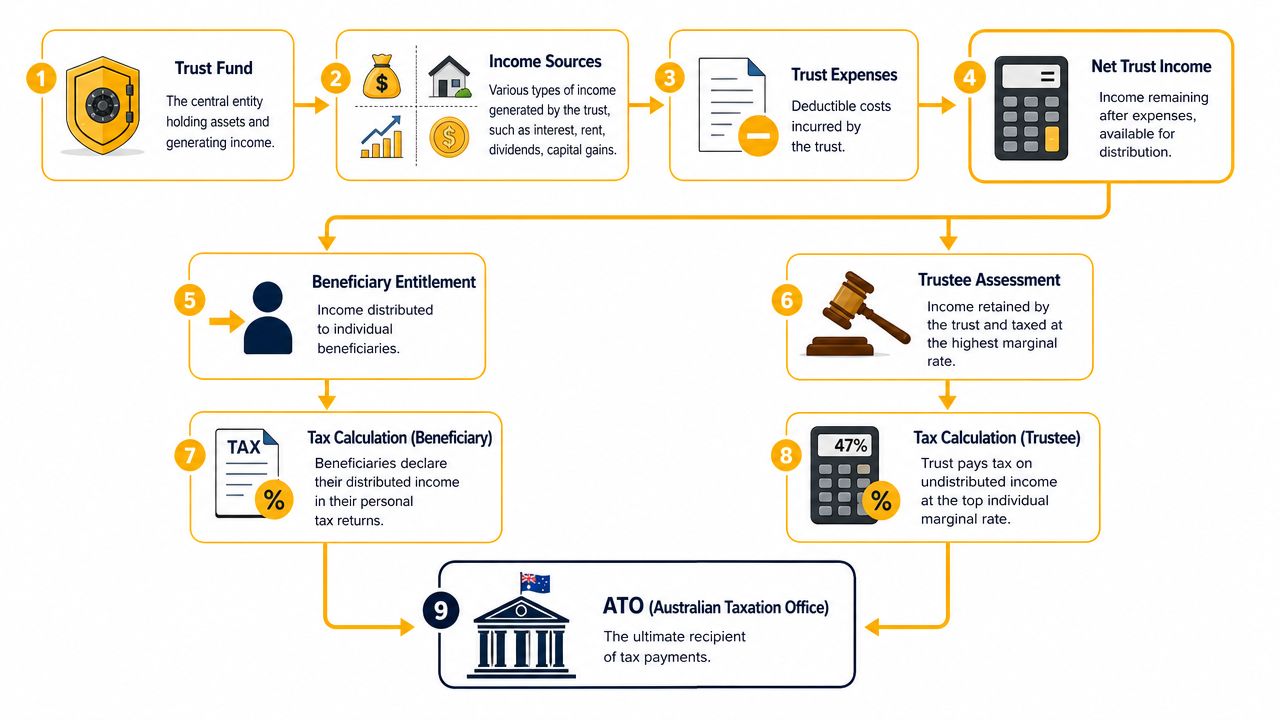
At a basic level, a trust usually does not pay tax in its own right. The tax burden generally passes through to the beneficiary who is made presently entitled to the trust income. If no valid present entitlement is created, the trustee can be assessed instead, often at the top marginal rate.
 RemoveUploadDownloadRegenerateAsk AI
That sounds simple. The practical result depends on three things being aligned on time:
- The trustee’s decision
The trustee must decide who is to receive income under the deed and document that decision properly.
- The beneficiaries’ entitlement
The right beneficiary has to be made presently entitled to the income, not just mentioned informally after year end.
- The trust deed
The deed sets the rules. If it does not permit a distribution method, the resolution can fail even if the accounting looked fine.
We see this regularly with family groups that focus on the tax return first and the deed second. That order causes expensive fixes.
Present entitlement is what drives the tax result
Present entitlement is the hinge point. If a beneficiary is presently entitled to trust income, that person is usually assessed on their share, even if the cash has not been paid out yet.
That catches business owners off guard.
A beneficiary can end up with taxable income on their return while the funds stay inside the trust or are used elsewhere in the family group. For investors and tradies using trust income to manage mortgage pressure, school fees, or working capital, that distinction matters. Tax is paid by the assessed person, but the economic benefit may have been enjoyed by someone else.
This is also where the lost credit trap can show up for lower-income beneficiaries. If trust income is appointed to someone mainly to use up a low tax bracket, but the related cash and tax credits are not handled cleanly, the family can create a result that looks efficient in theory and works poorly in real life.
What this looks like in a normal year
A family trust might earn rental income, franked dividends, and business profit from a trade business. Before the year’s end, the trustee reviews the deed, works out which beneficiaries can receive which categories of income, and signs a valid resolution. Those beneficiaries then return their share of trust income on their own tax returns.
If that resolution is late, vague, or inconsistent with the deed, the tax outcome can change fast. The trustee may be assessed instead. The family also loses flexibility because the intended distribution is no longer the distribution that counts.
For a more technical explanation of how these rules operate, see this guide on the tax treatment of trusts.
The practical point for families
Trust tax is not just about getting income onto the lowest rate. It is about matching the legal entitlement, the tax assessment, and the actual family benefit.
That is why we tell clients to check four things before 30 June:
- The deed still supports the intended distributions
- The resolution matches the income being distributed
- The beneficiary can deal with the tax that will fall on them
- The family understands where the cash is going
That approach becomes more important with the 2028 changes on the horizon. A trust can still be useful, but only if the paperwork, beneficiary choice, and family cash flow all point in the same direction.
Beneficiary Tax Rates: A Detailed Breakdown
A trust distribution can look smart on paper and still leave the family worse off.
We see it most often with tradie families and property investors. Income gets allocated to the person with the lowest taxable income; everyone expects a better tax result, but then the practical consequences become apparent. The beneficiary cannot use the cash, their tax credits do not convert into an actual benefit for the household, or the distribution creates a problem later when money needs to be moved.
Trust Beneficiary Tax Rates 2026
| Beneficiary Type | Applicable Tax Rate | Key Consideration |
|---|---|---|
| Adult resident beneficiary | Individual marginal tax rates | The result depends on that person’s own taxable income, tax offsets, and whether the cash and credits actually help the family |
| Corporate beneficiary | The company tax rate is often lower than the top individual rates | Can cap current-year tax, but funds stay in the company, and later access needs planning |
| Minor under 18 | Generally penalty rates for unearned income unless an exception applies | Usually unattractive for ordinary family trust distributions |
| Beneficiary where no present entitlement has been created | Trustee taxed at the top rate | Usually caused by poor documentation or a resolution problem |
Adult beneficiaries and company beneficiaries are taxed differently because the trust itself is usually not the end taxpayer. The rate follows the beneficiary’s position, unless the rules push the assessment back to the trustee. If you want background on trust structures used for property holding, this overview of understanding real estate trusts gives useful context, but family discretionary trusts raise a different set of tax and cash flow issues.
Adult beneficiaries
Adult beneficiaries usually give the most flexibility. If a spouse or adult child is on a lower marginal rate, a distribution to that person may reduce the overall tax paid by the family group.
That is the theory.
The practical question is whether the benefit stays in the family after tax, cash flow, and credits are taken into account. A low-income beneficiary may receive trust income with franking credits attached or with tax already effectively borne elsewhere in the structure, but the family does not always get the full value they expected. We flag this as the lost credit trap. The tax return looks efficient, yet the household does not feel better off.
This point matters more than many people realise. A beneficiary can be the right choice for tax and still be the wrong choice for family finances.
Corporate beneficiaries
A bucket company can still be useful where adult beneficiaries are already on high marginal rates. It can limit the immediate tax cost for the year and keep profits inside the broader family group.
But the trade-off is simple. The money is now in a company, not in your pocket. If the family later wants that cash for school fees, mortgage payments, or private spending, the extraction step needs its own planning. That is where many year-end tax strategies come unstuck. They solve this year’s rate problem and create next year’s access problem.
With the proposed 2028 trust changes coming, this trade-off deserves a closer look before defaulting to a company beneficiary every June.
Minors under 18
For ordinary family trusts, distributions to minors are usually expensive. The tax rules are designed to stop families splitting passive or business income to children just to use lower tax thresholds.
There are limited exceptions, but for most small businesses and investment trusts, minors are not the first option we consider. If a client asks whether they can distribute to the kids to save tax, the short answer is usually no, not in a standard discretionary trust and not without a clear reason grounded in the rules.
The decision that usually works best
Before signing a distribution resolution, test each proposed beneficiary against these questions:
- Will the deed allow the distribution?
- What tax rate will apply to that beneficiary on their own return?
- Will the family get the benefit of the cash and any tax credits?
- Does this create trapped funds or another problem later?
That is the difference between technical tax planning and useful tax planning. The lowest apparent rate is not always the best family outcome.
The Trustees’ Role and the Highest Marginal Rate
If there’s one trust tax outcome to avoid, it’s the trustee wearing the tax bill because the trust income wasn’t properly distributed. That’s usually the worst result available.

When no beneficiary is presently entitled to trust income, the trustee can be assessed at the highest marginal rate. For small business families, that outcome is rarely intentional. It usually happens because nobody checked the deed, nobody prepared the resolution properly, or everyone assumed the accountant could “sort it out later”.
What triggers the problem
In day-to-day practice, the common triggers are straightforward:
- No valid distribution resolution by year-end.
- A resolution that doesn’t match the deed.
- Unclear beneficiary entitlement, especially where the wording is loose.
- Last-minute paperwork done after decisions should already have been made.
These aren’t exotic legal problems. They’re process failures.
Why does this rate exist
The trustee assessment exists to stop trust income from floating around without a clear tax outcome. If trustees could delay or leave entitlements vague, the system would be too easy to manipulate. So the law pushes hard in the opposite direction. If nobody is properly entitled, the trustee carries the tax burden.
That’s why year-end trust planning is not just an admin job. It’s a control point.
Miss the trust resolution process and the tax outcome can move from strategic to punitive very quickly.
If your trust holds property or investment assets, it also helps to understand the structure itself, not just the tax return. This overview of understanding real estate trusts is a useful background for owners who want the commercial side and ownership side to line up.
What trustees should do before year-end
A trustee should be able to answer these questions clearly before 30 June:
- Who can receive income under the deed?
- What types of income exist this year?
- Has a valid resolution been prepared on time?
- Do the accounting records support the intended distribution?
Experienced trust advice proves its worth. Not because trust law is mysterious, but because the mistakes are usually simple, expensive, and avoidable.
Streaming Capital Gains and Franked Dividends
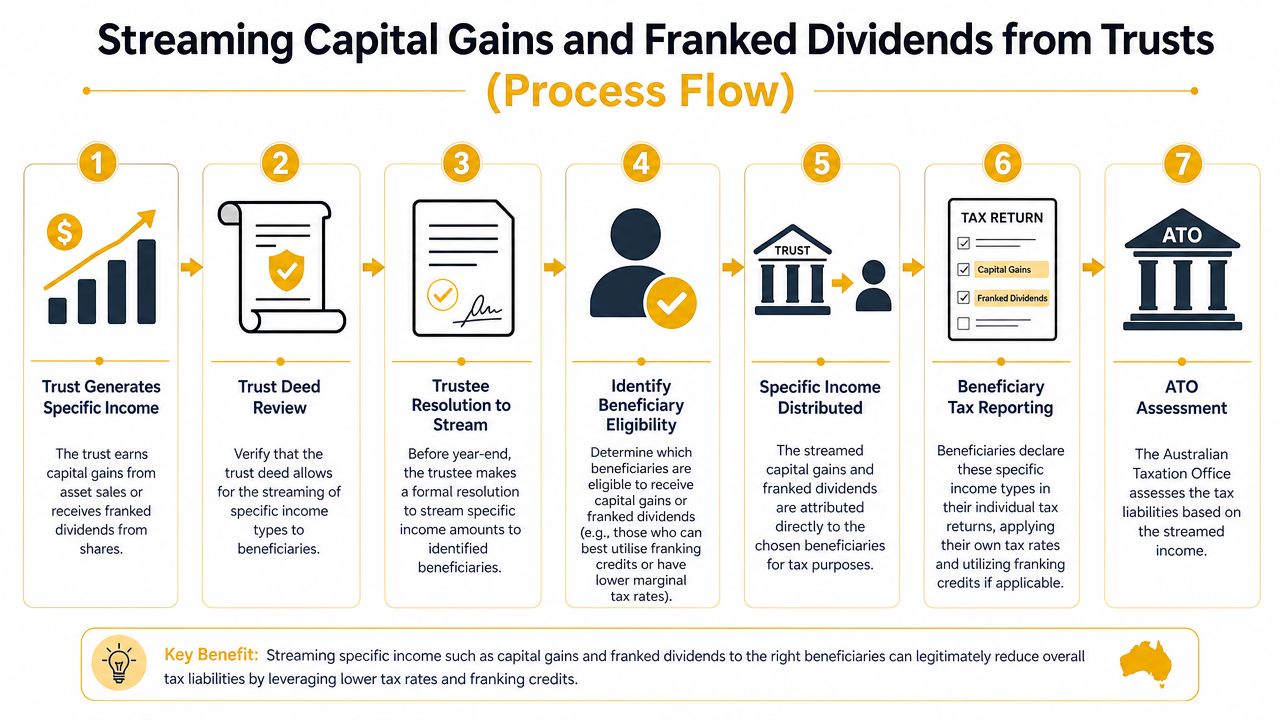
Not all trust income should be treated the same way. Rent, business profit, capital gains, and franked dividends can create very different outcomes depending on who receives them. That’s where streaming becomes one of the most useful trust planning tools.
A trustee may be able to direct specific classes of income to particular beneficiaries if the trust deed allows it and the paperwork is handled properly. Done well, that can improve the tax outcome without doing anything artificial.
Capital gains need their own treatment
Consider a family trust that sells an investment asset. That gain isn’t the same as ordinary business income. If the trust deed permits streaming and the trustee resolves correctly, the gain may be directed to a beneficiary who is best placed to bear that tax outcome.
For investors, this matters because one beneficiary may be better positioned than another to absorb the gain. A trustee who lumps everything together can waste the flexibility that the structure was meant to provide.
Franked dividends are different again
Franked dividends bring another layer into the decision because of the franking credits attached. A low-income beneficiary may appear attractive, but the practical value depends on that beneficiary’s wider tax position and, looking ahead, the proposed trust changes from 2028.
If you need a refresher on how those credits work, this guide on what a franking credit is is worth reviewing before making a distribution decision.
Two simple practical examples
Here are two broad examples that reflect how trustees often think about streaming:
- Capital gain to an individual beneficiary
A trust sells an investment asset. The trustee reviews the deed and decides a specific adult beneficiary is the right person to receive that capital gain because their broader tax position makes the gain easier to manage than if it were spread blindly.
- Franked dividends to a beneficiary who can use the credits effectively
The trust receives fully franked dividends from shares. The trustee considers which beneficiary is best placed to report that income and make practical use of the associated credits within the family’s wider tax position.
Streaming is only useful when the deed allows it and the resolution is specific. Generic paperwork usually isn’t enough.
What actually works
Trustees usually get better outcomes when they:
- Review the deed first. If the deed doesn’t support streaming, the tax theory won’t save you.
- Separate income classes clearly in the accounts.
- Document the trustee resolution with precision before year-end.
What doesn’t work is trying to retrofit the decision after the year has closed, or treating all trust income as interchangeable. For investors and business owners with shares, property sales, or lumpy one-off gains, that’s often where the biggest tax differences appear.
Upcoming Changes: The New 30% Minimum Trust Tax
A common Inner West scenario looks like this. The trust has business income or investment income, and the family plans to distribute part of it to a lower-income spouse, an adult child at uni, or a retired parent. On paper, that can still look sensible today. Under the proposed new rules, that same decision could leave the family paying more tax and getting less cash back than expected.
The Australian federal government has proposed a new minimum tax rule for discretionary trusts, with a proposed start date of 1 July 2028, subject to legislative change. According to Moore Australia’s Federal Budget summary on the proposed trust minimum tax, the proposal would impose a 30% minimum effective tax rate on certain discretionary trust distributions. Where a beneficiary’s own tax rate is below that level, the trustee-paid tax would be non-refundable.
For many families, the theory and the cash outcome are no longer the same.
Under the usual trust planning approach, trustees often direct income to family members on lower marginal rates. That can still work under current rules. The proposed measure changes the result for low-income beneficiaries because the family may lose the benefit of those lower rates once a 30% floor applies.
Why tradies, investors, and family groups should pay attention
We see this risk most often in family groups where trust is used in a practical, everyday way. A builder distributes to a spouse who works part-time in the business. A property investor includes a retired parent. A family with adult children uses the trust to spread income while one child is still studying. These are not aggressive structures. They are standard family arrangements built around cash flow.
If the proposal becomes law in its current form, some of those distributions may still be legally valid but produce a weaker family result. The tax is one problem. The household cash position is the bigger one.
The lost credit trap
The trap is simple. If the trustee pays tax at 30% and the beneficiary’s own tax position is below that rate, the extra tax does not come back as a refund under the proposal. The credit is effectively stranded inside the outcome.
That matters most for low-income beneficiaries. It includes the spouse helping a few days a week, the retired parent with limited other income, or the adult child with only part-time wages. A distribution that looked efficient under the old playbook can become expensive once those excess credits are lost.
Easy Refunds’ discussion of the family trust minimum 30% tax rate also highlights this risk for beneficiaries under the 30% threshold, including lower-income earners who would not be able to use the full amount of tax already paid.
A practical example
Say a family trust distributes income to a tradie’s spouse because she has very little other taxable income. Under current settings, that choice may reduce the family’s overall tax bill.
If the proposed minimum tax applies, the trustee may pay 30% on that distribution. If her personal rate is lower, there is no refund of the excess. The distribution still happens. The family still includes the income. But the tax savings that justified the decision is gone, and the family can be left with less after-tax cash than expected.
That is the part many trustees miss. The trust resolution may still be valid, but the family budget bears the cost.
What to do now
There is no reason to panic, and there is no reason to assume every family trust stops working. The measure is still proposed, not a law. It is also aimed at discretionary trusts, not every trust arrangement.
The practical step now is to review who currently receives trust income and why. Families who rely on low-income beneficiaries as part of the annual distribution pattern should model the numbers early, especially if the trust is holding business profits, share income, or property income. In our experience, the right response is rarely a rushed restructure. It is a clear review of the deed, the beneficiaries, the cash needs of the family, and the likely tax cost if the proposed rules proceed.
Frequently Asked Questions About Trust Tax
What is a bucket company in a trust structure?
A bucket company is usually a corporate beneficiary used to receive trust income when the family wants to cap the immediate tax rate at the company level rather than distribute more income to individuals. It can help in the right circumstances, but it doesn’t turn trust income into free personal cash. If the family later wants that money out of the company, further tax and compliance questions arise.
Do beneficiaries need to be physically paid each year?
Not always. What matters first is whether the beneficiary is presently entitled under a valid trustee resolution and the deed. In practice, that means the legal entitlement can exist before the cash is transferred. But trustees need to be careful. If you leave amounts unpaid for long periods without proper records, loan treatment, or balance sheet clarity, you can create avoidable problems.
Good trust records don’t stop at the resolution. The balance sheet and beneficiary accounts also need to make sense.
What deadlines matter most for trust distributions
The key practical deadline is getting the trustee decision made by year’s end and making sure it complies with the deed. Waiting until the tax return stage is usually too late for the underlying legal entitlement. Trustees should also allow enough time to review the deed, classify income correctly, and prepare support for the accounting records.
Will the proposed 30% minimum tax apply to every trust
No. The proposal is aimed at discretionary trusts, not every trust structure. As noted in Tax at Hand’s summary of the Federal Budget trust measure, the proposed 30 per cent minimum tax on discretionary trusts excludes widely held trusts, such as most managed investment trusts, and superannuation funds, including self-managed super funds (SMSFs).
Is a family trust still worth keeping
Sometimes yes, sometimes no. If the trust still gives your family flexibility, asset separation, and workable tax outcomes, it may remain useful. If the trust is only being kept because someone once said it was “good for tax”, that’s not enough. The right answer depends on the deed, the assets, the family group, and the proposed 2028 changes.
Your Next Steps for Smart Trust Management
The practical takeaway is simple. There isn’t one fixed trust tax rate for a family trust. The result depends on the beneficiary, the trustee’s decisions, the trust deed, and the quality of the year-end process.
That’s why smart trust management starts before 30 June, not when the tax return is due. Trustees should review the deed, confirm who can receive income, check whether streaming is available, and stress-test whether the planned distribution still makes sense for the family’s real cash flow. That’s especially important for tradies, investors, and family businesses who’ve relied on lower-income beneficiaries in the past.
The proposed 30% minimum tax from 1 July 2028 has made that review more urgent. If your current strategy depends on distributing to lower-income family members, don’t assume it will keep working the same way.
If your trust owns property, receives dividends, carries business income, or has a bucket company in the mix, get the structure reviewed early. The best trust advice usually prevents a mistake before it appears in a tax assessment.
If you want practical help with family trust tax planning, trustee resolutions, capital gains, or preparing for the proposed 2028 trust changes, speak with EndureGo Tax. Our registered tax agents and CPA-qualified team work with tradies, investors, and small businesses across Inner West Sydney, Belrose, and Adelaide. Call 1800 841 312 or book through the website to get clear advice before year’s end, not after the damage is done.
