


As tax time approaches, many Australians begin to question whether they’re claiming every entitlement. After all, the Australian tax system, governed by the Australian Taxation Office (ATO), provides numerous opportunities to reduce taxable income, yet navigating the legislation can be a complex task. Therefore, understanding the specific things you can claim on tax is the first and most critical step towards ensuring you don’t pay more than necessary.
For example, from home office running costs and vehicle expenses to often-overlooked self-education deductions, each legitimate claim is a potential boost to your refund or a reduction of your tax payable. That’s why this guide is specifically designed for individuals and small business owners, including tradies and those with capital gains concerns, in communities from Ashfield, Inner West Sydney. With this in mind, we provide expert, actionable insights into the most common and frequently missed deductions available.
In addition, we will break down the essential rules, offer practical, real-world examples relevant to your situation, and link directly to the governing ATO legislation. Ultimately, our goal is to empower you to prepare and lodge your 2025 tax return with confidence and accuracy. So, let’s explore how you can strategically and legitimately maximise your tax outcome this financial year.
1. Work-From-Home & Home Office Expenses
The rise of remote and hybrid work models means that understanding what work-from-home expenses you can claim on tax is more critical than ever. In fact, the Australian Taxation Office (ATO) allows you to claim a deduction for costs incurred while earning your income from home, but it’s essential to use the correct method to maximise your return and ensure compliance. Whether you have a dedicated home office in your Ashfield home or you work from a shared space in your apartment, knowing the rules can make a real difference to your financial outcome.

Choosing Your Method
You have two options for claiming these deductions: the ‘actual cost’ method or the ‘fixed rate’ method.
First, let’s look at the Fixed Rate Method (Revised): From 1 July 2022, this simplified method allows you to claim 67 cents for every hour you work from home. This rate already covers energy, internet, mobile, and home phone usage, as well as stationery. For example, if you work 1,500 hours from home during the year, your claim would be 1,500 x $0.67 = $1,005. However, you must keep a record of your total hours worked (e.g., a diary or timesheet) and have at least one corresponding bill for each expense category.
On the other hand, the Actual Cost Method requires calculating the specific work-related percentage of your actual running expenses. Although this method is often more complex, it can yield a larger deduction if you have significant costs. For instance, a freelance graphic designer would calculate the floor area of their workspace (e.g., 10% of the total home area) and claim that percentage of their electricity, gas, and internet bills. In addition, they could claim depreciation on office equipment, which can significantly increase their deductions.
Actionable Tips for Ashfield Residents
To ensure your claim is substantiated, meticulous record-keeping is non-negotiable. For the actual cost method, understanding all associated expenses, including reviewing the pricing for essential work-from-home software, is crucial for an accurate calculation. Remember, travel from home to your primary workplace is generally not deductible. For comprehensive ATO guidance, refer to Law Companion Ruling LCR 2023/1.
Actionable Call to Action: Start a spreadsheet or use a dedicated app today to log your work-from-home hours and file your utility bills digitally. This will make substantiating your claim effortless at tax time. For a deeper understanding of these rules, you can learn more about substantiating your home office deductions.
2. Business Meals and Entertainment
Navigating the rules for business meals and entertainment is one of the more nuanced things you can claim on tax, and understanding the distinctions is crucial for compliance and maximising deductions. Specifically, the ATO differentiates between providing sustenance for business purposes and offering entertainment, with different tax implications for each. For example, this applies whether you’re a consultant taking a client to lunch or an Ashfield-based business hosting an end-of-project team dinner.

Substantiation and Deductibility
The key to claiming these expenses lies in their direct connection to earning your income. In general, the cost of food and drink consumed by a current or potential client during business discussions is deductible. However, if the event is primarily social or recreational, it’s typically considered entertainment and is not deductible.
For example, deductible meal expenses include:
Taking a prospective client to a café to discuss a new contract.
Providing a catered lunch during a mandatory employee training session.
Meals consumed while travelling for work (e.g., attending a conference).
On the other hand, non-deductible entertainment includes:
Taking a client to a sporting event.
Hosting a social staff Christmas party at a restaurant.
Shouting your team drinks on a Friday with no formal business agenda.
Actionable Tips for Ashfield Residents
Meticulous record-keeping is your best defence in a tax audit. Specifically, for every meal, you must document the date, cost, location, attendees, and the specific business purpose of the discussion. Moreover, using a dedicated business credit card simplifies tracking and keeps your personal and professional expenses separate. In fact, many business owners invest in their financial literacy to manage these complexities better; exploring options like accounting, bookkeeping, and finance courses can provide the skills needed for precise tax management. For further clarity, detailed ATO guidance on what constitutes entertainment can be found in Taxation Ruling TR 97/17.
Actionable Call to Action: For your next business meal, immediately take a photo of the receipt and use a note-taking app on your phone to record who attended and what business was discussed. By doing this, you create a contemporaneous record that satisfies ATO requirements and strengthens your position if ever audited.
3. Vehicle and Transportation Expenses
If you use your car for work-related purposes, you can claim a significant deduction on your tax return. The Australian Taxation Office (ATO) allows you to claim the costs of using your personal vehicle to earn your income, but it’s crucial to understand that this does not typically cover the daily commute between your home and primary workplace. This deduction is particularly relevant for a tradesperson travelling between job sites in Inner West Sydney or a real estate agent in Ashfield driving to client meetings.

Choosing Your Method
There are two primary methods for calculating your claim, and selecting the right one depends on your circumstances and record-keeping habits.
Cents per Kilometre Method: This is a straightforward approach allowing you to claim a set rate for each business-related kilometre travelled, up to a maximum of 5,000 kilometres per vehicle. From 1 July 2023, the rate is 85 cents per kilometre. For example, if a community nurse travels 4,000 km between patient homes in a year, their claim would be 4,000 x $0.85 = $3,400. You need to show how you calculated the business kilometres (e.g., through a diary).
Logbook Method: While requiring more detailed records, this method can result in a much larger deduction, especially for high-use vehicles. You must maintain a logbook for 12 continuous weeks to determine the business-use percentage of your car. For example, if your logbook shows 70% business use, you can claim 70% of all car expenses, including fuel, insurance, registration, and depreciation.
Actionable Tips for Ashfield Residents
Meticulous record-keeping is the key to a successful claim for vehicle expenses, which is one of the most valuable things you can claim on tax. Use a smartphone app or a physical logbook to diligently record the date, destination, purpose, and odometer readings for every business trip. You must also keep all receipts for expenses if using the logbook method. For detailed ATO requirements, refer to Division 28 of the Income Tax Assessment Act 1997.
Actionable Call to Action: Download a logbook app today and start tracking your next work-related trip. Even if you plan to use the cents per km method, this data will help you accurately calculate and justify your total business kilometres. For a more comprehensive guide on maximising your return, you can learn more about substantiating your vehicle tax deductions.
4. Professional Development and Education
Investing in your skills is not just a career move; it’s a smart tax strategy. The ATO allows you to claim a deduction for self-education and professional development expenses directly related to your current employment. This is a crucial area of things you can claim on tax, whether you’re a marketing manager taking a digital certification or a tradie in Ashfield completing a course to maintain your licence. The key requirement is that the study must maintain or improve the skills needed for your current role, not for a career change.
The following quick reference summarises the key criteria and categories for claiming these expenses.
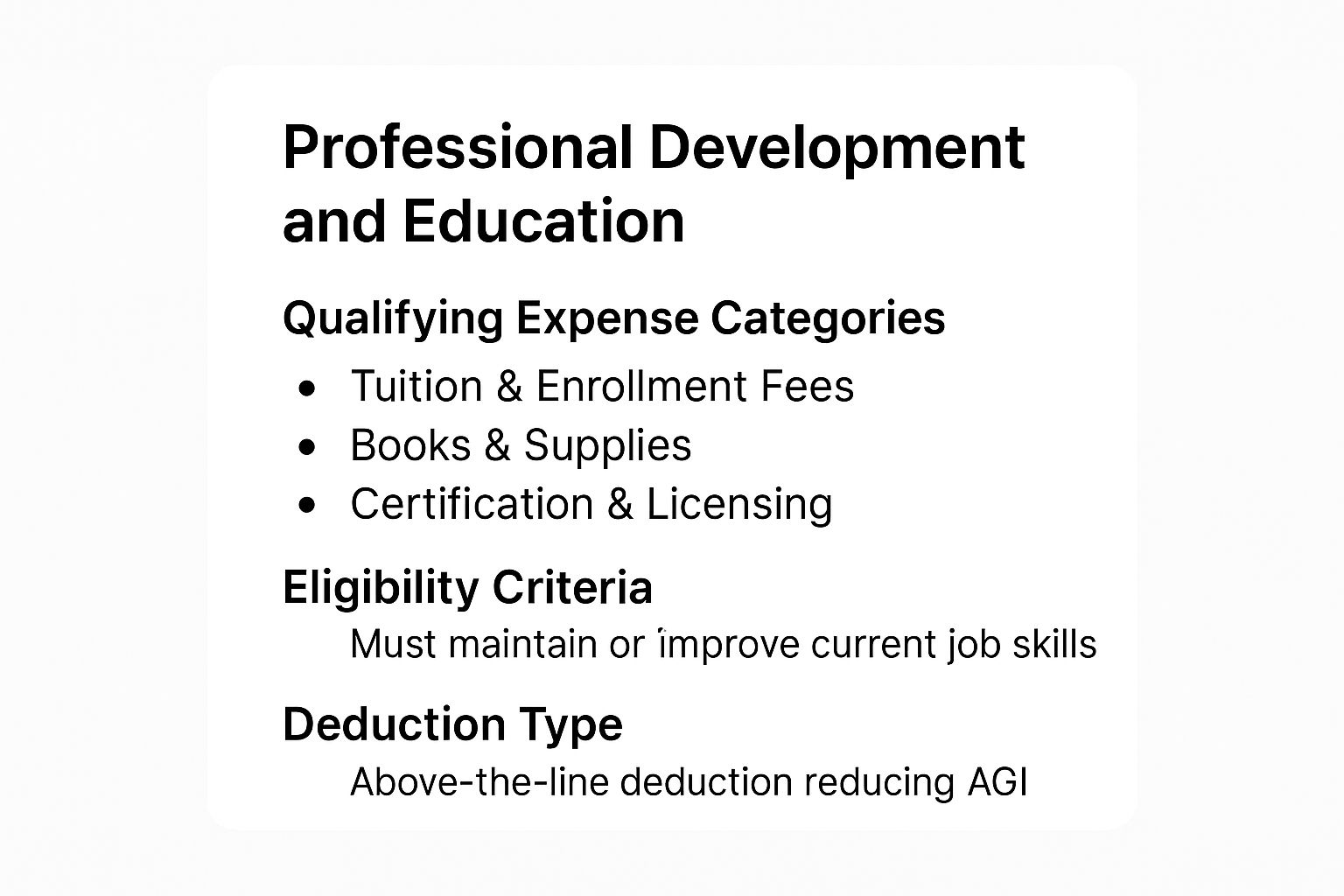
As the infographic highlights, the direct link between education and your current job is paramount for eligibility.
What Can You Claim?
A wide range of costs can be claimed, provided they meet the eligibility test. These are not limited to just course fees.
- Direct Costs: This includes tuition or course fees, textbooks, stationery, and student service fees. For example, a software developer attending a coding bootcamp can claim the full enrolment cost.
- Ancillary Costs: You can also claim associated expenses like travel to and from the course, and even the decline in value (depreciation) of assets like computers used for your study.
Actionable Tips for Ashfield Residents
To ensure your claim is valid, you must keep detailed records and clearly demonstrate the connection to your work. A doctor attending a medical conference, for instance, should keep the event program and receipts for travel and accommodation. For specific ATO guidance on what constitutes an eligible expense, refer to Taxation Ruling TR 98/9.
Actionable Call to Action: Before enrolling in your next course, write a brief justification of how it will maintain or improve the specific skills required in your current job description. Save this with your receipt to strengthen your claim. For more detailed information, learn more about claiming self-education expenses.
5. Medical and Health Insurance Premiums
While most personal medical expenses aren’t deductible in Australia, there’s a specific tax offset that can reduce your tax liability: the net medical expenses tax offset. However, it’s crucial to understand that this offset is being phased out and is now only available for specific types of medical expenses, making it a less common but still valuable claim for eligible taxpayers. Additionally, the private health insurance rebate is a key way the government assists with health costs.
Understanding Medical Expense Claims
The net medical expenses tax offset is now restricted to costs related to disability aids, attendant care, or aged care. To be eligible to claim this offset, you must have received it in both your 2013–14 and 2014–15 income tax returns. This narrow eligibility means it applies to a very limited group of taxpayers, but for those individuals, it remains one of the important things you can claim on tax. For example, an Ashfield resident who previously claimed attendant care services may continue to be eligible for the offset on those specific expenses.
Private Health Insurance Rebate
A more widely applicable benefit is the private health insurance rebate. This is a government contribution towards the cost of your private health insurance premiums. It is income-tested, meaning the rebate percentage you receive depends on your income tier. For instance, a small business owner in Ashfield can claim this rebate either as a reduced premium from their insurer throughout the year or as a refundable tax offset when lodging their annual tax return. This effectively lowers your out-of-pocket health insurance costs.
Actionable Tips for Ashfield Residents
If you believe you might still be eligible for the net medical expenses tax offset, it is essential to review your past tax returns and the specific ATO criteria. For everyone with private health insurance, ensure your income details are correctly updated with your fund to receive the appropriate rebate. For detailed eligibility on the offset, you can refer to the ATO’s guidance on total net medical expenses.
Actionable Call to Action: Check your private health insurance statement at tax time. It will show the total premiums paid and any rebate you’ve already received. Ensure this matches what you claim on your tax return to receive the correct offset.
6. Charitable Contributions
Supporting causes you care about can also provide a valuable tax benefit. The Australian Taxation Office (ATO) allows you to claim a deduction for donations of $2 or more made to a Deductible Gift Recipient (DGR). This is a tangible way to reduce your taxable income while contributing to the community, whether you’re supporting a local Inner West Sydney surf lifesaving club or a community arts project in Ashfield.
What Qualifies as a Deductible Donation?
For a gift to be deductible, it must be a genuine gift or contribution where you receive no material benefit in return. Simply buying a raffle ticket or merchandise from a charity does not count.
Who to Donate to: The organisation must be endorsed as a DGR by the ATO. You can verify an organisation’s DGR status on the ABN Lookup tool. Donations can be monetary (cash, EFT, or credit card) or property, such as shares or real estate. A practical example: your $50 monthly donation to the RSPCA (a registered DGR) is fully deductible.
What Doesn’t Count: You cannot claim donations where you receive a personal benefit, such as event tickets, a pen, or a bumper sticker. Furthermore, donations to social media fundraisers or crowdfunding platforms are only deductible if the platform is acting as a collection agent for a registered DGR.
Actionable Tips for Ashfield Residents
Maximising your claim requires careful documentation. Always obtain and keep a receipt for your donation, as this is your primary evidence. For non-cash donations, like donating shares to a charity, you may need a valuation. Consider setting up regular, automated donations to your chosen DGRs; this simplifies record-keeping and allows for consistent support. You can find detailed rules and verify DGR status on the ATO’s official page for gifts and donations.
Actionable Call to Action: Create a dedicated folder in your email inbox or a physical folder at home specifically for donation receipts. As soon as you donate, file the receipt there so it’s ready for tax time.
7. Union Fees, Subscriptions, and Professional Memberships
Deducting costs associated with your profession is a fundamental part of maximising your tax return. This includes fees for union membership, subscriptions to professional journals or trade publications, and the cost of maintaining registrations with professional bodies. These are all things you can claim on tax, provided they are directly related to earning your income. For an Ashfield-based architect, this might mean their registration with the Architects Registration Board, while for an Inner West teacher, it could be their union fees.
What Qualifies as a Deduction?
The key principle is a clear link between the expense and your current employment. The ATO allows deductions for payments that maintain or advance your knowledge, skills, or professional standing in your field.
- Union & Professional Association Fees: Annual or periodic fees paid to a trade union or a professional association, like the Australian Medical Association or CPA Australia, are fully deductible.
- Professional Subscriptions: The cost of subscribing to industry-specific magazines, academic journals, or online publications that are essential for your role is claimable. For example, a marketing professional in Ashfield could claim their subscription to an industry marketing journal.
- Registration & Licensing: Any compulsory fees for professional registration or licensing required to perform your job, such as a tradesperson’s contractor licence fee, are deductible.
Actionable Tips for Ashfield Residents
To ensure your claim is valid, you must have incurred the expense yourself and not been reimbursed by your employer. Meticulous record-keeping, such as retaining invoices and bank statements, is essential for substantiation. Note that while fees for professional associations are deductible, payments to social clubs or associations with a primarily recreational purpose, even if membership consists of people from your industry, are not. For detailed information, refer to the ATO’s guidance on other work-related deductions.
Actionable Call to Action: Review your bank and credit card statements from the last financial year for any recurring payments to professional bodies or publications. Compile a list of these with their corresponding invoices to claim at tax time.
8. Mortgage Interest Deduction
Understanding which mortgage-related costs are deductible is a crucial part of managing your finances, especially when your home is also a place of business or an investment. The Australian Taxation Office (ATO) has specific rules about when you can claim mortgage interest, and it’s essential to get it right. For property owners in areas like Inner West Sydney, where property values are high, correctly claiming these expenses can significantly impact your tax liability.
When is Mortgage Interest Deductible?
In Australia, the interest on a loan for your primary residence is generally not tax-deductible. However, you can claim the interest on a loan used to purchase an income-producing asset, such as an investment property or shares.
Investment Properties: If you have a loan for a rental property, the interest charged on that loan is a deductible expense. You can claim this against your rental income. For example, a homeowner in Ashfield who rents out a second property can deduct the full interest amount from the loan used to purchase that investment.
Business Use of Home: If you run your business from home or have a dedicated home office, you may be able to claim a portion of your mortgage interest. This is calculated based on the percentage of your home used for income-producing activities. For example, if your home office occupies 15% of your home’s floor space, you may be able to claim 15% of your mortgage interest.
Actionable Tips for Ashfield Residents
Meticulous record-keeping is vital. Ensure your loan accounts are structured correctly; mixing private and investment loan purposes can complicate claims. Always keep bank statements and loan documents that clearly show the interest paid and the purpose of the loan. For detailed information on rental property deductions, the ATO’s guide on Interest expenses is an indispensable resource.
Actionable Call to Action: If you have an investment property loan, download your annual loan statement, which summarizes the total interest paid for the financial year. This is the primary document you’ll need for your claim. If you use your home for business, consult a tax professional to ensure you are apportioning the interest correctly. You can learn more about managing rental property expenses to ensure you are compliant.
9. Retirement Plan Contributions
Making personal contributions to your superannuation fund is a powerful strategy to build your retirement nest egg while simultaneously reducing your taxable income. The Australian Taxation Office (ATO) allows you to claim a tax deduction for these after-tax contributions, effectively turning them into pre-tax contributions. This is a particularly valuable strategy for self-employed individuals or small business owners in Ashfield looking to boost their retirement savings and lower their tax liability.
How to Claim Your Contribution
To claim a deduction, you must make a personal, non-concessional (after-tax) contribution to your super fund and then submit a ‘Notice of intent to claim or vary a deduction for personal super contributions’ form to your fund. You must receive an acknowledgement from your fund before you lodge your tax return.
Self-employed Consultant: A freelance IT consultant in Ashfield earning a high income can make a personal concessional contribution up to the cap. This directly reduces their assessable income, resulting in a significant tax saving while bolstering their super balance for the future.
Small Business Owner: An Ashfield café owner can contribute a portion of their profits to their super. For example, a $10,000 contribution reduces their taxable income by $10,000, saving them tax at their marginal rate, a key consideration for managing cash flow.
Actionable Tips for Ashfield Residents
It’s crucial to be aware of the concessional contributions cap, which is the limit on contributions you can make that are taxed at the lower rate of 15%. Exceeding this cap can lead to extra tax. The contribution must be made and received by your fund by 30 June to be claimed in that financial year. For a detailed breakdown of the current limits, you can learn more about superannuation contribution limits. As per ATO regulations, ensure all paperwork is correctly filed with your fund to validate your claim.
Actionable Call to Action: Contact your super fund before June 30th to confirm the process for submitting a ‘Notice of Intent’ and to get the correct payment details. This proactive step ensures your contribution is processed in time for the financial year.
10. Business Equipment and Technology
Investing in the right equipment and technology is fundamental to business growth, and understanding how to claim these costs on tax can significantly improve your cash flow. The Australian Taxation Office (ATO) provides several ways for businesses to claim deductions for assets like computers, tools, and machinery, whether you’re a tradie or a consultant in Ashfield. These deductions can often be claimed immediately, providing an instant benefit.
Choosing Your Method
Depending on the cost of the asset and your business turnover, you can claim the expense immediately or deduct it over time.
Temporary Full Expensing: Although this measure ended on 30 June 2023, assets purchased before this date may still be eligible. This allowed businesses to deduct the full cost of eligible depreciating assets immediately.
Instant Asset Write-Off: For the 2023–24 income year, businesses with an aggregated turnover of less than $10 million can immediately deduct the full cost of eligible assets costing less than $20,000. For instance, a construction company in Inner West Sydney could immediately write off a new $15,000 trailer purchased in August 2023.
General Depreciation Rules: If an asset doesn’t qualify for an immediate write-off (e.g., it costs over $20,000), you can claim a deduction for its decline in value (depreciation) over its effective life.
Actionable Tips for Ashfield Businesses
Meticulous record-keeping is crucial for substantiating your claims for these valuable things you can claim on tax. Always keep invoices, receipts, and a detailed asset register that outlines the date of purchase, cost, and the percentage of business use. Consider the timing of your purchases; acquiring an asset just before the end of the financial year can bring forward your tax deduction. For specific rules, refer to the ATO’s guidance on the instant asset write-off for small businesses.
Actionable Call to Action: Create a simple asset register in a spreadsheet. For every business asset you buy, log the date, description, cost, and business use percentage. This will be invaluable for your accountant at tax time.
Tax Deduction Claims: Top 10 Comparison
Deduction Type | Implementation Complexity 🔄 | Resource Requirements 💡 | Expected Outcomes ⭐📊 | Ideal Use Cases 💡 | Key Advantages ⚡ |
|---|---|---|---|---|---|
| Home Office Deduction | Moderate – Requires regular exclusive use & record-keeping | Detailed expense tracking, space measurement | Significant tax savings if the criteria are met | Self-employed, remote workers with dedicated space | Simplified or actual expense methods are available |
| Business Meals and Entertainment | Low to Moderate – Must document business purpose | Receipts, participant details, business logs | Partial deduction (50%) on meals | Client meetings, employee meals, business travel | Helps offset dining costs, some 100% exceptions |
| Vehicle and Transportation | Moderate to High – Detailed mileage logs needed | Mileage tracking apps or logs, receipts | Deductions based on mileage or expenses | Professionals traveling between sites or clients | The standard mileage method is simple; actual mileage may yield more |
| Professional Development & Education | Moderate – Must prove relevance to current job | Receipts, certificates, and course documentation | Deductible education expenses linked to a job | Continuing education, certification maintenance | Encourages skill growth, wide expense inclusion |
| Medical and Health Insurance | Moderate – Threshold limits and itemizing needed | Detailed medical records, receipts | Deduction for expenses above 7.5% AGI; HSA benefits | Self-employed, chronic condition patients | Self-employed health insurance deduction, HSA tax advantages |
| Charitable Contributions | Low to Moderate – Requires documentation | Receipts, appraisals for property over $5,000 | Itemized deduction with high AGI limits | Donors to IRS-qualified charities | Encourages giving, carry-forward allowed |
| State and Local Tax (SALT) | Low – Limited by $10,000 cap, itemizing required | Tax payment records | Itemized deduction capped at $10,000 total | Taxpayers in high state/local tax areas | Choice between income or sales tax deduction |
| Mortgage Interest Deduction | Moderate – Must itemize and meet debt limits | Form 1098, mortgage statements | Significant deduction on mortgage interest | Homeowners with qualified mortgages | Reduces taxable income, encourages homeownership |
| Retirement Plan Contributions | Low to Moderate – Contribution limits and deadlines | Contribution records | Above-the-line deduction reduces AGI | Self-employed, employees saving for retirement | Builds savings with immediate tax benefits |
| Business Equipment & Technology | Moderate to High – Depreciation and expensing rules | Asset purchase records, use tracking | Immediate or accelerated deductions available | Businesses investing in equipment or tech assets | Section 179 and bonus depreciation options |
Partner with the Experts to Maximise Your Tax Return
Navigating the complexities of the Australian tax system can feel like an overwhelming task. From calculating home office expenses to substantiating vehicle logbooks and ensuring your professional development claims are directly related to your current income-earning activities, the details matter immensely. That’s why this guide has armed you with a comprehensive list of potential things you can claim on tax, covering everything from business equipment and technology to charitable donations and retirement plan contributions. In turn, each deduction represents a legitimate opportunity to reduce your taxable income and, ultimately, increase your tax refund or lower your tax payable.
More importantly, the key takeaway is that diligence and documentation are your greatest allies. The Australian Taxation Office (ATO) requires you to substantiate your claims with clear, organised records. For instance, a simple receipt for a business meal, a detailed logbook for your car, or an invoice for a training course can be the difference between a successful claim and a rejected one. Furthermore, as we’ve explored, the nuances are significant. For example, understanding the difference between a repair and an improvement for a rental property or knowing the threshold for capital gains tax (CGT) implications can have a substantial impact on your financial outcome.
From Knowledge to Action: Your Next Steps
Mastering these concepts moves you from being a passive taxpayer to an active participant in managing your financial health. However, applying this general knowledge to your unique situation as a tradie or a small business owner in Inner West Sydney, or a property investor in Ashfield, is where the real value is unlocked. Because your financial picture is distinct, a one-size-fits-all approach rarely yields the best results.
To put this knowledge into practice, consider the following actionable steps:
First, review your records: Go back through your bank statements and receipts from the past financial year with this list in hand. Did you miss any potential claims for work-related car expenses, self-education, or tools and equipment?
Next, implement a system: Don’t wait until next June to get organised. Start now by using a digital app or a simple spreadsheet to track your expenses as they happen. This way, you prevent the last-minute scramble and ensure you don’t miss out on valuable deductions.
Finally, seek professional guidance: The sheer volume of tax legislation, as seen in instruments like the Income Tax Assessment Act 1997, is vast. A qualified tax agent can identify deductions specific to your industry and circumstances that you may not have even considered, while also protecting you from potential ATO audits or objections.
Ultimately, the goal is not just to file a tax return, but to file an optimised one. Indeed, understanding the full spectrum of things you can claim on tax is the first step. Then, the next step is partnering with an expert who can help you navigate the legislation, ensure compliance, and strategically plan for the future. As a result, this transforms tax time from a stressful obligation into a strategic financial opportunity.
Don’t leave your hard-earned money on the table or risk costly errors. The specialists at EndureGo Tax provide expert, tailored advice to clients across Ashfield, Inner West Sydney, ensuring you claim every legitimate deduction you are entitled to. Contact EndureGo Tax today to secure your financial advantage and approach tax time with confidence.
