


As a small business owner or tradie in Australia, mastering the tax calendar is a non-negotiable step towards financial control. Forget the standard January-to-December calendar—the Australian tax system operates on its own distinct schedule, and understanding it is critical for compliance and strategic planning.
The most important framework to commit to memory is the Australian tax year, which runs from 1 July to 30 June annually. For most individuals lodging their own tax return, the key deadline for lodgement is 31 October. Adhering to this timeline is the foundational step in maintaining a positive relationship with the Australian Taxation Office (ATO).
Decoding Australia’s Tax Year Dates
It’s easy to feel overwhelmed by the labyrinth of deadlines that define Australia’s unique tax calendar. Unlike many other nations, we operate on a ‘financial year’ (or ‘fin year’), a structure that underpins everything from your personal tax return to your company’s compliance schedule.
This guide is engineered to eliminate that confusion, particularly for the ambitious small business owners, tradies, and investors in our local Ashfield and Belrose communities. Consider this your expert manual for managing your tax obligations without the typical stress and uncertainty.
The Foundation of Australian Tax
The 1 July to 30 June financial year has been the backbone of our tax system for over a century. This period dictates when you must have your financial records in order and your return lodged. That 31 October deadline is an immovable fixture for anyone lodging their own return.
It’s no surprise that so many Australians seek expert guidance. Last year alone, ATO data revealed that registered tax agents managed a staggering 6.3 million of the 12.4 million individual returns lodged. For businesses navigating the complexities of BAS, SMSF compliance, or emerging areas like cryptocurrency tax, a proficient agent is not a luxury—it’s an essential business asset.
What This Guide Covers
We are not here to offer generic advice. Our purpose is to provide you with a clear, actionable strategy to master your tax compliance.
Here’s what we will break down for you:
- Key Deadlines: We will cover the must-know lodgement and payment dates for individuals, companies, trusts, and SMSFs.
- BAS and PAYG: You will gain a firm grasp of your regular reporting schedules, ensuring you never miss a critical lodgement.
- Common Pitfalls: We will highlight the simple errors that trigger ATO penalties and, more importantly, how to proactively avoid them.
Our objective is simple: to transform complex tax regulations into a practical, manageable checklist. Preparing for tax time should not be a source of anxiety. With expert knowledge and a robust plan, you can remain compliant and focus on what truly matters—growing your business and achieving your financial goals.
Why Is the Financial Year 1 July to 30 June Anyway?
Ever wondered why Australia’s tax year appears to operate in a different orbit compared to much of the world? While countries like the US adhere to a straightforward January-to-December calendar, we are finalising our financial affairs on 30 June. It may seem arbitrary, but this system is actually rooted in deep, practical Australian history.
It all dates back to our agricultural origins. For the farmers and graziers who powered the early economy, a 30 June year-end was perfectly logical. It aligned with the natural rhythm of the seasons, allowing them to sell their wool and wheat after the main harvest and shearing seasons had concluded. It was the most rational time to calculate profits.
This practical, seasonal cadence was eventually codified into our national framework when federal income tax was introduced. The government simply adopted the system that was already in widespread use.
From the Paddock to Parliament
What began as a rural convention swiftly became official government policy, cementing our unique tax year dates. Today, this timeline is woven into the fabric of the Australian economy, influencing everything from federal and state budgets to corporate financial reporting and, of course, the Australian Taxation Office’s entire compliance architecture.
Unlike a January start, our mid-year cycle shapes the flow of business across the nation. For a tradie in Belrose or a cafe owner in Ashfield, it’s the reason why End of Financial Year (EOFY) sales and tax planning kick into high gear as winter approaches.
The Australian financial year is legally entrenched by the Income Tax Assessment Act 1997. This legislation formally defines the “income year” for taxpayers, making the 1 July to 30 June period the default for assessing nearly all income tax in Australia.
Understanding this history is more than a trivia point—it clarifies why these dates are completely non-negotiable. The entire Australian economic engine is calibrated to this timeline.
Why This Actually Matters for Your Business
Knowing the ‘why’ behind the 1 July to 30 June tax year provides the essential context for the ‘what’ and ‘when’ of your obligations. It’s not just another deadline; it’s the rhythm of Australian commerce.
Here’s the real-world takeaway for you:
- Smart Planning is Everything: Your business strategy, especially concerning major asset purchases or last-minute superannuation contributions, must be laser-focused on that 30 June cut-off. It is your final opportunity to maximise deductions for the financial year.
- Master Your Cash Flow: This cycle helps you forecast when significant tax liabilities will fall due. You can plan your cash flow to manage BAS payments and your final income tax bill without facing a damaging financial shock.
- Think Globally, Act Locally: If you collaborate with international clients or suppliers, remember their financial year is likely different. This can impact invoicing, payment cycles, and project deadlines, so keep it on your radar.
Practical Example: You are a builder planning to purchase a new ute. Buying it before 30 June allows you to claim depreciation in that year’s tax return, immediately reducing your taxable income. If you wait until the first week of July, you delay that tax benefit by a full 12 months.
Ultimately, this history lesson reinforces just how rigid the ATO’s deadlines are. The system has been built on this foundation for over a century, which is why precise timing is so critical.
Don’t let Australia’s unique financial year catch you unprepared. Mastering these dates is the first step to a stress-free tax time. To align your business strategy with the tax calendar, book a professional consultation with the experts at EndureGo Tax today.
Critical Tax Deadlines for Individuals and Sole Traders
For individuals and sole traders across Australia, the end of the financial year on 30 June initiates a familiar countdown. Once this date passes, the clock officially starts ticking on lodging your tax return. Locking these dates into your calendar is the essential first step to staying compliant with the ATO and avoiding a last-minute scramble.

The primary date etched in the public consciousness is 31 October. If you are lodging your own tax return, this is your deadline. Missing it exposes you to ATO penalties. This deadline applies to millions of Australians, from employees with straightforward tax affairs to sole traders navigating their first year of business.
The Standard 31 October Deadline
The 31 October deadline can be considered the default setting for the Australian tax system. It provides a four-month window after the financial year concludes to collate your documents, calculate your income and deductions, and submit your return.
For many, this is ample time. However, if you are a busy tradie in Belrose or a freelance consultant in Ashfield, juggling jobs, invoices, and bookkeeping can make this deadline feel like it’s approaching at an alarming rate. Missing it can trigger a Failure to Lodge (FTL) penalty, which increases the longer your return remains outstanding.
This is precisely where understanding your options can save you significant stress and money. You are not necessarily bound by that October deadline.
Unlocking a Major Advantage with a Tax Agent
Here is the game-changer: engaging a registered tax agent like the team at EndureGo Tax completely transforms your lodgement schedule. Instead of a rigid deadline on 31 October, you gain access to a special lodgement program with deadlines extended well into the following year.
This is not an unofficial loophole; it is a formal arrangement the ATO provides to accredited tax professionals. As long as you appoint an agent before 31 October, you are automatically added to their client list, and your new deadline could be as late as 15 May of the following year.
This extension is one of the single most significant benefits of using a professional. It converts your tax return from a frantic sprint into a manageable marathon, affording you crucial breathing room and superior control over your cash flow.
For a sole trader, that additional time is invaluable. It means you can focus on your busy summer season without a tax deadline looming. To explore this further, examine our expert guide on the tax return for sole traders.
Managing PAYG Instalments and Other Debts
In addition to your annual tax return, many sole traders and individuals with investment income must also manage Pay As You Go (PAYG) instalments. This system is designed to help you pay your anticipated income tax in smaller increments throughout the year, preventing a single, large liability at year-end.
These PAYG instalments are typically due quarterly, and the dates often align with your Business Activity Statement (BAS) lodgements:
- Quarter 1 (July – September): Due 28 October
- Quarter 2 (October – December): Due 28 February
- Quarter 3 (January – March): Due 28 April
- Quarter 4 (April – June): Due 28 July
Meeting these dates is critical to avoid interest charges. Furthermore, if you have a HELP or HECS debt, the ATO calculates your compulsory repayment based on your income when you lodge your tax return, and the final payment is due on the same date as your income tax.
Here’s a practical example:
Imagine you are a carpenter based in Belrose. By engaging a tax agent, your lodgement deadline is extended to 15 May. This means you do not have to finalise your tax liability for almost eleven months after the financial year has ended. This extended timeframe is invaluable for managing cash flow, ensuring you have the necessary funds available without disrupting your business operations during peak periods.
Mastering these individual and sole trader tax dates is fundamental to your financial health. While the 31 October deadline is a strict rule for self-lodgers, partnering with an expert unlocks a more flexible and strategic approach to managing your tax obligations.
Ready to take control of your tax deadlines? Book a consultation with EndureGo Tax today and let us manage the calendar for you.
What About Companies, Trusts, and SMSFs? Key Deadlines to Watch
Once your business structure evolves beyond a sole trader, the tax compliance landscape becomes more complex. For companies, trusts, and Self-Managed Super Funds (SMSFs), the core financial year remains 1 July to 30 June. However, the deadlines and obligations layered on top are far more specific.
For any company director in Ashfield or an SMSF trustee on the Northern Beaches, mastering this schedule is not just good practice—it is fundamental to maintaining compliance and protecting your assets.
Unlike an individual tax return, these structures are governed by rules from both the ATO and, for companies, the Australian Securities and Investments Commission (ASIC). This means a single missed deadline can trigger a cascade of negative consequences, impacting your business’s registration status and your finances with penalties.
Why Your Lodgement Date Isn’t Set in Stone
The ATO assigns lodgement deadlines based on your entity type, lodgement history, and sometimes even your total income. While a “standard” due date exists, nearly every business operating under one of these structures partners with a registered tax agent. The reason is simple: it provides access to a staggered, more favourable lodgement program.
This is a game-changer for managing cash flow and provides the necessary time to prepare accurate financials without a last-minute panic.
A new company, for instance, may have a different first-year deadline compared to an established family trust with a perfect compliance record. A one-size-fits-all approach is insufficient; your specific circumstances dictate your dates. Over the years, Australia’s tax system has retained its 1 July to 30 June anchor, but tax rates and compliance demands have evolved—especially for structures like SMSFs that are under constant audit scrutiny. You can explore long-term trends and statistics on the ABS website.
A Side-by-Side Look at the Key Deadlines
To truly grasp the different requirements, it helps to see them laid out together. Here’s a breakdown of the typical deadlines for companies, trusts, and SMSFs when lodging through a tax agent like EndureGo Tax.
Lodgement and Payment Deadlines by Business Structure
| Entity Type | Key Lodgement Deadline (with Agent) | Key Payment Deadline | Common Considerations |
|---|---|---|---|
| Company | Varies, but usually 15 January to 15 May. | Follows the lodgement date. | Must also meet ASIC annual review deadlines to remain registered. This is a separate but equally critical obligation. |
| Trust | Generally 15 May, but can differ. | Follows the lodgement date. | Crucially, beneficiary distributions must be legally finalised by 30 June each year. There are no exceptions. |
| SMSF | Often 28 February for new funds, 15 May for established ones. | Follows the lodgement date. | An annual independent audit is non-negotiable and must be completed before the tax return can be lodged. |
As you can see, while the ultimate deadline may appear similar, the compliance journey varies significantly depending on your business structure.
What This Looks Like for Local Businesses
Let’s apply these dates to real-world scenarios you might encounter in our community.
Example 1: The Ashfield Family Trust
The Chen family operates a thriving cafe in the Inner West through a discretionary trust. Their primary goal is to distribute profits to family members in the most tax-effective manner. For them, the most critical date on the calendar is not the lodgement date—it’s 30 June. Before midnight, they must have legally documented minutes detailing how the trust’s income for the year will be allocated. If they fail to do this, the trustee could be taxed at the highest marginal rate. Once this is complete, their tax agent has until the following 15 May to prepare and lodge the trust’s tax return.
Example 2: The Belrose SMSF
A small business owner on the Northern Beaches uses an SMSF to build her retirement wealth. Her fund’s financial year also concludes on 30 June. However, before her accountant can even begin preparing the SMSF annual return, the fund must be audited by an independent, registered SMSF auditor. With a final lodgement deadline of 15 May, she needs to initiate the audit process months in advance to avoid a last-minute compliance crisis.
Don’t Forget Your ASIC Duties
For companies, ATO compliance is only half the story. You must also meet your obligations to ASIC. This involves paying your annual review fee and ensuring all your company details are current and correct. This is where a registered ASIC agent is an invaluable asset.
An ASIC agent handles all that critical corporate administration, such as:
- Lodging changes to company details (e.g., new directors, addresses, or shareholders).
- Managing the annual company statement review and payment.
- Ensuring the company avoids late fees and the serious risk of being deregistered by ASIC.
Missing these deadlines can cause far greater problems than a simple ATO penalty. It can jeopardise the legal status of your entire business.
For any business operating as a company, trust, or SMSF, diligent management of tax year dates is not just good housekeeping—it’s essential for survival and growth. The complexity almost demands professional oversight.
Don’t leave your company, trust, or SMSF compliance to chance. Contact EndureGo Tax today for expert guidance and ensure you meet every deadline, every time.
Mastering Your BAS and PAYG Schedules
Beyond your annual tax return, your most frequent interaction with the ATO will be through your Business Activity Statement (BAS) and Pay As You Go (PAYG) withholding. For most small businesses, these deadlines represent the true pulse of the financial year. Master this rhythm, and you will manage your cash flow effectively. Falter, and you risk financial and compliance complications.

Consider your BAS and PAYG obligations as regular progress reports to the tax office. They account for the GST you have collected and the tax you have withheld from employee wages. Falling behind is not an option if you wish to avoid penalties and maintain your business’s financial health.
Quarterly vs Monthly Reporting Cycles
How often must you report? The ATO determines this based on your business turnover.
Most small businesses, such as a local cafe in Belrose or a tradie servicing the Northern Beaches, fall into the quarterly reporting cycle. This is the default for businesses with an annual GST turnover under $20 million and is generally the most manageable schedule.
Conversely, larger operations—like a major construction company in Ashfield—are typically required to report monthly. This also applies to businesses that have had compliance issues in the past. While more frequent, it necessitates a much tighter control over financial reporting.
Australia’s tax revenue, anchored to the strict 1 July to 30 June tax year, has been climbing steadily. In the 2023-24 financial year, it reached a massive $801.7 billion, a 6.1% increase from the previous year. Those quarterly BAS payments from businesses across the country are a significant contributor to this figure, which is why the ATO enforces deadlines rigorously. You can explore these powerful tax revenue trends and their impact on CEIC Data.
Key BAS and PAYG Lodgement Dates
Knowing your due dates is half the battle. If you are on the standard quarterly cycle, the deadlines are predictable. We strongly advise entering them into your calendar now.
Here are the critical dates you must know:
- Quarter 1 (July – September): Due 28 October
- Quarter 2 (October – December): Due 28 February
- Quarter 3 (January – March): Due 28 April
- Quarter 4 (April – June): Due 28 July
For those on a monthly cycle, the rule is simpler: your BAS is due on the 21st day of the following month. For example, your July BAS would be due by 21 August.
Pro Tip: One of the most valuable benefits of using a registered BAS or tax agent is the automatic extension granted for quarterly lodgements. This typically extends your deadline by four weeks, providing essential breathing room to finalise your figures and manage your cash flow.
How This Works in Practice
Let’s apply this to real-world scenarios with two local examples.
Example 1: A Belrose Cafe (Quarterly Lodger)
A bustling cafe on the Northern Beaches is GST-registered and reports quarterly. For its trading period from July to September, its BAS and any GST payment would normally be due by 28 October. However, because it partners with EndureGo Tax, it receives an extension until 25 November. That additional time is invaluable for managing cash flow after a busy school holiday period.
Example 2: An Ashfield Construction Firm (Monthly Lodger)
A growing construction business in the Inner West employs a large team and has a turnover exceeding $20 million. The ATO requires it to lodge its BAS and report PAYG withholding every month. For all its activities in October, the deadline is firmly set for 21 November. This regular reporting ensures it stays on top of what can be very substantial tax obligations.
Mastering these schedules is fundamental to your financial stability. Our detailed guide on BAS lodgement due dates offers even more expert advice to help you stay ahead.
Managing your BAS and PAYG obligations is more than a compliance task; it is a cornerstone of smart business management. Missing these dates can trigger penalties and interest that will directly erode your hard-earned profits.
Don’t let BAS deadlines cause unnecessary stress. Contact EndureGo Tax to streamline your reporting and leverage valuable lodgement extensions.
Common Mistakes That Trigger ATO Penalties
Understanding key tax dates is one thing; appreciating the significant cost of ignoring them is what truly protects your business. Missing a deadline is not a minor administrative slip. It is a direct path to financial penalties from the ATO that can rapidly escalate, transforming a manageable tax liability into a serious financial burden.
The Australian Taxation Office (ATO) has a transparent penalty system designed to ensure universal compliance. The two most common penalties that affect small businesses are the Failure to Lodge (FTL) penalty and the General Interest Charge (GIC).
The Real Cost of Lodging Late
A Failure to Lodge (FTL) penalty is precisely what its name implies—it is applied by the ATO when you fail to lodge your tax return, BAS, or other required statements by the due date. The ATO calculates this using penalty units, and the value per unit increases over time. For a small business, being just one or two months late can easily result in a penalty of several hundred dollars.
Practical Example: A sole trader in Ashfield becomes preoccupied with a major project and forgets to lodge their September quarter BAS by the 28 October deadline. If they are more than 28 days late, a penalty notice is almost certain. This is not just a one-off issue; a history of late lodgements can flag your business for closer ATO scrutiny in the future. You can delve deeper into the specifics in our detailed article on penalties for late tax returns.
The real danger lies in how these penalties compound. What begins as a small oversight can grow into a major financial liability, especially when interest charges are added to any unpaid tax.
The Pain of Paying Late
Then there is the General Interest Charge (GIC). This is what the ATO applies to any tax that remains unpaid after the due date. It is calculated on a daily compounding basis, meaning you soon start paying interest on the interest. The GIC rate is reviewed quarterly and is significantly higher than a standard bank loan rate, making it a very expensive form of debt.
Imagine a small company on the Northern Beaches lodges its return on time but cannot pay the $10,000 tax bill. The GIC begins to accrue from the day after the payment was due, adding to their debt every single day until it is cleared. This is how a manageable tax bill can spiral out of control. Getting reporting right is crucial in all jurisdictions—for instance, in the US, a detailed guide to the 1099 for attorney fees shows how simple errors there can also lead to significant financial penalties.
Avoiding the Penalty Trap
Staying out of trouble with the ATO comes down to being proactive and knowing when to seek professional help. A few simple strategies can make all the difference:
- Calendar Everything: Do not rely on memory. Input every lodgement and payment deadline into a digital calendar and set multiple reminders. This simple action is one of the most effective compliance tools available.
- Leverage Extensions: This is critical. Partnering with a registered tax agent like EndureGo Tax grants you access to automatic lodgement extensions, providing crucial time that is unavailable to self-lodgers.
- Communicate with the ATO: If you anticipate being late, do not ignore the problem. Your tax agent can communicate with the ATO on your behalf to negotiate a payment plan or explain the circumstances, often mitigating penalties.
Ultimately, prevention is the best strategy. Having a professional in your corner ensures you not only lodge on time but also have a clear, strategic plan for managing your tax payments throughout the year.
Don’t risk costly penalties. Book a consultation with EndureGo Tax today and let us secure your financial peace of mind.
Your Action Plan for a Stress-Free Tax Year
Knowing the dates is one part of the equation. Implementing a strategic plan to ensure you are not scrambling on 30 June is what sets successful businesses apart.
Realistically, no one wants to spend their evenings sifting through a shoebox of receipts or struggling with their BAS at the last minute. A simple, year-round plan keeps you in control, prevents unwelcome surprises from the ATO, and allows you to focus on your core business operations.
For tradies and small business owners in Ashfield and Belrose, this foresight is invaluable. It facilitates effective cash flow management and enables smart financial decisions long before a tax deadline appears on the horizon.
Your Month-by-Month Tax Checklist
Here is a practical timeline we implement with our clients to keep their finances organised throughout the year. Consider it your financial fitness routine.
- July: It is time to close the books on the previous financial year. Finalise your accounts while the details are still fresh. This is also the ideal moment to set up new payroll files and review your budget for the year ahead.
- October: Your September quarter BAS is due. More importantly, this is your final opportunity to engage a tax agent for the previous financial year. Missing this deadline means forfeiting access to the lodgement extensions that provide crucial flexibility.
- January: You are at the halfway point of the financial year. How is your performance tracking against your budget? This is an excellent time to review your PAYG instalments to ensure they are accurate, varying them if necessary to avoid a large liability later.
- April: The End of Financial Year (EOFY) is now in sight. Begin planning your tax-saving strategies now. Consider opportunities like the instant asset write-off, making additional superannuation contributions, or prepaying expenses to legally reduce your taxable income.
To master your record-keeping, investing in a tool like the smartreceipts platform can be a game-changer. It digitises and organises your receipts, eliminating the stress of manual data entry at tax time.
If you require motivation to adhere to this plan, consider the consequences of inaction. The timeline below illustrates how quickly a missed deadline can escalate.
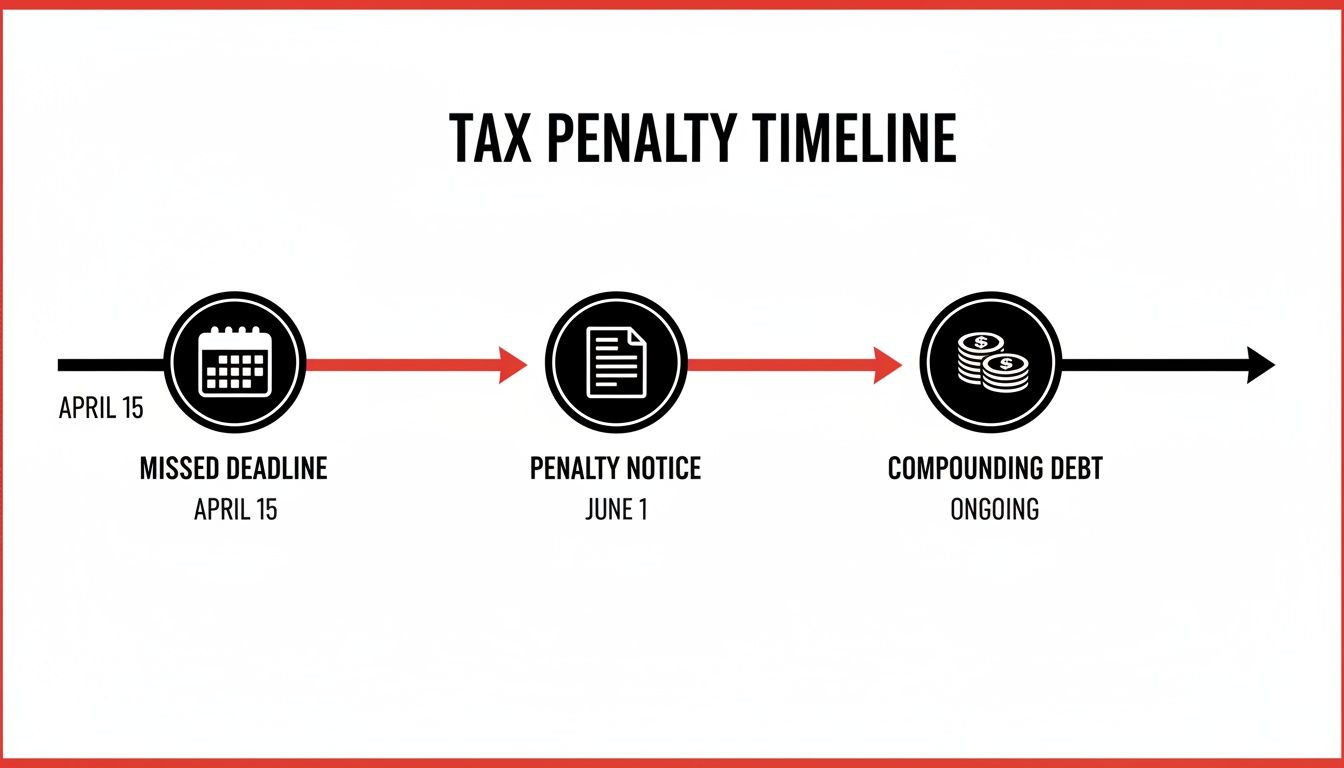
As the graphic demonstrates, a single missed deadline can snowball into penalty notices and compounding debt. The ATO operates within a strict legislative framework; the Income Tax Assessment Act 1997 provides a clear basis to enforce these dates and apply penalties for non-compliance.
