


June hits. You’ve got jobs to finish, staff to pay, BAS in the background, and a plastic tub or shoebox full of receipts waiting for “when things slow down”. Then the tax bill lands bigger than expected, or your accountant starts asking questions you can’t answer quickly because the records aren’t there.
That cycle is common for Sydney small business owners. A sparky in Belrose, a plumber in Ashfield, a café owner in the Inner West, a builder on the Northern Beaches. Good operators often run profitable businesses, but weak tax planning turns solid revenue into stress, rushed decisions and poor cash flow.
Tax planning for business owners isn’t about scrambling in June to buy something you don’t need. It’s about making better decisions all year, using the ATO rules properly, and keeping enough structure around the business so you know where the money is going. When that happens, tax becomes manageable. It stops being a nasty surprise and starts becoming part of how you protect profit.
Beyond the Shoebox A New Approach to Tax Planning
A Northern Beaches tradie finishes a long week, opens the ute, grabs a handful of fuel receipts and tosses them onto the passenger seat. An Inner West owner closes the till, pays suppliers, answers messages, and promises to “sort the books later”. Later usually becomes EOFY.
That’s where most tax pain starts. Not because people are doing the wrong thing on purpose, but because they’re running flat out and tax gets treated as a once-a-year event.
A better approach is simple. Keep records as you go, review the numbers before year end, and make decisions while you still have options. That means knowing which expenses are worth claiming, whether the current structure still fits the business, and whether the cash sitting in the account is available or partly owed to the ATO.
Good tax planning starts long before the return is lodged.
The business owners who sleep better in June usually aren’t more expert. They’re more organised. They’ve moved beyond the shoebox and built a system that gives them a clear view of income, expenses, payroll and GST. That’s also why clean record keeping requirements in Australia matter so much. Without proper records, even smart tax advice has limits.
Why reactive tax habits cost more
Reactive tax management usually leads to three problems:
- Missed deductions: receipts go missing, payments can’t be substantiated, and claims become risky
- Weak cash flow: the tax bill arrives after the money has already been spent elsewhere
- Bad decisions: owners buy equipment for tax reasons rather than business reasons
Tax planning for business owners works best when it supports the business you’re building. For a tradie, that might mean replacing tools at the right time. For a service business, it might mean tightening payroll and director obligations before they become a problem. For an owner thinking about selling in future, it means planning years ahead, not weeks ahead.
Laying the Right Foundations Your Business Structure and Records
The first tax planning decision isn’t about deductions. It’s about structure.
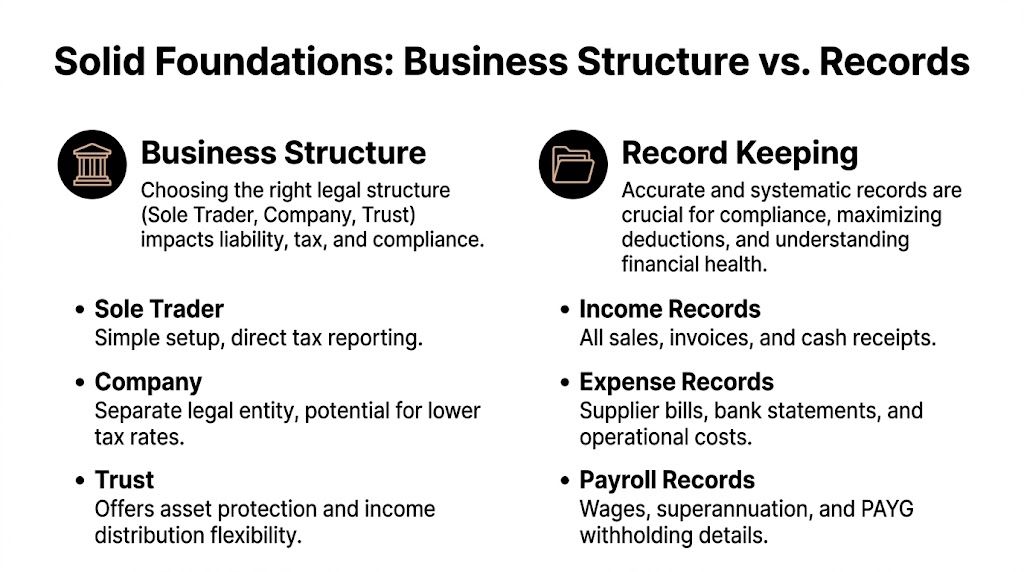
A lot of businesses start as sole traders because it’s fast and cheap. That makes sense early on. But growth changes the picture. More income, staff, equipment, risk and admin usually mean the original setup stops being the best one.
When your structure starts holding you back
Take a Belrose plumbing business. It may begin with one person, one van and straightforward invoicing. As soon as that owner adds apprentices, wins larger jobs and starts buying more equipment, the tax and legal position shifts. The business may still be operating like a sole trader, but the exposure is no longer small.
According to this business tax planning guide, Australian business owners can reduce tax liabilities by 15-25% through entity restructuring. The same source says 70% of small businesses remain sole traders, potentially missing over $10,000 in annual tax savings, and a mismatched structure after growth is a trigger for 35% of ATO audits.
That doesn’t mean every business should rush into a company or trust. It means the structure should match the current business, not the business you had two years ago.
A practical structure comparison
| Structure | Usually suits | Main upside | Trade-off |
|---|---|---|---|
| Sole trader | New or simple operations | Easy to start and simple tax reporting | Personal tax exposure and less separation between owner and business |
| Company | Growing businesses with stronger profits and staff | Separate legal entity and potentially lower tax rates | More compliance, director duties and ASIC obligations |
| Trust | Family groups, asset protection planning, income distribution flexibility | Useful for planning and protection in the right setup | More complexity and needs proper administration |
The right answer depends on profit levels, risk, family circumstances, future sale plans, and how disciplined the admin is. A structure that saves tax on paper can cause headaches if the bookkeeping and compliance can’t keep up.
Practical rule: restructure because the business has changed, not because someone at a barbecue said trusts “save tax”.
What to review before changing structure
Before changing from sole trader to company or trust, look at these issues together:
- Profit pattern: are profits becoming more consistent, or still volatile?
- Risk exposure: are you signing larger contracts, hiring staff, or taking on more liability?
- Cash extraction: how do you take money from the business?
- Future plans: do you want to grow, hold assets, or eventually sell?
Owners who understand their numbers make better decisions here. If you want a plain-English refresher on reading the figures properly, this guide to understanding profit and loss statements is useful because it helps connect bookkeeping to actual business decisions.
There’s also a practical overview of business structures in Australia if you need the legal and tax basics side by side.
Records are not admin. They are strategy
Once the structure is right, records become the engine room of tax planning for business owners.
Clean bookkeeping tells you what you can claim, what GST you owe, whether payroll is accurate, and whether cash flow is real or misleading. Dirty bookkeeping does the opposite. It turns tax planning into guesswork.
A good record-keeping setup should capture:
- Income records: invoices issued, sales reports, deposits and job payments
- Expense records: supplier bills, subscriptions, fuel, tools, repairs and bank transactions
- Payroll records: wages, super, leave and PAYG withholding
- Asset records: what was purchased, when it was first used, and whether it’s partly private
What works in practice
For most small businesses, the strongest setup is boring on purpose. Use accounting software, separate business banking, digital receipt capture and regular bank reconciliations. That’s what makes year-end reviews faster and cleaner.
What doesn’t work is relying on memory, mixed personal and business spending, or dumping receipts on the accountant once a year. If the file is messy, the tax advice becomes cautious, because no one wants to claim something they can’t defend.
The Art of Year-Round Tax Savings Deductions and Cash Flow
It’s 24 June. A plumber in Ashfield has had a strong quarter, BAS is due soon, and someone tells him to buy a new trailer “for the tax”. He can claim it, but that does not automatically make it a smart move. If the cash was better kept aside for GST, wages or supplier accounts, the tax deduction can leave the business tighter, not stronger.
That is the part many owners miss. Good tax planning happens across the year, not in a rush at the end of June. The owners who keep more after tax usually do three things well. They claim ordinary deductions properly, they time purchases with a real business purpose, and they protect cash set aside for the ATO before it gets absorbed into day-to-day spending.

Claim work-related costs you can support
For tradies and small business owners in the Inner West and on the Northern Beaches, many deductions are not exotic. They are the regular costs of getting the work done. Tools, software, public liability insurance, accounting fees, protective clothing, trade licences, job management apps, a fair share of phone costs, and vehicle expenses where business use is recorded properly.
The ATO’s position is straightforward. There needs to be a real connection to earning business income, and you need records that back the claim. If part of the expense is private, only the business part is deductible.
The claims that cause trouble are usually the familiar ones:
- Vehicles: a ute used for site visits during the week and family errands on weekends needs a logbook or another proper method to support the business percentage
- Home office costs: a dedicated workspace used to run quotes, ordering and admin is different from doing the occasional invoice at the kitchen table
- Travel and meals: being away from home for work can be deductible, but grabbing lunch during a normal workday usually is not
- Tools and devices: easier to claim where they are clearly for the business, harder where the same laptop or tablet is shared around the house
In practice, the safest approach is simple. If you would struggle to explain the business purpose to an ATO officer, revisit the claim before it goes into the return.
Timing purchases properly
The timing of a purchase can change the tax result, but timing should follow business need.
For the 2024-25 income year, eligible small businesses with turnover under $10 million may be able to immediately deduct eligible assets costing less than $20,000 each if the asset is first used, or installed ready for use, between 1 July 2024 and 30 June 2025 under the ATO instant asset write-off rules. That can help a business bring a deduction forward instead of depreciating the asset over several years.
I regularly see two very different outcomes from the same rule.
A carpenter in Dee Why replaces worn-out tools and a laptop already due for replacement. The purchases are needed, affordable, and used straight away in the business. The deduction helps.
A contractor in Ashfield buys equipment in the last week of June because someone said “you’ll get it back on tax”. The gear sits in the shed, cash gets squeezed, and the BAS bill lands two weeks later. The deduction exists, but the decision was poor.
A deduction is not a refund of the full cost
Plain maths is helpful here.
If a business spends $10,000 on an eligible asset, it does not get $10,000 back from the ATO. It gets a deduction that reduces taxable income. The tax saved depends on the business structure, the owner’s tax rate, and whether the purchase qualifies under the rules. The business still needs to fund the full purchase price upfront.
That is why I focus on the after-tax cash position. A purchase should do one or more of these things:
- produce income
- reduce labour time
- replace failing equipment
- improve service capacity
- solve a real operational problem
If it does none of those, the tax deduction alone is a weak reason to spend the money.
The best pre-30 June purchase is one you were already going to make because the business needs it now.
What usually works in small business
Across Sydney small businesses, the strongest results usually come from ordinary habits done consistently.
- Works well: buying replacement tools, equipment or software already budgeted for and needed in the next quarter
- Works well: reviewing expected profit before year end so purchases, drawings and tax estimates line up
- Works well: checking whether an asset is ready for use before 30 June, rather than assuming ordering it is enough
- Backfires: spending to “save tax” without checking cash reserves
- Backfires: mixing personal and business use without records to support the business percentage
- Backfires: waiting until late June to ask what can be claimed
That last point matters. Owners who ask early usually have options. Owners who ask in the final week of June usually just have pressure.
Cash flow discipline matters as much as deductions
A business can show a profit on paper and still run short of cash. In Sydney, I see this most often in growing trade businesses where the work is there, invoices are going out, but GST, PAYG and income tax have not been set aside as the money comes in.
Treat GST collected as money held for the ATO. Treat PAYG withholding the same way. If those amounts stay in the main trading account, they tend to get used on materials, fuel, labour or overdue creditors. Then the BAS arrives and the business feels blindsided, even though the cash was never fully theirs to spend.
A practical routine is more useful than a clever tax idea:
- Review turnover monthly so a strong run of jobs does not create a surprise tax problem later.
- Set aside tax regularly into a separate account as receipts come in.
- Check large purchases early so you can decide based on workflow, cash reserves and tax effect together.
- Review drawings or owner pay during busy periods, especially if profit is rising faster than expected.
For a Northern Beaches electrical business with seasonal peaks, that can be the difference between entering spring with cash in the bank or carrying ATO debt while trying to fund wages and stock.
Tax savings should support the business, not distract from it
The strongest deduction strategy is tied to how the business operates.
If a concreter needs a new mixer because jobs are booked out and downtime is expensive, buying before year end may make sense. If the same business is waiting on debtor payments and already behind on GST, keeping cash may be the better move. Same tax rule. Different answer.
That is how year-round tax planning should work for business owners in Ashfield, Manly, Brookvale or anywhere else in Sydney. Use the rules. Keep the records. Make purchase decisions with both tax and cash flow in view. That is how you reduce tax without creating a bigger problem three months later.
Meeting Your Obligations Payroll Super and ASIC Compliance
Some tax problems don’t start with tax returns. They start with payroll, super and company administration being left too long.
That’s where otherwise solid businesses can come undone. The owner is busy, staff are on the tools, invoices are going out, and payroll is treated as a weekly processing task instead of a risk area. Then something doesn’t match. Super falls behind. PAYG withholding hasn’t been handled properly. ASIC paperwork gets ignored because it didn’t feel urgent at the time.
Payroll is not just bookkeeping
If you have employees, payroll has to be right. Not roughly right. Right.
Wages, leave, PAYG withholding and super all need to line up with what’s reported and what’s paid. If they don’t, the problem usually gets more expensive the longer it sits there. It also creates mistrust with staff very quickly.
A practical payroll review should ask:
- Are pay runs consistent: same process, same records, same approval path?
- Do wage categories match the actual work performed: especially where overtime, allowances or different staff roles exist?
- Is super being paid on time: not just recorded in the software?
- Do payroll reports agree with BAS and year-end reporting: because mismatches create avoidable trouble
Super and PAYG are not working capital
A common mistake in small business is treating withheld amounts as temporary cash support. That feels manageable in a tight month, but it rarely stays contained. Once the business starts relying on money already committed elsewhere, catching up gets harder.
If the business needs the ATO’s money or employees’ super to stay afloat, the real problem is cash flow, pricing, or margin.
Good operators protect themselves by separating these obligations early. Some use dedicated bank accounts. Others sweep estimated amounts aside after each major payment run. The method matters less than the consistency.
Company owners also have ASIC duties
If you run through a company, tax compliance is only part of the job. Directors also take on ASIC responsibilities. That includes keeping company details current, managing annual review obligations, and making sure company records match reality.
Many small businesses get caught. They set up a company for good reasons, then keep operating with sole trader habits. The company exists, but the governance around it is loose. That creates risk because the legal structure only works properly when the admin behind it is kept up to date.
A basic company compliance checklist includes:
| Area | What to check |
|---|---|
| Director details | Current addresses and officeholder details are accurate |
| Company records | Share structure and key registers are maintained |
| Annual review | ASIC correspondence is opened, understood and acted on |
| Business changes | New trading addresses, business activities or ownership changes are properly recorded |
Why this matters for tax planning
Payroll, super and ASIC compliance might not feel like tax planning, but they are part of it. They protect the structure that the tax strategy relies on.
A business with sharp deduction planning but poor payroll controls is still exposed. A company with a tax-effective setup but sloppy ASIC administration is still exposed. The point isn’t perfection. It’s making sure the foundations of the business can support growth without hidden problems sitting underneath.
For most owners, the practical answer is simple. Keep payroll clean, pay super when it’s due, treat PAYG withholding as untouchable, and don’t leave company administration to chance.
Navigating Complex Assets Capital Gains Crypto and Your Exit
The bigger tax decisions usually don’t happen in the weekly bookkeeping. They happen when you buy, hold or sell valuable assets, or when you start thinking about stepping back from the business.
That’s where tax planning for business owners becomes strategic. A business sale, a restructure before exit, goodwill, shares, business premises, or crypto held inside the broader financial picture can all change the final tax outcome in a major way.

Small Business CGT Concessions can change the result
Many owners assume selling a business automatically means a painful capital gains tax bill. Sometimes it does. But many small businesses have access to concessions that can significantly reduce the result if the planning is done properly.
According to this summary of the Small Business CGT Concessions, ATO statistics from 2023 show 28,000 small businesses claimed CGT relief totalling $3.4 billion, averaging $121,000 per claim. The same source notes that for a business sale with a $1 million gain, proper use of the concessions can save over $95,000 in tax.
That’s not a niche rule. It’s one of the most important tax planning areas for owners thinking about retirement, succession, or selling part of the business.
A plain-English sale example
Say a business owner sells a business and ends up with a capital gain. Without planning, more of that gain may be exposed to tax than necessary. With proper access to the small business concessions, the outcome can be materially better.
The key issue is that these concessions aren’t something you sort out casually after contracts are signed. Eligibility depends on factors such as turnover, asset levels, whether the asset is active, and how the business has been structured and held over time. If those points haven’t been considered early, the owner can lose options.
Owners often focus on sale price and ignore sale structure. The after-tax result is what actually matters.
Sale structure matters too
When a business changes hands, the purchase price often needs to be allocated across items such as plant, goodwill and other assets. That allocation can affect both buyer and seller outcomes, so it shouldn’t be treated as boilerplate wording in the contract.
If you want a commercial overview of how this works, this article on purchase price allocation is a useful starting point. It helps explain why the way value is split across the deal can matter long before settlement.
Crypto creates modern tax problems fast
Crypto is another area where confident business owners can get into trouble because the records feel informal. Someone buys digital assets, moves them between wallets, uses an exchange, or treats it like a side investment connected to the business. Then tax time arrives and the transaction history is incomplete.
The ATO takes crypto seriously. Record-keeping and classification matter. So does understanding whether a transaction triggers a tax event and how it interacts with the wider business structure.
For business owners dealing with digital assets, a practical guide to crypto tax in Australia can help clarify the basics before mistakes compound.
The three crypto mistakes that cause trouble
Poor records from the start
Owners keep screenshots, partial exchange exports or scattered notes instead of complete transaction history. Once wallets and platforms multiply, reconstructing the data becomes painful.Assuming no cash-out means no tax issue
Swapping one asset for another, using crypto in a transaction, or moving value in certain ways can still matter. The lack of cash in the bank doesn’t automatically mean no reporting consequence.Mixing business activity and personal activity
That muddies the record trail and makes advice slower and more cautious. Clean separation matters here just as much as it does with ordinary business banking.
Think about the exit before you need it
A lot of owners build a business with no clear exit file. They know they want to sell one day, retire one day, or pass the business on one day. But the tax side sits untouched.
A stronger approach is to maintain records and structure with the exit in mind. Keep asset ownership clear. Don’t leave historic issues unresolved. Review who owns what. Make sure company, trust and personal records align. When the sale conversation starts, clean history gives you options. Messy history limits them.
Your 2026 Tax Action Plan and Avoiding ATO Audits
It is late June. A plumber in Ashfield has three utes on the road, two apprentices on payroll, a stack of supplier invoices still waiting to be coded, and a mate telling him to buy another tool trailer “for the tax”. Up in the Northern Beaches, a consultant has strong turnover on paper but is behind on super and has not checked whether last year’s company setup still suits the business. That is how ATO trouble usually starts in small business. Not from one dramatic error, but from small issues left alone for too long.
Tax planning works best as an operating routine. If you leave it until the return is due, options shrink fast.
A practical rhythm for the year
Business owners who stay out of trouble usually have one thing in common. They review the numbers during the year, not just after the year has finished.
A quarterly review does not need to be complicated. For many Sydney tradies and owner-managers, it is a 45-minute check of the books, cash position, wages, super, BAS and any big changes in the business. That simple habit picks up problems while they are still fixable.
Quarterly habits that keep you in control
- Review profit and cash together: strong sales do not mean much if GST, PAYG withholding, super and supplier bills are still sitting there unpaid.
- Clean up the bookkeeping file: uncoded bank transactions, missing receipts and unreconciled accounts make BAS errors more likely and tax advice less useful.
- Check whether the structure still fits: a sole trader setup that worked in year one can become clumsy once profits rise, staff are added, or asset protection starts to matter.
- Review payroll and super: make sure what is recorded in Xero, MYOB or your payroll system matches what was paid and lodged.
Many audits are often prevented at this point. The issue gets fixed before it turns into a pattern.
What to do before 30 June
Year end still matters. It is just not the only planning point.
A proper pre-30 June review should cover commercial decisions first, then tax treatment. I regularly see owners chase deductions on purchases they did not need, while overdue debtors and unpaid super are doing far more damage to the business than the tax bill.
| Checklist area | What to do |
|---|---|
| Asset purchases | Check whether the equipment is genuinely needed for work, who should own it, and whether the timing affects this year or next year |
| Debtors and cash | Follow up old invoices and compare the profit report to the actual bank balance |
| Expense support | Make sure larger claims have tax invoices, clear business purpose and clean coding |
| Owner drawings | Review how money has come out of the business, especially if you operate through a company or trust |
| Crypto and investments | Pull full transaction reports early and separate business activity from personal activity |
One blunt rule helps here. If you would not buy it without a deduction, reconsider the purchase.
What to review once a year properly
The annual review should be wider than the tax return. It should test whether the business still makes sense from a tax, compliance and ownership point of view.
Annual review questions worth asking
Has the structure kept pace with growth
A setup that suited a sole trader in Marrickville or a one-person consulting business in Dee Why may not suit a business with staff, equipment finance, higher profit or plans to bring in family members.Are any assets likely to create tax issues later
Business premises, goodwill, shares and digital assets need clear records long before a sale or restructure is on the table.Is the admin system strong enough for the business you now run
If records still depend on text messages, paper dockets and memory, the business has outgrown its process.Are compliance dates controlled, not guessed
BAS, super, STP, ASIC annual review fees and company records all need a proper calendar and clear responsibility.
Five ATO red flags small business owners should take seriously
Not every review turns into an audit. Certain patterns do make your file harder to defend.
Red flag one. Tax-driven purchases with no business case
Buying a vehicle, machine or piece of equipment only because someone said it is “good for tax” is a common trap. A deduction reduces tax. It does not turn a poor purchase into a smart one.
Fix: write down the business reason before you buy, check who should own the asset, and confirm the timing with your accountant before signing anything.
Red flag two. Structure no longer matches the business
I see this often with growing tradie businesses in the Inner West. The owner starts as a sole trader, then adds staff, signs larger contracts, takes on more risk, and keeps the same setup because changing it feels like admin. Later, the tax and asset protection issues are harder to clean up.
Fix: review the structure after major growth, changes in ownership, new property or equipment purchases, or a move toward selling the business.
Red flag three. Weak records
Poor records usually show up in the same places. Meals with no explanation. Tool and hardware purchases mixed with personal spending. Transfers between accounts with no notes. That creates problems for deductions, BAS accuracy and loan applications, not just tax returns.
Fix: use separate business accounts, capture receipts as you go, and reconcile the books regularly.
“I definitely spent money on the business” is not enough if the ATO asks for evidence.
Red flag four. Payroll and super mismatches
This is one of the most expensive areas to get wrong because it crosses tax, employment and cash flow. If wages, PAYG withholding and super do not match your lodgements and payment records, the problem usually gets bigger each quarter.
Fix: review payroll reports against bank payments, clear super on time, and do not use withheld tax or super money to cover short-term cash gaps.
Red flag five. Crypto under-reporting or confusion
Digital assets still cause trouble because many owners treat them as separate from the rest of the business records. They are not. If crypto has been used for investing, paying, swapping, or receiving value, the records need to be complete and the treatment needs to be checked properly.
Fix: keep full exchange and wallet records from day one, avoid mixing personal and business activity, and review digital asset transactions well before lodgement.
The practical playbook that works
For most small business owners, a simple routine is enough:
- Monthly: keep the books current and set aside cash for GST, PAYG and income tax
- Quarterly: review profit, cash, payroll, super, BAS and any structure issues
- Before major purchases: check whether the item makes commercial sense and how it should be owned
- Before 30 June: hold a proper planning review with current numbers
- Annually: review the bigger picture, including ASIC obligations, asset ownership, CGT exposure and exit planning
That is how good tax planning works in practice. It keeps cash under control, reduces avoidable mistakes, and gives you better options if the ATO ever asks questions.
If you want practical help applying this to your own business, EndureGo Tax works with tradies, investors and small business owners across Ashfield, the Inner West, Belrose and the Northern Beaches on tax planning, BAS, company compliance, crypto tax and business structure advice. Book a consultation and get a clear plan that fits how your business operates.
