


Hiring a new team member is an exciting step for any business, but it also kicks off a series of critical compliance tasks. The two most important tax forms for new employees in Australia are the Tax File Number (TFN) Declaration and the Superannuation Standard Choice form. Getting these right from day one is essential for compliant payroll and meeting your obligations under Australian law.
Your Essential New Employee Tax Form Checklist
Getting your new hire’s paperwork sorted isn’t just good practice—it’s non-negotiable for running a smooth payroll and meeting your obligations to the Australian Taxation Office (ATO). As an expert in Australian business compliance, I can tell you that failing at this first hurdle is a common but costly mistake.
Think of it as a pre-flight checklist before your new employee even walks in the door. For example, a plumbing business in Ashfield we work with now has a “Day Zero” policy: no TFN form, no start. This simple rule prevents major headaches, ensures you withhold the correct amount of tax, and demonstrates your professionalism from day one.
Every new employee form is more than just paperwork; it’s a legal document that forms the foundation of your relationship with your new team member, ensuring their pay and entitlements are managed correctly.
The Two Core Onboarding Forms
In Australian employee onboarding, two documents are central to the process: the TFN Declaration and the Super Choice form. Each one performs a different but equally vital function in setting up your payroll.
Here’s the expert breakdown:
- Tax File Number (TFN) Declaration: This form is used by your employee to provide their tax details. Crucially, it informs you whether they are claiming the tax-free threshold, which directly affects their take-home pay. The ATO requires you to lodge this form within 14 days of your employee’s commencement date, a deadline stipulated under the Taxation Administration Act 1953.
- Superannuation Standard Choice Form: This document allows your employee to nominate their preferred super fund for compulsory superannuation contributions. You must provide this form to them within 28 days of their start date.
This simple flowchart outlines the core process for getting a new hire’s tax and super details in order.
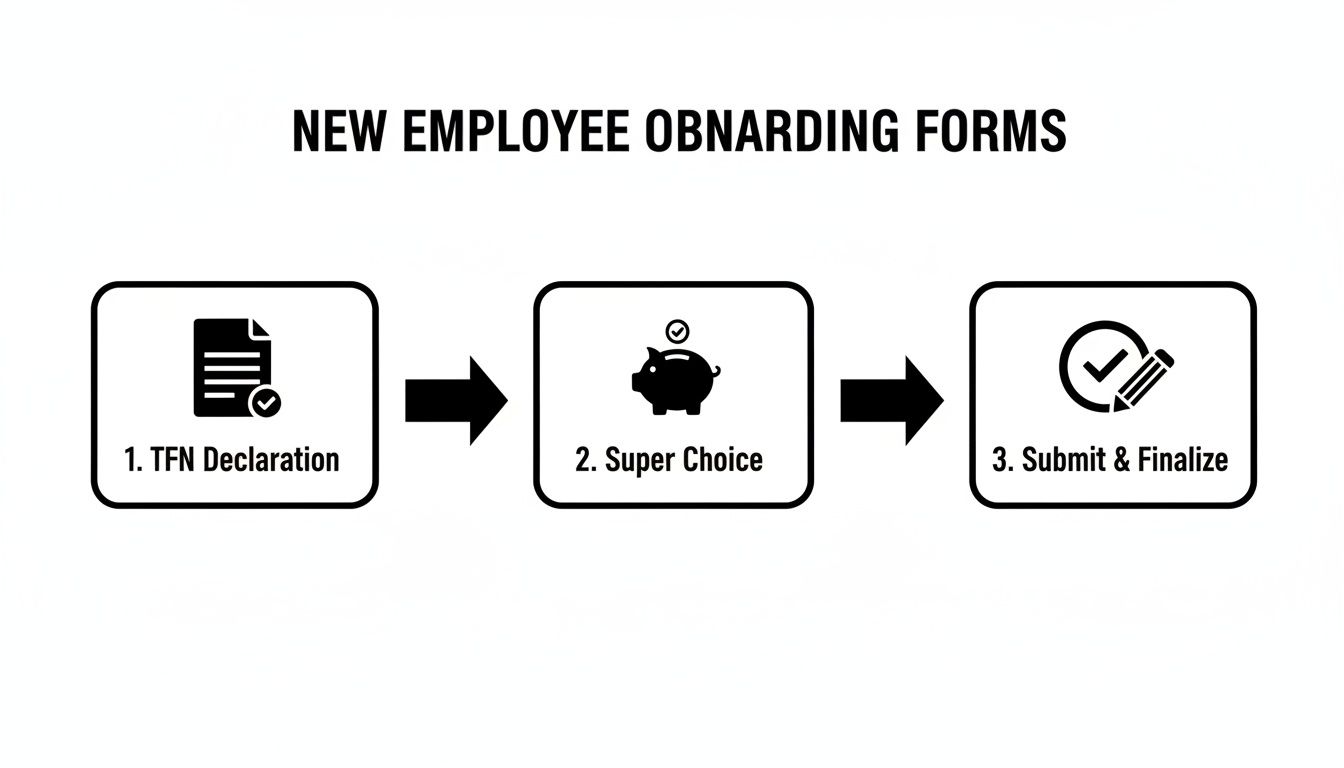
As the visual shows, collecting the TFN Declaration and providing the Super Choice form are the absolute foundations of a compliant and smooth onboarding experience.
To make it even clearer, here’s a quick-reference table to keep on hand.
New Employee Onboarding Form Summary
This table is your go-to guide for the essential forms you’ll need every time you bring someone new onto the team.
| Form Name | Purpose | When to Complete |
|---|---|---|
| TFN Declaration | To determine the correct amount of tax to withhold from an employee's pay. | On or before their first day of work. |
| Superannuation Standard Choice Form | To allow an employee to choose their super fund for compulsory contributions. | Provide to the employee within 28 days of them starting. |
Mastering these two forms is the first step toward flawless payroll. If you’re a small business owner in Ashfield or across the Northern Beaches, feeling swamped by these obligations, don’t leave it to chance.
Actionable Step: Take control of your compliance today. Book a consultation with our local accountants today and let our experts ensure your new hire’s paperwork is perfect from day one.
Getting the TFN Declaration Form Right
When you hire someone new, the Tax File Number (TFN) Declaration is arguably the most critical piece of paper you’ll handle. As a tax expert, I view this form as the instruction manual from your new employee to you about their tax situation.
Getting this form right is the bedrock of a smooth payroll process. It tells you exactly how much tax to withhold from their pay.

Here’s a practical example: if your new team member ticks the box to claim the tax-free threshold, you’ll withhold less tax from each paycheque because the first $18,200 they earn is tax-free. However, if they don’t claim it (perhaps because they have a second job), you must tax them from the very first dollar. This single tick box makes a massive difference to their take-home pay. For a deeper look into why this number is so critical, check out our guide on understanding the Tax File Number in Australia.
What You’re Legally Required to Do
Once your new hire provides their completed TFN Declaration, the responsibility shifts to you. You have a legal obligation to transmit this information to the Australian Taxation Office (ATO).
The ATO is unequivocal on this: employers must lodge the completed TFN Declaration within 14 days of the employee’s start date. This is a legal requirement under the Taxation Administration Act 1953, not a suggestion.
What happens if you don’t receive the form? The consequences are severe. If an employee fails to provide a TFN Declaration, you are legally required to withhold tax at the highest marginal rate. This is a poor outcome for everyone.
For small businesses and tradies in areas like the Northern Beaches or Ashfield, correctly managing the TFN is non-negotiable. A simple error can lead to penalties. Conversely, getting it right ensures your new hire benefits, especially with tax bracket changes on the horizon.
Tips for a Pain-Free TFN Process
To maintain compliance and avoid common pitfalls, here are a few actionable tips we provide our clients:
- Make it a Day One Task: Do not allow a new hire to begin work until this form is completed. Integrate it into your onboarding checklist.
- Go Digital: The most efficient method is for employees to complete the form through their myGov account linked to ATO online services. It pre-fills their details, minimising errors.
- Conduct a Quick Review: Before lodging, perform a quick check. Is the TFN present? Is the tax-free threshold question answered? Is it signed and dated? A 30-second review can prevent hours of future complications.
Managing paperwork for new staff is a chore, but it’s an unavoidable part of running a legitimate business in Australia.
Actionable Step: Don’t risk ATO penalties. If this feels overwhelming, book a consultation with our local accountants today and ensure your payroll is set up correctly from day one.
Getting Superannuation Sorted
Once the TFN Declaration is handled, the next critical component for any new hire is superannuation. This is not just a line item on a payslip; it’s a non-negotiable legal duty with stringent rules. The primary document here is the Superannuation Standard Choice form.
You are legally required to provide this form to your new team member within 28 days of their start date. It is their opportunity to decide where their retirement savings are directed. Completing this step correctly is a cornerstone of compliance as an employer.

What on Earth Is a Stapled Super Fund?
But what if your new hire doesn’t complete the form or choose a fund? This is a common scenario, for which the ATO has implemented a system called a ‘stapled super fund’.
A stapled fund is an existing super account that is “stapled” to an employee from a previous job. If they do not nominate a fund, the law requires you to request their stapled fund details from the ATO and to direct their super payments to that fund. For example, a young worker starting their second job at a cafe in Belrose likely has a super fund from their first job; this is their stapled fund. This system prevents the creation of multiple unintended super accounts.
Under the Superannuation Guarantee (Administration) Act 1992, you must pay super into either the fund your employee chooses or their stapled fund. Failure to do so can result in the Superannuation Guarantee Charge (SGC), a significant penalty you must avoid.
This process is critical. You can request an employee’s stapled fund details via the ATO’s online services for business portal. This is a mandatory step before considering payment into your business’s default fund.
The Super Guarantee and the Upcoming Payday Super
The amount of super you must pay is determined by the Superannuation Guarantee (SG) rate. It is calculated as a percentage of their ordinary time earnings, and the rate is legislated to increase; staying informed is crucial. You can get the full rundown on the rules in our guide to superannuation contribution limits.
A major change is on the horizon. From 1 July 2026, the government will implement ‘payday super’. This will require employers to pay superannuation contributions on the same day they pay staff wages, placing tighter cash-flow management demands on small businesses.
With the SG rate marching towards 12%, ensuring full compliance has never been more important.
Actionable Step: Superannuation is a complex area with severe penalties for non-compliance. Book a consultation with our local accountants today, and we’ll ensure your super obligations are handled perfectly, every time.
Putting It All Together with STP Reporting
You’ve collected the new employee forms and filed them away. The job is not finished; in fact, this is where your ongoing reporting duties commence. Now, you must connect these forms to your payroll, your Pay As You Go (PAYG) withholding, and the ATO’s mandatory Single Touch Payroll (STP) system.
STP is a direct, digital reporting line to the ATO. Each time you pay your staff, you must report their wages, the tax you’ve withheld, and their super information simultaneously. The tax office sees everything in real-time.
From TFN Declaration to PAYG Withholding
The details in the TFN Declaration are key to correctly taxing your new hire. You use their answers, such as whether they claim the tax-free threshold, to determine the precise amount of PAYG tax to withhold using the official ATO tax tables.
For example, for the 2025-26 financial year, an Australian resident earning between $18,201 and $45,000 has a 16% tax rate on income above the threshold. For a new hire in Sydney’s Inner West, getting that TFN form right from day one is crucial to prevent them from being taxed at a much higher default rate. You can review the details in the 2025-26 tax tables on the ATO website.
Why STP-Enabled Software Isn’t a ‘Nice to Have’ Anymore
The days of quarterly or annual payroll reporting are over. STP reporting is now mandatory for all employers in Australia, making compliant, STP-enabled software a non-negotiable requirement.
The law underpinning this is the Taxation Administration Act 1953. It mandates that businesses report payroll information to the ATO on or before each payday, fundamentally changing employer obligations.
Using STP software is a core part of staying compliant. It automatically extracts data from your pay run and transmits the required report directly to the tax office. This simplifies compliance in several key ways:
- No More Group Certificates: You no longer issue annual payment summaries. Staff can access their year-to-date tax and super information via their myGov account.
- Simpler BAS Reporting: PAYG withholding figures from STP can pre-fill your Business Activity Statement (BAS), reducing manual entry and errors.
For busy tradies and small business owners, manual payroll management is a recipe for disaster. For a deeper look at what this all means for your business, check out our guide on Single Touch Payroll for you.
Actionable Step: If you’re tangled up in STP, don’t wait for an ATO notice. Book a consultation with our local accountants today. Our local experts can set you up for seamless, compliant payroll reporting.
Common Payroll Traps and How to Avoid Them
You’ve collected all the required tax forms for new employees. Your new hire is ready to go. But for a busy tradie or small business owner, the paperwork is just the first hurdle. The real challenge is sidestepping common—and expensive—payroll traps that can lead to serious issues with the ATO.
As experts, we see the same mistakes repeatedly. The biggest pitfall? Misclassifying an employee as a contractor. It might seem like a shortcut, but it’s a gamble with massive consequences.
The Contractor vs. Employee Trap
Here’s a practical example: you’re a builder needing an extra labourer. The person has an ABN and offers to invoice you. This seems easy, allowing you to bypass payroll tax, super, and workers’ compensation.
The problem is that the ATO assesses the reality of the working relationship, not what you label it. They ask:
- Who has control? If you set the hours, location, and methods, they are likely classified as employees.
- How are they paid? A set hourly or daily rate points to employment. A quote for a finished result is typical of a contractor.
- Who supplies the gear? If you provide the main tools, they are likely to be an employee.
Getting this wrong can be devastating. An ATO audit could reclassify your “contractor” as an employee, resulting in a bill for years of unpaid super, PAYG withholding, and payroll tax—plus substantial penalties and interest.
The ATO is crystal clear: the distinction is determined by the working arrangement’s specific terms and conditions. The consequences of misclassification are a major business risk.
Messy and Missing Records
Another easily avoidable trap is disorganised record-keeping. It’s not enough to get the tax forms for new employees signed; you must keep them safe and accessible.
Under the Taxation Administration Act 1953, you are legally required to keep all payroll records for a minimum of five years. This includes TFN Declarations, Super Choice forms, and proof of every payment. Good record-keeping is your primary defence in an audit.
Actionable Step: Feeling uneasy? You’re not alone. Payroll is a huge source of stress for small businesses. Book a consultation with our local accountants today and let our experts make your payroll system bulletproof.
Take Control of Your Payroll and Ditch the Paperwork Headaches
Let’s be clear—getting tax forms for new employees right is non-negotiable for any Australian business. But it doesn’t have to be a source of stress. This is where expert advice makes all the difference.
At EndureGo Tax, we are experts in helping small businesses, tradies, and entrepreneurs across Ashfield, Belrose, and the Northern Beaches manage their ATO obligations, headache-free. We speak your language.
We transform messy tasks like TFN lodgements, super reporting, and Single Touch Payroll (STP) compliance into a smooth, simple process. Australian payroll rules are highly specific. While it might be interesting to read about the complete UK process of payroll, you absolutely need local Australian expertise to remain compliant.
Partnering with us provides peace of mind that your payroll is accurate. It frees you to focus on growing your business, secure in the knowledge you are meeting legal obligations under laws like the Taxation Administration Act 1953.
Don’t gamble with compliance and risk costly ATO penalties. Our local accountants understand the unique pressures on businesses in the Inner West and Northern Beaches. We provide clear, practical advice for success.
Actionable Step: Build your business on a solid foundation, not guesswork. Book a consultation with our local accountants at EndureGo Tax today and take the first step towards perfect, stress-free payroll.
A Few Common Questions We Hear
Getting the paperwork right for a new hire always raises a few questions. Let’s tackle some of the most common questions we get from employers about tax forms for new employees so that you can stay compliant and stress-free.
What Happens If My New Hire Doesn’t Have a TFN?
This is a critical question. If a new employee starts without a Tax File Number (TFN), they have 28 days to apply for one and provide it to you. They can tick a box on their TFN Declaration form to indicate they have already applied.
Here’s the expert advice: if that 28-day window closes and you still don’t have their TFN, ATO rules are incredibly strict. You are legally required to withhold tax from their pay at the highest marginal rate—a staggering 47% (including the Medicare levy). This is a significant financial blow, so it is crucial to follow up with them to confirm that number.
Do I Need New Tax Forms for a Rehired Casual?
Great question. If you re-employ a casual worker within the same financial year, you can generally use their previous TFN Declaration.
However, if you rehire them in a new financial year, the ATO strongly advises obtaining a fresh TFN Declaration. This ensures their details, particularly their claim for the tax-free threshold, are up to date. For example, a student who worked for you over the summer and returns the following year should complete a new form. Their super fund choice remains valid, so a new form is only needed if they wish to change funds.
How Long Do I Need to Keep Employee Tax Forms?
Under Australian law, you are required to keep all payroll-related records for a minimum of five years.
This five-year rule, mandated by the Taxation Administration Act 1953, covers the employee’s TFN Declaration, records of every super contribution, and all your Single Touch Payroll (STP) data. While the original TFN Declaration is lodged with the ATO, you must retain a copy. These records can be digital or paper but must be secure and easily accessible for a potential ATO audit.
What’s the Difference Between PAYG Withholding and Payroll Tax?
This point confuses many business owners, but the distinction is simple.
- PAYG Withholding is the income tax you collect from your employees’ wages and remit to the ATO on their behalf. It’s a federal tax, and it is compulsory for all employers.
- Payroll Tax is a separate state and territory tax. As the employer, you are only liable to pay this if your total annual wage bill exceeds the applicable threshold (e.g., $1.2 million in NSW).
If your total wages are below the threshold, payroll tax does not apply. However, you are still absolutely required to manage PAYG withholding for every employee.
Getting tax forms for new employees sorted from day one is a cornerstone of a well-run, compliant business. It is too important to leave to chance. The team at EndureGo Tax lives and breathes this, making payroll seamless for small businesses and tradies in Ashfield and across the Northern Beaches.
Actionable Step: Book a consultation with our local accountants today, and let’s build your business on a foundation of certainty.
