


Closing your business is a huge decision, but it's more than just locking the doors for the last time. It's a major financial event, and in Australia, the tax consequences of winding up a company can be complex.
As expert accountants, we see many business owners make costly mistakes at this final hurdle. The path you take—and the tax you end up paying—boils down to one key question: is your company solvent? A healthy company with retained earnings is one story. A company struggling with debt is a completely different ball game for directors and shareholders alike.
Your Company's Final Chapter: Navigating the Tax Maze
Winding up a company isn't just an admin task on a to-do list; it's a formal legal process with tax implications at every single turn. Think of it as the ultimate, final audit of your company's entire financial life.
Every asset sold, every dollar handed back to shareholders, and every debt paid off comes under the microscope of the Australian Taxation Office (ATO). Getting the rules right isn't just good practice—it's crucial for closing your company's books cleanly and compliantly.
The whole journey starts with that one question: solvent or insolvent? This single fact dictates the entire process.
- Solvent Wind-Up (Members' Voluntary Liquidation – MVL): This is the road for a healthy company where assets are greater than liabilities. The main goal here is to distribute those surplus assets and retained profits back to the shareholders in the most tax-savvy way possible.
- Insolvent Wind-Up (Creditors' Voluntary Liquidation – CVL): This is the path for companies that simply can't pay their debts. A liquidator steps in, and their primary job is to sell off assets to pay back creditors. The ATO is often near the front of that queue, and shareholders rarely see a return.
The Tax Journey You Can Expect
No matter which path you're on, certain tax events are unavoidable. You'll need to lodge a final company tax return, finalise every last Business Activity Statement (BAS), and square away all outstanding PAYG withholding and employee superannuation.
For shareholders in a solvent company, this is where strategic tax planning is paramount. The payments you receive from the liquidator aren't just a simple cash handout. The ATO views these distributions as a mix of a capital return and a dividend.
Expert Tip: When a liquidator distributes funds, it triggers what's known as Capital Gains Tax (CGT) event C2. In plain English, this is the moment the ATO considers your shares to be cancelled. Understanding this is absolutely key to getting your final tax position right.
This means you'll have to work out if you've made a capital gain or a capital loss on your shares. On top of that, a portion of what you receive might be treated as a "deemed dividend"—which can come with valuable franking credits to help lower your personal income tax bill.
Trying to navigate this alone is a recipe for headaches and potential missteps, which can lead to unexpected tax bills down the track. To ensure you tick every box and achieve the best possible financial outcome, engaging a registered tax agent or expert accountant is the first, and most important, actionable step. They possess the expertise to guide you through this complex process with confidence.
Solvent vs. Insolvent: A Tale of Two Wind-Ups
When it's time to close your company, its financial health is the single biggest factor that dictates what happens next. It’s a true fork in the road.
Is your company sitting on a healthy pile of cash, or is it struggling to pay its bills? The answer doesn't just change the process—it completely alters the tax outcomes for you and everyone involved.
Think of it this way. A solvent company is like a well-stocked ship returning to port, ready to divvy up the valuable cargo among its owners. An insolvent company is a ship taking on water, where the priority is a frantic rescue mission to save what’s left for the people it owes money to. The tax treatment for these two scenarios couldn't be more different.
The Solvent Wind-Up: A Members’ Voluntary Liquidation (MVL)
When your company has more assets than liabilities and can pay all its debts on time, you can choose a Members’ Voluntary Liquidation (MVL). This is a controlled, orderly process kicked off by the directors and shareholders. The goal is simple: wrap up the company’s affairs and distribute the surplus assets and profits back to the shareholders.
For solvent companies, getting your head around a Members Voluntary Liquidation is the key to a tax-effective closure. In an MVL, the liquidator’s job is to sell the assets, pay off any final bills, and then make distributions to you, the shareholder.
This is where the tax planning really comes into play. A distribution from a liquidator isn’t just a simple payment. For tax purposes, it’s a mix of two things:
- A return of share capital: This is the part of the payment that represents the original cash you put in to buy your shares. This portion isn’t taxed as income. Instead, it’s treated as part of the capital proceeds for your Capital Gains Tax (CGT) calculation.
- A 'deemed dividend': This is the slice of the distribution that comes from the company's accumulated profits. Under Section 47 of the Income Tax Assessment Act 1936, the ATO treats this amount as a dividend paid directly to you.
The good news? These deemed dividends can often be “franked.” This means they come with tax credits attached from the tax the company has already paid, which can seriously reduce your personal tax bill. For a deeper look at this, check out our complete guide on liquidating a company.
The Insolvent Wind-Up: A Creditors’ Voluntary Liquidation (CVL)
The story changes completely when a company is insolvent—meaning it can’t pay its debts when they’re due. Here, the process is usually a Creditors’ Voluntary Liquidation (CVL). It’s a tough call, but the directors themselves resolve that the company is insolvent and appoint a liquidator.
The liquidator's focus shifts entirely. Their main duty is no longer to the shareholders; it’s to the company’s creditors.
Expert Insight: In an insolvent liquidation, the liquidator's job is to act as an independent umpire, selling off company assets to create a pool of funds to pay creditors in a specific, legally mandated order. The ATO is a priority creditor for outstanding taxes like GST and PAYG withholding.
So where do shareholders stand? Unfortunately, you’re at the very back of the line. In the vast majority of insolvent liquidations, once all creditors are paid, there are simply no funds left to distribute to shareholders. Any tax losses are trapped in the defunct company, and shareholders are usually left holding worthless shares, resulting in a capital loss.
Here's a quick comparison to put it all into perspective.
Tax Treatment Snapshot: Solvent vs. Insolvent Wind-Up
| Aspect | Solvent Wind-Up (MVL) | Insolvent Wind-Up (CVL) |
|---|---|---|
| Primary Goal | Orderly wind-up and distribution of surplus assets to shareholders. | Maximise returns for creditors (e.g., suppliers, ATO, employees). |
| Shareholder Distribution | Shareholders receive surplus assets after all debts are paid. | Shareholders are last in line and rarely receive any distribution. |
| Tax on Distributions | A mix of CGT-event (return of capital) and assessable income (deemed dividends). | Typically no distribution, resulting in a capital loss for shareholders on their shares. |
| Franking Credits | Deemed dividends can be franked, reducing the shareholder's personal tax. | Not applicable, as there are no profits to distribute as dividends. |
| Company Tax Losses | Can sometimes be utilised before wind-up, but careful planning is required. | Generally lost. They cannot be distributed or used by shareholders. |
As you can see, the path you take has massive financial consequences.
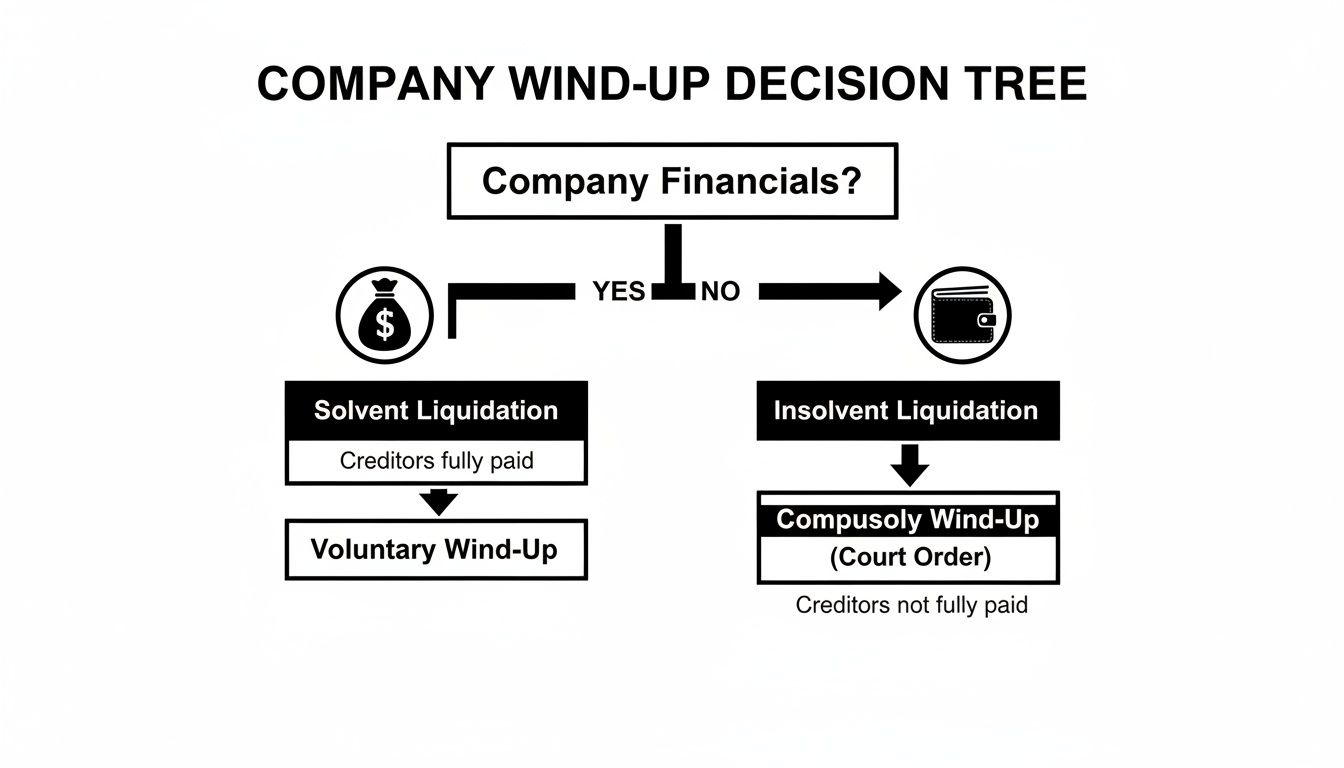
The takeaway here is simple but critical. Your company’s solvency status—whether it’s in the black or in the red—is the first and most important question to answer. It determines whether the wind-up will be a process of returning value to shareholders or recovering funds for creditors, and that changes everything from a tax perspective.
Your Final Tax and ATO Compliance Checklist

Closing down a company isn't just about locking the doors for the last time. It’s a final, crucial sprint to tie up every loose end with the Australian Taxation Office (ATO). Get this part wrong, and you could be facing penalties long after you thought it was all over.
Think of it as the ultimate handover. You’re not just ceasing trade; you’re officially ending your company's relationship with the ATO. From that final tax return to cancelling your GST, every step needs to be handled with precision.
Here’s the checklist you and your liquidator need to follow to ensure a clean, compliant finish.
Lodging the Final Company Tax Return
This is the big one. Your company's final income tax return isn't just another annual lodgement—it’s the bookend to its entire financial story.
This return must cover the period from the beginning of the company's financial year right up to the exact date it was deregistered. So, if your company’s year-end is 30 June and it’s dissolved on 15 December, that final return covers 1 July to 15 December.
What's absolutely critical here is that you must mark the return as the final return. This is your official signal to the ATO that the company is done, has stopped all trading, and won't be lodging any more returns. It’s a small detail with huge importance.
Finalising GST and Business Activity Statements (BAS)
Just like the tax return, your GST and BAS obligations need a clean finish. You’ll need to lodge one last BAS that accounts for every bit of business activity up until the day your GST registration is cancelled.
You are required to cancel your GST registration within 21 days of shutting down your business. If you don't, the ATO will assume you're still trading, which can lead to auto-generated BAS forms and a phantom tax debt if they go unlodged.
Your final BAS needs to include:
- All remaining sales, including the sale of any business assets.
- Every last input tax credit you’re entitled to claim.
- Any GST adjustments that need to be made.
Once that final BAS is lodged and paid, you can get your tax agent or liquidator to cancel the GST registration through the business portal.
Employer Obligations: PAYG and Superannuation
If your company had staff, settling your employer obligations is non-negotiable. The ATO takes employee entitlements very seriously, and the penalties for getting this wrong can be severe, as outlined in both tax law and the Corporations Act 2001.
Here’s what you must do:
- Final PAYG Withholding: Pay every last dollar of Pay As You Go (PAYG) withholding owed to the ATO.
- Lodge Final Summaries: A final PAYG payment summary annual report (or a Single Touch Payroll finalisation) must be lodged. This details all payments made to staff and tax withheld during the company's last year.
- Pay All Superannuation: All superannuation guarantee (SG) contributions for every employee must be paid in full to their super funds. Any shortfall means lodging a Superannuation Guarantee Charge (SGC) statement and paying the debt directly to the ATO.
Expert Insight: Unpaid PAYG withholding and superannuation can haunt you personally. Under the Director Penalty Notice (DPN) regime, the ATO can pursue directors personally for these debts—even after the company is liquidated.
Getting your ducks in a row for that final assessment is crucial. A big part of that is properly organizing deductible expenses to ensure the numbers are spot on.
Actionable Steps Before You Finalise
Proactive communication is your best friend here. Your liquidator or accountant should formally notify both the ATO and the Australian Securities and Investments Commission (ASIC) that the company is being wound up.
This simple step ensures all the regulators are on the same page, preventing crossed wires or compliance headaches down the track. Following this checklist is your best defence against the long-term tax consequences of an untidy company wind-up.
Ready to close your company’s final chapter without leaving any loose ends? Book a consultation with us today. Our expert accountants and registered ASIC agents will manage your final ATO compliance with the precision it needs, giving you the peace of mind you deserve.
Unpacking CGT and Deemed Dividends for Shareholders
For shareholders of a solvent company, the final wind-up is about more than just closing the doors. It’s your chance to unlock the value you've spent years building.
But here’s the catch: the money you receive from a liquidator isn't just a simple bank transfer. The ATO has very specific rules about how these funds are taxed, and getting your head around them is crucial for managing your final tax bill.
When a liquidator makes that final distribution, two critical tax events are triggered: Capital Gains Tax (CGT) and deemed dividends. Understanding how these two interact is the secret to a tax-effective company wind-up.
CGT Event C2: The End of the Line for Your Shares
From the ATO's point of view, when you receive a final payout from a liquidator, it marks the official end of your ownership in the company. In tax-speak, this is known as CGT event C2.
Think of it as selling your shares back to the company for the very last time. The payment you get from the liquidator is your 'capital proceeds' for the cancellation of those shares. You then have to compare this amount to your shares' 'cost base' to see if you’ve made a capital gain or a capital loss.
Your cost base is simply what you originally paid for the shares, plus any extra costs like brokerage fees.
The formula is pretty straightforward:
Capital Proceeds – Cost Base = Capital Gain or Loss
If you have a capital gain, you’ll need to declare it in your personal tax return. But here's some good news: if you've held those shares for more than 12 months, you might be eligible for the 50% CGT discount, which can halve the tax you pay on that gain.
The Power of Deemed Dividends and Franking Credits
This is where it gets a little more complex—but also where the real tax-planning opportunities lie. Not every dollar of your final distribution is treated as a return of capital. A chunk of it might be classified as a 'deemed dividend'.
This is all thanks to Section 47 of the Income Tax Assessment Act 1936. This rule says that any part of a liquidator's distribution that comes from the company's accumulated profits is treated as if the company paid you a dividend.
And the best part? These deemed dividends can come with franking credits attached. Franking credits are a record of the tax the company has already paid on its profits (at a rate of either 25% or 30%). When these credits are passed to you, they act as a tax offset, dramatically reducing the personal income tax you owe on that dividend income.
For a deeper dive into how company profits and loans are handled in a wind-up, check out our article on unpaid entitlements and Division 7A loans.
A Practical Example: Breaking Down a Distribution
Let's put this into a real-world scenario to see how it works.
Imagine you're the only shareholder in a company being wound up. You originally paid $20,000 for your shares (your cost base). The company also has $80,000 in retained profits that it has already paid tax on. The liquidator gives you a final distribution of $100,000.
Here’s how the ATO splits that payment:
- Deemed Dividend: The $80,000 portion that came from company profits is treated as a fully franked dividend under Section 47.
- Capital Proceeds: The remaining $20,000 is considered a return of your original investment. This becomes your capital proceeds for your CGT calculation.
Now, let's look at your tax position:
- Capital Gain/Loss: Your capital proceeds are $20,000 and your cost base is also $20,000. That means your capital gain is $0. Zero.
- Dividend Income: You receive an $80,000 dividend. Assuming a 25% company tax rate, this would carry franking credits of about $26,667. You declare the grossed-up amount ($106,667) as income, but you also get a $26,667 credit to reduce your tax bill.
As you can see, making sure these final distributions are structured correctly is essential. It’s this powerful mix of CGT rules and franked dividends that makes a solvent liquidation such a smart way to extract wealth from a successful business.
Navigating these rules isn't a DIY job; it requires an expert hand. Book a consultation with EndureGo Tax today. Our accountants in Ashfield and the Northern Beaches are specialists in managing the tax consequences of winding up a company, ensuring you walk away with your final distribution in the most tax-effective way possible.
Don't Get Caught Out: Avoiding Costly Traps with Smart Tax Planning
When it comes to winding up a company, most of the heavy lifting happens before you even think about appointing a liquidator. Too many business owners treat it like a quick clean-up job, only to stumble into expensive tax traps that can wipe out their final payout.
This reactive approach can lead to some serious financial pain and unwanted attention from the ATO.
One of the biggest red flags we see is the informal wind-up. This is where directors try to sell off the company's assets, pay the cash out to themselves, and then just apply to have the company deregistered. The ATO has a name for this: "asset stripping."
If they catch you, they can invoke anti-avoidance rules and treat the entire payout as an unfranked dividend, hitting you with a tax bill at your personal marginal rate. It’s a shortcut that can cost you dearly.
Another common mistake is simply failing to document everything properly. Passing shareholder resolutions without formal minutes or forgetting to sign a declaration of solvency can create a compliance nightmare down the track, leaving you exposed if the process is ever questioned.
Your Pre-Liquidation Checklist: Getting It Right From the Start
The secret to a smooth, tax-effective wind-up is getting your house in order before the formal process begins. Proactive planning puts you in control and helps you protect your final return.
A crucial first step is a pre-liquidation tax review. Think of it like a builder checking the blueprints before pouring the concrete. Your accountant should forecast the entire process, from selling the assets to the final distribution to shareholders.
This review estimates your final tax position and shines a light on any potential problems before they become expensive headaches. It’s all about knowing the numbers before you kick things off.
Clearing the Decks for a Clean Closure
Before you even think about liquidation, it's vital to settle any internal financial messes. These are the loose ends that can cause major problems later on.
- Settle Director and Inter-Company Loans: Any outstanding loans between the company and its directors (or other related companies) must be formally repaid or forgiven. If you ignore these, you can get tangled up in messy Division 7A issues, where the ATO can deem the loan balance to be an unfranked dividend.
- Pay Out All Employee Entitlements: You must ensure every last dollar of wages, superannuation, and leave entitlements is paid and reported correctly. The ATO’s Director Penalty Notice (DPN) regime means directors can be held personally liable for unpaid PAYG withholding and super.
- Get Australian-Specific Advice: Tax rules are not universal. Relying on generic advice you found online or that applies in another country is a recipe for disaster. What works in the U.S. or the U.K. can cause serious confusion and costly mistakes here. To understand why local advice is so critical, it's worth exploring how different tax systems handle business closures.
Under the ATO’s Taxation Administration Act 1953, directors have a legal duty to ensure the company meets its PAYG withholding and superannuation guarantee obligations. Fail to do so, and the corporate veil can be pierced, making you personally responsible for the debt.
Good tax planning isn't just another cost; it's an investment in a clean, compliant, and financially successful exit from your business. It's the difference between walking away with your hard-earned profits and facing a drawn-out, stressful battle with the ATO.
Don't leave the final chapter of your business journey to chance.
Ready to plan a smart, tax-effective wind-up for your company? Book a consultation with EndureGo Tax today. Our expert accountants in Ashfield and the Northern Beaches specialise in proactive tax planning for company liquidations, ensuring you avoid common pitfalls and achieve the best possible outcome.
Your Step-by-Step Australian Company Wind-Up Plan
So, you’ve decided it’s time to close your company. Where do you even start?
Winding up a company properly is more than just ceasing to trade. It's a structured process with legal and tax obligations that can feel overwhelming. To make it easier, we've broken it down into a clear, actionable plan. Think of this as your master checklist to work through with your accountant and liquidator, ensuring every 'i' is dotted and 't' is crossed.
Phase 1: The First Moves and Formalities
Getting the first few steps right is everything. This initial phase sets the foundation for the entire wind-up, helping you sidestep legal headaches and financial traps down the track.
Confirm Company Solvency: First thing’s first: meet with your accountant. You absolutely must determine if your company is solvent – in simple terms, can it pay all its bills and debts? This single answer will decide which path you take.
Pass the Formal Resolutions: If you're solvent and heading for a Members' Voluntary Liquidation, there's some essential paperwork. The directors need to formally resolve to wind up the business and sign a declaration of solvency. From there, the shareholders must pass a special resolution to approve the liquidation and appoint a liquidator. These aren’t just suggestions; they are strict legal requirements.
Appoint a Registered Liquidator: You can't do this part yourself. You must appoint a registered liquidator to take the reins. This professional officially takes control of the company, and their appointment is critical for making sure everything is handled by the book, according to the Corporations Act 2001.
Phase 2: The Liquidation Process
Once the liquidator is on board, the process gets hands-on. Their job is to manage the operational and compliance tasks, while your role shifts to providing them with the necessary information and records.
- Official Notifications: The liquidator is legally required to notify both the Australian Securities and Investments Commission (ASIC) and the Australian Taxation Office (ATO) that they've been appointed and the liquidation has begun.
- Compile Financial Records: Get ready to hand everything over. The liquidator will need complete access to all company financial records—think ledgers, bank statements, asset registers, and all your employee records.
- Verify Final Tax Obligations: While the liquidator oversees this, you need to ensure all final tax lodgements are sorted. This includes the final Company Tax Return, all outstanding Business Activity Statements (BAS), PAYG withholding, and superannuation guarantee payments. A word of caution: be careful with online advice. Many guides you'll find discuss U.S. rules like Form 966 or 21% federal rates, which are completely irrelevant here. You can see why country-specific advice is so vital by looking at these C-Corporation closure issues that simply don't apply in Australia.
Phase 3: The Finish Line and Your Personal Tax
This is the final stage, where you receive any remaining company funds and need to account for them correctly in your personal tax affairs.
Practical Example: Let's say the liquidator finalises their work and issues you a "Final Distribution Statement". This document shows a total payment of $250,000. It explicitly breaks this down into:
- $50,000 Return of Capital
- $200,000 Deemed Dividend (fully franked)
You must use these exact figures on your personal tax return. This isn't optional; it's a legal requirement and your key to claiming the franking credits.
Finally, it's over to you. You must declare any capital gains, losses, and deemed dividends (along with their franking credits) on your personal income tax return. This is the last step to realising the financial outcome of the wind-up. While formal liquidation is the required path for a solvent company holding assets, it’s worth knowing about the simpler alternative. You can learn more by checking out our guide on how to deregister a company in Australia.
Getting this plan right from start to finish demands professional oversight. Book a consultation with EndureGo Tax today. Our team in Ashfield and Belrose Northern Beaches will work alongside your liquidator, giving you peace of mind that every step is managed perfectly.
Common Questions About Winding Up a Company
Closing a company is a huge step, and it's natural to have a lot of questions. As your local accountants in Ashfield and Belrose Northern Beaches, we've guided countless business owners through this final chapter.
Here are the straight-talking answers to some of the most common queries we get about the tax side of things.
Can't I Just Deregister My Company Instead of Liquidating It?
This is a big one, and the answer is: probably not.
You can only apply for a simple, voluntary deregistration if your company has less than $1,000 in assets and zero outstanding debts. It’s designed for dormant companies that have truly ceased all activity.
If your company has retained profits or other assets you want to distribute to shareholders, a formal Members' Voluntary Liquidation (MVL) is the proper—and tax-effective—legal path. Trying to strip the assets out first and then deregister is a huge red flag for the ATO and can trigger serious anti-avoidance penalties under the Corporations Act 2001. Don't risk it.
What Happens to Our Franking Credits When the Company Is Liquidated?
Here’s where a properly managed solvent wind-up really shines.
When the liquidator makes distributions to shareholders, a portion of that payment can be treated as a deemed dividend. The great news? These dividends can come with franking credits attached, passing them straight to you.
This is a massive advantage. Those tax credits directly reduce the personal tax you’d otherwise pay on that income, making it one of the most efficient ways to get the remaining profits out of your company.
This process is all thanks to Section 47 of the Income Tax Assessment Act 1936. It's a key piece of tax law that makes a formal solvent wind-up so valuable for shareholders.
How Long Does a Company Wind-Up Actually Take?
Honestly, it depends. The timeline can vary hugely based on how complex the company's affairs are.
For a straightforward Members’ Voluntary Liquidation (MVL) of a small, solvent company with clean books, you're typically looking at 6 to 12 months. This gives the liquidator enough time to notify all creditors, get the final green light from the ATO, sell any remaining assets, and pay out the final distributions.
On the other hand, a complex or insolvent liquidation can drag on for several years. This is especially true if there are major assets to sell, legal disputes, or disagreements with creditors that need to be resolved.
Navigating the complexities of a company wind-up isn't something you should do alone. At EndureGo Tax, our expert accountants and registered ASIC agents in Ashfield and Belrose Northern Beaches provide the peace of mind you need.
We’ll make sure every "i" is dotted and every "t" is crossed, maximising your returns while keeping you fully compliant. Book a consultation with us today and let's secure a smooth and successful closure for your business.
