


You’re usually here because a form has asked for a super fund ABN number, and you’ve hit that annoying pause. Is it on your statement? Is it the same as the USI? Do you use your TFN instead? If you’re an employer, it’s even more critical because the wrong identifier can send contributions into limbo or trigger a rejection.
I see this confusion often with new hires, payroll teams, and SMSF trustees. The issue usually isn’t finding a number. It’s making sure you’ve got the right number for the right purpose. In super, that distinction matters.
The Super Fund ABN Explained for 2026
A new employee starts on Monday. Payroll asks for their super details, they send through a fund name, a member number, and something labelled USI, but no one is sure whether the ABN is missing or whether the USI does the same job. That is how contribution mistakes start.
A super fund ABN number means the fund’s Australian Business Number. It is usually an 11-digit identifier registered through the Australian Business Register and used across ATO and payroll systems to identify the fund itself. For example, AustralianSuper’s fund ABN is 65 714 394 898, while Australian Retirement Trust’s ABN is 60 905 115 063, as noted in industry guidance on super fund identifiers.

In practice, the ABN is only one part of getting super set up properly. Employers use it in onboarding and payroll. Clearing houses use it to direct payments. Trustees and advisers use it to confirm they are dealing with the correct fund before money is sent.
Where mistakes usually happen
The trouble starts when one form asks for several identifiers at once. A standard super choice or payroll setup might ask for:
- Fund name
- ABN
- USI or SPIN
- Member number
- TFN details in a separate field or declaration
Each item has a different job. If the wrong one goes into the wrong field, contributions can be delayed, rejected, or sent for manual review.
The practical check that avoids problems
Before entering any super details, confirm three points:
- The ABN matches the fund
- The USI matches the product, where a USI is required
- The member number belongs to the employee, not another account or rollover product
That sounds basic, but it is where payroll errors happen. I see it with new staff setup, fund rollovers, and SMSFs that have only just been established.
Practical rule: Do not stop once you have found a number. Confirm what the number identifies, who issued it, and whether your payroll system needs an ABN, a USI, or both.
For employers, this is about paying the right fund on time and keeping records clean if the ATO ever checks your contribution process. For SMSF trustees, it is about making sure the fund is properly identified before any employer contribution is made.
What Is a Super Fund ABN and Why Does It Matter
Friday payroll is due, a new employee has handed over their super choice form, and the fund details look complete. Then the software asks for an ABN, a USI, and member information in separate fields. If those numbers are mixed up, the contribution can stall, bounce, or end up in manual review. That is usually when employers realise each identifier does a different job.
A super fund ABN identifies the fund itself. It is the fund-level identifier used across official records, employer onboarding, clearing house processes, and verification tools. It does not identify the member, and it does not identify a specific investment product inside the fund.

A super fund ABN is an 11-digit identifier issued through the Australian Business Register to a complying super fund, as explained in this guide to finding and using a super fund ABN. If you want background on how ABNs work more broadly, this ABN registration guide is a useful starting point.
The three identifiers people confuse
The practical problem is not finding a number. It is knowing which number belongs in which field.
- ABN
Identifies the super fund. - USI or SPIN
Identifies the super product within the fund. This is commonly required for APRA-regulated funds when contributions are being routed to a specific product. - TFN
Identifies the member for tax and reporting purposes. It is personal to the member and does not replace the fund ABN.
That distinction matters because a form can look complete while still being wrong. A payroll officer might enter the USI where the system expects the ABN, or assume the employee TFN covers fund identification. The contribution file may still be generated, but the payment can be rejected later or held up while details are checked.
The ABN’s function in practice
In day-to-day admin, the ABN is the first check that confirms the legal fund you are paying. The USI then narrows that down to the right product where a USI is required. The TFN sits on the member side of the transaction.
I see this regularly with employer onboarding and fund changes. The employee gives valid details, but one identifier is copied into the wrong box. Nothing looks obviously broken until contributions are not allocated properly.
If a form asks for both ABN and USI, enter both in their own fields. If it asks for a TFN declaration, treat that as a separate member requirement, not as part of fund identification.
Why it matters for employers and trustees
For employers, the risk is compliance and timing. Super guarantee payments need to go to the correct fund, with clean records to support what was paid, when, and to whom. Using the wrong identifier can create avoidable rework and leave you explaining contribution delays later.
For SMSF trustees, the issue is slightly different. An employer cannot just pay into a new SMSF because the name sounds right. The fund details need to be verified properly before any contribution is made, especially where the fund has only recently been established.
What works in practice is simple:
- Use the exact fund name from official records
- Confirm the ABN belongs to the fund, not a product or marketing label
- Check whether the process also requires a USI
- Keep the member TFN and member number in their own fields
That small verification step prevents a lot of mess.
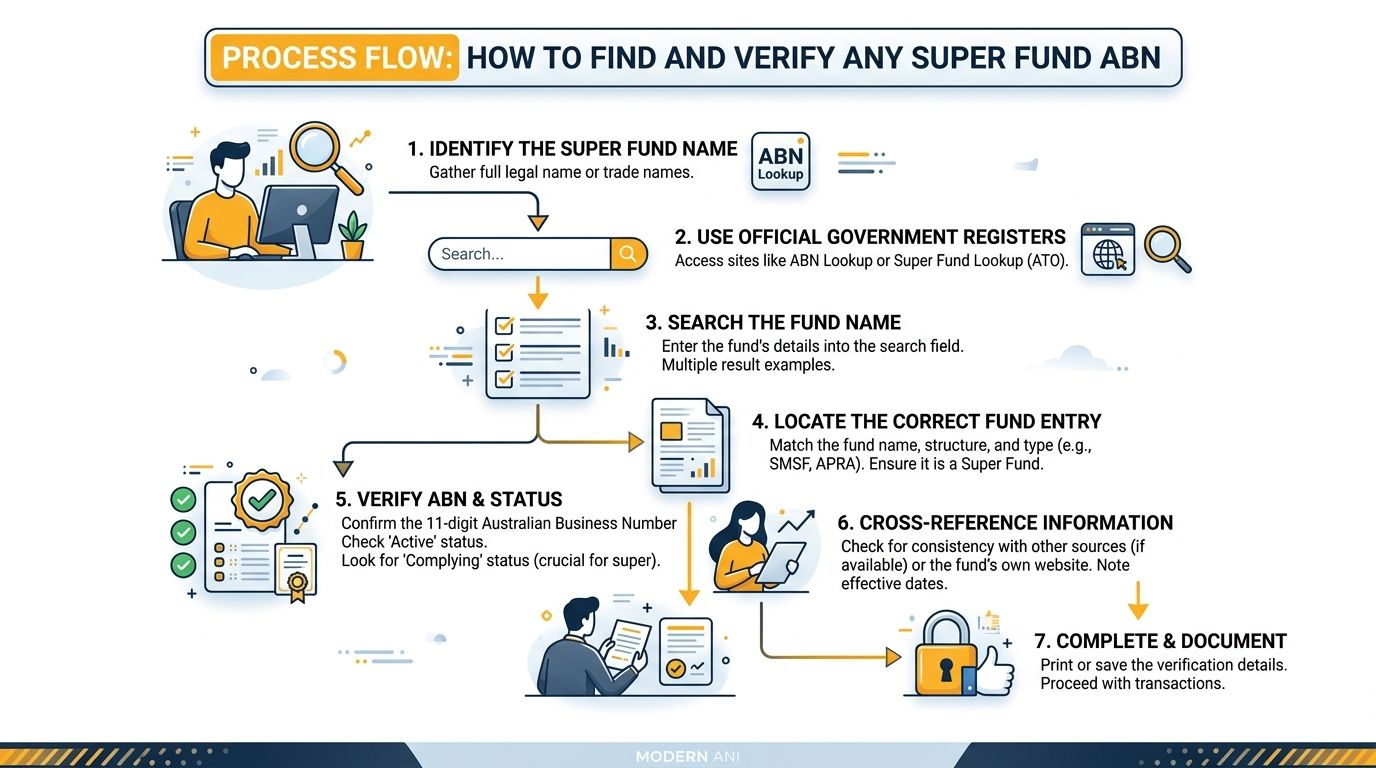
How to Find and Verify Any Super Fund ABN
Most articles stop at “search for the fund name”. That’s only half the job. The actual task is to find and verify the super fund ABN number before contributions or rollovers go out.
A major practical issue is that similar fund names can return many results, including dozens of SMSFs. That creates a real risk of using the wrong ABN in payroll or rollover paperwork. The official Super Fund Lookup tool and the ABR are the authoritative sources for verification, as noted in Canstar’s discussion of finding and checking a super fund ABN.
Start with the easy documents
Before you jump into government tools, check the obvious places:
- Your super statement. Many funds show the ABN in the fund details section.
- The fund website. Look in contact, forms, employer, or fund details pages.
- Employer onboarding forms. If you’re an employee, your previous payroll setup may already have the correct fund details.
That approach is quick, but it isn’t enough on its own when money is about to move.
Use the official verification process
Here’s the process I recommend for employers, bookkeepers, and anyone handling rollovers.
- Collect the full legal fund name
Don’t rely on a nickname or marketing name alone. - Get the ABN provided by the fund or member
Treat this as a starting point, not final proof. - Check the ATO’s Super Fund Lookup tool
Use it to verify that the ABN matches the fund you intend to use. You can access the ATO service via Super Fund Lookup. - Cross-check against ABR records
This helps confirm you’re looking at the correct registered entity rather than a similar-sounding name. - Confirm whether a USI is also needed
This is especially important for APRA funds and payroll setup. - Keep a record of what you verified
A saved PDF, screenshot, or payroll note can save time later if a contribution fails.
Similar names are where errors start
This is the trap. A search may produce multiple near-identical names. Some are large funds. Some are SMSFs. Some may no longer be the right destination for the contribution workflow you’re completing.
Common mistake: People search by fund name, pick the closest match, and assume the rest of the details will sort themselves out. Super systems don’t work like that.
A better framework for employers and trustees
Use this shortlist before pressing submit:
| Check | What you’re confirming |
|---|---|
| Fund name | Matches the legal or official fund record |
| ABN | Matches the fund, not a product or unrelated entity |
| USI | Correct product identifier where required |
| Status | Suitable for the intended contribution or rollover process |
| Recordkeeping | You can show what was checked and when |
If you’re setting up a new structure and need the business registration side handled properly, this ABN registration guide is a useful, practical reference.
For SuperStream obligations and official ATO guidance around employer super processes, it’s worth checking the ATO’s SuperStream information.
ABN Rules for Self-Managed Super Funds
SMSFs are a different category altogether. If you’re a trustee, you’re not just looking up someone else’s super fund ABN number. You’re responsible for getting and maintaining your fund’s registration details properly.
For SMSFs, ABN registration is not optional. The ATO and ABR registration step is part of establishing the fund so it can legally receive superannuation guarantee contributions and interact with banks, rollover systems, and tax lodgment channels, according to this overview of super fund ABN requirements for SMSFs.
What trustees need to understand early
A lot of trustees assume the ABN is an admin detail that can wait until after the deed, bank account, or investment decisions. That’s the wrong order.
The ABN is part of the operational setup of the SMSF. Without it, ordinary tasks become harder fast. Employers may not be able to direct contributions correctly. Other funds may not process a rollover the way you expect. Service providers may ask for registration details before they move forward.
The practical setup sequence
For SMSF trustees, the safer sequence is:
- Establish the fund properly first
Make sure the trust deed and trustee structure are in place. - Register through the ATO and ABR process
The ABN step forms part of the fund establishment process. - Check the fund details once listed
Don’t assume every detail has flowed through exactly as intended. - Set up contribution and message handling correctly
Super administration is now heavily tied to electronic processes.
A lot of trouble comes from rushing the first step and fixing the records later. That clean-up is usually slower than getting it right at the start.
Batch checking matters for administrators
The same source notes that the Super Fund ABN Lookup tool supports batch validation by ABN, which is useful if you manage multiple funds or multiple employee records. That matters more than initially apparent. A single manual check is fine for one fund. It’s not efficient if you’re onboarding a group of staff, cleaning up historic payroll data, or reviewing a book of SMSF files.
If you administer many records, build a repeatable process:
- Confirm the fund list.
- Validate the ABNs in batches where appropriate.
- Review any mismatches manually.
- Update payroll or trustee records immediately.
Good SMSF admin is rarely about one big decision. It’s a series of small checks done in the right order.
For trustees who want a plain-English summary of the obligations around running the fund, these self-managed super fund rules are a useful starting point.
What tends to go wrong
The recurring issues are usually practical rather than technical:
- Details don’t match across documents. The fund name on one record differs slightly from another.
- The trustee assumes the setup is complete too early. Then the contribution or rollover steps stall.
- Records aren’t updated after a change. Old details remain in payroll, banking, or adviser files.
- Too much reliance on memory. Trustees often think they know the fund identifiers, but they’re looking at the wrong field.
For SMSFs, clean records aren’t just good admin. They’re part of staying compliant.
Super Fund ABN vs TFN: What Is the Difference
This is one of the most common mix-ups on super forms. The short version is simple. The ABN identifies the fund. The TFN identifies you for tax purposes.
For Australian SMSFs, the ABN is not just an identifier but a compliance milestone. An SMSF must register for an ABN to operate and to receive contributions through SuperStream, and it must also have an Electronic Service Address (ESA) for electronic contribution and rollover messages. The fund’s ABN is the anchor for its operational identity, as explained in this SMSF-focused guide on super fund ABNs.
ABN vs TFN for superannuation
| Aspect | Super Fund ABN | Member TFN |
|---|---|---|
| What it identifies | The super fund | The individual member |
| Main use | Fund identification for contributions, payroll, and administration | Tax identification for the member |
| Who uses it | Employers, payroll systems, funds, administrators | The ATO, the fund, and the member |
| Does it replace the other number | No | No |
| SMSF relevance | Central to fund operation and SuperStream setup | Still relevant to the member, but not the fund identifier |
A practical example
If your boss is paying your super, the employer needs the fund details. That means the fund ABN, and often the USI if the fund requires it for product-level routing.
If you’re giving your super fund your tax details, that is about your TFN, not the fund’s ABN.
The extra confusion with SMSFs
SMSFs make this trickier because trustees deal with both fund-level and member-level records at the same time. You may be a member, a trustee, and the person completing the forms. That can blur the lines unless you slow down and check which entity the form is asking about.
For a clearer explanation of the personal tax identifier side, this guide to understanding tax file number in Australia is worth reading.
On super paperwork, the easiest way to avoid errors is to ask one question first. Is this field asking about the fund, the product, or the member?
Ensuring Your Super Compliance with Expert Help
The super fund ABN number looks simple on paper. In practice, it sits at the centre of payroll setup, contribution routing, rollover processing, and SMSF administration. The problems usually start when people use the wrong identifier, rely on an outdated record, or skip the verification step.
For employees, the key issue is accuracy. For employers, it’s compliance and recordkeeping. For SMSF trustees, it’s registration, operational readiness, and ongoing maintenance of the fund’s details. The safest habit is to verify before money moves, keep clear records, and treat ABN, USI, and TFN as separate data points with separate jobs.
If you need help with SMSF setup, super fund administration, or related tax work, options include using the official ATO and ABR tools directly, working with your payroll provider, or engaging an accountant who handles fund compliance work. In practice, firms such as EndureGo Tax assist with trust and SMSF compliance, including the reporting and administration tasks where fund identification details need to be handled correctly.
If you’re in Ashfield, Belrose, the Inner West, or the Northern Beaches, getting a second set of eyes on your fund details can save a lot of back-and-forth later. That’s especially true when you’re establishing an SMSF, changing payroll records, or sorting out a rollover that doesn’t look right.
If you want practical help checking fund details, setting up an SMSF properly, or sorting out super compliance issues before they become expensive admin problems, speak with EndureGo Tax. We work with individuals, employers, and trustees across Ashfield and Belrose, and we can help you get the paperwork, registration, and compliance side right from the start.
