


When you’re self-employed, you're the boss. You set the hours, you chase the invoices, and you wear every hat in the business. But there’s one job title many sole traders forget: Head of Retirement Planning.
Unlike employees who receive mandatory Superannuation Guarantee (SG) payments, as a sole trader or contractor, you are the employer. That means building your retirement nest egg is entirely your responsibility. It can feel like just another task on a never-ending to-do list, but ignoring your super is a financial risk you simply can't afford. This expert guide provides actionable strategies to take control of your superannuation.
Getting Started With Super for the Self-Employed
For a tradie, freelancer, or small business owner, navigating super for self-employed individuals can seem complex. Let's reframe this: superannuation is not a chore; it's your single most effective tool for building long-term wealth, completely separate from the daily grind of your business.
Think of it this way: you are both the employer and the employee. You have the power to decide how—and when—to pay your own super.
Starting now, even with small, consistent contributions, is the key to securing financial freedom in the future. It’s about ensuring the future you benefits from the hard work you’re putting in today.

Your Key Contribution Options
So, how do you actually transfer money into your super fund? There are several methods, each with distinct rules regarding taxation and annual limits set by the Australian Taxation Office (ATO). Understanding these is fundamental to a sound strategy.
Your Super Contribution Options
Here’s a quick-reference table to clarify your main options for growing your super.
| Contribution Type | What It Is | Tax Treatment | Annual Cap (2024-25) |
|---|---|---|---|
| Personal Concessional | Voluntary payments you make and then claim as a tax deduction. This is a powerful strategy for reducing your taxable income. | Contributions are taxed at a low 15% within your super fund, which is typically far more advantageous than your personal income tax rate. | $27,500 |
| Non-Concessional | Voluntary payments made from your after-tax income (money that's already been taxed through your business or personal earnings). | As tax has already been paid, these contributions enter your fund tax-free, allowing for strategic wealth accumulation. | $110,000 |
| Spouse Contribution | A contribution you make into your spouse's super account, particularly effective if they are a low-income earner. | You may be eligible to claim a tax offset of up to $540 for making this type of contribution. | N/A |
Understanding these strategic choices is the first step. It demonstrates how contributing to super is not merely saving—it's an astute tax-planning mechanism.
Taking Your First Steps
Knowing the options is one thing; implementing a disciplined plan is what truly builds wealth. For the self-employed, professional guidance can be invaluable. An expert financial advisor, like the team at Oupac Financial Services, can help you structure contributions in a way that aligns with your business's cash flow and long-term financial goals.
Actionable Tip: Start today. Automate a weekly transfer of just $50 from your business account to your super fund. This small, consistent action builds a powerful habit and leverages the magic of compound interest over time.
Ready to take decisive control of your financial future? Don't wait. Book a no-obligation consultation with our superannuation specialists to map out your first steps.
Why Ignoring Super Is a Risk You Can't Afford
When you're a sole trader, it’s tempting to push superannuation to the bottom of your priority list. You're busy chasing invoices, managing projects, and ensuring cash flow. Tomorrow’s retirement fund seems a world away from today's immediate needs.
However, neglecting your super is one of the most significant financial gambles a self-employed person can make. It’s not just about saving; it’s about deploying the most powerful wealth-building tool available: compound interest.
Your money starts earning returns, and then those returns start earning their own returns. The earlier you begin, the more explosive this compounding effect becomes.

The Power of an Early Start: A Tale of Two Tradies
Let's illustrate with a practical example. Imagine two self-employed carpenters, both skilled in their trade but with divergent approaches to retirement planning.
- Carpenter A – The Proactive Planner: At age 25, she commits to her future self and begins contributing $200 a week into her super fund. She treats it as a non-negotiable business expense.
- Carpenter B – The "I'll Catch Up Later" Procrastinator: Also 25, he decides to defer contributions. Business costs are high, and he believes he can make up for lost time later. He finally starts contributing the same $200 a week at age 40.
Fast forward to retirement at age 67. Assuming their funds achieve an average annual return of 7%, the difference is staggering. Carpenter A, simply by starting 15 years earlier, could amass a retirement nest egg hundreds of thousands of dollars larger than Carpenter B's.
This is the irrefutable mathematics of compounding.
Expert Insight: When it comes to superannuation, time is a far more powerful asset than the initial amount of money. Small, consistent contributions made early will always outperform large, panicked contributions made later in life.
Super Is More Than Just Your Retirement Nest Egg
A comfortable retirement is the ultimate goal, but your super account has another critical function: it’s your personal financial safety net. For a self-employed individual without access to sick leave or employer-funded insurance, this is a massive advantage.
Most super funds offer built-in insurance cover, often at a group rate that is significantly cheaper than sourcing it individually.
This typically includes three types of cover:
- Life Insurance (or Death Cover): A lump sum paid to your nominated beneficiaries if you pass away.
- Total and Permanent Disability (TPD) Insurance: A lump sum payout if you are seriously injured or disabled and can never work in your usual occupation again.
- Income Protection Insurance: This is vital for sole traders. It replaces a significant portion of your income if you are temporarily unable to work due to illness or injury.
One accident could mean months without income. Having income protection through your super ensures you can meet your financial obligations and focus on recovery. The Australian Taxation Office provides clear guidelines on how insurance fits within the superannuation sole purpose test.
This fundamentally changes the perception of super. It’s a powerful tool for building wealth and protecting you and your family. Take action now: log into your super fund's portal, review your insurance options, and set up a recurring contribution. Even a small amount is a significant step forward.
How to Make Contributions and Claim Tax Deductions
Understanding that you should contribute to super is the first step. Knowing how to do it strategically to reduce your tax liability is where the real power lies. For self-employed Australians, this isn't just retirement planning—it's one of your most effective tools for managing taxable income today.
Your personal contributions are categorised into two main types: concessional (before-tax) and non-concessional (after-tax). Mastering the distinction is crucial as they serve very different financial purposes.
Concessional Contributions: Your Tax-Saving Powerhouse
Concessional contributions are your primary strategy for legally minimising your tax bill. These are payments you make directly to your super fund, which you then claim as a tax deduction.
This action effectively lowers your total taxable income for the financial year. The contributed amount is then taxed at a flat rate of just 15% within the super fund. For most business owners, this is substantially lower than their marginal income tax rate.
Practical Example: The Freelance Graphic Designer
Sarah, a freelance graphic designer in Belrose, has had a successful year with a projected taxable income of $120,000. At this level, her marginal tax rate is 37%.
She decides to make a $20,000 personal concessional contribution. By claiming this as a tax deduction, she immediately reduces her taxable income from $120,000 to $100,000.
The $20,000 contributed to super is taxed at 15% ($3,000). Had she retained it as income, it would have been taxed at 37% ($7,400). This results in an immediate tax saving of $4,400, and the money is now invested for her retirement.
How to Claim Your Super Tax Deduction
Simply making the payment is not enough. To legally claim the deduction, you must follow a specific process mandated by the ATO. Failure to do so will forfeit the tax benefit.
Here is your step-by-step action plan:
- Make the Contribution: Transfer the funds to your super fund via their required method (e.g., BPAY, direct debit). Ensure the payment is received by the fund before the 30 June deadline.
- Submit a 'Notice of Intent to Claim': This is the critical step. You must complete and send a 'Notice of intent to claim or vary a deduction for personal super contributions' form to your super fund. This form is available on the ATO website or often through your fund's online portal.
- Receive Acknowledgement: Your fund will issue a confirmation letter or email acknowledging receipt of your notice. Do not lodge your tax return until you have this acknowledgement.
- Lodge Your Tax Return: You can now proceed. In your tax return, declare the amount you are claiming as a deduction in the relevant section.
This process is not optional; it is enshrined in tax law and strictly enforced by the ATO.
Non-Concessional Contributions: For Strategic Wealth Building
If concessional contributions are so effective for tax savings, why consider non-concessional contributions? These are made from your after-tax dollars—money on which you have already paid income tax.
Because the tax is prepaid, the money enters your super fund tax-free. While you don't receive a deduction, this is a powerful method for transferring a significant amount of capital into the tax-advantaged superannuation environment. It is particularly useful if you have maximised your concessional cap or received a lump sum of cash, such as from an inheritance or the sale of an asset.
Practical Example: The Tradie Selling an Asset
Mark, a plumber on the Northern Beaches, sells an investment property. After paying Capital Gains Tax, he has a $100,000 windfall.
He has already utilised his full concessional contribution cap for the year with regular, tax-deductible payments.
Mark makes a $100,000 non-concessional contribution. This strategically moves the capital from his personal bank account (where future investment earnings would be taxed at his high marginal rate) into his super fund (where future earnings are taxed at a maximum of 15%).
For a deeper understanding of how these contributions are reported, see our analysis of reportable superannuation contributions in our detailed guide.
Ready to implement these strategies but unsure where to begin? The rules are complex. Book a consultation with EndureGo Tax, and we will construct a contribution strategy that maximises your tax savings and aligns with your business objectives.
Taking Control: Is a Self-Managed Super Fund (SMSF) Right for You?
For many entrepreneurial Australians, the prospect of directly controlling their retirement savings is highly appealing. This is the domain of a Self-Managed Super Fund (SMSF). An SMSF is your own private super fund where you, as trustee, make the investment decisions—a popular choice for hands-on business owners serious about their super for self employed journey.
In an SMSF, you and up to five other members act as trustees. This means you are personally responsible for all aspects of the fund, from investment strategy to ensuring compliance with complex Australian superannuation and tax laws. It represents a significant increase in responsibility compared to a standard industry or retail fund.
Who Is an SMSF Really For?
An SMSF is not a universal solution. It demands significant time, financial acumen, and a level of administrative commitment that does not suit every business owner.
An SMSF is typically best suited for individuals who:
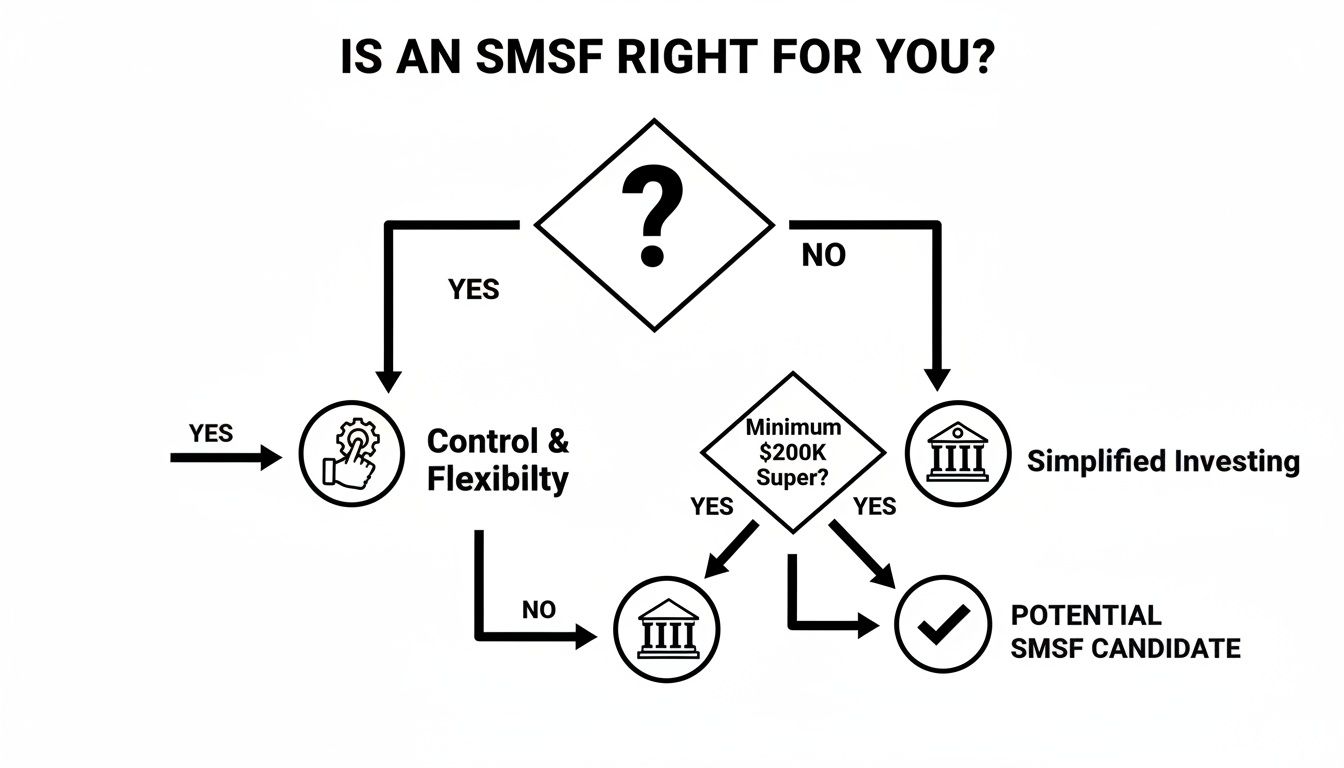
- Have a substantial super balance. While there is no official minimum, industry consensus suggests a starting balance of at least $200,000 to $250,000 is needed for an SMSF to be cost-effective.
- Desire control over specific investments. This could include direct commercial property, a specific share portfolio, or alternative assets not available in conventional funds.
- Possess the time and skill for administration. Running an SMSF is a serious undertaking involving meticulous record-keeping, arranging an annual audit, and staying abreast of legislative changes.
The Major Advantages of Running Your Own SMSF
The primary appeal of an SMSF lies in two key benefits: control and flexibility. For many business owners, these are decisive factors.
Expert Insight: A significant advantage is the ability to invest in ‘business real property’. Under strict regulations, your SMSF can purchase your business premises. Your business then pays commercial rent directly into your super fund, effectively converting a major business expense into a retirement investment.
Other key advantages include:
- Wider Investment Choice: You gain access to direct shares, residential or commercial property, and even alternative assets like artwork (though rules for these are extremely stringent!).
- Advanced Tax Strategies: Direct control over asset sales allows for more effective management of capital gains tax, particularly as you approach retirement.
- Potential Cost Efficiencies: For larger balances, the fixed administrative costs of an SMSF can be lower than the percentage-based fees charged by many retail funds.
When you are making the investment decisions, a robust strategy is essential. Understanding the 8 factors to consider before investing is non-negotiable for any SMSF trustee.
Understanding the Downsides and Responsibilities
With great control comes significant responsibility. The autonomy an SMSF provides is counterbalanced by serious legal and administrative obligations.
As a trustee, you are personally liable for any compliance breaches. The ATO enforces these rules rigorously, and penalties for errors can be severe.
Key responsibilities include:
- Strict Compliance: Your fund must adhere to the 'sole purpose test', meaning it exists solely to provide retirement benefits for its members. This is a core tenet of the Superannuation Industry (Supervision) Act 1993.
- Annual Audits: You must engage an approved SMSF auditor to conduct a full audit of your fund each financial year.
- Higher Costs (for smaller balances): Setup and annual running costs—including accounting fees, audit fees, and the ATO supervisory levy—can make SMSFs prohibitively expensive for balances under $200,000.
Establishing and managing an SMSF is a complex process. For a comprehensive overview, our guide on how to start a Self-Managed Super Fund provides a detailed roadmap.
Is an SMSF the right strategic move for you? It depends entirely on your financial situation, goals, and willingness to assume the trustee role. Contact EndureGo Tax for an expert consultation to evaluate the pros and cons for your specific circumstances.
Navigating Contribution Caps and Avoiding Tax Traps
While contributing to your super is a brilliant tax-saving strategy, you cannot contribute unlimited amounts. The Australian Taxation Office (ATO) imposes strict annual limits on contributions. Adhering to these rules is non-negotiable for the self-employed to avoid significant penalties.
Think of these caps as the legal speed limits on the superannuation highway. Stay within them for a smooth journey; exceed them, and you risk turning a smart financial move into a costly error.
Understanding the Two Key Contribution Caps
Each financial year, two primary caps must be on your radar:
Concessional Contribution Cap: This is the limit for your pre-tax contributions—those that provide a tax deduction, such as personal deductible contributions. For the 2024-25 financial year, this cap is $27,500. These funds are taxed at a concessional rate of 15% within your super fund.
Non-Concessional Contribution Cap: This is the limit for your after-tax contributions. For 2024-25, this cap is $110,000. As income tax has already been paid on these funds, they are not taxed again upon entering your super fund.
Monitoring your contributions against these two figures is a cornerstone of effective superannuation planning.
The 'Carry-Forward' Rule for Concessional Contributions
For the self-employed, income can be highly variable. The $27,500 concessional cap might feel restrictive in a high-income year.
This is where the ‘carry-forward’ concessional contributions rule becomes an invaluable strategic tool.
It allows you to utilise any unused portion of your concessional cap from the previous five financial years. The primary condition is that your total super balance must have been under $500,000 on 30 June of the preceding financial year.
Practical Example: The Consultant with Lumpy Income
An IT consultant has a few lean years and contributes only $10,000 annually to her super. Each year, she accrues $17,500 of unused cap space. After three years, she has a 'bank' of unused cap space totalling $52,500.
In her fourth year, she secures a major project, and her income skyrockets.
Leveraging the carry-forward rule, she can make her standard $27,500 contribution plus the $52,500 she didn't use over the last three years. This enables her to make a total tax-deductible contribution of $80,000 in a single year, significantly reducing her taxable income when she needs it most.
The 'Bring-Forward' Rule for Non-Concessional Contributions
A similar mechanism, the 'bring-forward' arrangement, exists for after-tax contributions. If you are under 75 years of age, you may be able to group three years' worth of your non-concessional caps into a single financial year.
This allows for a potential contribution of up to $330,000 ($110,000 x 3) at once. It’s an excellent strategy if you receive a large sum of money—from the sale of a business asset or an inheritance—and wish to move it into the tax-effective super environment efficiently.
ATO Legislation Reference: The rules governing these arrangements are strict and detailed. The ATO outlines the core principles for non-concessional contributions in the Income Tax Assessment Act 1997 (ITAA 1997).
These advanced strategies are often utilised by trustees of a Self-Managed Super Fund (SMSF). This flowchart can help you determine if an SMSF aligns with your circumstances.
What Happens if You Go Over the Caps?
Exceeding the caps requires immediate attention. If you exceed the concessional cap, the excess amount is added back to your taxable income and taxed at your marginal rate (though you receive a 15% tax offset for the tax already paid by your fund).
If you exceed the non-concessional cap, the ATO will issue a determination. You will generally have the option to withdraw the excess amount, which will then be subject to tax.
Contribution caps and special rules are powerful tools, but they are also complex. Book a consultation with EndureGo Tax today to ensure your contribution strategy is both tax-effective and compliant, avoiding any unforeseen liabilities from the ATO.
Let's Build Your Super Action Plan
You now understand the theory behind superannuation for the self-employed. However, translating this knowledge into a coherent, actionable strategy for your future is the most critical step.
It’s easy to become overwhelmed by the jargon—caps, contributions, compliance. The next step is to cut through the noise and build a clear plan that works for you.
This is where expert guidance becomes indispensable. At EndureGo Tax, we specialise in the financial landscape of sole traders and small business owners. We don't just complete your tax return; we partner with you to construct a robust financial future.
Your Personal Superannuation Game Plan
We advocate for a proactive, not reactive, approach. Instead of scrambling at tax time, we help you plan your financial moves months—or even years—in advance. Our expert support is designed to cover every angle of your business and personal wealth.
Here's how we can help:
- Strategic Contribution Planning: We analyse your cash flow and tax position to determine the optimal mix of concessional and non-concessional contributions for maximum benefit.
- BAS and Tax Lodgements: We manage all your compliance needs, from sole trader tax returns to Business Activity Statements, freeing you to focus on your core business.
- SMSF Compliance and Advice: Considering an SMSF? We provide expert advice on setup, administration, and annual audit requirements to ensure you remain fully compliant with the ATO’s complex legislation.
- High-Level Tax Advice: From capital gains tax planning to optimal business structuring, we provide the strategic thinking required to protect and grow your wealth.
Don't let superannuation remain on your "to-do later" list. Taking control of your super is one of the most powerful financial decisions a self-employed individual can make. Expert advice ensures you execute it correctly.
Your financial future is too important to leave to chance. Stop trying to solve the superannuation puzzle alone.
Book a consultation with the expert local accountants at EndureGo Tax today and gain the peace of mind that comes with a professionally crafted plan.
Common Questions About Super for Self Employed
For the self-employed, the world of superannuation can seem like a different beast. Rules from past employment may not apply, and understanding your obligations is key to staying compliant and building a secure future.
Let's address some of the most frequent questions we receive from tradies, freelancers, and small business owners.
As a Sole Trader Do I Have to Pay Myself Super?
The short answer is no. As a sole trader, you are not legally obligated to pay yourself the Superannuation Guarantee (SG). The mandatory 12% (as of 1 July 2024) is a requirement for employers paying their staff. Since you are your own boss, the law does not compel you.
However, while it is not compulsory, it is a financial imperative. Without an employer contributing to your retirement fund, the entire responsibility rests on your shoulders. If you don't pay yourself super, no one will.
Can I Pay Super from My Business Bank Account?
Yes, absolutely. This is a common and practical method. The ATO is not concerned with the source bank account; their focus is on the correct reporting and claiming procedure.
The critical action is to lodge a 'Notice of intent to claim a deduction for personal super contributions' form with your super fund. This must be done before you file your tax return. Once your fund acknowledges this notice, you can then claim the contribution as a tax deduction, effectively reducing your taxable income for the year.
What Happens if I Switch from a Sole Trader to a Company?
This transition fundamentally changes your superannuation obligations. The moment you incorporate a proprietary limited (Pty Ltd) company and begin drawing a salary or director’s fees, you have created a separate legal entity. Your company is now legally defined as your employer.
Expert Alert: From that point on, your company is legally required to pay the 12% Superannuation Guarantee on your behalf. This is no longer optional; it is a legal obligation under the Superannuation Guarantee (Administration) Act 1992, identical to the requirement for any other employee.
You can, of course, continue to make additional personal contributions to accelerate your savings. However, the base SG payment becomes a mandatory and non-negotiable business expense.
Are you struggling to make sense of your super obligations or seeking to build a tax-effective contribution strategy? Don't leave your financial future to chance. The experts at EndureGo Tax are here to provide clear, actionable advice tailored for self-employed Australians. Book a consultation today and secure the peace of mind that comes with professional guidance.
