


When you’re starting a business in Australia, one of the first critical questions you’ll face is how to structure it. The sole trader vs company tax debate isn’t just about paperwork; it’s a fundamental choice that shapes how you’re taxed, your legal liability, and your administrative workload.
As an expert in business structuring, I can tell you the core difference boils down to this: as a sole trader, your business profit is taxed as your personal income at individual marginal rates. As a company, your profit is taxed at a flat corporate rate, completely separate from your personal finances. This distinction is the bedrock of your financial strategy.
So, which one is right for you? It depends entirely on whether your priority is immediate simplicity and low setup costs, or if you’re executing a long-term strategy focused on tax efficiency, asset protection, and scalability.
Sole Trader vs Company: Which Tax Structure Wins?
Choosing between operating as a sole trader or establishing a company is one of the most pivotal decisions a business owner will make. There is no single “best” answer—the optimal choice is dictated by your income, growth ambitions, and tolerance for administrative complexity.
If you’re a sole trader, the tax system is simple. Your business income is your personal income. This structure is highly effective when profits are low, as you can leverage the $18,200 tax-free threshold. However, as your business grows, your profits are pushed into higher personal tax brackets, and that initial simplicity can become a significant financial drawback.
On the other hand, a company structure offers a flat, and often much lower, tax rate. This is a substantial advantage for businesses with high profits. It also establishes a separate legal entity, meaning your personal assets (like your family home) are shielded if the business encounters financial distress. The trade-off? Higher setup costs and more complex compliance obligations.
Key Differences at a Glance: Sole Trader vs Company
To make this decision clearer, let’s break down the fundamental differences between the two structures. This table provides an expert snapshot of what you’re committing to with each option.
| Feature | Sole Trader | Company |
|---|---|---|
| Tax Rate | Progressive individual rates (0% – 45%) | Flat corporate rate (25% or 30%) |
| Legal Liability | Unlimited (personal assets are at risk) | Limited (personal assets are protected) |
| Setup Cost | Low (only an ABN is required) | Higher (ASIC registration fees apply) |
| Compliance | Simple (part of your personal tax return) | Complex (separate company tax return) |
The paths are starkly different. In Australia, a sole trader’s business income is taxed using the same progressive scale as any individual, starting at 0% for income up to $18,200 and climbing to a top marginal rate of 45%.
A company, however, benefits from a flat rate. While the general company tax rate is 30%, many small businesses qualify for the more attractive 25% rate. You can find more insights on what the sole trader vs company tax structures mean for your business on our blog.
Expert Insight: The strategic tipping point often occurs when your business generates more profit than you require for personal living expenses. A company structure is brilliant for this scenario, as it allows you to retain excess profits within the business, taxed at the lower corporate rate, to fuel future growth and investment.
Ultimately, this choice comes down to where your business is today and where you envision it tomorrow. Are you just starting out and need maximum simplicity? Or are you scaling and require a smarter approach to tax and liability?
Answering that question is your first step. If you’re still uncertain how these rates and rules apply to your specific situation, seeking professional advice is the most strategic move you can make. Book a consultation with our tax experts today to ensure your business is built on the right foundation.
Analyzing Your Core Tax Obligations
Understanding your fundamental tax responsibilities is the bedrock of effective business management. The structure you choose in the sole trader vs company tax debate dictates not just the rate you pay, but your entire compliance relationship with the Australian Taxation Office (ATO).
As a sole trader, the system is refreshingly direct because legally, you and your business are one and the same entity. All your business profits are treated as your personal income.
This means your net business profit is added to any other income you earn (like from a part-time job or investments) and is taxed at your individual marginal tax rate. You report it all on a business schedule that forms part of your personal tax return. The simplicity here is a massive drawcard for new ventures.
For a detailed look at this process, our guide on how sole trader tax returns are made easy breaks it all down.
Managing Tax as a Sole Trader
The ATO requires you to manage your tax liability proactively through the Pay As You Go (PAYG) instalment system to avoid a large bill at the end of the financial year.
- PAYG Instalments: If your business income hits a certain threshold, the ATO will automatically enter you into this system. You’ll then make quarterly payments towards your estimated annual income tax. Practical Example: Let’s say you’re a freelance graphic designer. The ATO estimates your annual tax bill will be $12,000. They will issue you with quarterly PAYG instalment notices of $3,000 each to ensure you are paying your tax throughout the year.
- Reporting: Come tax time, everything is tallied. Your total income (business and personal) and the PAYG instalments you’ve paid are reconciled on your individual tax return.
This pay-as-you-go approach is a non-negotiable for managing your cash flow and a vital habit for any successful sole trader.
How Companies Handle Tax
A company operates under a completely different set of rules. It’s a separate legal and tax entity, a crucial distinction. The company’s profits belong to the company itself—not directly to you as the owner or shareholder.
This means a company lodges its own, separate company tax return and pays tax on its net profit at a flat rate. For the 2023-24 financial year, that rate is 25% for businesses with an aggregated turnover under $50 million, or 30% for all other companies.
Key Takeaway: The flat 25% company tax rate is a game-changer for profitable businesses wanting to reinvest and grow. Profits can be retained within the company and taxed at this lower rate, instead of being paid out to an individual who could be taxed at a marginal rate as high as 45% (plus the Medicare levy).
When you want to access these profits, they are distributed to shareholders as dividends. These often come with franking credits, which represent the tax the company has already paid. This prevents double taxation, as you can use these credits to reduce your personal tax bill.
Figuring out which of these structures aligns with your goals is essential for both compliance and tax-effective planning. To forecast your obligations accurately and make the right call, book a consultation with one of our expert accountants today.
Running the Numbers: Sole Trader vs. Company Tax in the Real World
Tax rates and rules are abstract concepts until you see their real-world impact on your bank account. To truly grasp the financial implications of the sole trader vs company tax decision, we must analyse practical profit scenarios. This is where the difference between a sole trader’s scaling tax rates and a company’s flat rate becomes crystal clear.
Let’s crunch the numbers for a business at three distinct profit levels: $60,000, $120,000, and $200,000. These scenarios will reveal the tax liability under each structure and identify the financial tipping point where one setup becomes superior to the other.
The Low-Profit Scenario: $60,000
When you’re starting out and profits are modest, say $60,000 for the year, the sole trader structure usually proves more tax-efficient. Because your personal tax is calculated on a progressive scale, you benefit from the lower tax brackets and the tax-free threshold.
- Sole Trader: At this income level, your total tax bill (including the Medicare levy) would be approximately $10,467.
- Company: A company is taxed at a flat 25% from the first dollar of profit. This results in a tax liability of $15,000, which is significantly higher.
In this case, the sole trader structure leaves more cash in your pocket. The progressive tax system is your ally when profits are in this range.
No matter which structure you choose, maximising your deductions is key to lowering your taxable income.
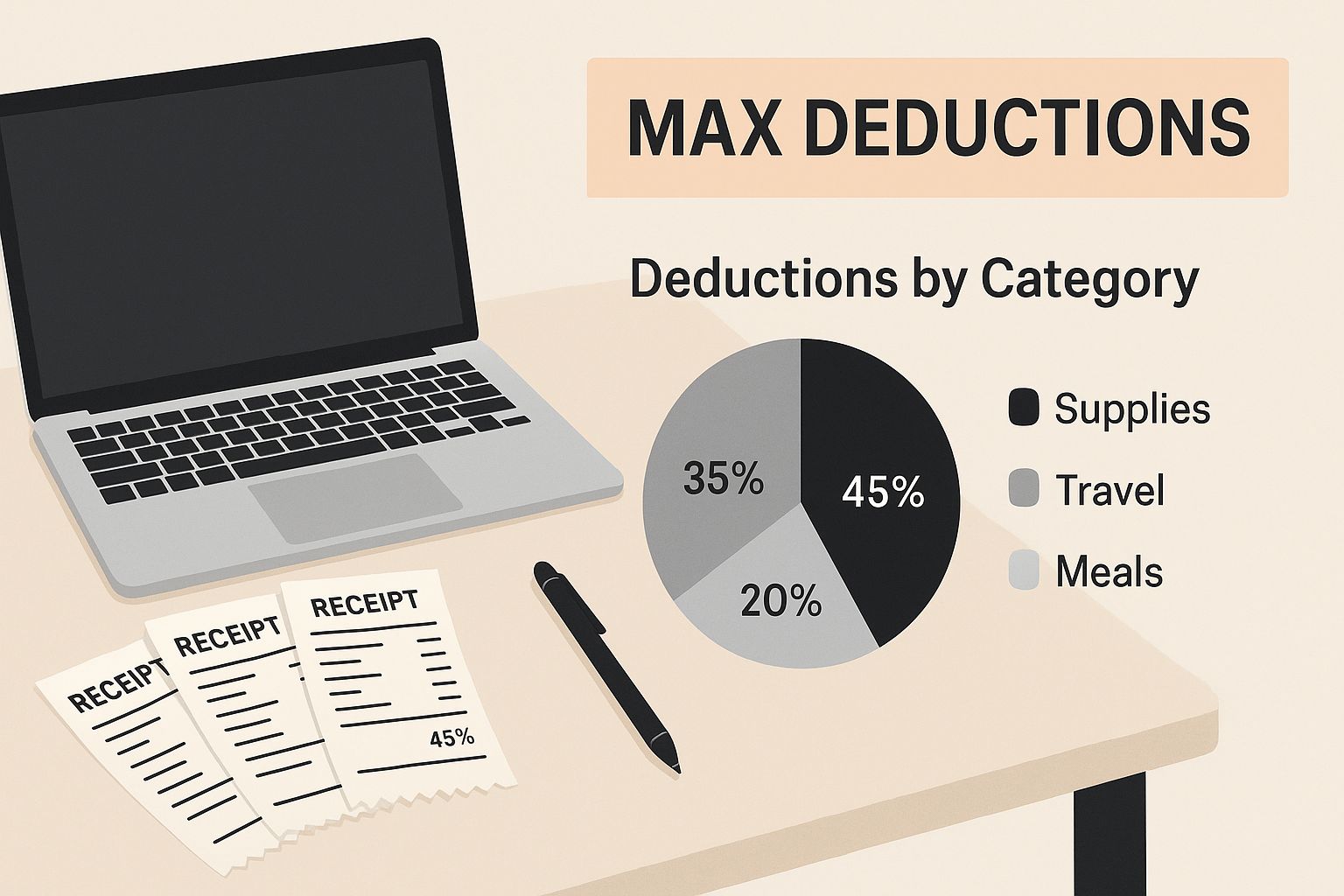
As the visual above illustrates, diligent record-keeping of receipts and expenses directly translates to paying less tax at EOFY. This is a non-negotiable for any smart business owner.
The High-Profit Scenarios: $120,000 and $200,000
This is where the strategic landscape shifts. As your business grows and profits climb, the flat 25% corporate tax rate becomes far more attractive than the higher personal income tax rates faced by a sole trader.
Let’s compare the tax payable under each structure at various profit levels.
| Tax Liability Scenarios Sole Trader vs Company | ||
|---|---|---|
| Annual Profit | Estimated Sole Trader Tax (incl. Medicare Levy) | Estimated Company Tax (25% rate) |
| $60,000 | ~$10,467 | $15,000 |
| $120,000 | ~$31,567 | $30,000 |
| $200,000 | ~$64,667 | $50,000 |
As demonstrated, once your profit reaches $120,000, the company structure becomes more tax-effective. By the time you reach $200,000 in profit, the company saves you nearly $15,000 in tax for the year. The higher your earnings, the wider that gap becomes. You can find more detail on these kinds of calculations over at Taxopia.com.au.
Expert Insight: The real strategic power of a company lies in retaining profits. As a sole trader, every dollar of profit is taxed in your name, immediately. A company, however, can retain its after-tax profits (that’s $150,000 in the $200k example) to reinvest in the business. You only pay personal tax on these funds when they are paid out to you as dividends.
These examples prove there’s a clear financial crossover point. Understanding where your business sits now—and where you plan for it to be—is absolutely crucial. For tailored advice based on your specific numbers, book a consultation with our tax specialists to ensure your structure is working for you, not against you.
Evaluating Asset Protection and Legal Liability
When weighing the sole trader vs company tax question, it’s easy to fixate on the numbers. But the most critical difference—the one that could define your personal financial future—is how each structure handles legal liability and asset protection. This isn’t just about paperwork; it’s about building a financial fortress around your personal wealth.
As a sole trader, you are the business. There’s no legal distinction. If the business fails, the line between your business and personal life evaporates, and your personal assets become fair game for creditors.
The Sole Trader’s Unlimited Liability
Let’s be direct. Imagine your business cannot repay a major supplier or a client files a lawsuit claiming damages. Because you and the business are legally the same entity, creditors are not limited to your business bank account.
They can pursue your personal assets to settle the debt.
This means your:
- Family home
- Personal car
- Savings, shares, and other investments
This unlimited personal liability is the single greatest risk of operating as a sole trader. Practical Example: You’re a sole trader builder, and a structure you built is found to have a major defect, leading to a $250,000 lawsuit. If your business insurance doesn’t cover it, your personal home and savings could be seized to pay the damages.
The Company’s Corporate Veil
Conversely, establishing a proprietary limited (Pty Ltd) company creates a powerful legal shield known as the ‘corporate veil’. A company is a separate legal entity from you, the owner.
Think of the corporate veil as a protective barrier. If the company incurs debt or faces legal trouble, creditors can generally only pursue the company’s assets, not your personal ones. Your house, car, and savings remain separate and safe.
This is a game-changer and a primary reason business owners incorporate as they grow. It allows you to take calculated risks to expand your business without jeopardising your family’s financial security. Correctly setting up a proper corporate structure for business is key to this protection.
However, this shield is not absolute. Company directors have significant legal duties, such as acting in the company’s best interest and preventing insolvent trading. Breaching these duties can lead a court to ‘pierce’ the corporate veil, making you personally liable. Good governance is required to maintain this protection.
Ultimately, the choice is between the simplicity of a sole trader and the robust asset protection of a company. If you’re at a crossroads, unsure how to best protect your personal wealth as your business evolves, book a consultation with our expert team to navigate the options with confidence.
Weighing the Compliance Costs and Admin Workload
The allure of a lower tax bill is powerful, but it is only half the story in the sole trader vs company tax debate. A significant tax saving can be quickly eroded by high compliance costs and administrative burden. It is critical to realistically assess the time and money required to remain compliant.
For sole traders, the administrative load is refreshingly light. Your main obligations are obtaining an Australian Business Number (ABN), registering for GST if you meet the threshold, and lodging your annual tax return with a business schedule. It’s a straightforward process that integrates with your personal tax affairs.
A company, however, operates at a different level of administrative complexity, demanding more time, attention, and financial outlay.
The Company Compliance Checklist
When you establish a company, you enter a formal world regulated by the Australian Securities and Investments Commission (ASIC). These are not suggestions; they are legal duties with recurring annual fees.
Here’s a snapshot of what’s involved:
- ASIC Registration: The initial fee to register a proprietary company.
- Annual Review Fee: A yearly fee paid to ASIC to maintain your company’s registration. This is currently $310 for a standard proprietary company.
- Separate Tax Return: Lodging a completely separate and more complex company tax return with the ATO.
- Maintaining a Corporate Register: Keeping detailed, up-to-date records of directors, shareholders, meeting minutes, and share issuances.
Beyond the time investment, the financial tools you use can add to your costs. It’s worth exploring options for the best free bookkeeping software for small businesses to help manage this workload.
Expert Insight: The administrative difference is profound. A sole trader might spend a few hours on their BAS each quarter and a day compiling records for their tax return. A company director, however, has ongoing duties—formal meetings, solvency declarations, and maintaining registers—that require consistent attention all year, often necessitating professional assistance.
This additional workload is a real cost. For more tips on managing tax obligations, our article on small business tax tips offers excellent practical advice.
Choosing between these structures requires a clear-eyed look at both potential tax savings and real-world administrative costs. If you’re unsure whether the benefits of a company structure outweigh its compliance burden for your specific situation, book a consultation with our ASIC-registered agents today for clarity.
So, How Do You Choose the Right Structure for Your Business?
Let’s bring it all together. Making the final call in the sole trader vs company debate isn’t about a magic formula—it’s about a strategic assessment of your business today and your vision for the future. There is no one-size-fits-all answer; the optimal choice is deeply personal and hinges on your unique circumstances and ambitions.
For freelancers, side-hustlers, or any business with lower or unpredictable income, the sole trader structure is often the perfect fit. Its simplicity is unmatched. With minimal setup costs and paperwork, you can become operational quickly without being bogged down in administration. You pay tax as an individual, which is efficient when profits are modest.
However, once your business achieves consistent, high profits and you have ambitious growth plans, the conversation must change. A company structure then becomes a powerful tool for intelligent tax planning and asset protection, setting the stage for a resilient and scalable enterprise.
A Strategic Checklist to Guide Your Decision
To guide your thinking, ask yourself these critical questions. Your honest answers will point you in the right direction.
- What is my projected annual profit? If you’re consistently clearing over $100,000, the 25% company tax rate becomes highly attractive compared to your personal marginal rate.
- What is my personal risk tolerance? Are you comfortable with your family home being at risk if the business incurs debt? If not, the limited liability of a company is a significant advantage.
- What are my long-term goals? Do you plan to reinvest profits, bring on investors, or eventually sell the business? A company structure facilitates all these goals more effectively.
Answering these questions provides a solid strategic foundation. The next actionable step is to run the numbers with a professional who can apply these insights to your specific financial situation.
Before locking in your decision, it’s also vital to understand the small business legal requirements and compliance tips associated with each structure. Understanding these obligations from the outset will save you from costly headaches later.
Ultimately, this decision is a cornerstone of your financial future. While the principles are straightforward, their correct application requires expertise. For a confident choice based on your unique circumstances, book a consultation with our expert accountants today. We will help you translate these principles into a practical, tax-effective strategy for your business.
Got Questions? We’ve Got Answers
When you’re weighing the sole trader vs company decision, a few specific questions inevitably arise. This is completely normal. Let’s tackle some of the most common queries we hear from business owners to provide expert clarity.
Can I Switch From a Sole Trader to a Company Later On?
Absolutely. Transitioning from a sole trader to a company is a standard growth strategy for successful businesses. This move is typically made once profits increase significantly and the need for personal asset protection becomes paramount.
The process involves registering a new company with ASIC, formally transferring your business name and assets, and then closing your sole trader ABN. It is crucial to seek professional advice during this transition to navigate potential Capital Gains Tax (CGT) implications and ensure all contracts and liabilities are transferred correctly.
What Are the Superannuation Rules for Each Structure?
This is a critical distinction with fundamentally different rules. As a sole trader, you are personally responsible for contributing to your superannuation fund from your after-tax profits. While it is not compulsory, failing to do so is a common and significant long-term financial mistake.
With a company, the rules change. If you work for your own company as an employee (which you do, as a director), the business is legally required to pay the Superannuation Guarantee into your nominated fund. This is currently 11% of your salary or wages.
Our Take: Forgetting to pay your own super as a sole trader is dangerously easy. A company structure enforces good financial habits, as the super guarantee is a non-negotiable legal requirement. It ensures your retirement savings are actively being built.
How Does Personal Services Income (PSI) Affect My Choice?
If you are a consultant, freelancer, or contractor, you must pay close attention to this. The Personal Services Income (PSI) rules are designed by the ATO to prevent individuals from using a company structure merely to pay less tax on income that is essentially derived from their personal skills and labour.
If your income is classified as PSI, you generally cannot claim the same broad range of business deductions as a typical company, even if you operate through one. This can negate many of the tax benefits of a company structure. It is essential to determine if the PSI rules apply to you before incorporating.
Choosing between a sole trader and a company structure lays the groundwork for your business’s entire financial future. At EndureGo Tax, our mission is to provide the expert guidance you need to make that choice with confidence.
Whether you need assistance with a company tax return, ASIC compliance, or high-level tax advice, our trusted local accountants in Ashfield are here to help.
Book a consultation with EndureGo today and gain the peace of mind that comes from knowing your business is structured for success from day one.
