


Welcome to the only guide you’ll need for handling your sole trader tax in Australia. Let’s get one thing straight from the start: as a sole trader, you and your business are the same legal entity. This is brilliant for keeping things simple when you’re kicking off, but it also means you’re personally on the hook for any business debts and, of course, the tax man.
Kicking Off Your Sole Trader Tax Journey
Starting out on your own is a huge step, and getting a handle on your tax obligations from day one is non-negotiable. You’re now part of a massive, vital engine of the Australian economy. In fact, you're joining over 1.1 million other sole traders—freelancers, tradies, and consultants—who pump more than $72 billion into Australia's GDP every year.
But here's the reality check for local business owners in communities like Ashfield and Belrose: they spend a staggering average of 10 million hours a week on financial admin. That’s a massive hit to productivity and shows just how crucial a clear game plan is. You can dig into these stats yourself in the Hnry Sole Trader Pulse report.
Think of this guide as your roadmap. It’s here to cut through the noise and give you the confidence to manage your tax like a pro.
The First Few Steps on Your Path
Your journey starts with a few must-do actions. Nailing these fundamentals ensures you’re square with the Australian Taxation Office (ATO) and sets you up for long-term success.
- Get an Australian Business Number (ABN): This is your unique 11-digit ID for everything business-related. The ATO is very clear: you need an ABN to run your business in Australia and it's a legal must-have for sending out invoices. For the full rundown, check out the Australian Business Register's guidance on who needs an ABN.
- Remember Your Income is Taxed at Individual Rates: Unlike a company structure, your business profit isn't taxed separately. Instead, it gets added to any other income you earn (like from a part-time job) and taxed at your personal marginal tax rates.
- Set Aside Money for Tax: This is the single most important habit you can build. Because tax isn't automatically taken out of your business income, it's on you to squirrel away a portion of every dollar you earn to cover your future tax bill.
Practical Example: A freelance copywriter earns $2,000 for a project. To stay ahead of their sole trader tax obligations, they immediately transfer 30% ($600) into a separate high-interest savings account labelled 'Tax Savings'. This builds a financial buffer, making sure they have the cash ready for their income tax bill and any quarterly PAYG instalments.
Getting on top of your sole trader tax isn't just about ticking boxes for the ATO; it's about building a business that’s profitable and built to last.
If you’re feeling lost in the maze of sole trader tax, you're not alone. Working with a trusted local accountant can turn your financial admin from a headache into a smooth, streamlined process. Call EndureGo Tax in Ashfield or Belrose today to ensure you're set up for success from the very beginning.
Getting to Grips with Your Tax and GST Obligations
When you're a sole trader, you wear a lot of hats. One of them, whether you like it or not, is ‘tax collector for the ATO’. Understanding your core tax and Goods and Services Tax (GST) duties isn't just about ticking boxes for the government; it's about keeping your cash flow healthy and dodging nasty surprises at tax time.
Let's break down what you absolutely need to know.
Right from day one, there are a few fundamental steps. This flowchart maps out the basic journey of earning money and managing your tax as a sole trader.
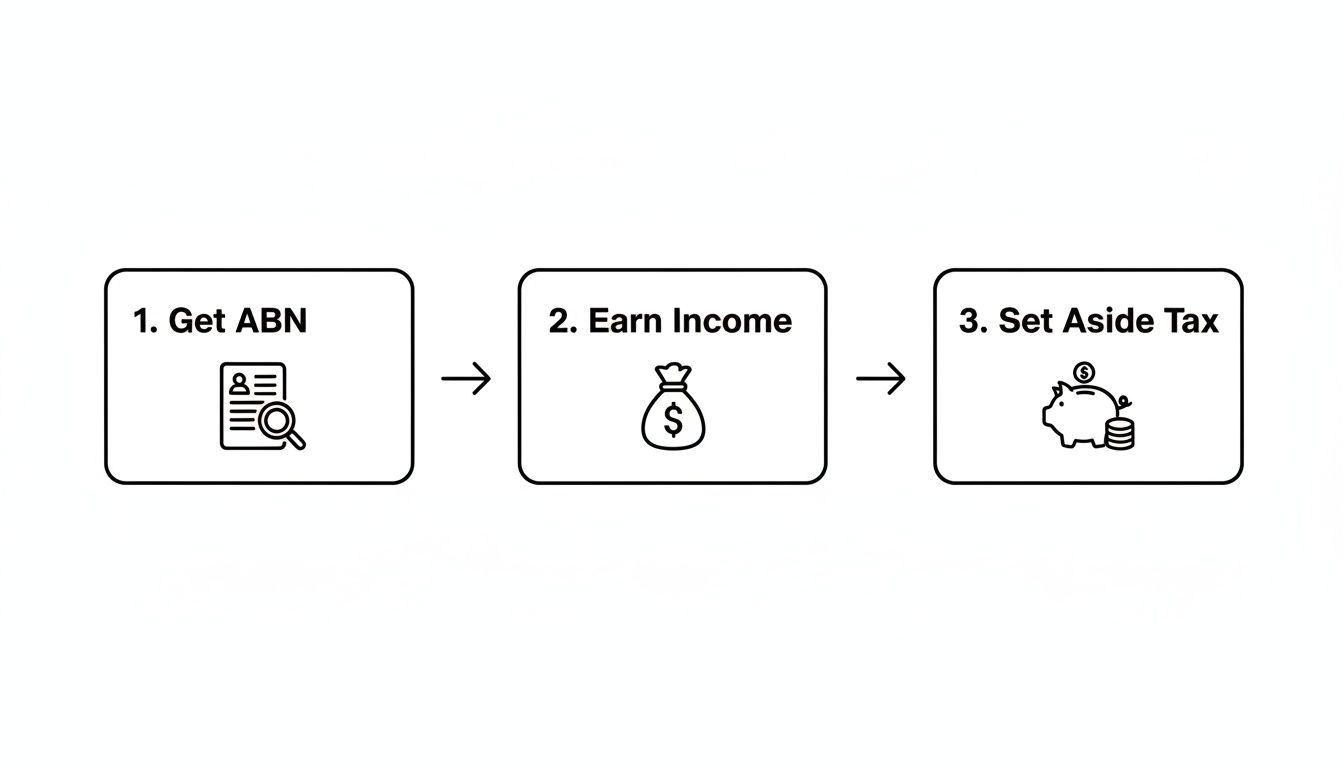
It boils down to a simple truth: you earn the income directly, so you’re the one responsible for putting money aside to cover your tax bill.
Mastering Pay As You Go (PAYG) Instalments
Think of the Pay As You Go (PAYG) instalment system as the ATO’s way of stopping you from facing a giant, scary tax bill once a year. Instead, you pre-pay your tax in smaller, more manageable chunks, usually every quarter. It's a lifesaver for cash flow.
The ATO will automatically pop you into the PAYG system once your business income hits a certain level. They'll look at your last tax return, estimate what you might owe for the coming year, and calculate an instalment amount based on that.
Practical Example: Sarah, a freelance writer in Ashfield, earns $80,000 in her first year. When she lodges her return, the ATO places her on the PAYG system. For the next year, they’ll ask her to pay roughly $4,500 each quarter towards her future tax bill. This is outlined in the Taxation Administration Act 1953, which governs the PAYG system.
Demystifying GST and Your Business Activity Statement (BAS)
Goods and Services Tax (GST) is the 10% tax added to most things sold in Australia. As a sole trader, you must register for GST if your business turnover is $75,000 or more in a year (or you expect it to be).
Once you're registered, you have to add GST to your prices. Then, you report it to the ATO by lodging a Business Activity Statement (BAS), which is typically done quarterly.
The good news? You can claim back the GST you pay on your own business purchases. This is called a GST credit.
Practical Example: David is an electrician in Belrose with a turnover of $120,000. He invoices a client $1,100 for a job ($1,000 fee + $100 GST). In that same period, he buys $550 worth of materials for his business ($500 + $50 GST). On his BAS, he reports the $100 GST he collected but also claims the $50 GST credit. This means he only needs to send the difference, $50, to the ATO.
To give you a quick-reference tool, here's a checklist of the key obligations you'll need to stay on top of.
Sole Trader Tax and Compliance Checklist for 2026
| Obligation | What It Is | Key Threshold or Requirement | ATO Reference |
|---|---|---|---|
| Get an ABN | Your 11-digit Australian Business Number. | Required to operate any business in Australia. | ATO ABN Essentials |
| Register for GST | Goods and Services Tax registration. | Mandatory if your annual turnover is $75,000 or more. | ATO GST Registration |
| Lodge BAS | Your Business Activity Statement. | Used to report and pay GST collected and PAYG instalments. | ATO BAS Essentials/) |
| Pay PAYG Instalments | Pre-paying your income tax in quarterly instalments. | The ATO will notify you when you need to start. | ATO PAYG Instalments |
| Keep Good Records | All income and expense records. | Must be kept for 5 years and prove your claims. | ATO Record Keeping |
| Pay Super (for yourself) | Making personal superannuation contributions. | Not compulsory, but highly recommended for retirement. | ATO Super for self-employed |
| Lodge Annual Tax Return | Your individual tax return, including business income/losses. | Due by 31 October (or later with a tax agent). | ATO Lodging your tax return |
This table is your roadmap for staying compliant and in control throughout the financial year.
Taking Charge of Your Super
This one’s crucial. Unlike being an employee, there’s no one else paying super for you. It’s 100% on your shoulders to build a retirement nest egg.
As a sole trader, you can make personal contributions to a super fund. Even better, these contributions are often tax-deductible up to a certain limit, which is a fantastic way to lower your taxable income while saving for the future. Juggling your sole trader tax duties, including super, is just part of running a smart business.
Actionable Tip: To make your retirement savings work for you, talk to a tax expert. They can help you structure your super contributions to maximise your tax deduction without breaching contribution caps. Call our team at EndureGo Tax in Ashfield or Belrose to build a smart super strategy.
Maximising Your Business Deductions The Right Way
Understanding what you can claim as a business deduction is one of the most powerful tools you have for managing your sole trader tax bill. Every legitimate expense you claim lowers your taxable profit, which in turn reduces how much tax you owe. It’s that simple.
But to do it right, you need to play by the rules.
The Three Golden Rules of Deductions
The Australian Taxation Office (ATO) has three golden rules for every single business deduction. For an expense to be claimable, it has to pass all three of these tests, no exceptions.
- The expense must be for your business, not for personal use.
- If it’s for a mix of business and private use, you can only claim the business portion.
- You must have records to prove it.
This means the direct link between the money you spent and the income you earned is everything. You can’t claim your weekly groceries, but you absolutely can claim that new laptop you use to send invoices and manage projects.
Think of it this way: if you can draw a straight, logical line from the expense to earning your income, you're on the right track. This is where good record-keeping becomes your best friend and can save you from a major headache come tax time. A good habit is to get a system in place from day one. Learning how to track business expenses properly will make lodging your tax return a whole lot easier.
Common Deductions for Sole Traders
While the specific claims you can make will depend on your industry, some deductions pop up for almost every sole trader. Getting your head around these is a solid starting point for lowering your tax bill.
Practical Example: A Tradie in Belrose
- Tools and Equipment: A local carpenter buys a new $1,200 power saw. Because he uses it 100% for his business, he can claim the full cost. Depending on the instant asset write-off rules that year, he might even claim it all at once.
- Vehicle Expenses: He uses his ute for everything—driving to job sites, picking up materials from Bunnings, and quoting new work. By keeping a logbook, he works out that 80% of his ute’s use is for business. This means he can claim 80% of his rego, insurance, fuel, and servicing costs.
Practical Example: A Consultant in Ashfield
- Home Office Costs: A marketing consultant works from a dedicated home office in her Ashfield apartment. She can claim a portion of her electricity, internet, and phone bills. She could use the ATO's simple fixed-rate method or track her actual costs for a potentially bigger claim.
- Professional Development: She spends $2,500 on a digital marketing course to stay ahead of the curve. Because this directly helps her do her job better and earn more income, the full course fee is a deductible expense.
Diving Deeper Into Specific Expense Types
Let's break down two of the most common—and often misunderstood—deduction categories for sole traders.
According to ATO Taxation Ruling TR 93/30, to claim "occupancy expenses" like rent or mortgage interest, part of your home must truly have the character of a "place of business." That’s a high bar to clear. Most sole traders will claim "running expenses" instead.
Home Office Expenses
If you work from home, you're absolutely entitled to claim the costs of running that workspace. You’ve got two main ways to do it:
- Fixed-Rate Method: This is the simple way. You claim a set rate for every hour you work from home, which covers running costs like power, gas, and wear-and-tear on furniture. No complex maths needed.
- Actual Cost Method: This method requires more detailed records, but it can lead to a bigger deduction. You calculate the business-use percentage of your actual bills for lighting, heating, cleaning, and internet.
Vehicle Expenses
Claiming your car or ute costs also gives you two options:
- Cents per Kilometre Method: You can claim a set rate for every business-related kilometre you drive, up to a maximum of 5,000 kilometres per car, per year. You don't need a full logbook, but you do need to show the ATO how you worked out your kilometres.
- Logbook Method: This involves keeping a detailed logbook for 12 weeks straight to work out your business-use percentage. You can then claim that percentage of all your car's running costs (fuel, insurance, servicing—the lot) for up to five years.
Actionable Tip: Choosing the right vehicle expense method can save you thousands. Contact the team at EndureGo Tax today. We'll analyse your travel patterns and running costs to determine which approach will deliver the maximum legal deduction on your sole trader tax return.
How Your Sole Trader Income Is Actually Taxed
Alright, let's get down to brass tacks. It's time to see how the money you work so hard for turns into a number on your tax bill. This is where many sole traders get a little tripped up, but the core idea is simple.
The most important thing to understand is that the ATO isn’t interested in your total sales figures. They care about your taxable income, which is your gross business income minus all your legitimate business deductions. Think of it as your final profit.
This profit figure is then lumped in with any other income you might have earned throughout the year – maybe from a part-time job or some investment dividends. That grand total is what gets taxed, using the exact same personal income tax rates as every other Aussie employee. You’re not in a special "business owner" tax category; you're taxed as an individual.
Your Profit Determines Your Tax Bracket
Australia runs on a progressive tax system. In simple terms, this means the more you earn, the higher the percentage of tax you pay on the portions of your income that fall into higher tax brackets.
For the 2026 financial year, sole traders will see rates start at zero for the first $18,200 and climb up to 45% for income over $190,000, plus the Medicare levy. You can learn more about how these rates apply from the experts at Sleek.com.
To make it crystal clear, here are the individual income tax rates set for the 2025-2026 financial year. This is the official yardstick your total taxable income will be measured against.
Australian Individual Income Tax Rates 2025-2026
| Taxable Income | Tax on this Income |
|---|---|
| $0 – $18,200 | Nil |
| $18,201 – $45,000 | 16c for each $1 over $18,200 |
| $45,001 – $135,000 | $4,288 plus 30c for each $1 over $45,000 |
| $135,001 – $190,000 | $31,288 plus 37c for each $1 over $135,000 |
| Over $190,000 | $51,638 plus 45c for each $1 over $190,000 |
Just a heads-up: The rates above don't include the 2% Medicare Levy. As laid out in the Income Tax Rates Act 1986, these marginal rates form the backbone of our personal tax system.
A Practical Example: Meet Sarah the Designer
Theory is one thing, but let's see how this plays out in the real world.
Meet Sarah, a talented graphic designer running her business from a home office on the Northern Beaches. She’s had a fantastic year and wants to get a clear picture of her sole trader tax obligations.
1. Calculate Gross Business Income
First, Sarah adds up all the invoices she sent to clients. The total comes to $95,000. This is her starting point.
2. Tally Up Business Deductions
Because Sarah kept excellent records, she can easily find her claimable expenses:
- Software subscriptions (Adobe, etc.): $1,800
- Home office expenses (calculated using the actual cost method): $3,500
- Professional indemnity insurance: $1,200
- New laptop for work: $3,000
- Total Deductions: $9,500
3. Determine Net Business Profit
Now, we simply subtract her deductions from her income:
- $95,000 (Income) – $9,500 (Deductions) = $85,500 (Net Business Profit)
4. Add Other Assessable Income
Sarah also owns some shares that paid her $500 in dividends during the year. We need to add this to her business profit:
- $85,500 + $500 = $86,000 (Total Taxable Income)
5. Calculate the Final Tax Bill
Using the 2025-2026 tax rates, we can work out her tax bill piece by piece:
- On the first $18,200: $0 tax
- On the slice from $18,201 to $45,000 ($26,800): $26,800 x 16c = $4,288
- On the slice from $45,001 to $86,000 ($41,000): $41,000 x 30c = $12,300
- Total Income Tax: $4,288 + $12,300 = $16,588
Finally, we calculate the 2% Medicare Levy:
- $86,000 x 2% = $1,720
- Total Tax Payable: $16,588 + $1,720 = $18,308
Walking through it step-by-step like this really takes the mystery out of the whole process. If you’re a sole trader in Ashfield or Belrose and want this level of clarity for your own business, contact EndureGo Tax today for a personalised consultation.
Essential Record Keeping and Lodgement Deadlines
Let’s be real: solid records are your best friend at tax time. They’re also your number one defence if the ATO ever comes knocking. For sole traders, treating record-keeping as just another chore is a huge mistake—it’s a core business activity that directly impacts your bottom line and keeps you out of legal trouble.
The Australian Taxation Office (ATO) is crystal clear on this. Under tax law, you’re legally required to keep most business records for five years after they’re prepared, obtained, or the transactions are completed—whichever date is latest.
Your Essential Record Keeping Checklist
Good record-keeping goes way beyond just stashing receipts in a shoebox. You need a complete paper trail of your business's financial life. This is where modern accounting software becomes a game-changer, turning that messy shoebox into an organised, searchable, and audit-proof system.
Here’s what you absolutely must keep:
- Income Records: All invoices you've sent out, bank statements showing customer payments, and any records of cash jobs.
- Expense Records: Every single tax invoice and receipt for your business purchases. This is your proof for claiming those all-important deductions.
- Bank Statements: You need statements for all your business-related accounts. They prove the flow of money in and out of your operation.
- Vehicle Logbooks: If you’re claiming your actual car expenses instead of the cents-per-km method, a detailed 12-week logbook is non-negotiable. It’s what you’ll use to prove your business-use percentage.
By going digital with your records, you’re not just making tax time easier. You’re building a rock-solid system that can withstand an audit. For a deeper look at what to keep, check out our detailed guide on record keeping requirements in Australia.
Navigating Critical Lodgement Deadlines
Missing an ATO deadline isn't just an admin slip-up. It can sting, leading to hefty penalties and interest charges that mess with your cash flow. Knowing your key dates is crucial.
The most famous deadline is 31 October. If you’re lodging your own annual tax return, that’s your final day. But there’s a massive advantage to bringing in a professional.
When you partner with a registered tax agent like us at EndureGo Tax, you almost always get an extended deadline, often pushing well into the next year. That extra time allows you and your agent to meticulously prepare your return and find every possible deduction.
For those registered for GST, your quarterly Business Activity Statement (BAS) deadlines are a constant on the business calendar. They're typically due on the 28th day of the month after the quarter ends. Since your PAYG instalments are also paid through your BAS, it’s a lodgement you can’t afford to miss.
Actionable Tip: Don't wait until the last minute. Book a consultation with EndureGo Tax today. We’ll handle your lodgements, giving you peace of mind and more time to focus on what you do best, and ensuring you benefit from extended tax agent deadlines.
Got Questions About Sole Trader Tax? We've Got Answers.
When you're running your own show, the world of sole trader tax can throw up some curly questions. To give you a bit of clarity, we’ve pulled together the most common queries we hear from tradies, consultants, and freelancers across Ashfield and the Northern Beaches.
Here are the quick, no-fluff answers.
Can I Pay Myself a Salary as a Sole Trader?
Short answer: no. As a sole trader, you can't pay yourself a formal salary or wage like an employee.
This is a really important concept to grasp. Because you and your business are seen as one and the same in the eyes of the law, you simply ‘draw’ money from the business bank account to cover your personal living expenses.
These drawings aren't a business expense, so you can't claim them as a tax deduction. The ATO taxes you on your business's profit (that’s your income minus expenses), not on how much cash you've pulled out for yourself. It’s smart to track your drawings for budgeting, but they don’t change your final tax bill.
What Happens if My Business Makes a Loss?
If your total business deductions for the financial year are higher than your gross business income, you've got a business loss. What you do with it depends on the ATO's 'non-commercial loss' rules.
In many cases, you can offset this business loss against other income you've earned in the same year, like a salary from a part-time job or some investment income. To do this, you need to meet a specific income requirement and pass one of four business activity tests laid out in the Income Tax Assessment Act 1997.
But if you don't meet those conditions, that loss can't be used to lower your other income for that year. Instead, you have to carry the loss forward and claim it against future profits from that same business. An expert at EndureGo Tax can work out the right way to treat a business loss to keep you compliant and get the best outcome.
When Should I Switch from a Sole Trader to a Company?
This is a classic question that pops up as your business starts to take off. While being a sole trader is beautifully simple at the start, there are definite signs it might be time to think about a company structure.
Here are the main triggers for considering a company:
- Tax Savings: Your annual profit is consistently pushing you into the higher personal income tax brackets. A company has a lower, flat tax rate (currently 25% for eligible small businesses), which can save you a fair bit of tax.
- Asset Protection: You want to protect your personal assets, like your family home, from business risks and debts. A company is a separate legal entity, giving you what’s called 'limited liability' protection.
- Growth and Investment: You’re thinking about bringing on partners, looking for outside investment, or just need to look more established to land bigger contracts.
A company does have higher setup and ongoing costs, but it’s worth having a strategic chat with an accountant once your annual profit starts consistently hitting the $150,000 mark.
Do I Need a Separate Bank Account for My Business?
Yes. Absolutely. While it's not technically mandated by law, we consider this a non-negotiable for every single sole trader.
Opening a separate bank account just for business income and expenses is the single best thing you can do to get organised.
It makes bookkeeping a thousand times easier, simplifies tracking your cash flow, and gives the ATO clear proof that your expenses are genuinely for your business. Trust us, it will save you (or your accountant) hours of headaches trying to separate your personal coffees from your business material costs.
Still wrestling with these or other sole trader tax questions? The right advice can make all the difference. Contact the friendly local accountants at EndureGo Tax in Ashfield or Belrose for clear, practical answers that make sense for your business.
Ready to Partner with a Local Tax Expert?
Let's be real—juggling your sole trader tax obligations can feel like a second full-time job. We've walked through the maze of quarterly BAS, PAYG instalments, maximising deductions, and staying on the right side of the Australian Taxation Office. It's a lot to handle.
Now, imagine letting a professional take all of that off your plate. You don't have to navigate this complex world alone.
Local Knowledge for Your Specific Needs
Whether you're a busy tradie in Belrose trying to figure out your vehicle expense claims, or a creative consultant in Ashfield juggling multiple income streams, our team gets it. We have the local, on-the-ground knowledge you need to succeed because we understand the unique pressures and opportunities for sole traders across the Northern Beaches and Inner West Sydney.
We specialise in:
- Sole trader tax lodgements: We'll make sure your annual return is accurate, compliant, and maximises every possible refund. No more guessing.
- BAS services: Take the stress out of quarterly reporting so you can get back to what you actually enjoy doing.
- Strategic tax advice: We provide clear, forward-thinking guidance to help you plan for growth and legally minimise your tax bill.
When you're looking for professional help with your sole trader taxes, partnering with experienced local accounting and bookkeeping firms is a game-changer. It turns tax from a burden into a strategic part of your business. As 'Your Trusted Local Accountant', we offer the peace of mind that comes from knowing your finances are in expert hands.
Take control of your tax life and get back to what you do best—growing your business. Partnering with a dedicated tax agent means no more worrying about missed deadlines or unclaimed deductions.
The Taxation Administration Act 1953 is the rulebook for tax agents, ensuring you only receive advice from qualified, registered professionals. It’s your guarantee of quality and expertise when you engage with a firm like ours.
It’s time to stop letting tax admin hold your business back.
Take the first step towards financial clarity and peace of mind. EndureGo Tax, your trusted local accountant in Ashfield and the Northern Beaches, is here to help. Book your consultation today by visiting https://www.endurego.com.au and take control of your sole trader tax.
