


For any sole trader in Australia, getting your head around tax deductions is the single most powerful way to boost your bottom line. Let's be honest, nobody wants to pay more tax than they have to. This guide cuts through the ATO jargon and provides a clear, actionable roadmap to claiming every dollar you're entitled to.
Your Essential Guide to Sole Trader Tax Deductions
Running a business as a sole trader is the most popular structure in Australia, and for good reason. It’s straightforward, keeps compliance simple, and lets you focus on what you do best—growing your business. The numbers don't lie: the Australian Bureau of Statistics clocked approximately 822,873 sole proprietors in the 2024–25 period, a 2.4% jump from the year before.
But this simplicity comes with a crucial detail: your business isn't a separate legal entity. Its income is your income. That’s why mastering your sole trader tax deductions isn't just good financial practice; it’s absolutely essential for shrinking your personal taxable income and keeping more of your hard-earned cash.
The Golden Rules of Claiming Deductions
The Australian Taxation Office (ATO) has a fundamental principle when it comes to business deductions. At its core, an expense must be directly linked to earning your income. The legislative basis for this is found in section 8-1 of the Income Tax Assessment Act 1997, which establishes the general deductibility of business expenses.
Just remember these three 'golden rules' for any claim you make:
- It must be for your business, not personal use. If you use something for both, like a phone or car, you can only claim the business portion of the expense.
- You must have the records to prove it. This almost always means a receipt or tax invoice. No proof, no claim. It’s that simple.
- The money must already be spent. You can’t claim for something you’re planning to buy.
Practical Example: A graphic designer buys a new high-end laptop for $3,000. She determines through a log that she uses it 70% for client work and 30% for personal tasks like streaming movies. Therefore, she can only claim 70% of its cost, which is $2,100, as a tax deduction.
Nailing this framework is the first step to building a solid tax strategy. For a deeper look into managing your finances, check out this info on sole trader accounts.
By applying these principles to everything you spend money on for your business, you create a clear and defensible tax position. Now, let's walk through exactly how to do that, one expense category at a time.
How Sole Trader Income and Tax Rates Work
Before we jump into the crucial world of sole trader tax deductions, it’s vital to understand how the Australian Taxation Office (ATO) actually treats your income. As a sole trader, the line between you and your business is invisible for tax purposes. Your business income is your personal income.
This means you don't pay a separate 'business tax'. Instead, whatever profit your business makes gets added to your personal income and is taxed at the standard individual rates. This is exactly why nailing your deductions is so powerful—every dollar you claim in expenses directly lowers your total taxable income.
What Is Your Taxable Income, Really?
Your taxable income is your gross business income (all the money that came in) minus all your allowable business expenses. It’s this final number, not your total sales, that the ATO uses to figure out how much tax you owe.
Australia uses a progressive tax system, which means the more you earn, the higher the tax rate you pay on that portion of your income.
Here's a quick look at the tax brackets the ATO uses.
ATO Individual Income Tax Rates for Sole Traders
This table shows the Australian tax brackets for sole traders for the 2023-24 financial year. Remember, this doesn't include the Medicare levy, which is usually an extra 2% on top.
| Taxable Income | Tax on this Income |
|---|---|
| $0 – $18,200 | $0 |
| $18,201 – $45,000 | 19 cents for each $1 over $18,200 |
| $45,001 – $120,000 | $5,092 plus 32.5 cents for each $1 over $45,000 |
| $120,001 – $180,000 | $29,467 plus 37 cents for each $1 over $120,000 |
| $180,001 and over | $51,667 plus 45 cents for each $1 over $180,000 |
For more detail, you can always check out the official sole trader tax rates on the ATO website or find helpful guides explaining sole trader tax in Australia.
This tiered structure is what makes deductions so valuable. Let’s look at a real-world example.
Practical Example: The Power of Deductions
Imagine you’re a freelance marketing consultant and you’ve invoiced a total of $95,000 this year. With zero deductions, that entire amount gets taxed, with a big chunk falling into the 32.5% bracket.But you were smart and tracked everything. You found $15,000 in legitimate business expenses (like software subscriptions, client travel, and a new work computer). Suddenly, your taxable income drops to $80,000. This single move saves you thousands in tax.
Staying Ahead with PAYG Instalments
Because you don't have an employer withholding tax from each paycheck, the ATO has a system to stop you from getting hit with a monster tax bill at the end of the year. It’s called Pay As You Go (PAYG) instalments.
Basically, you make regular prepayments—usually every quarter—towards your estimated annual tax bill.
The ATO works out your instalment amount based on your last tax return, but if your income drops or shoots up, you can adjust it. Keeping on top of your PAYG instalments is absolutely vital for managing your cash flow without any nasty surprises.
Getting these basics right is the foundation of a smart tax strategy. Once you know your likely tax rate and have your PAYG instalments sorted, you can make your deductions work much harder for you. And if you’re ever unsure, speaking with a tax professional is always a smart move.
Claiming Home Office Expenses The Right Way
For most sole traders, the daily commute is a short stroll from the kitchen to the desk. When your home pulls double duty as your head office, you unlock one of the biggest opportunities for sole trader tax deductions.
Getting this right means more money in your pocket, but it’s crucial to play by the Australian Taxation Office (ATO) rules. To do that, you first need to understand the two main categories of expenses. Think of them as two different buckets of costs you can dip into.
Running Costs Versus Occupancy Costs
Running costs are what you spend to keep your home office ticking over day-to-day. These are the most common and straightforward claims for sole traders.
- Electricity and gas for heating, cooling, and lighting your workspace.
- Phone and internet bills, but only the portion you use for business.
- Stationery and computer consumables like paper, ink cartridges, and software subscriptions.
- Depreciation of office furniture and equipment, which covers the declining value of your desk, chair, computer, and other gear.
On the other hand, occupancy costs are the big-ticket items related to owning or renting your property. This includes things like rent, mortgage interest, council rates, and home insurance.
The ATO has very strict rules here. Generally, you can only claim occupancy costs if your home is your principal place of business and you have an area used almost exclusively for it—think a doctor's surgery or a photographer's studio built into your home. A word of caution: claiming these can have serious Capital Gains Tax (CGT) implications when you sell your home, so getting expert advice is a must.
This infographic helps clarify when GST registration becomes mandatory, which is a key factor for many sole traders as their income grows.
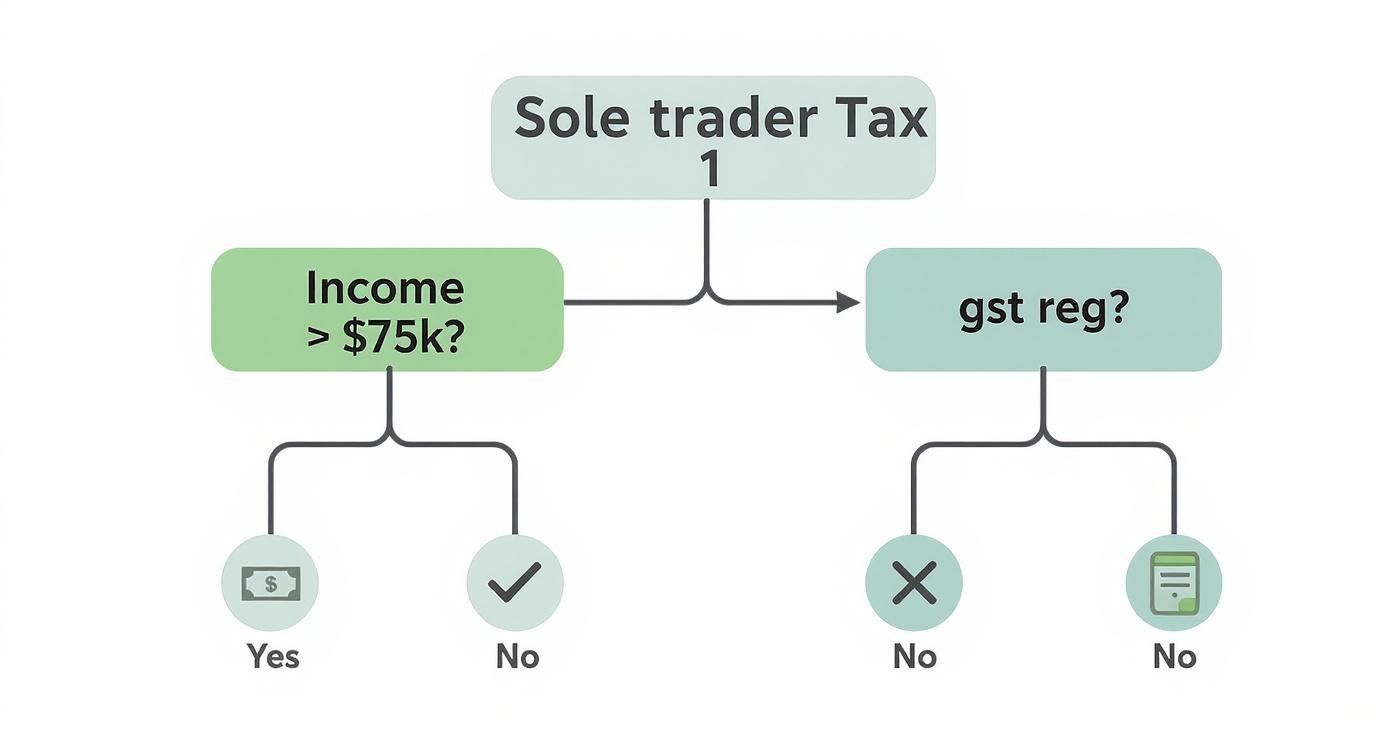
The main takeaway here is that once you cross that $75,000 income threshold, you have to register for GST. This decision directly intertwines with how you manage and claim your expenses.
Choosing Your Calculation Method
The ATO gives you a couple of ways to calculate your home office running costs, which offers some welcome flexibility.
The Fixed Rate Method: This is the simple, no-fuss approach. For the 2023-24 financial year, you can claim a flat rate of 67 cents for every hour you work from home. This shortcut rate bundles up your energy, phone, internet, and stationery costs into one neat figure. You just need to keep a record of your hours worked, like a simple timesheet or diary entries.
The Actual Cost Method: This method involves a bit more legwork but can often lead to a larger deduction if you’re a heavy user of your home office. You’ll need to calculate the business-use percentage of your actual running costs. For example, if your dedicated home office takes up 10% of your home's total floor area, you can claim 10% of your electricity and gas bills. For your phone and internet, you'll need to go through your bills and work out a reasonable percentage based on your work-related use.
For a deeper dive, our comprehensive guide offers more detailed scenarios on calculating home office deductions.
Practical Example: A freelance copywriter works 30 hours per week from home for 48 weeks a year. Using the simple fixed rate method, her deduction is: 30 hours x 48 weeks x $0.67/hour = $964.80. An online retailer with a large area of their home dedicated to storing stock, however, might find the actual cost method far more beneficial.
Ultimately, the right method comes down to your specific situation and how much you tolerate record-keeping. Whichever path you choose, remember that meticulous records are your best friend if the ATO ever comes knocking.
Key Deduction Categories Beyond Your Home Office
When we talk about sole trader tax deductions, most people think of their home office. But honestly, that’s just the tip of the iceberg. Some of the biggest savings come from the everyday expenses of running your business out in the real world.
Let's dive into the key categories you absolutely need to be tracking.
Vehicle and Travel Expenses
If you use your car for business, every kilometre you drive is a potential tax deduction. The Australian Taxation Office (ATO) gives you two main ways to claim these costs, but they come with very different record-keeping requirements.
The Cents Per Kilometre Method: This is the simple, no-fuss option. It's perfect if you don't do a huge amount of business-related driving. You can claim a set rate for every kilometre, but you’re capped at a maximum of 5,000 business kilometres per car, each year.
The Logbook Method: This one needs more attention to detail, but it almost always leads to a much bigger tax claim. You'll need to keep a detailed logbook for 12 consecutive weeks to figure out your car's business-use percentage. The beauty of this is you can then apply that percentage to all your car's running costs for up to five years.
For a deeper dive into which method is right for you, check out our guide on claiming vehicle tax deductions. It’s packed with detailed examples and ATO rules.
Practical Example: The Mobile Personal Trainer
Imagine a personal trainer based in the Northern Beaches. She’s constantly driving—to client homes, different parks for boot camps, and picking up new equipment. Using the logbook method, she calculates her car is used for business 80% of the time. Now, she can claim 80% of everything: her fuel, insurance, rego, servicing, and even the car's depreciation. That's a massive saving.
Tools, Equipment, and Depreciating Assets
The tools of your trade are absolutely deductible. How you claim them, though, really depends on their cost and the specific rules for that financial year.
Right now, the rules often let you claim an immediate deduction for the full cost of eligible assets in the same year you buy and start using them. This is a powerful way to slash your taxable income straight away.
For more expensive gear that doesn't qualify for an instant write-off, you’ll need to claim its decline in value over time. This is what accountants call depreciation. It's all officially laid out by the ATO under Division 40 of the Income Tax Assessment Act 1997.
Other Essential Business Deductions
Beyond the big-ticket items like cars and equipment, there's a whole world of other operational costs that qualify as legitimate sole trader tax deductions. The key is to keep meticulous records of every single one.
Here’s what you should be tracking:
- Professional Development: Any courses, seminars, or subscriptions that directly improve the skills you need for your business are claimable.
- Insurance and Memberships: Your public liability insurance premiums? Deductible. Fees for professional associations? Deductible.
- Financial Costs: Don't overlook the small stuff. Bank fees on your business account and the interest on any business loans all add up. For instance, understanding payment gateway fees can reveal significant transaction costs that you can claim.
- Marketing and Advertising: Every dollar you spend on your website, social media ads, business cards, and other promotions is a valid deduction.
To help you get organised, here's a quick summary of common categories sole traders should track.
Common Sole Trader Deduction Categories
| Deduction Category | Examples of Claimable Expenses | Key Record-Keeping Tip |
|---|---|---|
| Vehicle Expenses | Fuel, insurance, registration, servicing, loan interest, depreciation. | Keep a 12-week logbook to maximise claims or use the cents per km method for simplicity. |
| Tools & Equipment | Power tools, laptops, cameras, software, machinery. | Keep receipts for all purchases. For items over $300, check instant asset write-off rules. |
| Professional Development | Courses, seminars, industry journals, online subscriptions. | Ensure the expense directly relates to your current income-earning activities, not a future one. |
| Financial Costs | Business bank account fees, loan interest, payment processing fees. | Review your bank statements monthly and highlight all business-related fees. |
| Marketing & Advertising | Website hosting, social media ads, business cards, flyers, online listings. | Create a specific folder for all marketing invoices and receipts as soon as you get them. |
| Insurance & Memberships | Public liability insurance, professional indemnity, association fees. | Keep a copy of your policy renewal notice and payment receipt each year. |
Keeping on top of these varied expenses might feel like a chore, but it’s one of the most effective ways to lower your tax bill. A solid system for capturing every receipt and invoice isn't just a good idea—it's non-negotiable for a smart sole trader.
Mastering Record Keeping for ATO Compliance
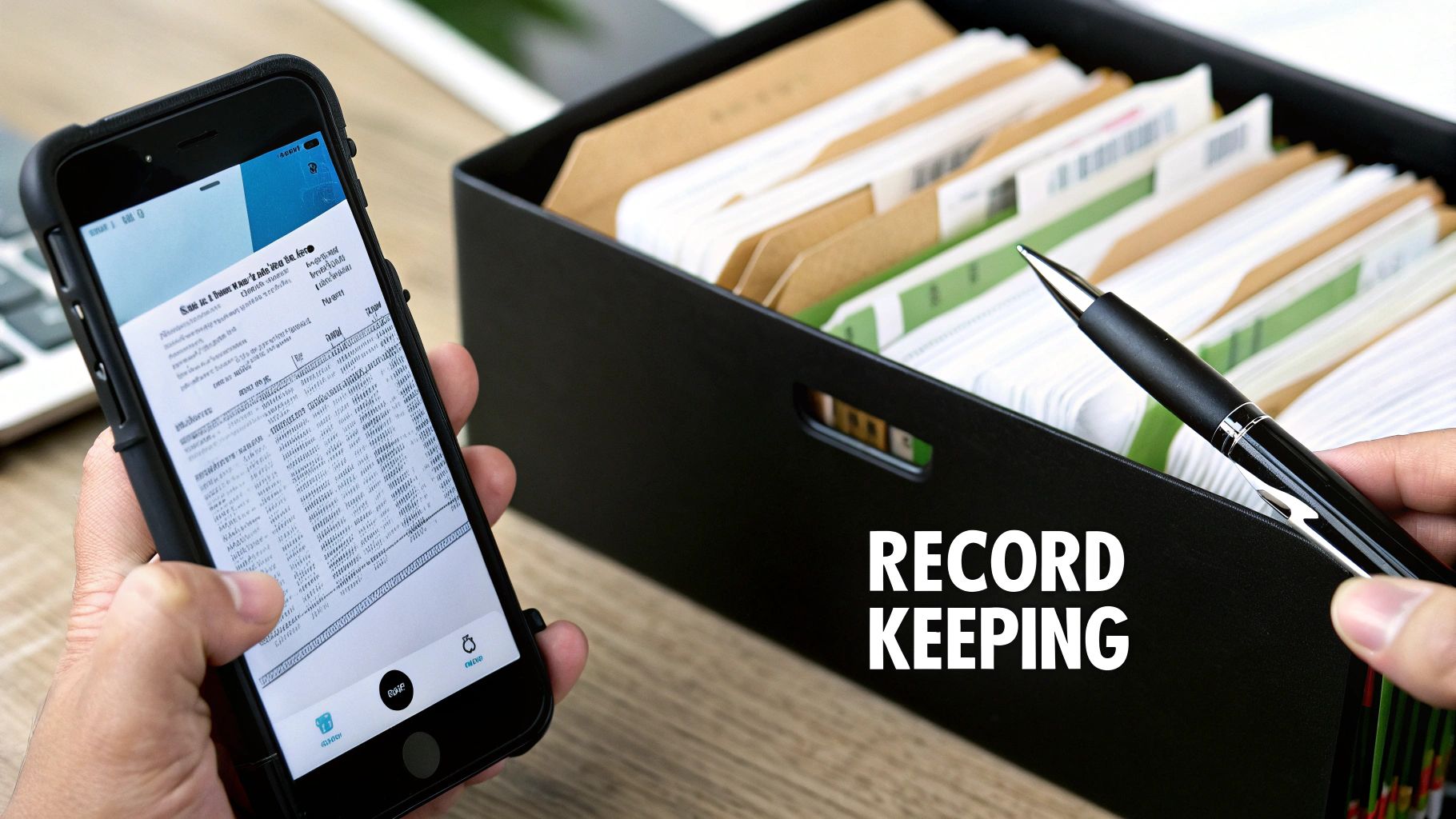
When it comes to sole trader tax deductions, there’s one simple, non-negotiable truth: if you can’t prove an expense, you can’t claim it. Meticulous record-keeping isn't just a good habit; it’s your legal obligation and the absolute foundation of an audit-proof tax return.
The Australian Taxation Office (ATO) doesn't leave much room for guesswork here. To claim a business expense, you must have solid proof of the transaction. We're not just talking about bank statements, either. You need the actual tax invoices or receipts showing exactly what you bought, when you bought it, and who you bought it from.
This paper trail is your first line of defence. It’s what proves your expenses are legitimate and were incurred to earn your income, satisfying the core principles of Australian tax law.
The ATO's Five-Year Rule
Here’s one of the most critical requirements to burn into your memory: you must keep all business-related records for five years from the date you lodge your tax return.
This rule comes straight from the Taxation Administration Act 1953, and the ATO is very strict about it. It doesn’t matter if they audit you next year or four years from now—they will expect you to produce the original proof for every single deduction you've claimed.
Practical Example: An electrician lodges their 2024 tax return on 15 October 2024. They must keep all receipts and invoices related to that return until at least 15 October 2029. Losing a receipt for a $2,000 piece of equipment in 2028 could mean having that deduction disallowed and facing a penalty.
Getting a system in place to manage this is non-negotiable. It could be a simple set of digital folders organised by financial year or a sophisticated accounting software package. Whatever you choose, consistency is everything.
Building Your Audit-Proof System
A robust record-keeping system does more than just protect you; it saves you a world of stress come tax time. The best approach is always the one you can actually stick to, turning it into a reflex rather than a chore you put off.
Here are a few actionable strategies you can implement right now:
- Go Digital Immediately: Don’t let that mountain of paper receipts build up in a shoebox. Use your phone to snap a photo of a receipt the second it hits your hand. Apps like Xero or MYOB have built-in features for this, but even a dedicated Google Drive folder will do the trick. A tradie buying materials can capture the Bunnings receipt before even leaving the car park, ensuring it’s never lost.
- Separate Business and Personal Finances: This is a big one. Open a dedicated business bank account. It creates a clean, clear transaction history that makes it infinitely easier for you or your accountant to spot deductible expenses without untangling them from your personal life.
- Organise by Category and Date: Within each financial year, create folders for different expense types. Think 'Vehicle Costs,' 'Marketing,' 'Office Supplies,' and so on. This simple step makes tallying up your sole trader tax deductions incredibly straightforward when it's time to lodge.
For a deeper dive, check out our detailed breakdown of record-keeping requirements in Australia. Mastering this discipline can transform tax time from a frantic scramble into a calm, simple review process.
Don’t wait until the end of June to get your house in order. By putting a solid system in place today, you ensure every claim is backed by solid proof, giving you complete peace of mind.
Your Actionable Tax Time Checklist
Alright, let's pull all this together. Tax time doesn’t have to feel like a mad dash to the finish line. If you’ve prepared well, it’s actually a fantastic opportunity to review your business’s financial health and make sure you’re not leaving any money on the table.
Think of this checklist as your final pre-lodgement game plan, turning all that expert advice on sole trader tax deductions into simple, actionable steps.
Your Pre-Lodgement To-Do List
Round Up All Your Income Records: Before you even think about deductions, get a crystal-clear picture of your income. Collate every single invoice, bank statement, and payment summary to get an accurate total gross income figure. This is your starting point.
Sort Every Single Expense: Now for the important part. Go through your business bank statements, credit card bills, and your organised digital receipt folder. Start sorting each expense into the key categories we’ve covered, like vehicle costs, home office expenses, supplies, and marketing.
Finalise Your Big Calculations:
- Home Office: It’s decision time. Are you using the straightforward fixed rate (67 cents per hour) or the more detailed actual cost method? Finalise your total work-from-home hours or get your floor-area percentage calculation locked in.
- Vehicle Use: If you kept a logbook, it's time to crunch the numbers and figure out your final business-use percentage. If you’re using the cents per kilometre method, tally up your total business kilometres (remembering the 5,000 km cap).
Tag Your Depreciable Assets: Did you buy a new laptop, expensive tools, or other significant equipment this year? Check the latest instant asset write-off rules. If your purchase qualifies, you can claim the full cost straight away. If not, get the details ready for your accountant to handle the depreciation calculations.
Let’s be clear: the foundation of any claim is solid proof. The ATO's stance on this is unwavering, as laid out in the Taxation Administration Act 1953: you must be able to prove your claims. No receipt, no deduction. It's as simple as that.
This checklist is designed to put you in control and help you approach your tax obligations with confidence. But tax law is a tricky beast, and it’s always changing. Partnering with a registered tax agent is the best way to ensure you've ticked every box, maximised your return, and stayed completely compliant.
Don’t risk leaving your hard-earned money with the tax office. Book a consultation with EndureGo Tax today and let’s make sure your tax return is lodged correctly, with every single deduction you’re entitled to.
A Few Common Questions We Hear
When it comes to sole trader tax deductions, a few questions pop up time and time again. Let's tackle some of the most common queries we get from business owners just like you.
Can I Claim My Entire Phone and Internet Bill?
This is a big one. The short answer is no—you can only claim the business-use portion.
The ATO needs you to figure out a reasonable percentage. The easiest way is to track your usage over a typical four-week period. If your log shows that 60% of your phone calls and data were for business, then you can claim 60% of that bill. Just make sure you can show the Australian Taxation Office (ATO) how you crunched the numbers if they ask.
What if I Buy a Laptop for Mixed Use?
It’s the same principle as your phone bill. You can only claim a deduction for the slice of the pie that’s business-related.
You'll need to make a reasonable estimate of its work use, based on your records. If that shiny new laptop is used 80% of the time for your business, you can claim 80% of its price. Depending on the cost and the current thresholds, this could be an immediate write-off or an amount you claim over time through depreciation.
Are Receipts Needed for Every Single Expense?
For a sole trader, the answer is a firm yes. You absolutely must have proof of purchase for almost every expense you claim.
Unlike some employee claims where there's a bit of leeway, the ATO requires sole traders to keep solid records, like tax invoices or receipts, for all deductions. This is all laid out in the Taxation Administration Act 1953.
The main exception is when you use a set rate method, like the cents per kilometre for car expenses. In that case, the rate is designed to cover all your individual running costs, so you don't need to keep receipts for fuel or maintenance for those specific kilometres.
Want to maximise your tax return and make sure you’re fully compliant? That’s where expert help makes all the difference. EndureGo Tax provides professional accounting services for sole traders in Ashfield and across the Northern Beaches.
Book a consultation today and get the peace of mind you deserve.
