


If you're a sole trader in Australia, there’s a magic number you absolutely need to know: $75,000.
Once your business income hits this amount in any 12-month period, you're legally required to register for GST. Think of it as a key milestone. It means your business is growing, and it’s time to step up your game with the Australian Taxation Office (ATO).
A Sole Trader’s Quick Guide to GST
Getting your head around the relationship between being a sole trader and GST is one of the first major hurdles for any growing small business. Many tradies and freelancers start out without giving it a second thought, but as your revenue climbs, it becomes a non-negotiable part of your financial routine.
And trust us, this isn't something you can ignore. The ATO can backdate your registration and hit you with a bill for GST you never even collected from your clients.
Whether you're a plumber in Ashfield forecasting your jobs for the year or a graphic designer in Belrose quoting new projects, getting this right is your best defence.
GST for Sole Traders at a Glance
To make it simple, here's a quick summary of what every sole trader needs to know about their GST obligations.
| Concept | Key Detail | What It Means for You |
|---|---|---|
| Mandatory Registration | When your gross business income hits $75,000 in a 12-month period. | You have 21 days to register for GST once you cross the threshold. |
| Voluntary Registration | You can choose to register even if your income is below the threshold. | You can claim back GST on business expenses but must charge GST on all sales. |
| Charging GST | Add 10% to the price of your goods and services. | Your invoices will need to be updated to show GST as a separate line item. |
| Claiming GST Credits | You get a refund for the GST you pay on your business-related purchases. | This helps reduce your overall tax bill when you lodge your BAS. |
| Lodging a BAS | Report your GST collected and paid via a Business Activity Statement. | This is usually done quarterly and is how you settle up with the ATO. |
This table covers the basics, but let's dive into what this looks like in the real world.
The Core GST Concepts, Made Simple
At its core, the Goods and Services Tax (GST) is a 10% tax on most things sold or consumed in Australia. When you're registered, your role changes slightly. You become a tax collector for the government.
Here’s how it works:
- You charge GST by adding 10% to your invoices.
- You claim GST credits for the GST you paid on your business expenses (like tools, software, or materials).
- You report it all to the ATO by lodging a Business Activity Statement (BAS).
Essentially, the GST you collect from customers minus the GST you paid on expenses is what you owe the ATO. The final cost is passed down the line until it's paid by the end consumer.
A critical point to remember: GST registration is tied to your ‘GST turnover’—your gross business income, not your profit. This is a common trap many sole traders fall into. It’s all about the total amount you invoice, before expenses. This is detailed in the A New Tax System (Goods and Services Tax) Act 1999.
A Practical Example of Hitting the Threshold
Let's say you're a self-employed electrician working across Sydney's Inner West. You've had a busy year. Looking back at your invoices over the last 12 months, you realise your total billings have just hit $76,000.
Because your gross income has crossed the $75,000 threshold, the clock is now ticking. You have exactly 21 days from that point to get registered for GST.
Dealing with GST doesn't have to be a headache. With the right know-how and a bit of expert support, you can manage it like a pro.
If you’re feeling lost in the paperwork or just want to be sure you’re doing everything by the book, book a consultation with the experts at EndureGo Tax. Our teams in Ashfield and Belrose are here to make your sole trader GST obligations simple and stress-free.
The GST Registration Threshold: When Do You Really Need to Register?
The $75,000 GST registration threshold sounds simple, but for a sole trader, it’s one of the most important numbers to get right. Getting this wrong can cause major headaches with the ATO.
It’s not about your profit. It’s about your GST turnover—the total gross income your business brings in before you take out any expenses.
You need to keep an eye on two figures: your current GST turnover (what you've earned in the last 12 months) and your projected GST turnover (what you expect to earn in the next 12 months). The moment either of these is likely to hit $75,000, the clock starts ticking.
Getting Your GST Turnover Calculation Right
Think of your GST turnover as the total cash your business generates from its day-to-day activities. But not every single dollar that lands in your bank account counts towards that magic $75,000 number. Knowing the difference is crucial.
Here’s a quick rundown of what you need to include in your calculation:
- All your sales of goods and services connected to your business in Australia.
- Income from selling business assets, like old tools or equipment.
- Any income you earned while acting as an agent for another business.
What’s left out? The ATO specifically excludes certain things, like the money from selling the business itself, the sale of a capital asset like your main work ute, or income from financial supplies. Nail this calculation, and you’re on your way to staying compliant.
The rule is strict: you must register for GST within 21 days of your turnover hitting the threshold. The Australian Taxation Office doesn't mess around with this deadline, and missing it can lead to penalties.
Let’s Use an Example: A Sydney Plumber
Picture a plumber based in Sydney's Inner West. It’s January, and she’s looking over her books. She sees her income for the last 10 months is $68,000. So far, so good.
But then she lands two big renovation jobs for February and March, worth a combined $10,000.
Suddenly, her projected GST turnover for the 12-month period is $78,000. Even though the money isn't in her account yet, she is projected to cross the threshold. This means she now has just 21 days to get registered for GST.
The Big Risk of Registering Late
Failing to register on time is a trap many sole traders fall into, and it's a costly one. If you miss the deadline, the ATO can backdate your GST registration to the day you should have registered.
This means you’ll owe 10% GST on every single sale you made from that date—even though you never charged it to your customers. Ouch. You’ll have to pay that GST bill out of your own pocket, which is like taking a 10% pay cut on all your past work. On top of that, the ATO can sting you with penalties and interest.
This is exactly why you need to be proactive. If you can see your annual turnover getting close to that $75,000 mark, it’s much safer to register early. To get a better handle on this, you can learn more about the specifics of the turnover test to make sure you stay on the right side of the ATO.
What About Registering for GST Voluntarily?
So, what if you’re nowhere near the $75,000 threshold? You can still choose to register for GST. For some businesses, this is a smart strategic move, especially if you have a lot of expenses.
Why would you register early?
- Claim GST Credits: This is the big one. You can claim back the 10% GST you pay on your business purchases—think tools, materials, fuel for the ute, or software subscriptions. This can be a huge boost to your cash flow.
- Look More Professional: Having an ABN and being registered for GST can make your business look bigger and more established, which can help when you’re quoting for larger clients or companies.
And why might you wait?
- More Admin: Once you’re registered, you have to start lodging a Business Activity Statement (BAS), usually every quarter. It’s more paperwork to keep on top of.
- Your Prices Go Up: You have to add 10% GST to your invoices. This might make you less competitive if your customers are the general public, as they can’t claim that GST back.
Deciding whether to register voluntarily comes down to your business model, your customer base, and your expenses.
If you’re a sole trader feeling unsure about your turnover calculations or whether voluntary registration is the right move for you, don't leave it to guesswork. Get in touch with the expert team at EndureGo Tax in Ashfield or Belrose. We can give you practical, straightforward advice for your business.
How to Correctly Charge and Invoice for GST
Once you're registered for GST, the way you invoice has to change. It's no longer just a simple request for payment; it becomes a critical tax document. Getting this right is fundamental to good business practice and, frankly, keeps the Australian Taxation Office (ATO) happy.
For any sale over $82.50 (including GST), you are legally required to provide a tax invoice. It’s not just a suggestion. For sales under that amount, you only need to issue one if your customer asks for it.
Think of a tax invoice as the official receipt that allows your business customers to claim back the GST you charged them. It's the paper trail that makes the whole system work.
What Makes an Invoice a 'Tax Invoice'
So, what separates a regular invoice from an official tax invoice in the eyes of the ATO? It all comes down to a few key details. Think of it as a checklist to tick off every time you bill a client.
Here’s what you must include:
- The words “Tax Invoice” displayed clearly, usually right at the top.
- Your identity (either your personal name or registered business name).
- Your Australian Business Number (ABN).
- The date you issued the invoice.
- A clear description of what you sold, including quantity and price.
- The GST amount. You can show this as a separate line item or, if the total price already has GST baked in, include a statement like "Total price includes GST".
- For any invoice of $1,000 or more, you must also include the buyer’s name or their ABN.
For a deeper dive into the nitty-gritty, we've put together a detailed article on the requirements of a tax invoice. It's a great resource to ensure you never miss a thing.
Practical Invoicing Examples
Let’s see how this looks in the real world for a couple of sole traders.
Example 1: A Sparky in Ashfield
An electrician just finished a switchboard upgrade for a local cafe. The job comes to $1,000 before GST.
His tax invoice needs to break it down like this:
- Subtotal: $1,000.00
- GST (10%): $100.00
- Total Payable: $1,100.00
Because the invoice is over $1,000, he also has to add the cafe's business name and ABN.
Example 2: A Copywriter in Belrose
A freelance copywriter has charged $500 for a website content job. Since she's GST-registered, she needs to add 10% on top.
Her invoice could simply state:
- Total price includes GST: $550.00
As long as her ABN and all the other required details are there, this simple statement is all the ATO needs.
Handling GST-Free and Input-Taxed Sales
Now, here’s where a lot of people get tripped up. Not everything you sell will have GST added to it. The ATO has special categories for certain goods and services, and it’s your job to know the difference.
It's a common myth that once you're GST-registered, you have to slap 10% on everything. Knowing when to apply GST-free and input-taxed rules is a sign of a well-run business and is crucial for staying compliant under the A New Tax System (Goods and Services Tax) Act 1999.
Here’s a simple breakdown:
- GST-free sales: You don't charge any GST on these sales, but the good news is you can still claim GST credits on the business expenses you incurred to make them. Common examples are things like basic foods, certain medical services, and anything you export.
- Input-taxed sales: You don't charge GST on these sales, but you also can't claim any GST credits on your related expenses. The most common example for a sole trader is earning residential rent.
Getting these invoice details right from day one saves a world of headaches later, keeps your cash flow healthy, and makes you look professional to your clients. If you’re getting tangled up in setting up your invoicing or are unsure which sales are taxable, give EndureGo Tax a call. Our expert accountants in Ashfield and Belrose can give you the clarity you need.
Claiming GST Credits to Improve Your Cash Flow
Once you’re registered for GST, it’s not just a one-way street of collecting tax for the government. This is where it gets good for you. While you collect GST for the Australian Taxation Office (ATO), you also get to claim it back on your business purchases.
Think of it like this: the ATO is essentially giving you a refund for the GST you’ve already paid on things you need to run your business. These refunds are called GST credits (or input tax credits), and they’re your ticket to better cash flow. Every time you buy something for your business and pay GST, you’re banking a credit that will lower your next BAS bill.
The Golden Rules of Claiming GST Credits
You can't just start adding up every receipt, though. The ATO has a couple of non-negotiable rules to make sure every claim is legitimate. Getting these right from the start will make lodging your BAS a breeze and keep you out of trouble.
The two most important rules are:
- You must hold a valid tax invoice: For any business purchase over $82.50 (including GST), you absolutely need a proper tax invoice from the supplier. No invoice, no credit. It’s that simple.
- The purchase must be for your business: The item or service has to be used—or intended to be used—to run your business. You can’t claim GST on your personal groceries or a new TV for the living room.
It’s also worth knowing that you generally have four years to claim a GST credit. So, if you stumble across an old, unclaimed invoice from a business purchase, it might not be too late. For a deeper dive into what you're entitled to claim, check out our guide on your GST input tax credit entitlement.
Practical Examples of GST Credit Claims
Let's make this real with a couple of scenarios we see all the time.
Example 1: The Carpenter in the Inner West
A carpenter in Ashfield buys timber for a job, costing $550 (which includes $50 in GST). On the same day, he picks up a new circular saw for $330 (including $30 in GST).
He has tax invoices for both. On his next BAS, he can claim a total of $80 in GST credits, which directly reduces what he owes the ATO.
Example 2: The Consultant in Belrose
A freelance business consultant on the Northern Beaches invests in a new laptop for $2,200 (including $200 of GST) and an annual software subscription for $440 (including $40 of GST).
Because both are 100% for her business, she can claim a total of $240 in GST credits.
It all comes down to compliance. The good news for sole traders is that Simpler BAS reporting has made life much easier, often requiring just three numbers: your total sales, the GST you collected, and the GST credits you’re claiming. The ATO reports that compliance is strong and getting better, which shows that diligent small businesses are successfully using the system to claim credits and grow. You can read more about these trends in the ATO's latest GST administration report.
Handling Mixed-Use and Capital Purchases
This is where many sole traders get tripped up. Not every purchase is a clean 100% for business, especially when you work from home or use personal assets for your job.
If you use your mobile phone 70% for business and 30% for personal calls, you can only claim 70% of the GST on your phone plan. You’ll need a reasonable way to justify that split, like a logbook or itemised phone records.
For big-ticket items like a new ute or expensive machinery (capital purchases), you can generally claim the full GST credit upfront in the BAS period you bought it in—as long as it’s used entirely for the business. If you’re using that ute for weekend trips, you have to work out the private use portion and reduce your claim accordingly. Getting this apportionment wrong can be a costly mistake.
Feeling unsure about what you can claim or how to split your expenses? Contact the tax experts at EndureGo in Ashfield or Belrose. We'll make sure you're maximising every legitimate GST credit to boost your cash flow.
Getting Your Head Around the Business Activity Statement (BAS)
For many sole traders, three letters can cause a bit of a headache: BAS. The Business Activity Statement is the form you'll use to report and pay your GST to the Australian Taxation Office (ATO). It might sound intimidating, but once you get the hang of it, it just becomes a regular part of your business rhythm.
Think of it this way: your BAS is where you balance the books with the ATO. You show them the GST you’ve collected from your customers and subtract the GST you’ve paid on your business expenses. It’s that simple.
When GST was introduced back on 1 July 2000, it created a new layer of admin for small businesses. Suddenly, any sole trader earning over the $75,000 turnover threshold had this new reporting duty. Thankfully, the ATO eventually introduced Simpler BAS, which stripped the process back to the essentials for small businesses, making life much easier.
Choosing Your Lodgement Cycle
When you register for GST, the ATO will put you on a reporting cycle. For most sole traders just starting out, this will be quarterly, but it’s good to know your options.
- Quarterly: This is the default for most small businesses. You'll lodge your BAS four times a year, at the end of September, December, March, and June. It strikes a good balance between staying on top of your obligations and not being buried in paperwork.
- Monthly: If your GST turnover hits $20 million or more, you'll be required to lodge monthly. Some smaller businesses choose this voluntarily to keep a tighter grip on their cash flow and get their GST refunds faster.
- Annually: This is only an option if you’re voluntarily registered for GST (i.e., your turnover is under $75,000). It means less paperwork, but you’ll only be able to claim back your GST credits once a year, which can be a long time to wait.
Cracking the BAS Code: G1, 1A, and 1B
If you're on the Simpler BAS method, you only need to worry about three little boxes. This is what makes it so, well, simple.
The whole point of the BAS is to figure out the difference between the GST you collected for the government and the GST you paid on business costs. That difference is either what you owe the ATO or what they refund to you.
These are the three labels you'll get to know well:
- G1 Total Sales: This is all the income your business earned for the period. Don't overthink it—just the total figure from your invoices, including any GST.
- 1A GST on Sales: This is the GST portion of your sales. The easiest way to work this out is to take your total sales figure at G1 and divide it by 11.
- 1B GST on Purchases: This is where you get your money back! It’s the total amount of GST you paid on business-related goods and services.
A Practical BAS Example for a Landscaper
Let's imagine a local landscaper in Sydney's Inner West sorting out her quarterly BAS.
- Total Sales (G1): She invoiced $22,000 (including GST) for her jobs this quarter.
- GST on Sales (1A): She collected $2,000 in GST ($22,000 / 11).
- GST on Purchases (1B): She spent $5,500 on soil, plants, tools, and fuel for her business. The tax invoices show this included $500 in GST.
Her BAS calculation is straightforward: $2,000 (1A) minus $500 (1B) = $1,500. This is what she needs to pay the ATO for the quarter. Getting this right is a key part of managing your finances, and it ties directly into how you handle things like quarterly estimated taxes.
The process for claiming credits for that 1B figure is a simple, repeatable cycle.
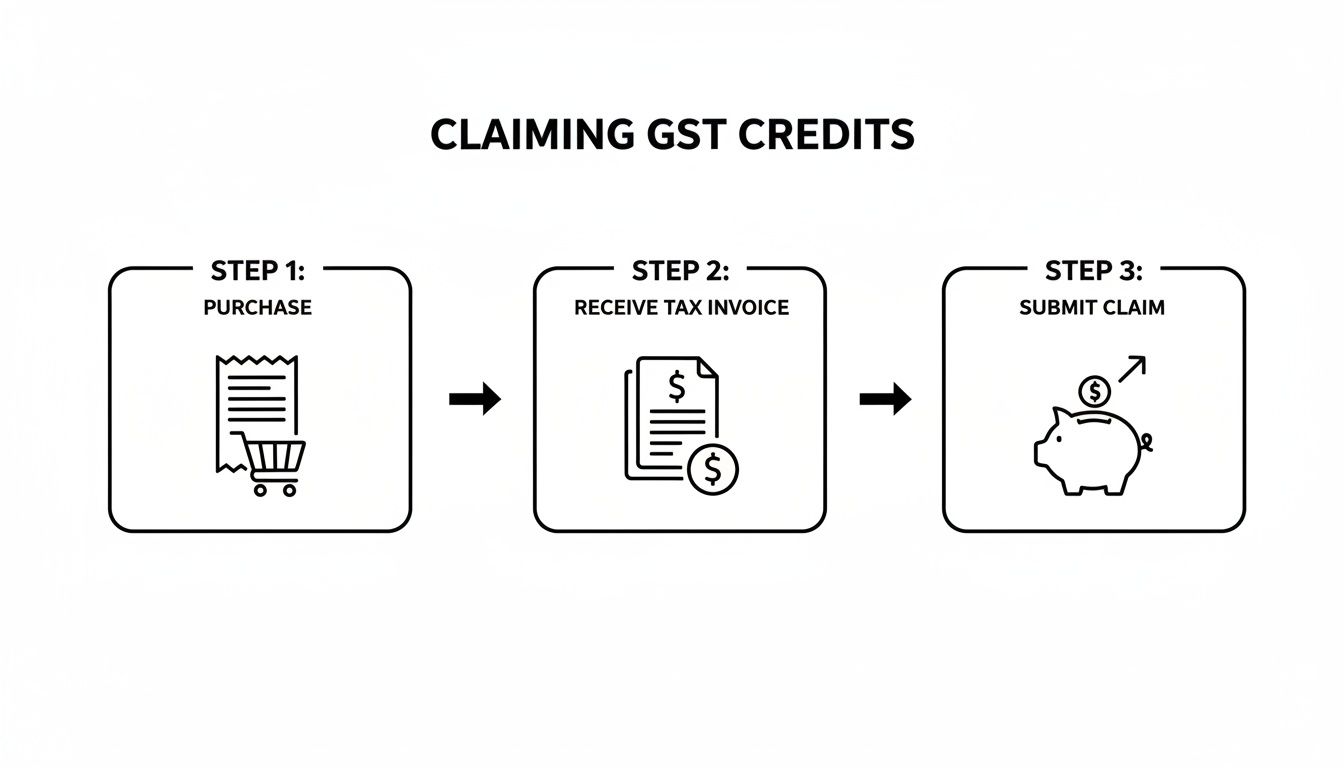
Make the purchase, get a valid tax invoice, and include it in your BAS claim. That’s the core discipline of managing your GST credits properly.
Don't let the BAS process become a source of stress. The most important thing is to lodge on time to avoid penalties and keep your accounts in good standing with the ATO. If you're based in Ashfield or Belrose and want to make sure you're getting it right every time, reach out to EndureGo Tax for a no-stress consultation.
Actionable GST Management Tips for Sole Traders
Alright, you've made it this far. Getting your head around GST is one thing, but managing it day-to-day is where the real work begins. Think of it less as a chore and more as a sign that your business is kicking goals. When you’re dealing with GST, it means you’re growing.
But staying on top of it isn't about last-minute panic when your BAS is due. It’s about building simple, solid habits that keep you compliant and cash-flow positive.
Your GST Action Plan
So, let's cut through the noise. Here are the non-negotiables every GST-registered sole trader needs to nail down:
- Keep a Hawk-Eye on Your Turnover: Your income isn't static. Always know where your rolling 12-month turnover is sitting. Getting ahead of that $75,000 threshold means no mad scramble to register and no nasty penalties from the ATO.
- Get Your Invoices Right, Every Time: Make sure every tax invoice you send out is 100% compliant. That means your ABN, the words "Tax Invoice," and the GST amount are all clearly listed. It’s a small detail that makes a huge difference.
- Don't Leave Money on the Table: Be relentless about collecting tax invoices for your business expenses. Every GST credit you claim—from the materials you buy to the software you use—is cash straight back into your business.
- Lodge Your BAS on Time: Whether you're lodging quarterly or monthly, those deadlines are set in stone. Consistent, on-time lodgement is the best way to keep your books clean and stay on the ATO’s good side.
Getting this right isn't about luck; it's about having a process. The law, like the A New Tax System (Goods and Services Tax) Act 1999, sets the rules, but getting practical, expert advice is how you apply them perfectly to your unique situation.
Your Next Step
You’ve got the theory down pat. Now, it’s all about execution.
Simple mistakes—like a missed BAS deadline or unclaimed credits—can add up to thousands of dollars lost over the years. The single most effective way to protect yourself and get total peace of mind is to work with someone who lives and breathes this stuff every single day.
If you’re a sole trader in Ashfield, the Inner West, or over on the Northern Beaches near Belrose, don't gamble with your compliance.
Contact EndureGo Tax today. We specialise in BAS lodgement and tax advice for tradies and small business owners just like you. Let us take the headache out of your GST and sole trader tax obligations, so you can get back to doing what you actually love—running your business.
Your Top GST Questions Answered
Once you get the hang of the basics, the world of sole trader GST can still throw a few curveballs. Let’s tackle some of the most common questions we hear from tradies and small business owners around Sydney to clear up any confusion.
What Happens if I Register for GST Late?
Honestly, this is a situation you really want to avoid. If the Australian Taxation Office (ATO) figures out you should have been registered from an earlier date, they have the power to backdate your GST registration.
This means you’re suddenly on the hook for 10% GST on all the taxable sales you made from that backdated point—even if you never actually charged it to your customers. On top of having to pay that GST out of your own pocket, you could also get hit with penalties and interest. It’s a painful and expensive mistake, which is why keeping a close eye on your turnover is so critical.
Do I Charge GST on Services for Overseas Clients?
This is a great question, especially as more businesses go global. Generally, the services and goods you provide to clients outside of Australia are considered 'GST-free' exports. This is good news for two big reasons.
First, you don’t have to add GST to your invoice, which makes your pricing more competitive on the international stage. Second, you can still claim the full GST credits on the business expenses you paid for to make that sale happen.
But here’s the catch: the responsibility is on you to prove it was a genuine export. The ATO requires you to keep clear records showing your client wasn't in Australia when you did the work. This is a key compliance point under the A New Tax System (Goods and Services Tax) Regulations 2019, so don't get caught out.
How Does GST Work on Platforms Like Airtasker or Uber?
The rules for the gig economy can get a bit tangled, and it often depends on the platform. For many platforms like Airtasker, the income you make counts towards your $75,000 GST turnover threshold. The platform itself will usually handle the GST on their own service fees.
However, some services have their own special rules. Ridesharing is the big one. If you drive for a service like Uber, you must register for GST from the very first dollar you earn. The $75,000 threshold simply doesn't apply. It’s vital to understand both the platform’s rules and your personal tax obligations here.
Can I Cancel My GST Registration?
Yes, you can cancel your GST registration. You can usually apply to do this if your business has shut down, been sold, or if your GST turnover has dropped below the $75,000 threshold and you're confident it will stay that way.
Just be aware of a crucial final step called 'exit adjustments'. When you deregister, the ATO might require you to pay back some of the GST credits you’ve claimed on business assets you still own—think tools, a ute, or expensive equipment. The amount you repay is based on their current value and how much you use them for business. Because this can have a real financial sting, we always recommend chatting with a tax professional before you make the call.
Feeling uncertain about late registration, overseas sales, or cancelling your GST? Don't leave it to chance. The team at EndureGo Tax provides expert, practical advice for sole traders across Ashfield, the Inner West, and the Northern Beaches. We make sure you're compliant, maximising your claims, and avoiding costly mistakes. Book a consultation today with your trusted local accountant at EndureGo Tax and get the peace of mind you deserve.
