


If you’re running a trade business in Ashfield, a clinic in Belrose, or a café anywhere across Sydney, tax usually becomes a problem at the same point. Work picks up, staff numbers grow, software subscriptions pile up, and suddenly you’re dealing with the ATO, Revenue NSW, BAS lodgements, payroll questions, and deadlines that don’t line up neatly.
That’s why small business tax in NSW trips up so many otherwise capable business owners. The issue usually isn’t effort. There is confusion about which rules sit with the federal government and which sit with New South Wales.
Navigating Small Business Tax in NSW
A common local scenario goes like this. A tradie starts as a sole trader, registers for GST once turnover rises, then hires an apprentice and a part-time admin person. A year later, the business has grown fast, cash flow is tighter than expected, and the owner still thinks “tax” mainly means income tax at year’s end. That’s where problems begin.

In NSW, this matters more than many owners realise because the business environment is dense and competitive. New South Wales hosts 916,603 active enterprises, representing about 33.6% of Australia’s 2.72 million businesses, according to Money.com.au’s Australian business statistics and the ATO small business tax gap material. When so many businesses operate in one state, generic tax advice stops being enough.
Federal tax and NSW tax are not the same thing
The biggest mistake I see is treating all business taxes as one system. It isn’t.
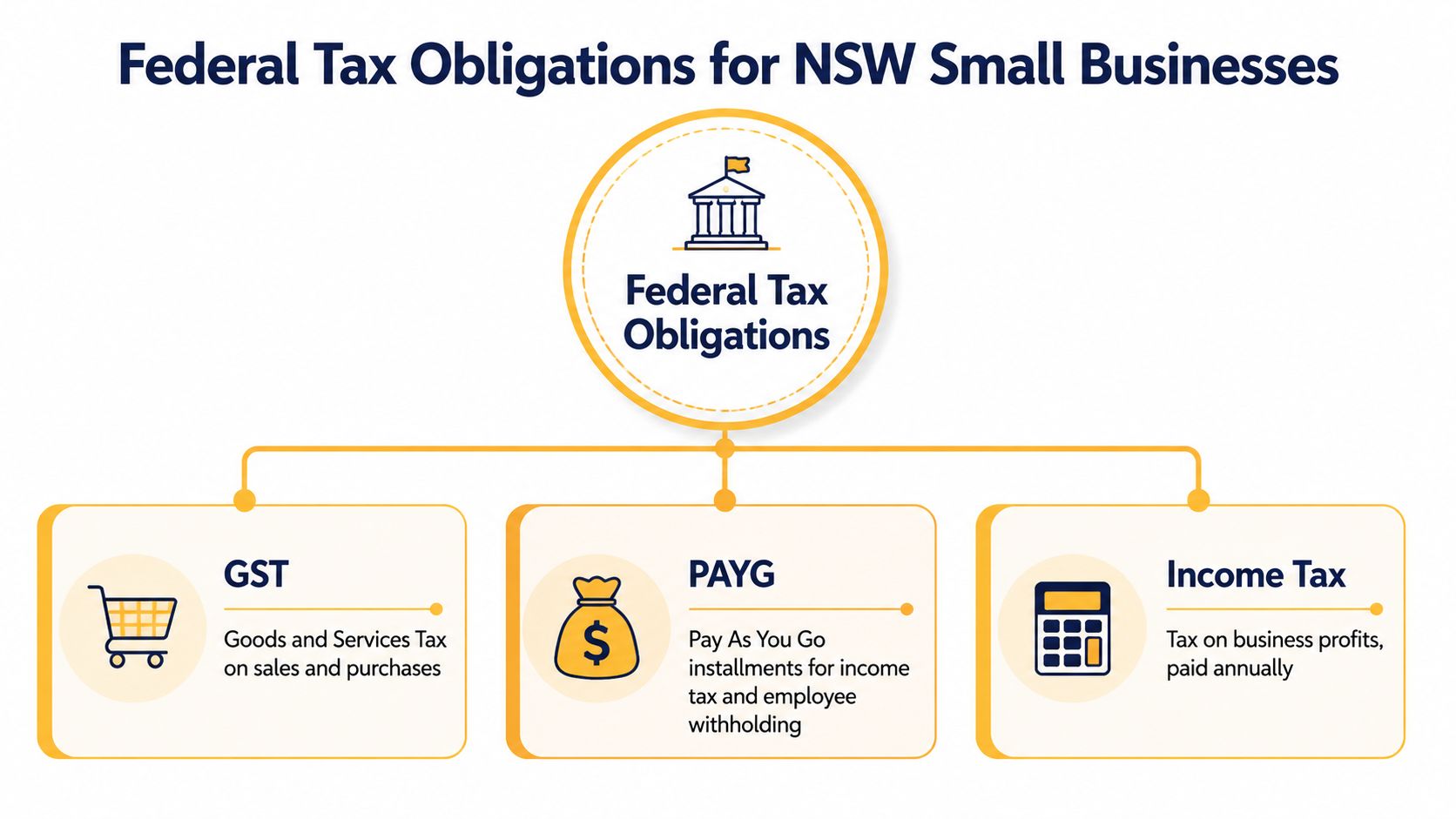
- The ATO handles federal taxes such as GST, PAYG and income tax.
- Revenue NSW handles state taxes such as payroll tax.
- Your council and other state bodies may apply separate rules or exemptions that don’t match ATO definitions.
Practical rule: If you’ve hired staff, changed structure, or crossed a turnover milestone, assume at least one tax obligation has changed until you confirm otherwise.
What works in practice
Business owners stay on top of NSW tax when they do three things well:
- Separate obligations early
Don’t mix GST issues with payroll tax planning. They are different systems with different triggers. - Track thresholds before you hit them
Waiting until after growth happens is what creates back payments and cash flow shocks. - Keep records in real time
Xero, MYOB, and QuickBooks don’t solve every tax issue, but they make the facts visible sooner.
A good tax setup isn’t just about avoiding penalties. It gives you cleaner pricing, steadier cash flow, and better decisions around hiring, purchases, and structure.
Your Federal Tax Obligations, GST, PAYG and Income Tax
Most NSW business owners deal with the federal system first. That means the Australian Taxation Office, not Revenue NSW. If you understand GST, PAYG and income tax, you’ve got the core framework right.
GST registration and reporting
You must register for GST when your GST turnover reaches $75,000 or more in a financial year, as set out by the ATO in its GST registration guidance for businesses. Once registered, you add 10% GST to most taxable sales and report it through your BAS.
A simple example helps. If a local tradie invoices $100 for a taxable service, the customer pays $110, with the extra $10 being GST. If that tradie’s annual turnover reaches $80,000, GST registration becomes compulsory under the same ATO rules.
What works is registering before the pressure hits. If you’re sitting close to the threshold, update your invoicing system, quote properly, and start setting aside GST collected instead of treating it as spendable cash.
PAYG starts when you hire
The next shift happens when you take on employees. At that point, you’re no longer just earning business income. You’re also handling withholding obligations.
PAYG withholding means you withhold tax from employee wages and report that through the BAS. Many growing businesses frequently come unstuck due to this. They focus on finding staff, then leave payroll setup until after the first pay run.
If you’re adding your first employee, get these basics right before wages go out:
- Set up payroll software properly
Use Xero, MYOB or QuickBooks with the correct employee tax settings from day one. - Separate wages from contractor payments
Don’t assume every worker with an ABN is a contractor for tax purposes. - Match payroll records to BAS reporting
Your bookkeeping and payroll figures must align. If they don’t, the BAS becomes guesswork.
For a deeper breakdown, the PAYG guide from EndureGo Tax is useful if you’re trying to sort out withholding obligations before your team grows further.
Hiring staff changes your tax job immediately. The paperwork doesn’t start at year end. It starts with the first wage payment.
Income tax depends on the structure
Income tax is where business structure matters. Companies don’t pay tax the same way sole traders and partnerships do.
A company may qualify for the 25% base rate entity tax rate if its aggregated turnover is less than $5 million and at least 20% of its income comes from active trading, rather than passive investment income, under the ATO rules explained in this base rate entity company tax overview. Otherwise, the standard company tax rate is 30%.
Sole traders and partnerships are different again. They’re generally taxed at individual marginal rates, and the tax-free threshold is $18,200. Some may also access a small business income tax offset of up to $1,000, based on the same ATO tax rate material.
That’s why structural decisions shouldn’t be made on hearsay. A company can help in some cases, but not every profitable business should incorporate. The right answer depends on profits, cash drawings, risk, succession plans, and whether income is active business income or passive.
The NSW Payroll Tax Trap: What You Must Know
Payroll tax is where many NSW businesses get blindsided. It’s a state tax, not a federal one, and Revenue NSW manages it separately from your ATO obligations. If your team is growing, this is one of the most important areas in small business tax NSW planning.
The threshold catches growing businesses
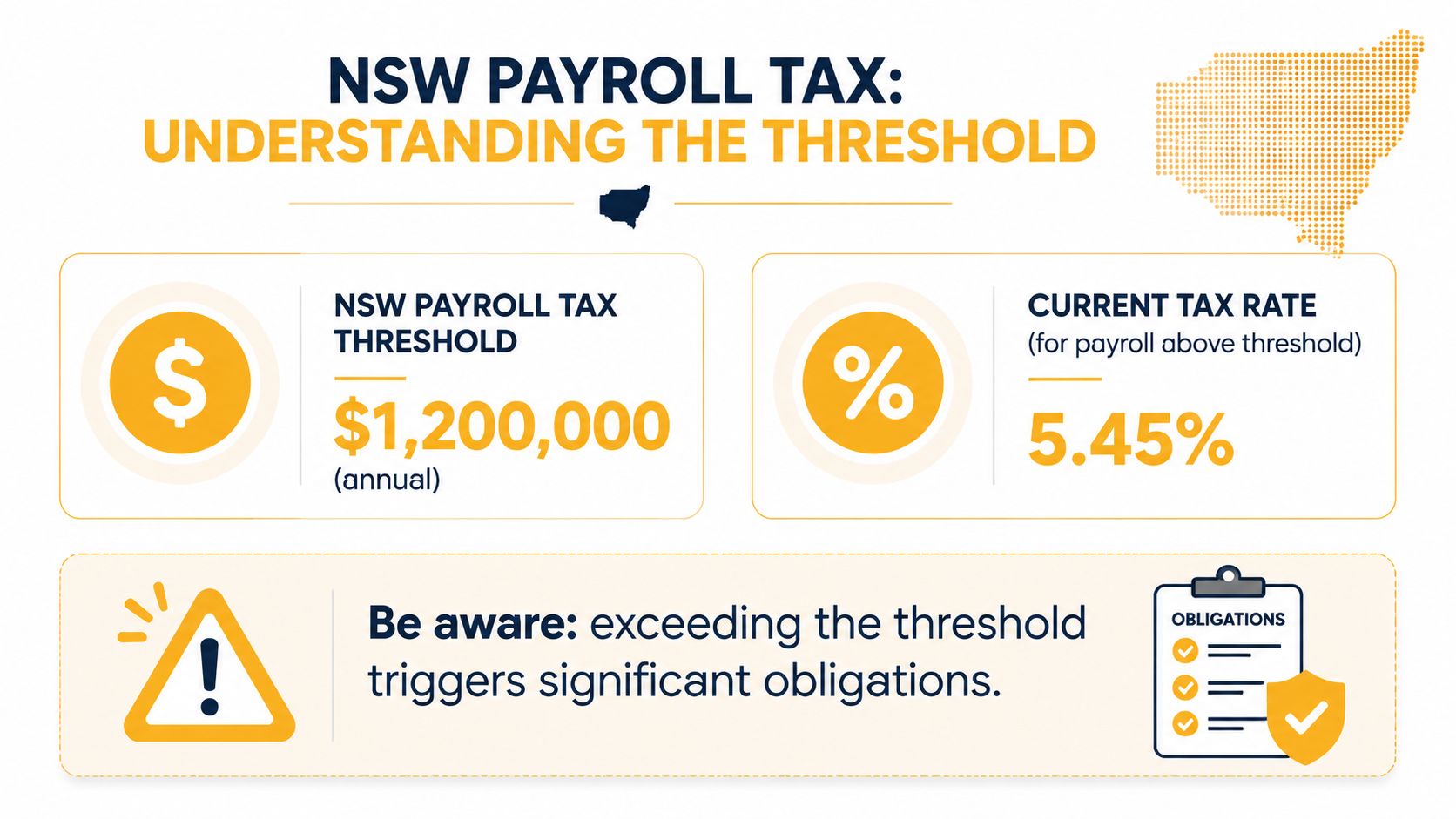
In New South Wales, the payroll tax system uses a tiered structure. The threshold is $1,250,000 in annual taxable wages, with a marginal rate of 5.45% for wages between $1.25 million and $2 million, and 6.1% for wages above $2 million, according to Revenue NSW payroll tax guidance and the supporting NSW business statistics references.
That single threshold changes planning. A business can feel “small” in every practical sense and still trip into payroll tax because of wages, superannuation, bonuses, and other taxable payments.
What this looks like in the real world
Take a service business on the Northern Beaches. It starts with the owner, one office manager, and a few field staff. Work is strong, so the owner adds another crew to cover more jobs. Revenue rises, but so does the wage bill.
The trap is simple. Owners often budget for wages, super, insurances and vehicles, but they don’t budget for payroll tax until after they’ve crossed the threshold. By then, the extra liability starts cutting into working capital.
A different verified example shows the practical effect. A NSW business paying $1.3 million in total wages would have a payroll tax amount of $56,150, based on the referenced payroll tax example using the 5.45% rate in the supplied data. Whether you use the threshold framing at $1.2 million or the tiered framework at $1.25 million, the commercial lesson is the same. Monitor payroll closely before hiring decisions stack up.
Payroll tax doesn’t arrive because you’re highly profitable. It arrives because your wage bill crosses a NSW threshold.
What counts and what doesn’t
Owners often assume payroll tax only applies to salaries. That’s too narrow. Taxable wages can include salary, wages, superannuation, bonuses, and allowances. That’s why rough estimates on a spreadsheet often understate the actual position.
What works better is a monthly payroll review with three questions:
- Has the annualised wage bill shifted?
One extra hire can change the year-end projection quickly. - Are all worker classifications still correct?
Trying to reduce payroll tax exposure by shifting workers into contractor arrangements can create bigger compliance issues. - Is cash flow still realistic after state tax is added?
Strong sales don’t help much if payroll obligations are funded late.
This is one area where delay costs more than advice.
Mastering Your Business Activity Statement
The BAS is where day-to-day bookkeeping meets tax compliance. If your records are messy, the BAS becomes stressful. If your records are clean, it becomes routine.
What the BAS actually pulls together
For most small businesses, the BAS is the reporting point for GST and PAYG obligations. It isn’t just a form to lodge because the quarter ended. It’s the summary of what happened in your business over that period.
That means your BAS is only as good as the records underneath it. If sales haven’t been coded correctly, supplier bills are missing, or payroll hasn’t been reconciled, you’re not preparing a BAS. You’re estimating.
A better BAS workflow
The businesses that stay calm around BAS time usually follow a steady rhythm rather than a last-minute scramble.
- Reconcile bank accounts regularly
Don’t leave months of transactions unmatched. - Review GST coding as you go
Fix errors when they appear. They’re harder to untangle later. - Check payroll before the quarter closes
PAYG errors often begin in payroll setup, not in the BAS itself. - Store source documents properly
Keep tax invoices, supplier receipts and payroll reports organised in one place.
The BAS preparation checklist from EndureGo Tax is a practical reference if you want a cleaner quarter-end process.
Clean BAS lodgements usually come from weekly habits, not end-of-quarter heroics.
What doesn’t work
A few habits almost always create trouble:
- Using one bank account for everything
Personal and business spending mixed slow every review. - Uploading receipts without checking coding
Software helps, but it doesn’t replace judgement. - Treating BAS as a bookkeeping catch-up
Lodgement time is too late to discover months of missing records.
If BAS keeps feeling harder than it should, the problem is rarely the form. It’s the workflow behind it.
Critical Tax Deadlines and Concessions in NSW
Deadlines matter because good businesses still get into trouble when cash flow and compliance fall out of sync. The practical fix is to run your calendar ahead of lodgement dates, not react to them after the fact.
2026 key tax dates for NSW small businesses
The exact due date can vary depending on how you lodge and whether an agent is involved, so always confirm the current timetable directly with the ATO or your adviser. As a planning tool, use a quarterly schedule like this:
| Quarter | Period | BAS Lodgement & Payment Deadline |
|---|---|---|
| Quarter 1 | July to September | Check your ATO lodgement calendar before quarter end |
| Quarter 2 | October to December | Confirm due date early and set cash aside progressively |
| Quarter 3 | January to March | Don’t let holiday shutdowns delay bookkeeping |
| Quarter 4 | April to June | Finalise records promptly to avoid year-end compression |
That table looks simple, but its primary value is behavioural. Schedule bookkeeping reviews before each quarter ends, not after. That gives you time to fix coding errors, unpaid invoices, payroll mismatches, and missing supplier documents.
A concession worth checking properly
One federal measure that has been highly relevant for digital upgrades is the Small Business Technology Investment Boost. Businesses with aggregated annual turnover under $50 million could claim an additional 20% tax deduction on eligible digital expenditure, capped at $100,000 expenditure per year, under the ATO measure explained in this small business technology investment boost guidance.
This wasn’t a blanket claim for every technology-related cost. Eligibility depended on the nature of the expense and timing, including the relevant usage requirements for depreciating assets.
A practical example is a small Inner West business moving from spreadsheets to cloud accounting and digital inventory tools. If the costs were eligible, the boost increased the deduction beyond the ordinary claim. What worked was keeping proper invoices, documenting what the software was for, and confirming whether the item was first used or installed, ready for use within the required period.
What didn’t work was assuming training, wages, or unrelated digital spending automatically counted.
For broader planning opportunities, including concessions that may apply to structure and assets, the small business tax concessions guide is a useful starting point.
Timing changes the result
A concession only helps if the claim is valid and documented. In practice, that means:
- Check eligibility before purchase
Don’t buy first and ask later. - Keep the tax invoice and implementation record
Software subscriptions are easier to support when the paperwork is complete. - Match claims to the correct period
Timing errors are one of the fastest ways to lose a benefit.
Avoiding Costly Tax Mistakes: A Checklist for Success
Most tax mistakes in small businesses aren’t exotic. They’re repetitive. The same preventable issues show up in different industries, from electricians to consultants to shop owners.
The common assumptions that cause problems
One of the worst assumptions is that a good bookkeeper or software subscription will automatically make the tax side correct. They help, but they don’t decide classification issues, structure questions, or threshold risks for you.
Another common mistake is treating tax as something to clean up after the financial year ends. By that point, the opportunity to plan has often passed.
Good records don’t just support deductions. They expose problems early enough to fix them.
A practical checklist
Use this checklist to tighten your small business tax NSW process:
- Separate accounts fully
Keep personal and business finances apart. That single step improves bookkeeping, BAS accuracy, and deduction support. - Review worker status before disputes arise
Don’t label someone a contractor just because it seems simpler commercially. - Reconcile regularly
Weekly or fortnightly reviews beat large quarterly clean-ups. - Keep source documents. Hold invoices, receipts, payroll reports, and finance documents in a system your accountant can review.
- Watch growth triggers
Tax obligations often change when turnover rises, staff is added, or the business structure shifts. - Use software properly
Xero, MYOB, and QuickBooks are only useful when bank feeds, chart of accounts, and payroll settings are maintained correctly.
What successful operators do differently
The strongest operators don’t obsess over claiming everything possible. They focus on claiming what they can support. That mindset usually produces better outcomes than aggressive deduction hunting.
They also review numbers during the year. A short monthly review of revenue, wages, GST collected, major purchases, and unpaid tax is far more useful than a pile of documents in June.
Take Control of Your Tax with Expert Support
By this point, the divide should be clear. Federal obligations such as GST, PAYG, and income tax sit with the ATO. NSW-specific liabilities, such as payroll tax, sit with Revenue NSW. That distinction sounds basic, but it’s one of the most important ideas in small business tax NSW compliance.
There are also clear moments when DIY stops being efficient. If you’re approaching the payroll tax threshold, hiring several staff, changing structure, planning a significant purchase, or responding to an ATO review, you need more than general advice. You need accurate treatment, clean records, and decisions made before the transaction, not after it.
A local accountant can also help with the commercial side of growth. For example, if you’re improving your website and want better visibility online, these accounting firm SEO strategies give useful context on how professional firms build trust and attract the right enquiries. That matters because many business owners now expect advisers to support both compliance and practical business improvement.
If you want direct support with BAS, company tax returns, sole trader and partnership lodgements, trust compliance, SMSF work, ASIC compliance or higher-level tax advice, EndureGo Tax is one practical option for businesses in Ashfield and Belrose that need ongoing tax and accounting support without guesswork.
The right support should make your tax position clearer, not more complicated. It should help you make decisions earlier, keep cash flow steadier, and lower the risk of avoidable errors.
If you want help getting your GST, BAS, payroll tax exposure, company tax, or business structure sorted properly, speak with EndureGo Tax. We work with tradies, investors, and small business owners across Ashfield, Belrose, and the Northern Beaches to keep tax obligations clear, compliant, and manageable.
