


You’ve started the business. You’ve sorted the ABN, sent out invoices, and finally seen money land in the account. Then the letters, deadlines, registrations, and acronyms start piling up. GST. BAS. PAYG. Super. ASIC. Suddenly, understanding the paperwork around the business feels harder than running the business itself.
That situation is normal. Small business owners across Sydney face the same pressure, especially when they keep jobs moving in Ashfield, manage staff on the Northern Beaches, or juggle quoting, ordering, and bookkeeping after hours. Usually, the problem is not a lack of effort. Instead, tax rules shift from practical to highly technical without much warning.
Your Guide to Navigating Small Business Tax
A lot of new business owners think the hard part is finding customers. In practice, one of the first real stress points is staying on top of tax once the business is active. A tradie in the Inner West might be flat out on-site all week, then sit down on Sunday night and realise they still don’t know which receipts matter, whether GST applies yet, or how to separate personal costs from business spending.
That confusion is common. The ATO small business population includes more than 2.5 million entities, and many owners still struggle with GST registration, BAS timing, and splitting business and private expenses correctly, as noted in this small business population reference. That’s why broad articles about “top deductions” often miss the point. The primary issue is usually compliance friction.
What trips people up first
Many individuals don’t get stuck on the idea of tax. They get stuck on timing and evidence.
- Timing problems happen when you earn money, spend money, and lodge forms in different periods.
- Evidence problems start when purchases are partly personal, receipts go missing, or bookkeeping falls behind.
- Structure problems show up when the business was set up quickly and the owner didn’t realise that tax treatment changes depending on the entity.
Good tax management starts well before tax time. It starts with clean records, the right structure, and a clear habit for handling ATO obligations as they arise.
A practical way to think about small business tax laws
Australian small business tax laws aren’t one single rulebook you read once. They’re a set of connected systems. Your business structure affects how profit is taxed. Your registration status affects whether you need to account for GST. Your payroll setup affects what must be reported each pay cycle. Your records support every claim you make.
If you’re new to this, don’t try to memorise everything at once. Focus on the few things that control most of your risk:
| Priority area | Why it matters |
|---|---|
| Business structure | Changes tax treatment and personal risk |
| GST and BAS | Affects cash flow and reporting |
| Record-keeping | Supports deductions and protects you in a review |
| Payroll and super | Needs to be right from the start if you hire staff |
If you get those foundations right, the rest becomes far more manageable.
Choosing Your Business Structure Wisely
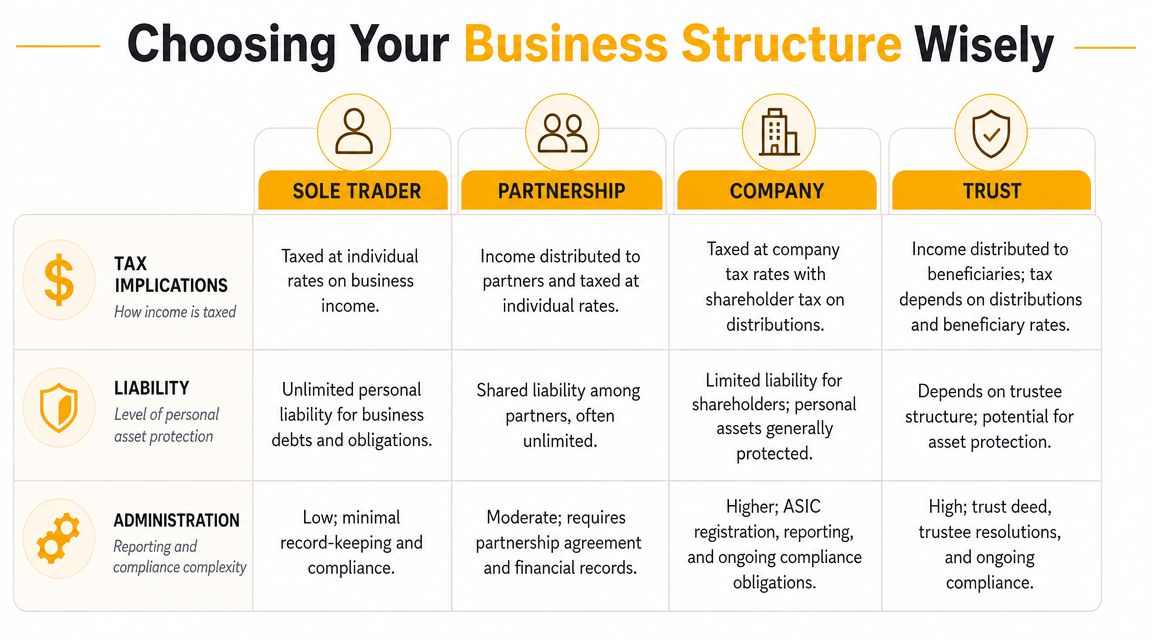
Choosing a structure is like choosing the right vehicle for the job. A sole trader setup might suit a simple operation. A company can be better when the business is growing, taking on risk, or adding owners. A trust can be useful in the right circumstances, but it also comes with more moving parts.
The four main structures in practice
Under Australia’s small business tax settings, companies with aggregated turnover below the relevant threshold are taxed at 25%, while the general company rate remains 30%. By contrast, sole traders and partnerships don’t pay a separate business-level tax because the profit is assessed through the owner’s personal return, as outlined in this business tax rate reference.
That distinction matters because structure changes not only your tax treatment, but also administration and asset protection.
| Structure | Tax treatment | Liability | Administration |
|---|---|---|---|
| Sole trader | Profit goes into your personal return | Personal assets are generally exposed | Lowest complexity |
| Partnership | Profit flows through to partners personally | Personal exposure can still be significant | Moderate, because partners must align records |
| Company | Separate taxable entity | Better separation between business and personal affairs | Higher compliance |
| Trust | Depends on how income is distributed and documented | Can help with asset holding in the right setup | Often the most technical |
When each structure tends to work
A sole trader setup often works well for someone starting small. Think of a freelance designer in Ashfield, or a mobile hairdresser who wants straightforward reporting and minimal admin. The trade-off is that simplicity doesn’t give you much protection if the business grows or takes on more risk.
A partnership can suit two people going into business together, but only if expectations are documented clearly. I’ve seen partnerships run into trouble not because the tax law was hard, but because the owners never agreed on drawings, expenses, or who keeps the records.
Practical rule: Don’t choose a structure only because it’s easy to register. Choose it based on how you’ll earn income, carry risk, and grow.
A company often suits builders, consultants, agencies, and trades businesses that want a clearer separation between personal and business affairs. The trade-off is more compliance. You’ll need proper company records and ongoing governance.
Trusts can be useful, but they are not a shortcut. They need careful setup, proper administration, and advice before decisions are made. If a business owner in Belrose tells me they “set up a trust because someone said it saves tax”, that’s usually a sign we need to slow down and review the structure properly.
For a closer look at how these options work in Australia, this guide on business structures in Australia is a helpful starting point.
What usually doesn’t work
These choices cause avoidable problems:
- Copying a mate’s setup because “that’s what he uses”.
- Running a growing business as a sole trader for too long, even though risk and admin have changed.
- Using a trust without understanding the paperwork that supports it.
- Switching structures too late after contracts, staff, or assets are already in place.
The best structure is the one that fits the business you run, not the one that sounded easiest on day one.
Mastering Your Core Tax Obligations
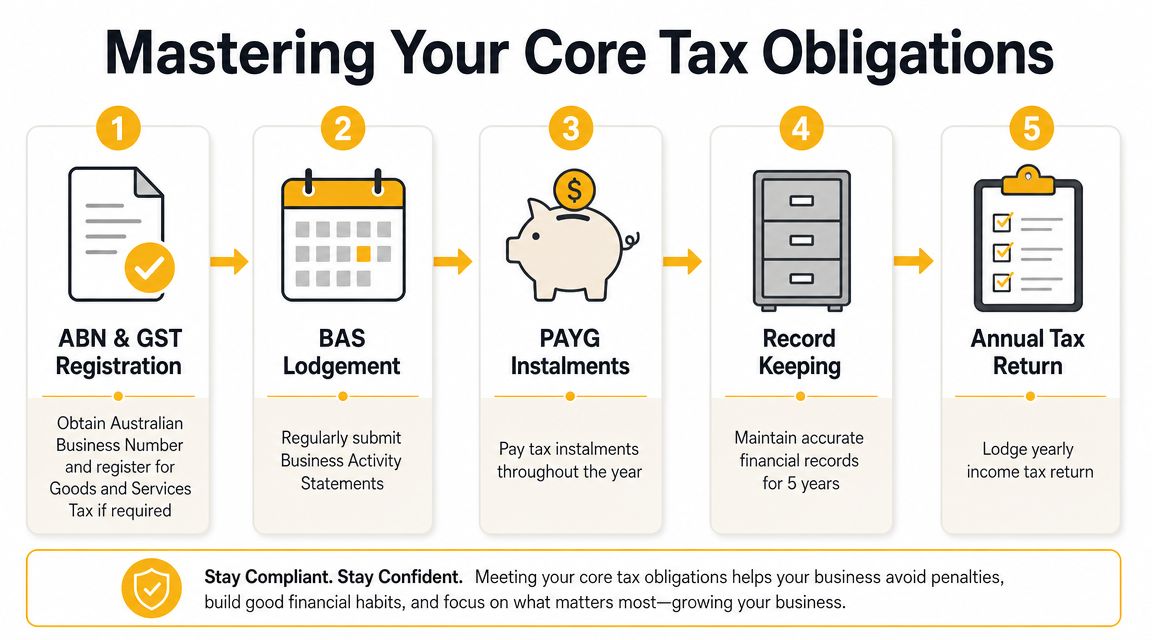
Most tax stress in a small business comes from recurring obligations that weren’t built into the weekly routine. Once you understand the rhythm, the pressure drops. The key areas are GST, BAS, PAYG, payroll reporting, and super.
GST and BAS
For many businesses, the BAS is the form that turns bookkeeping into a real cash issue. In Australia, GST is generally reported and paid through BAS, and the timing matters because quarterly cash outflows depend on how well you manage GST collected from sales against GST credits on purchases. The ATO also uses data-matching across BAS, income tax, and payroll reporting, so inconsistencies can raise review risk, as explained in this BAS and GST compliance overview.
If you invoice customers promptly but delay entering supplier bills, your BAS can overstate what you owe in the period. If payroll figures don’t match your reporting, that can create another layer of trouble.
What to do in real business terms
Think about a plumber in Sydney who collects payment for several jobs before month’s end. If those sales include GST, that money isn’t all theirs to spend. Part of it needs to be preserved for BAS. If they use the whole account balance as operating cash, the BAS due date can hurt.
Use this routine instead:
- Reconcile sales weekly so your GST on income is current.
- Enter purchase bills promptly so input tax credits aren’t missed.
- Set aside tax money regularly rather than hoping the account balance will cover it later.
- Review BAS before lodgement against accounting software, bank activity, and payroll reports.
If you want a plain-English explanation of BAS before going deeper, this article on what BAS tax is helps clarify the moving parts.
Keep GST money separate in your mind, and ideally separate in your banking habits too. That one habit prevents a lot of late-payment stress.
For businesses using hosted accounting and tax platforms, stable access and secure remote environments can make reporting easier, especially when multiple people handle the books. A practical resource on that front is Cloudvara’s tax software hosting.
PAYG and payroll reporting
Once you hire staff, tax reporting gets more technical. PAYG withholding, payroll records, and super all need to line up. If the wages in your payroll system don’t reconcile to what’s reported and paid, the mismatch can surface later.
A clean payroll process usually looks like this:
- Set up employees correctly from the start so pay categories, withholding, and super are mapped properly.
- Reconcile each pay run before the next one goes through.
- Check year-end totals early instead of waiting until deadlines are close.
- Keep source records organised, including timesheets, pay slips, and super payment confirmations.
What works and what doesn’t
Here’s the blunt version.
| Works | Doesn’t work |
|---|---|
| Weekly bookkeeping | Quarterly catch-up chaos |
| Reviewing reports before lodgement | Lodging off bank balance alone |
| Matching payroll to BAS figures | Assuming software always gets it right |
| Saving for tax as you trade | Treating tax money as spare cash |
Small business tax laws feel much easier when you build a repeatable process. They feel brutal when every BAS is a scramble.
Maximising Your Tax Deductions What You Can Claim
Paying the right amount of tax is the goal. Paying extra because your records are weak or your claims are disorganised is completely avoidable. Good habits will result in real savings.
Start with the basic test
Before claiming anything, ask three practical questions:
- Was the expense a legitimate business cost
- Can you show evidence of the expense
- Was any part of it private
That last point causes more trouble than most owners expect. A mobile phone, ute, laptop, and internet plan often have mixed use. If the item is partly private, the business claim needs to reflect that.
Common deduction areas that matter
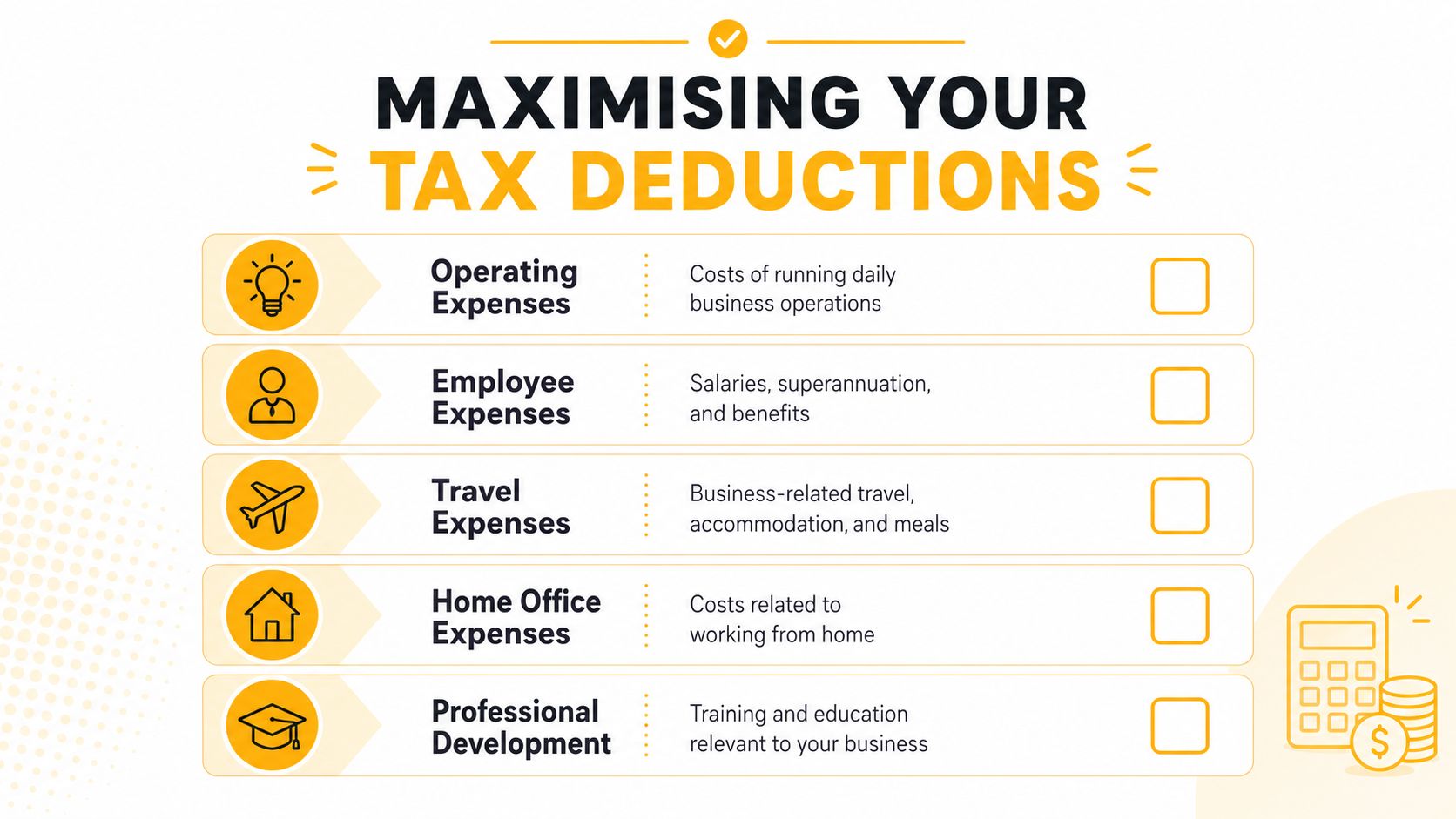
A lot of deductible spending is routine. It doesn’t look dramatic, but it adds up over the year if it’s captured properly.
- Operating costs include software subscriptions, office supplies, merchant fees, insurance, and professional services.
- Employee-related costs may include wages and other staff-related business outgoings where applicable.
- Travel costs can be claimable when they are directly connected to business activity and supported by proper records.
- Home office costs can arise if part of your work is run from home.
- Training and professional development may be relevant where the expense connects to your current business activity.
A consultant in Ashfield might miss recurring software costs because they’re paid by card and never coded correctly. A carpenter in Belrose might buy tools throughout the year but lose the tax benefit because receipts are sitting in the glovebox or mixed with private spending.
Asset purchases and the instant asset write-off
Timing matters. A small business in Australia can use the simplified depreciation rules, including the instant asset write-off, to deduct the full cost of eligible assets in the year of purchase. That accelerates deductions, lowers current-year taxable income, and can materially improve cash flow, especially for asset-heavy operators such as trades, according to this simplified depreciation summary.
That doesn’t mean every purchase is automatically smart. The deduction helps when the asset is needed, eligible, and bought at the right time for the business.
Buying equipment purely for a tax deduction rarely ends well. Buying needed equipment with the tax treatment in mind is smart planning.
Practical examples that owners understand
A tradie buying new tools or equipment may be able to bring the deduction forward instead of spreading it over future years, depending on eligibility and timing. That can help cash flow, especially in a strong profit year.
A consultant upgrading a laptop for client work may also benefit, but only if the purchase is legitimately connected to the business and supported by records.
For more examples of claim categories and common traps, this guide to small business tax deductions in Australia is useful.
What usually gets missed
These items are often underclaimed or mishandled:
| Area | Common mistake |
|---|---|
| Tools and equipment | No receipt or unclear business use |
| Vehicle costs | Claiming broadly without records |
| Phone and internet | Forgetting to apportion private use |
| Subscriptions and software | Leaving recurring costs uncoded |
| Professional fees | Not capturing bookkeeping or accounting costs properly |
Small business tax laws reward good evidence. They punish assumptions. If the expense is real, connected to the business, and documented, claim it properly.
Navigating Complex Tax Areas: CGT, Crypto, and Payroll Tax
Once a business is established, the tax issues often shift from routine compliance to occasional high-stakes decisions. These aren’t everyday matters, but when they come up, they matter enough to justify proper advice before you act.
Capital gains tax in a business setting
CGT becomes relevant when you dispose of a business asset or restructure ownership in a way that triggers a tax consequence. In simple terms, when a business sells something valuable, the tax implications often extend beyond ordinary income issues.
Machinery provides a straightforward example. When a business sells an asset it has held for several years, the tax treatment often becomes more complex than many owners expect, especially when depreciation, ownership history, or structural changes come into play. The same issue applies on a much larger scale when an owner plans to sell part of the business or move toward retirement.
One of the most common mistakes business owners make is finalising the commercial deal first and asking tax questions later. That approach can remove planning opportunities that would have been available with earlier tax advice.
Crypto in business
Crypto catches people out because it feels modern but still needs old-fashioned record discipline. If a business accepts crypto as payment, trades it, or holds it as part of its operations, the tax consequences need to be tracked carefully.
The practical problem isn’t just valuation. It’s evidence. You need clear records of when the transaction happened, what it related to, and how it was treated in the books. If crypto activity also touches exchanges, wallets, or cross-border transfers, compliance can become broader than tax alone. For businesses operating in that space, a practical explainer on how to navigate AML KYC compliance in crypto trading is worth reading alongside tax advice.
When crypto enters the business, casual record-keeping stops being an option.
Payroll tax
Payroll tax is different from PAYG withholding and super. It’s a state-based issue, and many owners don’t think about it until the wages bill starts growing. That’s risky because payroll tax can become relevant before the owner has built a process for monitoring it.
A business with a handful of staff across job sites in Sydney can drift into this area gradually. One apprentice becomes two. Then an office coordinator is added. Then, more subcontracting shifts to employment. The wage footprint changes, and so does the compliance picture.
The practical takeaway
These areas share one pattern. They usually arise around a decision:
- Selling an asset
- Changing structure
- Taking payment in crypto
- Hiring and expanding staff
If one of those is on the table, don’t rely on a quick search result. Tax outcomes often depend on facts that look minor at first but become decisive later.
Staying Compliant, Record-Keeping, Audits, and ASIC
Good record-keeping does more than satisfy administrative requirements. It turns tax compliance from a guessing exercise into a controlled process. Businesses that manage small business tax laws effectively usually do not rely on complicated systems or flashy tools. Instead, they stay organised and consistent.
Records shape the tax outcome
Records play a direct role in the tax outcome. If you cannot prove a purchase, explain the business purpose, or show how you calculated figures, defending the claim becomes much harder. That is why bookkeeping matters well beyond BAS lodgement day. Accurate records support deductions, payroll management, asset treatment, and year-end reporting.
Useful records often include invoices, receipts, bank statements, payroll reports, contractor agreements, and notes explaining mixed-use expenses. Digital storage systems work well when businesses use them consistently. The real issue is not whether records sit on paper or in the cloud. The issue is whether someone can quickly locate them when needed.
Audit readiness strengthens the business
Many business owners hear the phrase “ATO review” and immediately assume something has gone seriously wrong. In many cases, however, the ATO simply wants to verify figures or clarify inconsistencies. When businesses maintain clean and organised records, they handle the process far more effectively.
The ATO now uses extensive data-matching systems, so inconsistencies rarely stay hidden for long. That is why regular reconciliations matter. When wages, sales figures, GST records, and tax return information all align, businesses place themselves in a much stronger position.
Reality check: businesses do not prepare for audits after problems appear. They build audit readiness through the way they manage records and compliance every month.
Company obligations and ASIC responsibilities
If you operate through a company structure, tax compliance forms only part of your obligations. You also need to keep company details current and stay on top of ASIC requirements. Many directors focus heavily on ATO deadlines and only think about ASIC obligations after receiving a notice.
That situation often creates unnecessary stress. Businesses records, and report changes to officeholders, addresses, or company structures without delay. A registered ASIC agent can help business owners manage those obligations more effectively, especially when they need to focus on daily operations instead of corporate paperwork.
What disciplined businesses do differently
- They capture documents as transactions happen instead of chasing receipts later.
- They reconcile regularly, so surprises don’t build up for months.
- They separate business and private spending rather than trying to untangle it at year end.
- They review notices quickly instead of leaving ATO or ASIC correspondence unopened.
The peace of mind is real. Not because paperwork is exciting, but because organised records give you options when questions come up.
Your Action Plan and When to Call a Pro
The easiest way to stay on top of small business tax laws is to make tax part of the business rhythm, not a once-a-year panic. A simple review process goes a long way.
Your practical checklist
Use this at least once each year, and preferably revisit parts of it each quarter:
- Review your structure and ask whether it still suits the business as it exists today.
- Check your bookkeeping quality and fix coding issues before lodgements stack up.
- Confirm payroll and super processes if you have staff.
- Review major purchases before year-end so tax treatment isn’t an afterthought.
- Organise evidence for deductions, especially for mixed-use costs like vehicles, phones, and home office items.
- Check company records if you operate through a company.
When advice stops being optional
Call an accountant before you act if any of these apply:
- You’re hiring your first employee
- You’re changing from a sole trader to a company or trust
- You’re buying expensive equipment or vehicles
- You’re planning to sell assets or the business
- You’ve started dealing in crypto through the business
- You’ve fallen behind on BAS, payroll, or tax returns
- You aren’t sure whether your records would stand up to a review
Good advice is cheapest before the decision, not after it. That’s especially true when the business is growing fast or changing shape.
If you want practical help from a local accountant who understands Sydney small business, tradie tax issues, BAS, company compliance, and more complex advisory work, speak with EndureGo Tax. With offices in Ashfield and Belrose, they help business owners get compliant, stay organised, and make better tax decisions before problems become expensive.
