


If you’re sitting in Ashfield or up in Belrose with Xero open, BAS on your mind, and a rough idea of this year’s profit, you’ve probably asked the same question I hear all the time. What tax bracket is my small business in?
The short answer is that, in Australia, there usually isn’t one single small business tax bracket that applies across the board. That’s where a lot of the confusion starts. A sole trader, a partnership, a company, and a trust can all earn the same profit and still end up with very different tax outcomes.
That’s why smart tax planning starts with structure, not guesswork. If you understand how your business is taxed before year end, you can make better decisions about drawings, wages, dividends, deductions, cash flow, and growth.
The Myth of a Single Small Business Tax Bracket
Many business owners search for “small business tax brackets” as if there’s one chart for every café owner, electrician, consultant, or online seller in Australia. There isn’t. The tax result depends first on how the business is set up.
A sole trader doesn’t pay tax as a separate entity. The business profit lands in the owner’s personal tax return. A company is different. It’s a separate legal entity and pays company tax in its own right. Partnerships and trusts add another layer again because income usually flows through to the individuals behind them.
That’s why two businesses with the same turnover can have very different tax bills. One owner might be paying tax at personal marginal rates. Another might be paying company tax first and then dealing with dividends and franking credits later.
Practical rule: When someone asks, “What bracket is my business in?”, the better question is, “Which tax system applies to my structure?”
This has practical implications because the wrong assumption leads to poor decisions. I’ve seen owners hold off buying equipment, pull too much cash from the business, or incorporate too early because they were chasing a tax outcome they didn’t fully understand. Tax doesn’t work well when it’s treated like a shortcut.
A better approach is to strip the issue back to basics:
- Work out your structure first. Sole trader, partnership, company, or trust.
- Identify who pays the tax. You personally, the company, or the beneficiaries.
- Plan the cash flow. Tax rates matter, but timing matters too.
- Use concessions properly. They can help, but only when the structure and eligibility line up.
That’s the main starting point for understanding small business tax brackets in Australia.
How Your Business Structure Defines Your Tax Rate
Structure is the tax fork in the road. Once you choose the vehicle, the tax rules follow it.
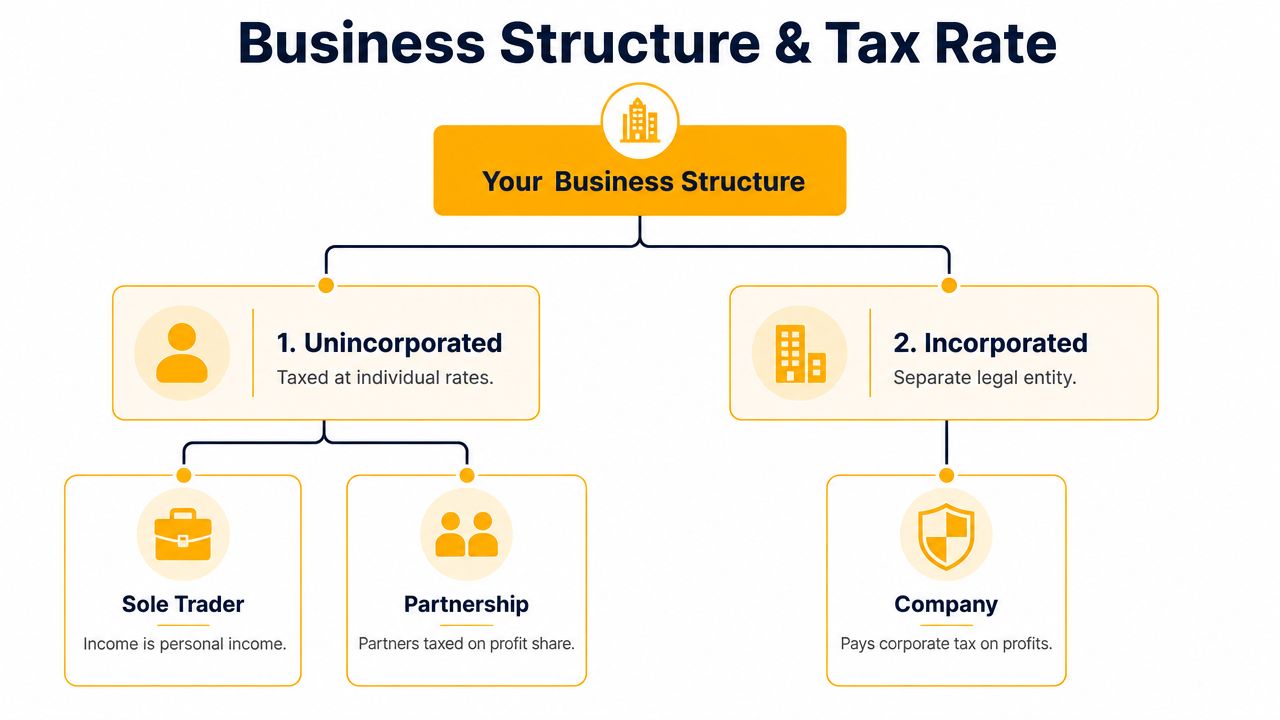
Unincorporated businesses
If you operate as a sole trader or through a partnership, the business generally isn’t taxed like a separate company. The profit flows through to the individual owner or partners. In plain English, the ATO looks through the business and taxes the people behind it.
For a sole trader, that means business profit is part of your own taxable income. For a partnership, the partnership itself usually allocates profit shares, and each partner deals with tax personally on their share.
This is why so many tradies and service businesses feel the tax jump as profit rises. They’re not moving into a “business bracket”. They’re moving into higher personal marginal tax rates.
Incorporated businesses
A company works differently. It’s a separate legal entity, which means the company pays tax on its own taxable profit. That’s one reason some owners like the company structure. It can create a clearer line between personal finances and business finances.
But don’t stop at that first layer. If the owners want to take profit out personally, that often happens through wages, director fees, or dividends. Each method has different tax consequences and compliance steps.
Here’s the simplest analogy I use over coffee with clients. Personal tax is like a train fare that changes by zone. The further the income goes, the rate on the next slice changes. Company tax is more like a flat ticket for the company itself. Then, when profit is paid out to owners, another set of rules kicks in.
Where trusts sit
Trusts are common in Australia, but they aren’t a magic tax button. They’re usually more about how income is distributed and who ends up assessed on that income. Used well, they can offer flexibility. Used badly, they create paperwork, cost, and risk without much benefit.
If you’re reviewing whether your current setup still fits your business, this guide to business structures in Australia is a useful starting point.
The tax rate doesn’t start with your industry. It starts with your structure.
A builder in the Northern Beaches, a consultant in Ashfield, and an online retailer in the Inner West can all earn similar profits and still land in different tax positions because their structures are different.
Tax for Sole Traders A Practical Breakdown
For sole traders, the key point is simple. There’s no separate company tax rate sitting off to the side. Your business profit becomes part of your individual taxable income.

How the tax actually works
For the 2024–25 income year, the resident tax scale starts at 0% up to $18,200, then 16% from $18,201 to $45,000, 30% from $45,001 to $135,000, 37% from $135,001 to $190,000, and 45% above $190,000, before the 2% Medicare levy is added in most cases, according to this summary of the 2024–25 resident tax scale.
A lot of sole traders get tripped up here because they think crossing into a higher bracket means all income is taxed at that higher rate. That’s not how marginal tax works. Only the part of income in the higher bracket gets taxed at the higher rate.
Here’s a quick reference table.
| Taxable income | Marginal rate |
|---|---|
| Up to $18,200 | 0% |
| $18,201 to $45,000 | 16% |
| $45,001 to $135,000 | 30% |
| $135,001 to $190,000 | 37% |
| Above $190,000 | 45% |
If you want a deeper look at record-keeping, deductions, and lodgement issues, this guide on sole trader tax is worth keeping handy.
A practical example for a Belrose plumber
Let’s say a plumber in Belrose finishes the year with $90,000 in net profit. That’s after business income and allowable business expenses.
The tax works in slices:
- First slice up to $18,200 is taxed at 0%
- Next slice from $18,201 to $45,000 is taxed at 16%
- Next slice from $45,001 to $90,000 is taxed at 30%
- Medicare levy may also apply at 2% in most cases, as noted in the tax scale summary above
The important takeaway isn’t just the arithmetic. It’s the planning opportunity. Because the business isn’t taxed separately, the main way to reduce a sole trader’s tax bill is to reduce taxable profit legitimately.
That means focusing on the basics that actually move the needle:
- Claiming valid deductions for tools, motor vehicle expenses, software, insurances, and subcontractor costs where the rules allow it
- Timing expenses properly so the deduction lands in the right income year
- Keeping clean records in Xero, MYOB, or similar software so nothing gets missed
- Thinking ahead about super contributions where appropriate as part of broader tax planning
If you’re a sole trader, your “business tax bracket” is really your personal tax position wearing a hi-vis vest.
What works and what doesn’t
What works is proactive bookkeeping and year-end planning before June. What doesn’t work is trying to backfill deductions from a shoebox of receipts after the year has closed.
Another mistake is treating drawings as deductions. They aren’t. Taking cash out of the business for yourself doesn’t reduce taxable profit. It’s just you taking your own money.
A sole trader structure can be efficient when profits are modest, the business is simple, and you want low compliance. It often becomes less attractive when profit grows, personal tax rates bite harder, or asset protection and succession planning start to matter more.
How Companies Are Taxed in Australia
A company changes the tax conversation because the company pays tax in its own name. That’s the headline difference. The more important part is what happens after that profit is paid out to the owners.
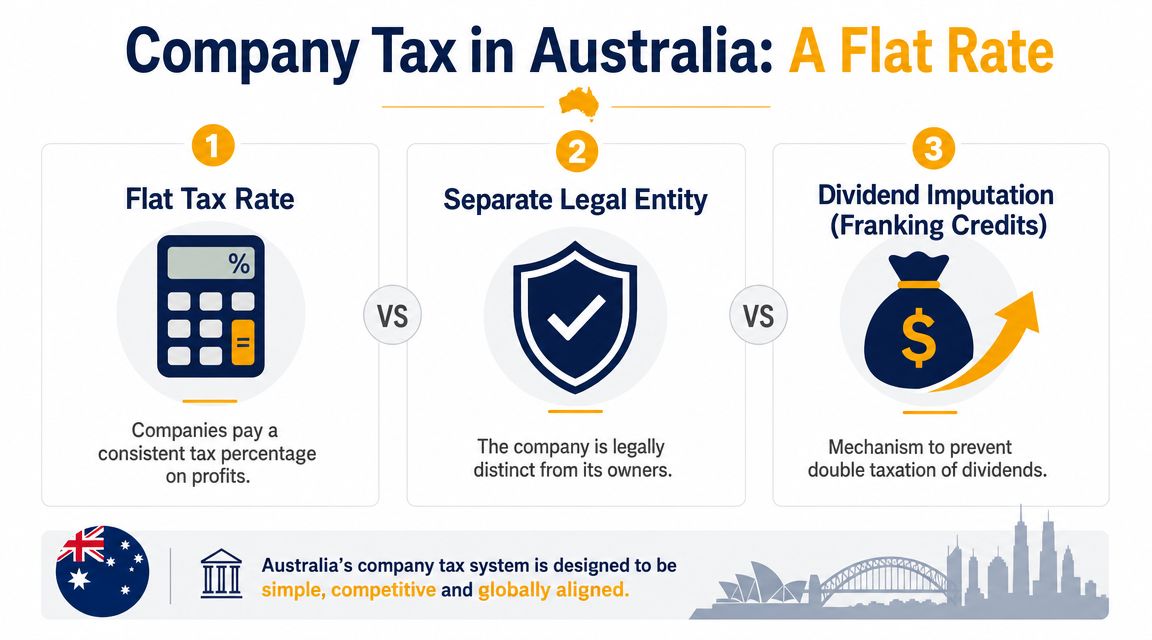
The company tax rate that small businesses actually watch
The small business company tax rate is 25% for base rate entities from the 2021–22 income year onward, and a business is an eligible base rate entity if it has aggregated turnover of less than $50 million and 80% or less of its assessable income is passive income, according to this overview of the base rate entity company tax rules.
That point matters because many owners assume all companies are taxed the same way. They aren’t. Whether a company qualifies as a base rate entity can change the company’s tax outcome.
This is one area where generic articles on small business tax brackets often fall short. They talk about “company tax” as if it’s one simple box. In practice, eligibility matters, passive income matters, and the facts behind the structure matter.
A simple company example
Say an Ashfield consulting company makes $90,000 taxable profit and qualifies as a base rate entity.
At the company level, the company pays tax at 25% if it meets the base rate entity rules noted above. That leaves after-tax profit sitting inside the company. At that stage, the owner hasn’t automatically received the cash personally just because the company earned it.
Then comes the second layer. If the company distributes profit as a dividend, the shareholder includes that dividend in their own tax position and may also use franking credits attached to the dividend. Franking credits are best thought of as a tax-paid receipt. They recognise tax the company has already paid.
A company can smooth tax inside the entity, but it doesn’t make personal tax disappear. It changes the timing and the pathway.
Where owners go wrong
Problems usually start when business owners focus only on the company rate and ignore the rest.
Common traps include:
- Using the company bank account like a personal wallet instead of documenting wages, dividends, or loans properly
- Assuming incorporation always saves tax when the owner still needs most of the cash personally
- Forgetting compliance costs such as ASIC obligations, company records, payroll, and minutes
- Missing the passive income issue when checking base rate entity status
If you’re comparing sole trader versus company, don’t just ask which rate looks lower on paper. Ask better questions.
| Question | Why it matters |
|---|---|
| Do you need most profits personally now? | Personal access to cash can change the result |
| Will profits stay in the business? | Retained earnings can support growth |
| Is asset protection a concern? | Structure affects legal risk separation |
| Can you manage compliance? | A company carries extra admin |
For many growing businesses, the company structure works well when profit is being reinvested, owners want a cleaner legal structure, and the business has moved beyond a very simple owner-operator model. It works poorly when it’s set up for tax alone without a plan for wages, dividends, and governance.
Key Small Business Tax Concessions to Reduce Your Bill
Tax rates matter, but concessions often shape cash flow outcomes. Used properly, they can reduce taxable income, simplify admin, or bring deductions forward. Used carelessly, they can create cleanup work later.
Concessions are useful, but they aren’t automatic
A lot of owners hear a phrase like “instant asset write-off” and assume it applies automatically to whatever they buy. It doesn’t work that way. Eligibility, timing, business use, record-keeping, and the rules for the relevant year all matter.
The same goes for simplified depreciation and trading stock concessions. These can be valuable tools, especially for tradies, retailers, and service businesses investing in equipment, vehicles, fit-out, or tools. But the concession only helps if the purchase itself makes commercial sense.
A bad purchase doesn’t become a good purchase because there’s a deduction attached to it.
What tends to work well
The best use of small business concessions usually sits inside a broader plan:
- Buying needed assets at the right time rather than panic spending in June
- Matching purchases to cash flow so the tax deduction doesn’t create a funding problem
- Checking entity eligibility early instead of assuming the business qualifies
- Keeping source documents organised so the claim is easy to support if queried
Buy the asset because the business needs it. Claim the concession because the rules allow it.
Many local businesses often get caught because the owner knows there may be a concession available, but they haven’t checked whether the structure, turnover, business use, or timing lines up. That’s how tax planning turns into tax repair.
A practical filter before claiming anything
Run each decision through three questions:
- Would I still buy this if there were no deduction?
If the answer is no, pause. - Does this fit the way my business is taxed?
A sole trader, company, or trust can land in different places even when the purchase is the same. - Can I support the claim cleanly?
Invoice, payment trail, business purpose, and accounting treatment all need to match.
For a more detailed overview of what may be available and how the rules can apply, this guide to small business tax concessions is a practical next read.
Your Next Steps for Smart Tax Planning
The best takeaway from all of this is simple. Small business tax brackets in Australia aren’t really a single chart to memorise. The primary driver is your business structure, followed by how profit moves from the business to you.
If you want fewer surprises at tax time, review the business the same way you’d review a quote before signing it. Look at the full job, not just one line item.
A short checklist that helps
- Review your current setup. Is the business still operating as a sole trader, partnership, company, or trust, and does that still suit the way you earn income?
- Project the next year or two. If profit is likely to rise, your current structure may stop being the most efficient fit.
- Work out your personal cash needs. Needing regular money for the mortgage and family spending is very different from leaving profit in the business.
- Check concessions early. Don’t wait until year end to ask whether a deduction or concession may apply.
- Keep budgeting tied to tax planning. Good decisions usually start with clean forecasting, and this guide to financial planning for small businesses is a useful companion if you’re tightening cash flow and planning ahead.
Where to focus first
If you’re a sole trader with rising profit, review whether the structure still makes sense. If you’re in a company, check whether the way you take money out is documented and tax-effective. If you’re using a trust, make sure the distribution strategy and records are consistent with the actual purpose of the structure.
The ATO’s own guidance on business structures and tax obligations is also worth reviewing when you want the legislation and administrative position in front of you.
Good tax planning isn’t about chasing gimmicks. It’s about choosing the right structure, using the rules properly, and making decisions early enough to matter.
If you want specific advice on small business tax brackets, company tax, sole trader tax, BAS, trust compliance, ASIC obligations, or broader tax planning, speak with EndureGo Tax. As a trusted local accountant for Ashfield, the Inner West, and Belrose in the Northern Beaches, EndureGo Tax helps business owners make clear, practical decisions with confidence. Book a consultation to get advice that fits your structure, your cash flow, and your goals.
