


Owning an investment property is a significant financial achievement, but mastering its tax implications is what truly unlocks its potential. The good news is that almost every cost you incur while managing your rental can be used to lower your tax bill. These rental property tax deductions are your most powerful tool for reducing your total taxable income, which ultimately means more money in your pocket.
As an expert in property accounting, I can tell you it all comes down to knowing what you can claim and, just as importantly, how to claim it correctly to maintain full compliance with the Australian Taxation Office (ATO).
Understanding Your Core Tax Obligations
Before we dive into the deductions, we must establish the foundation. It's critical to understand that your rental income is not treated separately by the ATO; it's added directly to your other income, such as your salary.
In Australia, every dollar of rental income is taxable and must be declared in your annual tax return. This income is taxed at your marginal tax rate, which for high-income earners can reach 45% (plus the Medicare levy).
Practical Example: If your job pays you $90,000 and your property brings in $25,000 in gross rent, your assessable income for the year becomes $115,000 before you claim a single expense.
This is precisely why rental property tax deductions are so essential. They aren’t just a compliance task; they're a core part of a savvy investment strategy. Every dollar you legitimately claim—from the interest on your loan to the fees you pay your property manager—is subtracted from that $25,000 rental income figure, directly reducing the tax you have to pay.
The Three Pillars of Rental Deductions
To make these concepts easier to manage, we can group rental deductions into three main categories. This diagram provides a clear visual breakdown of the main types of expenses you'll encounter.
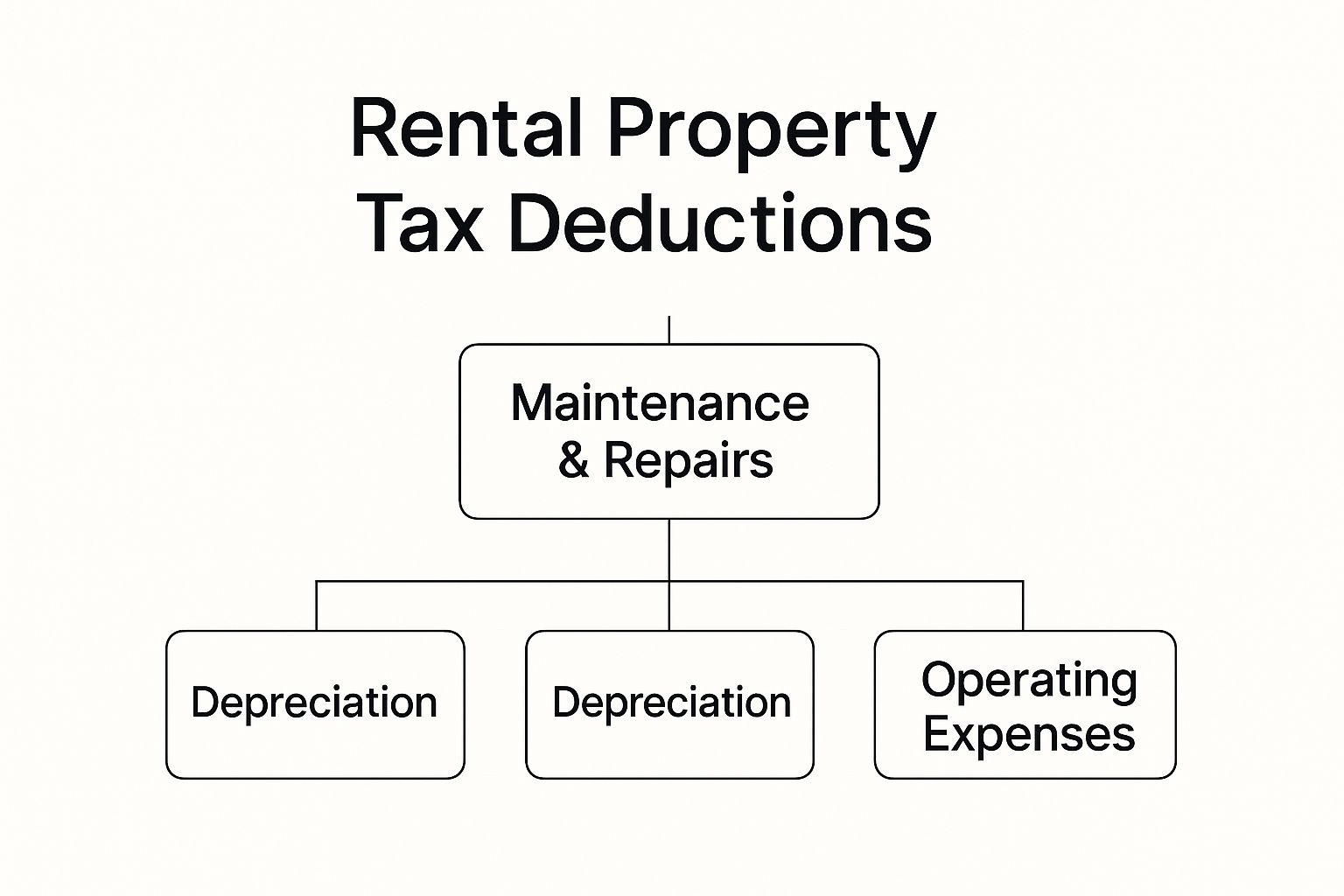
As you can see, your claimable costs fall into Maintenance & Repairs, general Operating Expenses, and Depreciation. Each category has different rules but they all contribute to your bottom line.
To get a clearer picture of what falls where, here's a quick cheat sheet.
Quick Guide to Claimable vs. Non-Claimable Expenses
This table summarises some of the most common expenses you'll encounter as a landlord, showing you how and when you can claim them.
| Expense Category | Claim Type | Example |
|---|---|---|
| Loan Interest | Immediately claimable | Interest portion of your mortgage repayments. |
| Council & Water Rates | Immediately claimable | Quarterly council and water service fees. |
| Repairs & Maintenance | Immediately claimable | Fixing a broken hot water system or leaky tap. |
| Property Management | Immediately claimable | Fees paid to a real estate agent to manage the property. |
| Insurance | Immediately claimable | Landlord insurance premiums. |
| Capital Works | Claimable over time (depreciation) | Renovating a kitchen or adding a carport (claimed over 25-40 years). |
| Depreciating Assets | Claimable over time (depreciation) | A new dishwasher or air conditioner (claimed over its effective life). |
| Initial Repairs | Not claimable (part of cost base) | Fixing issues that existed when you bought the property. |
| Private Use Portion | Not claimable | The portion of any expense related to your personal use of the property. |
| Loan Principal | Not claimable | The principal portion of your mortgage repayments. |
Remember, this is just a starting point. The key is to view every dollar you spend on your investment property through a tax lens. When you develop the habit of tracking everything, you actively lower your tax bill and boost your investment's cash flow.
If you're looking for a deep dive into this topic, this is an excellent resource: Your Guide To Rental Property Tax Deductions.
Start Your Tax Strategy Now
The costliest mistake investors make is waiting until tax time to think about deductions. To truly optimize your return, you need a system in place from day one of the financial year. This means keeping meticulous records and understanding the rules before you even spend the money.
A proactive approach is the only way to ensure you capture every last deduction you're entitled to. It's how you turn a tax headache into a tangible financial advantage. In the sections that follow, we'll break down exactly what you can claim.
The Most Common Rental Property Tax Deductions

Now that we’ve covered the basics, let’s get into the specifics—the day-to-day costs of owning a rental that you can claim right away. These are your most frequent and powerful tools for lowering your taxable income.
Think of these common rental property tax deductions as your core toolkit for smart investing. If you don't track and claim every last one, you're essentially leaving money on the table and making your investment less efficient than it could be.
Loan Interest: The Powerhouse Deduction
For the vast majority of investors, the interest paid on their investment loan is the single biggest deduction they can claim. It’s a game-changer. But you must get it right: you can only claim the interest portion of your repayments, not the principal component that actually pays down your loan.
Many investors find that a solid grip on their loan interest can dramatically change their tax outcome. If you want to dig deeper, resources on understanding investor loan interest rates can offer valuable clarity.
The ATO is incredibly strict on this point. They need to see that the loan was used purely to purchase the income-producing asset. If you’ve used that loan for anything else—like buying a car or funding a holiday—you must correctly apportion the interest. Only the percentage tied directly to the rental property is deductible.
Expert Example:
Let's say you have a $500,000 loan for your rental property. You redraw $50,000 to put in a new kitchen at your own home. Now, only 90% ($450,000 / $500,000) of that loan is generating rental income. That means you can only claim 90% of the total interest charged on that loan for the financial year.
Ongoing Property Expenses
Beyond the loan, a whole host of regular running costs are immediately deductible. This is where meticulous record-keeping truly pays off.
Council and Water Rates: You can claim council rates and the water supply service charges in full. You cannot claim the tenant’s water usage if they are billed for it.
Land Tax: If your property’s land value is high enough to attract state land tax, that bill is fully deductible in the year you pay it.
Strata and Body Corporate Fees: For anyone owning an apartment, townhouse, or unit, these fees are a gift at tax time. They cover the admin and upkeep of common areas and are completely deductible.
Insurance Premiums: Your landlord insurance, building insurance, and even contents insurance for any items you own inside the rental (like carpets or blinds) are all claimable.
Finding and Managing Tenants
The money you spend to get and keep great tenants is a direct cost of earning rental income, and the ATO recognizes it as such.
Advertising for Tenants
Any cost to market your vacant property is 100% deductible. This includes online listings, newspaper ads, or even a simple "For Rent" sign.
Property Management Fees
Hiring a real estate agent to manage the property? Their fees are a major deduction. This covers:
- Their management fee, usually a percentage of the rent collected.
- Any one-off leasing or letting fees for finding you a new tenant.
- Charges for preparing lease documents or carrying out property inspections.
Other Essential Deductions
Finally, don't ignore the small stuff. Those little miscellaneous expenses add up over a year and are just as legitimate as the big-ticket items.
A few common ones people forget include:
- Stationery and Postage: The cost of printing a lease or mailing documents.
- Bank Fees: Any account-keeping fees for a bank account used only for your rental.
- Gardening and Pest Control: Paying for lawn mowing, garden tidy-ups, or pest sprays at the property.
By understanding this full spectrum of common rental property tax deductions, you start to see the complete financial picture of your investment. To learn how to pull this all together correctly, check out our detailed guide on the investment property tax return process.
Actionable Takeaway: Open a separate bank account exclusively for your investment property. Have the rent paid into it and pay all property expenses from it. This creates a clean, ATO-friendly paper trail that will make your life infinitely easier at tax time and is a best practice for all serious investors.
Distinguishing Repairs from Capital Improvements
When it comes to your rental property’s tax deductions, getting the timing right is everything. And nowhere is this more critical than understanding the difference between a simple repair and a capital improvement.
Honestly, this is one of the most common and costly mistakes investors make. Getting it wrong can lead to incorrect claims, unwanted attention from the ATO, and leaving serious money on the table.
Think of it this way: a repair gets something back to its original working state, while an improvement makes it better than it was before. One is about restoring; the other is about upgrading. This single distinction dictates whether you can claim the full cost this financial year or have to spread it out over many years.
What Is a Repair?
A repair is simply work you do to fix damage or deterioration that happened while your property was rented out. These are the running costs you incur just to keep the place safe and liveable for your tenants.
Because you’re just putting something back the way it was, the ATO lets you claim the entire cost as a deduction in the same financial year you paid the bill.
Practical Examples of Repairs:
- Getting a plumber to fix a dripping kitchen tap.
- Replacing a single cracked windowpane that was broken during the tenancy.
- Calling someone out to clear a blocked drain.
- Fixing a broken hinge on a cupboard door.
- Patching a small hole in the plaster and touching up the paint on that one wall.
See the pattern? Each job tackles a specific problem to bring an item back to its former condition. That’s the heart of a repair.
What Is a Capital Improvement?
A capital improvement, which the ATO calls 'capital works', is a whole different beast. This isn't just a quick fix; it’s an expense that genuinely enhances the property's value, changes its character, or extends its life.
Instead of claiming these costs straight away, you depreciate them over their effective life, which can be up to 40 years.
The real test is the outcome. If the work gives you something new, different, or substantially better than what was there before, it’s almost certainly a capital improvement. For any serious property investor, knowing where to draw this line is non-negotiable.
Practical Examples of Capital Improvements:
- Gutting and renovating an entire bathroom with new tiles, vanity, and shower.
- Tearing out old kitchen cabinets and installing a brand-new, modern kitchen.
- Building a new structure, like a carport or a timber deck out the back.
- Replacing a huge section of the roof, rather than just a few broken tiles.
- Swapping out a tired old fence for a completely new one made of better materials.
The Critical Case of Initial Repairs
Now, here’s a classic trap for new investors. Any work you do to fix problems that were already there when you bought the property is called an initial repair.
Even if it feels like a normal repair—like fixing a leaky shower you knew about at purchase—the ATO sees it differently. They consider these costs part of buying the property.
These expenses are capital in nature. They get added to your property's cost base (which helps reduce Capital Gains Tax when you sell) and may be claimable as capital works deductions over the long haul. You cannot claim them as an immediate 100% deduction.
Actionable Takeaway: Before lodging your next tax return, audit your invoices from the past year. Create two columns: "Repairs (Immediate Claim)" and "Improvements (Capital Works)." Sort every expense. If you hesitate on any item, especially work done soon after settlement, that’s your signal to seek professional advice. A quick consultation with an expert at EndureGo can solidify your claims and save you the stress of an ATO audit.
Unlocking Value with Depreciation and Capital Works
While claiming immediate expenses like council rates and repairs is a great start, the biggest rental property tax deductions are often the ones you don’t actually pay for year after year. These are what we call "non-cash" deductions, and they are easily the most powerful, yet most overlooked, tools in an investor's kit.
We’re talking about depreciation. Think of it as a way to claim the wear and tear on your property and its fittings over time. The ATO recognises that your building and the assets inside it lose value as they age, so they allow you to claim this decline as a deduction, even though no money physically leaves your bank account. Getting this right can significantly boost your property's cash flow.
Division 40 Depreciation: Plant and Equipment
First up is Division 40, which covers the depreciation of "plant and equipment" in your rental. In simple terms, these are the removable items that don't last forever. Every year, the tax office lets you claim a deduction for the decline in value of these assets, from big-ticket items down to the smaller fixtures.
The core idea is that these assets have a limited lifespan, and you get to reflect that loss of value as a legitimate tax deduction.
Common Examples of Depreciable Plant and Equipment:
- Carpets and vinyl flooring
- Ovens, cooktops, and rangehoods
- Dishwashers
- Air conditioning units
- Blinds and curtains
- Hot water systems
- Smoke alarms
It's crucial to know the rules here. A few years back, the legislation changed, which means you generally can't claim depreciation on second-hand assets in residential properties you bought after 9 May 2017. We've got a detailed breakdown of these rules in our guide on the changes in second-hand asset depreciation. The good news? Any new assets you buy for the property are fully depreciable.
Division 43: Capital Works
The other side of the depreciation coin is capital works, also known as Division 43 deductions. This relates to the building's actual structure—the bricks and mortar. It allows you to claim a portion of the original construction costs, typically at a rate of 2.5% per year for 40 years.
This isn't just for the initial build. It also applies to any major structural improvements you make, like adding a deck, putting in a new kitchen, or renovating a bathroom. It’s a slow-burn deduction, but it delivers consistent tax relief for decades.
One of the biggest myths I hear is that you can only claim capital works if you were the one who built the property. That’s simply not true. As long as the property was constructed after 15 September 1987, you can claim these deductions, even if you're the third or fourth owner.
The impact of these deductions is massive. According to ATO statistics, over two million Aussie investors claimed an average of $1,363 for plant and equipment depreciation. For capital works, that number jumped to an average of $2,385. These figures prove just how essential depreciation is to a smart investment strategy.
The Key to Unlocking Depreciation: A Quantity Surveyor
So, how do you work all this out accurately? The ATO's gold standard is a tax depreciation schedule prepared by a qualified quantity surveyor.
A quantity surveyor is an expert in construction costs. They will inspect your property, identify every single depreciable asset, and calculate its value and effective life. They also research the original construction costs to ensure you're maximising your capital works claim. This information is then compiled into a comprehensive report that your accountant can use for the next 40 years.
The fee for this report is a one-off cost, and the best part is it's 100% tax-deductible. The value it creates usually pays for the report in the first year alone. For most investors, hiring a quantity surveyor is the single best financial decision they make after buying their property, unlocking thousands in legitimate rental property tax deductions every single year.
Actionable Takeaway: If you own an investment property and don't have a depreciation schedule, you are almost certainly paying more tax than you need to. Your next step should be to engage a reputable quantity surveyor to inspect your property and get that schedule sorted before your next tax return. It's the most effective way to turn a hidden asset into a real financial gain.
Mastering ATO Compliance and Record Keeping
Claiming every dollar you're entitled to in rental property tax deductions is only half the job. The other, arguably more critical half, is proving those claims are legitimate. That’s where flawless record-keeping comes in—it’s not just good practice, it’s the absolute bedrock of an audit-proof tax strategy.
Without solid proof, even the most valid expense claim can be wiped out by the Australian Taxation Office (ATO).
The ATO essentially has three golden rules for every deduction you want to claim. Think of them as non-negotiable checkpoints that every single expense must clear:
- You must have spent the money yourself, and you weren't paid back for it.
- The expense must be directly tied to earning your rental income.
- You must have a clear record to prove it.
Fall short on any one of these, and the deduction is off the table. And with the ATO's modern data analysis, their ability to spot flimsy claims has never been sharper.
Your Essential Record-Keeping Checklist
A shoebox stuffed with crumpled receipts just won't cut it anymore. What you really need is a simple, organised system—it’s your best line of defence. To get this right, it helps to implement top document management best practices.
So, what exactly do you need to hang onto? Generally, you’ll need to keep these records for five years from the date you lodge your tax return:
- Proof of Income: This includes bank statements showing rent deposits and, crucially, the end-of-year summary from your property manager.
- Proof of Expenses: Hold onto every dated receipt, invoice, and credit card statement—from a major roof repair down to a tiny tube of sealant.
- Bank Statements: You'll need statements for the loan account you used to buy the property, clearly showing the interest you've paid.
- Legal Documents: Keep the original contract of purchase, sale documents, conveyancing paperwork, and all loan agreements.
- Tenant Records: A copy of every lease agreement is essential.
- Depreciation: Make sure you have a comprehensive tax depreciation schedule prepared by a qualified quantity surveyor.
Expert Insight: Go digital, and do it immediately. Scan or photograph every receipt the moment it lands in your hand. Save it to a dedicated cloud folder (like Google Drive or Dropbox) and label it by the financial year. This simple act saves you from the headache of faded ink and lost paper, creating a searchable, audit-ready archive.
Navigating the ATO’s Data-Matching Focus
The days when the ATO relied solely on what you declared on your tax return are long gone. The tax office now runs sophisticated data-matching programs, cross-referencing information from real estate agents, rental bond authorities, and banks to get the full picture.
What does this mean for you? It means the income you report had better line up with what your property manager has on record. It means sloppy bookkeeping is a massive risk. A robust system isn't just about being tidy; it's about protecting your investment from costly penalties and reassessments.
A Practical System for Success
Don't worry, setting up an audit-proof system doesn't need to be a complex nightmare. It can be surprisingly straightforward.
Actionable Example:
- Open a Dedicated Bank Account: This is a game-changer. Have all your rent paid into this one account, and pay for every single property expense from it. This creates a clean, isolated financial trail for your property.
- Use a Simple Spreadsheet: Fire up Excel or Google Sheets. Create a basic tracker with columns for Date, Item/Supplier, Cost, and Category (e.g., Repair, Strata, Insurance). A quick update once a month is all it takes.
- Go Digital Instantly: Use a free mobile app like Adobe Scan or just your phone’s camera to digitise every receipt on the spot. File it away in your cloud folder then and there.
This simple three-step process builds a rock-solid, compliant foundation for your investment. It gives you the confidence that every claim is backed by proof. Understanding your obligations is key, and you can learn more by exploring how to stay on top of your rental property tax return obligation.
If the thought of organising all this feels overwhelming, please don't let it slide. Book a consultation with our expert team at EndureGo. We can help you set up a streamlined, stress-free system to ensure you're maximising your rental property tax deductions and staying 100% compliant.
Your Tax Time Action Plan

Knowing the theory behind rental property tax deductions is one thing, but putting that knowledge into practice is what actually makes a difference to your bottom line. This is where the rubber meets the road. Think of this as your practical checklist for the financial year—a way to make sure you arrive at tax time organised, confident, and ready to claim every dollar you're entitled to.
The aim is to move from simply reading about tax strategy to actively doing it. A few straightforward habits, set up now, can build a system that makes maximising your deductions an easy, year-round process instead of a chaotic, last-minute scramble.
Your Step-by-Step Implementation Guide
Let's get practical. Here are the immediate steps you can take to get your investment property's finances in order. This isn't about complicated spreadsheets; it's about creating simple, clear systems that just work.
Open a Dedicated Bank Account: This is the most effective first step you can take. Seriously, do this today. Funnel all rental income into this account and pay for every single property-related expense from it. This simple act creates a clean, easy-to-follow paper trail for you, your accountant, and the ATO.
Create a Digital Receipt System: Don't let valuable deductions vanish with a faded, lost receipt. Get into the habit of using your phone to snap a photo of every receipt the moment you get it. Save these images to a dedicated folder in a cloud service like Google Drive or Dropbox and name it by financial year (e.g., "Property Receipts 2024-25").
Engage a Quantity Surveyor Early: If your property was built after 1987 or you've done significant renovations, don't put this off. A quantity surveyor will prepare a tax depreciation schedule that can unlock thousands of dollars in non-cash deductions. The best part? The fee is 100% tax-deductible, and the report often lasts for the entire life of the property.
Remember, successful property investing isn't just about collecting rent; it's about maximising your net return. An organised system for tracking expenses is just as crucial as finding the right tenant.
Your Final and Most Important Action
While these steps will put you miles ahead of the pack, the single most important part of your action plan is teaming up with a professional who lives and breathes this stuff. You’re an expert in your field; a specialist property accountant is an expert in theirs. They are the final piece of the puzzle, making sure every claim is compliant, optimised, and strategically sound.
Don't leave your hard-earned money on the table. Take control of your investment's financial future today. Book a consultation with the EndureGo team to ensure your property is working as hard for you as it possibly can. We’ll help you implement these strategies and build a plan to achieve your long-term financial goals.
Frequently Asked Questions
When you're managing a rental property, it's natural for specific questions to pop up, especially around tax time. Getting these wrong can be costly. We've put together some of the most common queries we get from property investors to give you clear, straightforward answers.
Can I Claim Travel Expenses to Inspect My Property?
This is a big one, and the rules changed a few years back. For most individual investors, the answer is no. As of 1 July 2017, you can no longer claim deductions for travel expenses related to inspecting, maintaining, or collecting rent for a residential rental property.
This means things like your car expenses, flights, or accommodation for a trip to check on your investment are off the table. While there are some very narrow exceptions for those running a full-scale property business, for the vast majority of landlords, these travel costs are simply not deductible.
What Can I Claim If My Property Is Vacant?
You can absolutely claim expenses while your property is empty, but there’s a crucial condition: it must be genuinely available for rent. This is a non-negotiable point with the ATO.
To meet this test, you need to show the property is being actively advertised, is in a good, liveable state, and is listed at a fair market rent. If you tick all those boxes, you can continue to claim ongoing costs like:
- Interest on your loan
- Council and water rates
- Land tax
- Property insurance
But remember, if you take the property off the market for personal use—even for a short period—you can't claim any deductions for that time.
Are Repairs Made Right After I Buy a Property Deductible?
This is a classic trap for new investors. Any repairs you do for damage or defects that were already there when you bought the property are called ‘initial repairs’. These are not treated like standard, immediately deductible repairs.
Expert Example: Let's say you purchase an investment unit knowing the old hot water system is on its last legs. If you replace it a month after settlement, that's considered an initial repair. You can't claim the full cost in this year's tax return.
Instead, the cost of that new hot water system is a capital expense. It gets added to the property's cost base, which is good news down the track as it will reduce your Capital Gains Tax when you sell. You might also be able to claim a portion of it each year as a capital works deduction.
How Do I Claim Expenses for a Part-Time Rental?
If your property isn't rented out all year round—a common scenario with holiday homes—you need to apportion your expenses. You can only claim deductions for the period your property was genuinely available for rent.
Practical Example: Imagine you have a holiday house. You use it for personal trips for 4 weeks (8% of the year) and have it listed for rent for the other 48 weeks (92%). In this case, you can only claim 92% of your total eligible expenses for that financial year. Keeping meticulous records of usage is the only way to prove this apportionment if the ATO asks.
Working through these situations shows just how nuanced property tax can be. At EndureGo, our expertise is in helping property investors get the most out of their returns while staying firmly on the right side of the ATO. Don't leave your hard-earned deductions to guesswork. Book a consultation today by visiting https://www.endurego.com.au.
