


As a property investor in Australia, understanding your tax obligations is paramount. Central to maximising your return is a firm grasp of rental property deductions – the legitimate expenses you can claim against your rental income to reduce your taxable income. This isn't just about saving a few dollars; it's a critical financial strategy.
These deductions encompass a wide range of costs, from loan interest and council rates to property management fees and maintenance. Mastering these claims turns necessary expenditure into significant tax savings, forming the bedrock of a profitable property portfolio. As an expert in Australian taxation, this guide will provide actionable, expert advice to help you navigate the system with confidence.
The Foundations of Rental Property Deductions
This guide serves as your strategic playbook for navigating rental property deductions in Australia. We will dissect complex tax legislation, translating it into practical strategies that empower you to maximise claims and enhance your investment's cash flow.
We'll build your expertise from the ground up, starting with the fundamental question: what can you legally claim? We will cover everything from immediate, day-to-day expenses to long-term capital allowances and depreciation. By the end, you will not only know what to claim but also how and when, ensuring full compliance with the Australian Taxation Office (ATO).

Why Deductions Matter for Australian Landlords
Claiming every legitimate expense is non-negotiable for achieving an optimal tax outcome. For a deeper dive into optimising your claims, this a comprehensive guide to tax deductions for landlords is a fantastic resource. Mastering these rules isn't just about saving money; it's about maintaining compliance with the ATO while making your property work harder for you.
The scale of these deductions is significant. For the 2024-25 financial year, the government reported that the revenue forgone from these claims was around AUD 26.5 billion. This figure underscores the support available for investors, but it also signals why the ATO maintains strict oversight of such claims.
The core principle is straightforward: an expense is generally deductible if you incurred it in the course of earning your rental income. The ATO is unequivocal on this—you must possess the records to substantiate it. These rules are legislated in the Income Tax Assessment Act 1997.
What This Guide Will Cover
Our objective is to equip you with the confidence to manage your investment property's finances like a seasoned professional. Here’s a brief overview of what we’ll cover:
- Immediate Expenses: A detailed breakdown of the day-to-day costs you can claim in the same financial year they are paid.
- Depreciation: How to unlock the long-term value from your building's structure (capital works) and the assets within it (plant and equipment).
- Record-Keeping: Learn to build an audit-proof system to substantiate every single claim you make.
Ready to take professional control of your investment's financial health? Let's begin.
Claiming Your Immediate Day-to-Day Expenses
This is where the tactical execution of your tax strategy begins. Immediate, or day-to-day, expenses are the ongoing operational costs of maintaining your investment property. These are the fuel for your investment engine.
The significant advantage here is that these are the rental property deductions you can claim in the same financial year you incur them, providing immediate relief on your taxable income. The ATO's primary rule is clear: you can claim these costs provided the property was either tenanted or genuinely available for rent when the expense was paid.
Common Immediately Deductible Expenses
Let's delve into the most common operational costs you can claim immediately. Meticulous tracking of these expenses is the first step to maximising your tax return.
- Advertising for Tenants: Every dollar spent sourcing new tenants is 100% deductible. This includes online listings on platforms like realestate.com.au or Domain, newspaper advertisements, and even the cost of a "For Lease" sign. For instance, if you spend $450 on a premium online listing, that entire amount is an immediate deduction.
- Body Corporate Fees: For strata-titled properties such as units or townhouses, these regular administrative and sinking fund levies are immediately deductible. They cover the maintenance of common areas, which is a direct cost of owning the property. A quarterly levy of $1,200 means an annual deduction of $4,800.
- Council Rates and Land Tax: Your quarterly council rates and any applicable state land tax are fully deductible in the year they are paid.
- Insurance Premiums: Landlord insurance is an essential risk management tool. The premiums for building, contents, and public liability insurance policies are all fully deductible.
- Property Management Fees: Fees paid to a real estate agent for managing the property, sourcing tenants, and conducting inspections are a direct cost of earning rental income and are therefore fully claimable. If your agent charges 8% of the weekly rent of $600, you can claim the full $48 per week.
Here's a handy summary straight from the ATO's website showing some of the main expenses you can claim right now.
This visual guide from the ATO reinforces just how many day-to-day costs qualify as immediate rental property deductions, from your agent's fees right down to pest control.
The Critical Difference: Repairs vs. Improvements
Misclassifying a repair as an improvement is one of the most common and costly errors landlords make. This mistake is a significant red flag for the ATO and fundamentally changes how you claim the expense.
A repair is work undertaken to fix deterioration or damage to a property or asset, restoring it to its former condition. Repairs are immediately deductible.
An improvement, conversely, enhances an asset beyond its original state, increasing its value or changing its essential character. These are classified as capital works and must be depreciated over several years.
The ATO's definitive ruling on this matter, Taxation Ruling TR 97/23, clarifies the distinction: does the work restore the "efficiency of function" of the asset without changing its character? If so, it is likely a repair.
Let’s clarify this with practical examples:
| Scenario | Repair (Immediately Deductible) | Improvement (Claimed Over Time) |
|---|---|---|
| Painting | Repainting a single water-damaged wall after fixing a leaking pipe. | Repainting the entire interior from a dated colour to modernise the property's appeal. |
| Flooring | Replacing a few cracked kitchen tiles that had become a safety hazard. | Replacing old, worn carpet with polished timber floorboards throughout the property. |
| Windows | Replacing a single pane of glass broken during a storm. | Upgrading all old single-glazed windows to new, energy-efficient double-glazed units. |
The bottom line: if you are remedying a defect, it’s likely a repair. If you are upgrading or enhancing the property to add value, it’s an improvement.
Other Essential Day-to-Day Deductions
Beyond the major expenses, numerous smaller costs accumulate over a financial year. Utilising a comprehensive rental property maintenance checklist can help track every dollar spent.
Do not overlook these common rental property deductions:
- Cleaning Costs: Expenses for a professional clean at the end of a tenancy.
- Gardening and Lawn Mowing: Costs to maintain gardens and lawns if this is your responsibility under the lease agreement.
- Pest Control: Fees for annual termite inspections or specific pest treatments.
- Stationery and Postage: Legitimate costs for printing tenancy agreements or mailing documents.
- Bank Fees: Monthly account-keeping fees for a bank account used exclusively for rental income and expenses.
Mastering these immediate expense claims is your first major victory in optimising your tax position. While the distinction between repairs and improvements requires careful judgement, the principle is clear: if an expense was incurred to generate rental income, it is likely deductible.
Are you confident you're claiming every possible day-to-day deduction? Many investors leave money on the table by overlooking small but legitimate expenses. Contact EndureGo Tax today for a professional review of your rental property deductions to ensure you're maximising your return and staying compliant.
Unlocking Long-Term Value with Depreciation
While immediate deductions provide instant tax relief, the most substantial long-term tax benefits come from depreciation. It is staggering how many investors fail to claim these, effectively forfeiting thousands of dollars to the ATO.
Consider your property's structure and its internal assets like any other business asset; they experience wear and tear and lose value over time. The Australian Taxation Office (ATO) allows you to claim this decline in value as a depreciation deduction.
Crucially, this is a "non-cash" deduction. You do not spend any additional money to claim it. It is an on-paper expense that reduces your taxable income, potentially lowering your marginal tax rate and significantly improving your investment's cash flow. For any serious property investor, understanding depreciation is non-negotiable.
There are two primary categories of depreciation.
Capital Works Deductions Under Division 43
Capital Works deductions, governed by Division 43 of the Income Tax Assessment Act 1997, relate to the building's structure and items permanently fixed to it. This includes the original construction costs of elements like foundations, walls, roofing, doors, and windows. It also covers major renovations or additions, such as a new deck or an extension.
For most residential properties constructed after 15 September 1987, you can claim these costs at a rate of 2.5% per year over 40 years.
Here's a practical example: assume you purchased a new investment property where the eligible construction cost (excluding land) was $400,000. You can claim 2.5% of that value annually.
- $400,000 x 2.5% = $10,000
This represents a $10,000 deduction you can claim against your rental income each year for 40 years—without any further cash outlay.
This infographic breaks down some of the immediate deductions you can claim, which are handled differently from the long-term depreciation we're diving into here.
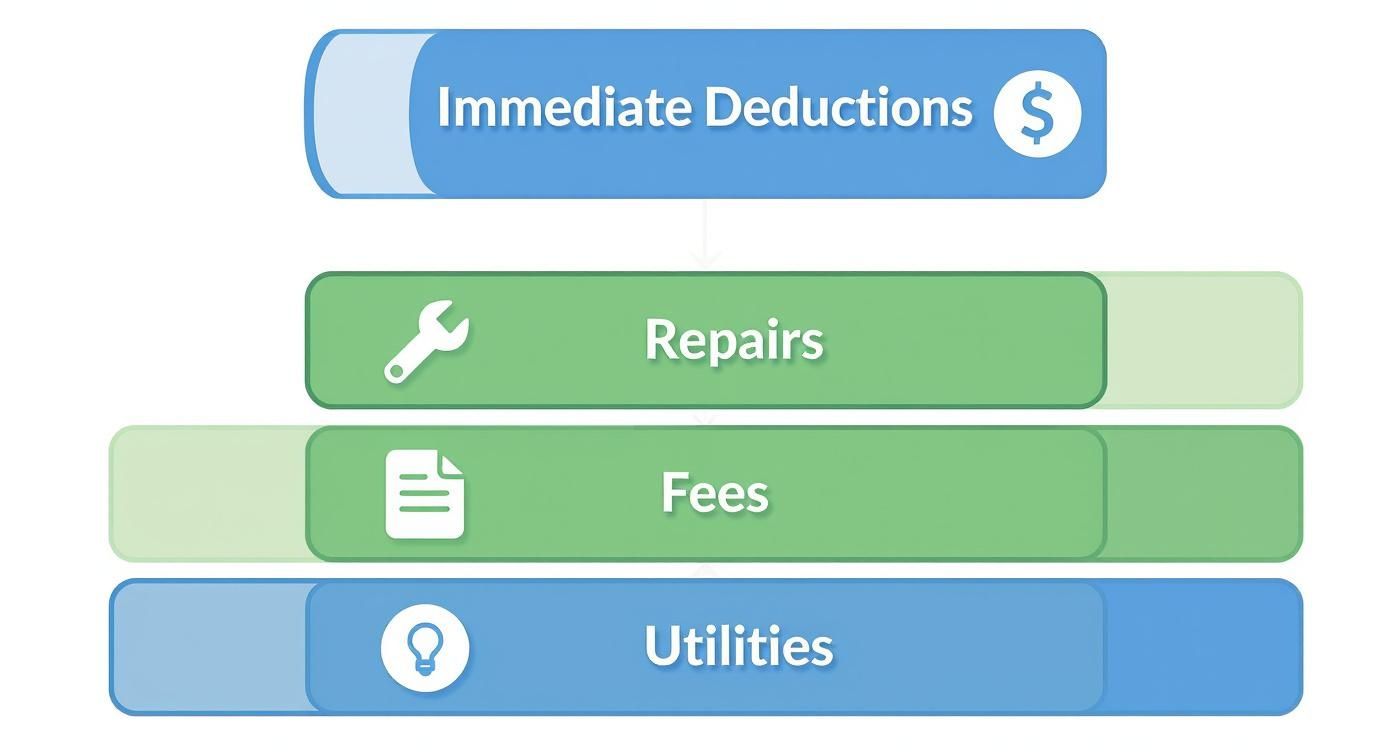
While instant write-offs provide a quick win, depreciation deductions deliver sustained financial benefits over the entire life of your investment.
Plant and Equipment Depreciation Under Division 40
The second category is Plant and Equipment, covered by Division 40. These are the removable or mechanical assets within your property that have a limited effective life. This includes items like ovens, dishwashers, carpets, blinds, air conditioners, and smoke alarms.
Unlike the flat 2.5% rate for capital works, each of these assets depreciates at a different rate based on its "effective life" as determined by the ATO.
For instance, suppose you install a new split-system air conditioner for $3,000 and lay new carpet valued at $4,000.
- The ATO might determine an air conditioner has an effective life of 10 years, while carpet has an effective life of 8 years.
- You would then claim deductions for these assets over their respective lifespans, adding a significant amount to your annual claims. For example, using the diminishing value method for the carpet ($4,000 / 8 years x 200% = $1,000 deduction in the first full year).
Understanding how to calculate depreciation for every asset can be complex, making professional advice a prudent investment. ATO data underscores the power of these deductions. In the 2016-17 financial year, the average capital works claim was $2,385, and the average plant and equipment claim was $1,363.
Immediate Deductions vs Deductions Over Time
To consolidate your understanding, here is a comparison of the two main types of rental property expenses.
| Expense Type | Example | How to Claim | ATO Reference |
|---|---|---|---|
| Immediate Deduction | Replacing a broken tap, paying council rates, property management fees | Claim the full cost in the same financial year the expense was incurred. | Repairs and Maintenance |
| Deduction Over Time | Installing a brand-new kitchen, building a pergola, purchasing a new oven | Claim a portion of the cost each year over the asset's effective life. | Capital Works & Depreciation |
As demonstrated, immediate expenses provide short-term tax relief, while capital costs deliver sustained value over the long term.
The Essential Role of a Quantity Surveyor
How can you accurately determine these costs, particularly for an older property where original construction records are unavailable?
This is where a quantity surveyor is an indispensable professional.
A quantity surveyor is an expert in construction costing. They will inspect your property and prepare a comprehensive tax depreciation schedule. This report is the cornerstone of your depreciation claims, listing every depreciable item and calculating the deductions you can claim each year for up to 40 years.
A quantity surveyor's report is not merely a guide; it is the key to unlocking the maximum legal deductions for your property. Furthermore, the fee for preparing the report is 100% tax-deductible.
Without a depreciation schedule, you are almost certainly leaving money on the table. It provides the substantiation the ATO requires and ensures you are claiming every dollar to which you are entitled.
Calculating Deductions for Holiday Homes and Airbnbs
Short-term rental properties, such as Airbnbs and holiday homes, present unique challenges for tax deductions. Unlike a standard long-term rental, these properties often have a mix of paying guests, vacant periods, and personal use by the owner. This mixed-use scenario is a major focus for the Australian Taxation Office (ATO).
The governing principle is apportionment. You can only claim expenses for the portion of the year the property was genuinely available for rent. Costs incurred during periods of personal use, or when the property was not being actively marketed, are not deductible. Errors in apportionment are a direct route to an ATO audit.
What Does "Genuinely Available for Rent" Really Mean?
The ATO's definition of "genuinely available" is rigorous. It requires evidence of active and commercial attempts to secure tenants.
Here are the key factors they assess:
- Active Advertising: The property must be listed on recognised platforms like Airbnb, Stayz, or with a local managing agent, making it visible to prospective renters.
- Reasonable Conditions: The rental terms must be commercially viable. Unreasonably high rental rates or restrictive booking conditions (e.g., a "minimum 6-month stay" for a holiday home) may indicate the property was not genuinely available.
- Accepting Bookings: A history of accepting reasonable booking requests serves as strong evidence of genuine rental activity.
The ATO's data-matching capabilities are extensive. To understand their scrutiny in this area, it is prudent to review their audit focus on fraudulent holiday homes deductions.
How to Apportion Your Expenses: A Real-World Example
Let's apply this with a practical scenario. Assume you own a coastal holiday home with total annual expenses (interest, rates, insurance) of $30,000.
The property's usage over 365 days was as follows:
- Rented to paying guests: 90 days
- Genuinely available (advertised but vacant): 30 days
- Personal use by your family: 45 days
- Unavailable (not advertised): 200 days
First, calculate the total income-producing period: 90 days (rented) + 30 days (available) = 120 days.
Next, calculate the deductible portion of your expenses:
(120 days / 365 days) x $30,000 = $9,863
You can claim $9,863 in rental deductions. The expenses corresponding to the 45 days of personal use and the 200 days it was unavailable are considered private and are not deductible.
The ATO's position is absolute: "Expenses must be apportioned when the property is used for both private and income-producing purposes… You must have records to show how you calculated your claim." This is a legal requirement, not a guideline.
Correctly apportioning expenses is critical for compliance. If you find the complexities of mixed-use properties daunting, seeking expert professional advice is the most prudent course of action.
Creating Your Audit-Proof Record-Keeping System
Effective record-keeping is not merely an administrative task; it is your primary defence in an audit and the foundation of a sophisticated investment strategy.
A haphazard approach, such as collecting receipts in a shoebox, is inadequate and exposes you to significant risk. To substantiate every claim with confidence, a systematic approach to tracking all income and expenditure is essential.
This involves a shift from a reactive scramble at year-end to a proactive, organised system maintained throughout the year. This provides irrefutable proof for every claim, offering peace of mind and a transparent view of your property's financial performance.

Building Your Digital Fortress
Modern record-keeping should be digital, accessible, and methodical. A well-structured spreadsheet or dedicated property management software can be highly effective.
Consistency is key. Record every transaction as it occurs. Immediately digitise receipts by taking a photo and filing it in a cloud-based folder (e.g., Google Drive, Dropbox) organised by financial year. This simple discipline prevents loss of documentation and streamlines tax preparation.
Australian taxation legislation is unequivocal: you must keep records that explain all rental income and expenditure. This is a legal obligation under the Taxation Administration Act 1953 required to claim deductions.
The Five-Year Rule Explained
A frequent question from landlords is about the required retention period for documents. The ATO mandates that you must retain all relevant records for at least five years from the date you lodge your tax return.
The five-year period commences from the date of lodgement, not the end of the financial year.
Practical example:
If you lodge your 2024 tax return on 30 October 2024, you must keep all supporting records for that return until at least 30 October 2029. For those new to property investment, understanding the general record keeping requirements in Australia is crucial for establishing compliant practices from the outset.
Your Essential Record-Keeping Checklist
To build a system that can withstand ATO scrutiny, certain documents are non-negotiable. This checklist outlines the essential records required to support your rental property claims.
| Document Type | Why You Need It | Retention Period (from lodgement) |
|---|---|---|
| Loan & Bank Statements | To prove interest payments on the investment loan and track income/expenses. | 5 Years |
| Quantity Surveyor Report | To substantiate claims for capital works and plant & equipment depreciation. | 5 Years |
| Property Agent Summaries | Provides a detailed breakdown of income received and expenses paid by the agent. | 5 Years |
| Receipts for All Expenses | Proof of purchase for repairs, maintenance, insurance, council rates, etc. | 5 Years |
| Property Purchase/Sale Contracts | Essential for calculating your cost base for Capital Gains Tax (CGT) purposes. | 5 years after the sale |
Ultimately, meticulous documentation is the hallmark of a savvy investor. By implementing a structured, digital system, you not only prepare for potential ATO inquiries but also gain powerful insights into your investment's financial health.
Is your current system robust enough for an audit? If you have any doubts, reach out to the experts at EndureGo Tax for a professional assessment. We'll ensure your claims are fully substantiated and protected.
Right, you've absorbed the theory behind rental property deductions. Now it's time to put that knowledge to work and turn insights into actual, tangible financial benefits for your investment property.
Let's get practical.
The core principles are straightforward: nail the difference between immediate expenses and long-term deductions like depreciation, be ruthless with apportionment for any mixed-use or holiday properties, and remember that pristine record-keeping is your best defence.
Conduct a Financial Health Check
First up, give your investment strategy a "health check." Pull out last year's financial records and run through every single expense against the categories we've covered. Did you forget any of those small but legitimate claims like bank fees or stationery? It all adds up. For example, if your dedicated rental bank account has a $5 monthly fee, that's a $60 annual deduction you shouldn't miss.
Next, if you're still relying on a shoebox full of receipts, now is the moment to go digital. A simple spreadsheet or a dedicated app to photograph and log every expense as it happens is a game-changer. This small habit transforms tax time from a mad scramble into a simple box-ticking exercise. Under the Taxation Administration Act 1953, the ATO mandates these records—it's not just a good idea, it's a legal requirement to back up your claims.
Get a Professional on Your Side to Maximise Claims
Finally, don’t go it alone. Bringing in a tax professional who lives and breathes property investment accounting is one of the smartest moves you can make. They have a knack for spotting nuanced deductions specific to your situation that you might easily overlook.
For many investors, getting a quantity surveyor's depreciation schedule is the single most valuable action you can take. It unlocks thousands in non-cash deductions that can dramatically improve your property's performance on paper.
This is your chance to shift from simply owning a property to actively steering its financial success. Don't leave your hard-earned money on the table.
Are you confident you're claiming every last dollar you're entitled to? Contact EndureGo Tax today for a comprehensive review of your investment property finances and build a strategy that truly maximises your returns.
Got Questions? We've Got Answers
Every landlord has questions, especially when it comes to tax time. Here are some of the most common ones we hear from our clients, with practical answers to help you navigate the finer points of Australian tax law.
Can I Claim Interest on My Investment Loan?
Yes, absolutely. In fact, the interest charged on the loan you used to buy your rental property is usually your single biggest tax deduction. You can claim the full interest amount for the time your property was rented out or was genuinely on the market for rent.
Here’s the catch, though: you have to be careful with mixed-use loans. If you redraw funds from your investment loan to pay for something personal, like a new car or a family holiday, you can only claim the portion of the interest that relates directly to the rental property. This is an area the ATO watches closely, so keeping meticulous records is non-negotiable.
Do I Really Need a Quantity Surveyor Report for an Older Property?
Definitely. It's a common misconception that they're only for new builds, but a quantity surveyor report is often even more valuable for older properties. A qualified quantity surveyor has the expertise to retrospectively estimate the original construction costs and identify all the depreciable assets, even if you don’t have the receipts from decades ago.
Think of it this way: under tax ruling TR 97/25, the ATO officially accepts these estimates for substantiating capital works and depreciation claims. Skipping this report means you are almost certainly leaving thousands of dollars in legitimate deductions on the table.
What Expenses Can I Claim Before My First Tenant Moves In?
This one trips a lot of people up. Any expenses you rack up before the property is genuinely available for rent are generally not immediately deductible. Things like initial repairs or improvements are considered capital costs. They get added to your property’s cost base, which helps reduce your capital gains tax when you eventually sell. For example, replacing a damaged hot water system before listing the property is a capital cost, not an immediate repair deduction.
However, once the property is officially listed for rent (even if it's still empty), you can start claiming ongoing costs. This includes things like:
- Interest on the loan
- Council rates
- Insurance premiums
- Advertising for tenants
Can I Claim My Travel Expenses to Inspect the Property?
Unfortunately, no. As of 1 July 2017, the rules changed, and travel expenses for inspecting, maintaining, or collecting rent for a residential rental property are no longer deductible. This was a big change designed to stop people from claiming holiday travel under the guise of a property inspection.
While there are some very limited exceptions for those running a full-scale rental property business, the bar for this is incredibly high and doesn't apply to the vast majority of individual investors.
What Happens If I Pay for Repairs Just Before Selling?
Timing is everything here. If you're fixing damage that happened while the property was rented out, that's a repair, and you can claim it as a deduction. It doesn't matter if you do the work right before you put the "For Sale" sign up.
But, if the work is an improvement—like renovating the kitchen to fetch a higher sale price—it’s treated as a capital expense. You can't claim it as an immediate rental deduction. Instead, this cost is added to your property's cost base, which will lower your capital gains tax bill when the sale goes through.
Maximising your rental deductions while staying on the right side of the ATO takes a bit of know-how. The team at EndureGo Tax specialises in property investment accounting for landlords in Ashfield and the Northern Beaches, and we make it our business to ensure you claim every single dollar you're entitled to.
Don't leave money on the table. Book a consultation with EndureGo Tax today and get the peace of mind that comes with expert advice.
