


So, you've got a rental property in Australia. That's a fantastic financial move. But with that great investment comes the not-so-great part: dealing with the Australian Taxation Office (ATO). Every dollar you earn from your property is on the ATO's radar and must be declared.
It's not just about the weekly rent hitting your bank account. We're talking about everything – bond money you've had to keep, insurance payouts for lost rent, you name it. Getting your head around rental income and taxes isn't just a good idea; it's essential for any savvy property investor looking to maximise returns and remain compliant.
Your Guide to Australian Rental Income and Taxes

Welcome to the no-nonsense guide for getting your rental income and taxes sorted. Whether this is your first property or you're a seasoned pro, understanding your obligations to the ATO is the key to staying out of trouble and making your investment work harder for you. As an expert in Australian property tax, my goal is to cut through the jargon. We'll show you how a solid grasp of the tax system can seriously boost your property's profitability. We’ll break down what the ATO counts as rental income, what you can (and can't) claim as an expense, and why keeping good records is your absolute best friend.
Key Concepts for Landlords
Before we dive deep, let's get a few basic ideas straight. Think of these as the building blocks for managing your tax responsibilities.
- Assessable Income: This is your gross rental income – the total amount your property earns before you take out any expenses.
- Allowable Deductions: These are the golden ticket. They're the specific, eligible expenses you can subtract from your assessable income to lower your overall tax bill.
- Net Rental Income (or Loss): This is the final number. It’s what you get when you subtract all your allowable deductions from your assessable income.
The whole game is about calculating this final figure accurately so you're not paying a cent more in tax than you have to. According to the ATO, every bit of income your property generates must go into your tax return. For the 2024–25 financial year, this income is taxed at your personal marginal rate, which can be as high as 45%.
And here’s a sobering statistic: the ATO finds errors in up to 9 out of 10 landlord tax returns. That's a huge number, and it highlights just how crucial it is to get this right. You can read more about how tax brackets affect rental income on labodeaccommodation.com.au.
We'll walk you through everything, from identifying all your income sources to mastering your deductions and steering clear of common ATO pitfalls. By the end, you'll be able to manage your investment with confidence.
Ready to take control of your property's finances? A quick chat with an expert can clear up any confusion about your specific rental income and tax obligations. Book a session with a specialist at EndureGo Tax today to make sure you're compliant and maximising your returns.
What the ATO Counts as Your Rental Income
When it comes to your rental property and tax time, the first thing to get straight is what the Australian Taxation Office (ATO) actually considers "income". It's a common trap for landlords to think it's just the rent that hits their bank account each month. The reality is, the ATO’s definition is much wider, covering pretty much every dollar your property brings in.
Getting this right from the start is the bedrock of staying out of trouble with the tax man. Missing an income source, even by accident, can lead to a nasty surprise from the ATO in the form of adjustments, penalties, and a whole lot of stress you don't need. The rule of thumb is simple: if you received it because of your rental property, you need to declare it.
It's More Than Just the Weekly Rent
While your tenant's regular payments are the main event, there are several other common payments that must go on your tax return. Forgetting these is an easy way to create a major headache down the line.
Here are the big ones to watch out for:
- Retained Bond Money: If you need to keep some or all of a tenant's bond to cover things like unpaid rent, that money becomes assessable income. You have to declare it. We've written more on this, especially with the ATO's new moves in the NSW rental bond system.
- Insurance Payouts: Received an insurance payment for lost rent? That’s taxable. If your insurer covers you for a few weeks while the property was empty, the ATO treats that payout just like regular rent.
- Tenant Reimbursements: Let's say you pay a water bill upfront and your tenant pays you back for their usage. That reimbursement is technically income. Don't worry, you can still claim the original water bill as a deduction.
When Income Isn't Cash
Sometimes, you'll be "paid" in ways that don't involve a bank transfer. The ATO is wise to this and requires you to declare the fair market value of any goods or services you get instead of rent. This is a classic blind spot for many landlords.
Here’s a practical example:
Imagine your tenant is a professional gardener. You both agree they’ll handle all the lawn and garden care in exchange for a $50 discount on their weekly rent. In the ATO's eyes, you've received a benefit worth $50 a week. You must declare that $50 as rental income, exactly as if they'd handed you the cash.
This principle makes sure all forms of payment are treated the same. The tax law, like the Income Tax Assessment Act 1997, is clear that assessable income includes the 'money value' of non-cash benefits.
Of course, the rental market itself plays a big role. With rents surging across Australia, many landlords have seen their taxable income jump, sometimes even pushing them into a higher tax bracket. This makes careful planning more important than ever. Digging into what revenue management entails for rental properties can also help you get a handle on all the different ways your property might generate income.
If you're feeling a bit lost in the details, a quick chat can make all the difference. Contact the property tax specialists at EndureGo Tax for expert advice on your rental income obligations.
Maximising Your Lawful Rental Property Deductions
Once you've tallied up all your rental income, the next step is where you can really make a difference to your bottom line: claiming every single deduction you’re legally entitled to. This is the most powerful tool you have to reduce your taxable rental income and boost your investment’s performance. For every dollar you correctly claim, you lower your taxable income by that same dollar, which directly cuts down your final tax bill.
So, what can you actually claim? The Australian Taxation Office (ATO) allows you to deduct expenses that were directly related to earning your rental income, as long as you have the receipts to back it up. This is precisely why good record-keeping isn't just a chore—it’s your best friend when managing your rental income and taxes.
The infographic below gives you a quick visual on the different streams that make up your assessable income, which is the total figure your deductions will be claimed against.
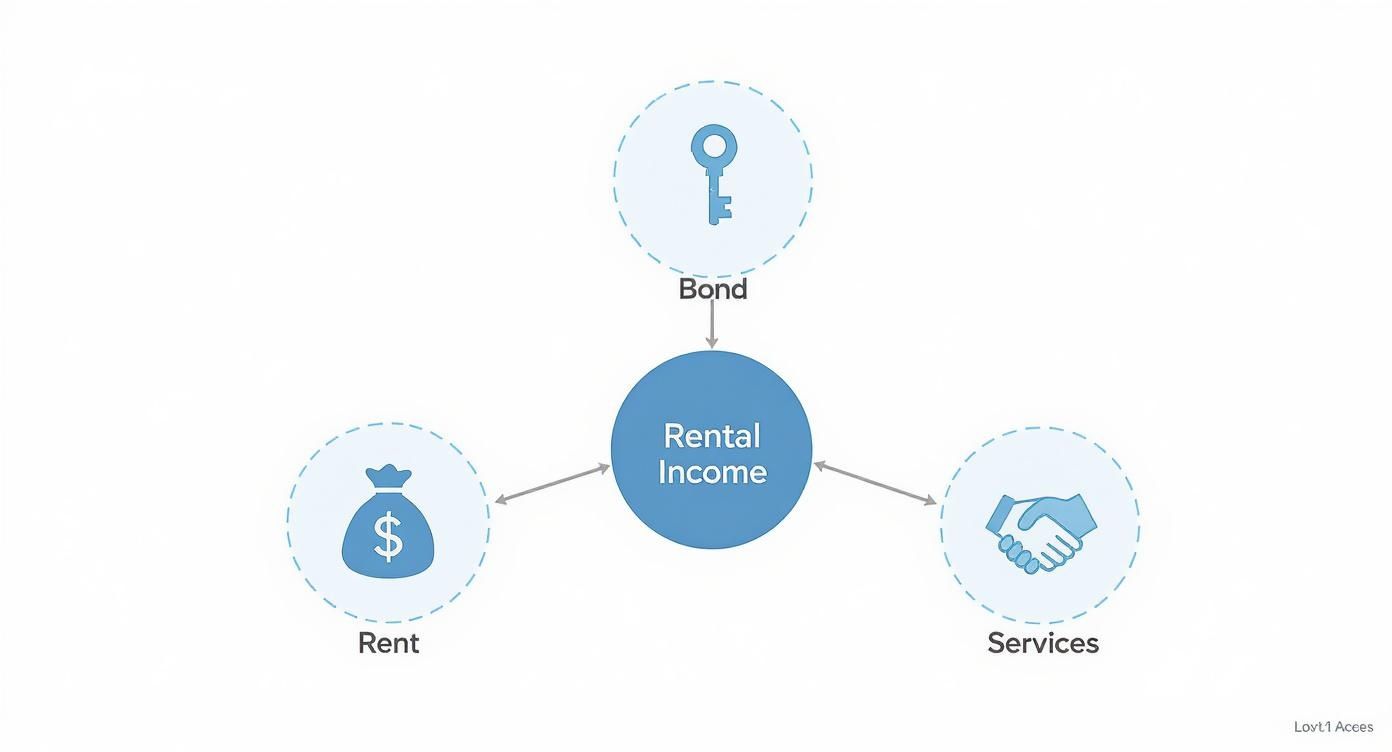
As you can see, it’s not just about the weekly rent. Things like retained bond money or payments from tenants for services all get bundled into your total taxable income.
Immediate Deductions You Can Claim Now
Many of your costs can be claimed in full in the same financial year you paid for them. Think of these as the day-to-day running expenses of owning and managing the property while it's either rented out or genuinely available for rent.
Some of the most common immediate deductions include:
- Management and Agent Fees: All those fees you pay a real estate agent for finding tenants, collecting rent, and managing the property.
- Council and Water Rates: The regular charges from your local council and water authority are a straightforward deduction.
- Land Tax: If your state or territory charges it, this annual tax on the land you own is fully claimable.
- Insurance: Premiums for your building, contents, and landlord insurance policies are all deductible.
- Loan Interest: For most investors, the interest portion of your mortgage repayments is one of the biggest deductions you'll claim each year.
Getting this right is absolutely critical. The ATO has ramped up its scrutiny on rental claims after finding that a shocking 90% of landlord tax returns contain errors, mostly from people claiming more than they should.
Repairs Versus Improvements: A Critical Distinction
Here’s where many landlords trip up: the difference between a 'repair' and an 'improvement'. Getting this wrong is a huge red flag for the ATO and can lead to disallowed claims and even penalties.
A repair is simply fixing something that's broken or worn out to get it back to its original working condition. You’re just restoring it, not making it better than it was. The cost of a repair is an immediate, 100% deduction.
Practical Example of a Repair:
Your tenant calls to say the hot water system has died. You get a plumber out who replaces a faulty heating element. That $450 bill is for a repair, so you can claim it in full this financial year.
An improvement, on the other hand, is when you make something substantially better than it originally was. You might be upgrading it, changing its character, or increasing its function. The cost of an improvement is a capital expense, which means you can't claim it all at once. Instead, you claim it over time through depreciation.
Practical Example of an Improvement:
Instead of just fixing the old 150-litre hot water system, you decide to rip it out and install a bigger, more efficient 250-litre model. This is an improvement because it provides a greater function. The cost must be claimed as a capital works deduction over several years, not all at once.
This is a vital distinction to understand. Our guide on claiming investment property deductions digs deeper into these rules. To really get the most out of your investment, it's also worth exploring the full range of property investment tax benefits available.
Here's a quick reference table to help clarify some of the most common rental property expenses and how they are typically treated.
Common Rental Deductions at a Glance
| Expense Type | Description | Claim Type | ATO Reference Example |
|---|---|---|---|
| Agent Fees | Costs for property management, advertising, and letting. | Immediate | Claim in full the year they are incurred. |
| Council Rates | Standard local government charges for the property. | Immediate | Claim in full the year they are incurred. |
| Repairs | Restoring a broken or worn-out asset to its original state. | Immediate | E.g., fixing a broken window or leaking tap. |
| Improvements | Upgrading or enhancing an asset beyond its original state. | Over Time | E.g., renovating a kitchen or adding a deck. |
| Loan Interest | The interest component of your investment property loan. | Immediate | The principal (loan amount) is not deductible. |
| Insurance | Premiums for landlord, building, and contents insurance. | Immediate | Claim the full premium for the financial year. |
This table is just a starting point, as every investor's situation is unique. What might be a simple claim for one person could be more complex for another, depending on the specifics.
Feeling unsure about what you can claim? A small mistake could be costly. Schedule a consultation with an EndureGo Tax expert today to ensure your deductions are fully compliant and optimised for your benefit.
Calculating Your Net Rental Income: A Practical Example
Theory and rules are one thing, but seeing how rental income and taxes actually play out in the real world makes it all click. Let's walk through a practical, step-by-step example to show you exactly how to calculate your net rental income or loss.
We'll follow a fictional landlord, David, who owns an investment unit in Ashfield, Sydney. By crunching the numbers on his annual financials, you’ll see how assessable income and deductible expenses come together to determine his final tax position. Think of it as a clear template you can adapt for your own property.

Step 1: David Totals His Assessable Income
First up, David needs to add every single dollar the property generated during the financial year. It's not just about the weekly rent; the Australian Taxation Office (ATO) considers any income related to the tenancy as assessable.
Here’s a look at his income streams for the year:
- Weekly Rent: David’s unit was tenanted for the full 52 weeks at $600 per week. That’s a primary rental income of $31,200.
- Tenant Reimbursement: Back in March, David paid a $220 water usage bill, which his tenant was required to reimburse. He received that payment shortly after.
- Retained Bond: The previous tenant left some minor wall damage that wasn't considered normal wear and tear. David used $300 from their bond to cover the plastering and painting costs.
Adding these figures together gives David his total assessable income for the year:
$31,200 (Rent) + $220 (Water) + $300 (Bond) = $31,720
Step 2: David Compiles All Deductible Expenses
Next, David meticulously pulls together the records for every legitimate expense he paid to manage the property and earn that rental income. This is the crucial step that can significantly reduce his taxable amount.
Here's a breakdown of his costs for the year:
- Loan Interest: He paid $22,500 in interest on his investment loan.
- Strata Fees: His quarterly strata levies totalled $4,800.
- Council Rates: The local council rates were $1,600 for the year.
- Water Rates: The fixed water service charges came to $800.
- Landlord Insurance: His annual insurance premium was $750.
- Property Management Fees: His real estate agent charged a 7% commission on the rent, which added up to $2,184.
- Repairs: A plumber had to be called out to fix a leaking tap, costing $250.
- Water Bill: The $220 water usage bill he paid (and was reimbursed for) is also a deductible expense.
Summing these up gives David his total deductible expenses:
$22,500 + $4,800 + $1,600 + $800 + $750 + $2,184 + $250 + $220 = $33,104
According to the ATO’s legislative framework, specifically the Income Tax Assessment Act 1997, expenses are deductible to the extent they are incurred in gaining or producing your assessable income. This principle underpins David's entire calculation.
Step 3: The Final Calculation – Net Profit or Loss
Now for the moment of truth: subtracting total expenses from total income to find the net result. This single figure determines David's tax obligation for his rental property.
The calculation is straightforward:
Total Assessable Income ($31,720) – Total Deductible Expenses ($33,104) = -$1,384
David’s property has made a net rental loss of $1,384. This situation is what’s known as negative gearing. This loss can now be used to reduce his taxable income from other sources, like his salary, potentially leading to a handy tax refund.
Of course, if his income had been higher than his expenses, the property would be positively geared, and he would need to pay tax on the net profit.
This example shows the power of tracking every expense. If you're unsure which costs you can claim or how to handle your specific rental income and taxes, professional guidance is invaluable. Book a consultation with an EndureGo Tax specialist today to ensure you're getting your tax return right.
Common Mistakes and ATO Focus Areas to Avoid
When it comes to rental income and taxes, you can be sure the Australian Taxation Office (ATO) has investment properties squarely in its sights. Year after year, the ATO flags rental properties as a major problem area, with audits revealing that a huge percentage of landlord tax returns are riddled with errors.
Staying compliant isn’t just about knowing the rules; it’s about actively steering clear of the common pitfalls that attract unwanted ATO attention. Think of this section as your compliance checklist—a guide to avoiding costly penalties and ensuring your tax affairs are always in order. Getting it wrong can lead to audits, amended assessments, and a whole lot of financial stress you just don't need.
Confusing Initial Repairs with Immediate Deductions
This is one of the most common—and costly—errors landlords make. When you first buy a property, any work you do to fix up defects that were already there at the time of purchase is considered an initial repair. These costs are not immediately deductible, even if you do the work after a tenant moves in.
Instead, the ATO views these expenses as capital in nature. This means they get added to the property's cost base and are claimed over time as capital works deductions, usually at a rate of 2.5% per year.
Practical Example:
You buy an older property and the back fence is rotting. Before your first tenant moves in, you spend $5,000 replacing it. This is a classic initial repair. You cannot claim the full $5,000 straight away; it must be treated as a capital expense.
The ATO's guidance on this is clear in Taxation Ruling TR 97/23: expenses that fix defects, damage, or deterioration existing when you bought the place are capital.
Incorrectly Apportioning Expenses
Another massive red flag for the ATO is failing to correctly apportion expenses for properties that have an element of private use. This is a huge one for holiday homes that you rent out for part of the year and use yourself for other periods.
You simply cannot claim 100% of the expenses if the property wasn't genuinely available for rent for 100% of the year. You have to divide your expenses based on the portion of the year the property was either rented or genuinely up for rent. Claiming deductions for periods you were there on a personal holiday is a clear breach of tax law.
The ATO is actively cracking down on these claims. You can learn more about the risks of fraudulent holiday home deductions under ATO audit.
Poor Record Keeping
Let’s be blunt: the single biggest reason rental deductions get disallowed is a lack of proof. The golden rule is simple: if you can't prove it, you can't claim it.
You must keep detailed records for all your income and expenses. This includes:
- Bank statements showing every dollar of rental income.
- Statements from your property agent.
- Receipts and invoices for every single expense.
- Loan documents that clearly detail the interest paid.
- Contracts for any capital works or improvements.
The ATO requires you to hang onto these records for at least five years from the date you lodge your tax return. Without this evidence, you have no defence in an audit. For any serious property investor, solid record-keeping is absolutely non-negotiable.
Navigating these ATO focus areas can be tricky, and a simple mistake can have big consequences for your rental income and taxes.
Don't leave it to chance. Book a consultation with an EndureGo Tax expert today to ensure your claims are accurate and you’re protected from ATO scrutiny.
Putting It All into Action
Knowing the rules is one thing, but putting them into practice is what really counts. Let's turn all this information about rental income and tax into a straightforward, actionable plan to keep you compliant and financially ahead.
A proactive approach is your best friend here. It’s all about setting up good habits today to avoid headaches and costly mistakes down the line.
Nailing Your Core Responsibilities
Mastering your tax obligations comes down to being consistent in a few key areas. If you focus on getting these non-negotiable tasks right, you'll build a rock-solid foundation for your investment.
- Track Every Dollar of Income: Seriously, every dollar. From the weekly rent payments to bond money you retain or even what a tenant pays you back for a water bill, it all needs to be recorded.
- Keep Meticulous Expense Records: This is your number one defence if the ATO ever comes knocking. Keep a digital or physical copy of every single receipt for every cost you plan to claim. No matter how small, it all adds up.
- Know Your Repairs from Your Improvements: This is a classic trip-up for landlords. A repair just gets something back to its original working order (and is an immediate deduction). An improvement makes it better than it was before (and is claimed over years). Mixing these up is a major red flag for the ATO.
It also pays to keep an ear to the ground on what the ATO is focusing on each year. They often publish guidance, like in Taxation Ruling TR 97/23, which can give you clues on what they're cracking down on.
Ultimately, your goal is to build a crystal-clear financial story of your investment property. This isn't just about ticking boxes for the tax man; it empowers you to make smarter financial decisions for your portfolio's future.
Your Immediate Action Plan
While this guide gives you a solid map, nothing beats having an expert navigator. The single most powerful step you can take to get your tax position right is to talk to a professional who lives and breathes property investment tax.
Don't wait until tax time to find out you've made a mistake. Take control of your investment's financial future today.
Book a consultation with a property tax specialist at EndureGo Tax. We can review your current setup, help you implement a robust record-keeping system, and make sure you're 100% compliant with Australian tax law.
Got Questions About Rental Income and Taxes?
Let's cut through the confusion. Here are some quick, no-nonsense answers to the questions we hear from landlords all the time.
I Rent Out a Room in My House. Can I Claim All the Interest on My Home Loan?
Afraid not. You can only claim the portion of the interest that directly relates to the part of your home you're renting out.
The ATO is quite specific about this. You need to work out a reasonable percentage based on the floor area the tenant has exclusive use of, plus their share of common areas like the kitchen and bathroom.
For example, if your tenant's room makes up 20% of your home's total floor space, you can generally claim 20% of your mortgage interest. Just make sure you have a clear, logical way of explaining how you got to that number if the ATO ever asks.
What Records Do I Actually Need to Keep for the ATO?
Good record-keeping is your best friend when you’re a landlord. The ATO expects you to hold onto records for all your rental income and expenses for at least five years from the date you lodge your tax return. Getting this wrong can lead to penalties under the Taxation Administration Act 1953, so it's worth getting right.
Your must-have list includes:
- Bank statements or statements from your property agent showing every dollar of rent you received.
- Receipts and invoices for every single expense, from a leaky tap repair to your landlord insurance.
- Loan documents that clearly show the interest you’ve paid.
- Paperwork for any big jobs, like renovations or capital improvements.
And yes, digital copies are fine, but they must be crystal clear and easy to pull up when needed.
Can I Claim My Travel Costs to Inspect My Rental Property?
For most individual investors, the answer is no. A few years back, the rules changed to stop people claiming travel that was more of a holiday than a necessary inspection.
There are exceptions, of course. If you’re running a full-blown property investment business or you're a certain type of company (like a corporate tax entity), the rules might be different. This is one of those grey areas where getting professional advice is crucial to avoid making a costly mistake.
Trying to navigate the maze of rental income and taxes on your own can be a headache, and a simple mistake can end up costing you. The property specialists at EndureGo Tax are here to make sure you're not just compliant, but that you're making the most of your investment.
👉 Book a consultation today and get peace of mind with a trusted local accountant on your side.
