


Ready to go out on your own and register as a self-employed sole trader in Australia? It’s a huge step, and getting the legal framework right from the start is crucial for your success.
The entire process boils down to one critical action: obtaining an Australian Business Number (ABN) and linking it to your personal Tax File Number (TFN). This is what officially establishes your new venture in the eyes of the Australian Taxation Office (ATO).
Your Essential First Steps to Operating Legally
Jumping into self-employment is exciting, but you must nail the foundations. To start trading, sending invoices, and getting paid correctly, your first task is to secure an ABN.
This unique 11-digit number is what you'll put on every invoice and business document. It's the key identifier for anyone running a business in Australia.
Without an ABN, other businesses are legally required to withhold tax from your payments at the highest marginal rate. Trust us, that’s a cash flow headache you want to avoid. Securing your ABN is the official starting pistol for your sole trader journey.
ABN, Business Name, and Your TFN
Once you've got your ABN sorted, consider what you'll call your business. If you plan on trading under a name that isn't your own—for example, "Sydney Sparky Services" instead of just "Jane Smith"—you'll need to register that business name with the Australian Securities and Investments Commission (ASIC).
This flowchart breaks down the basic path to getting set up.
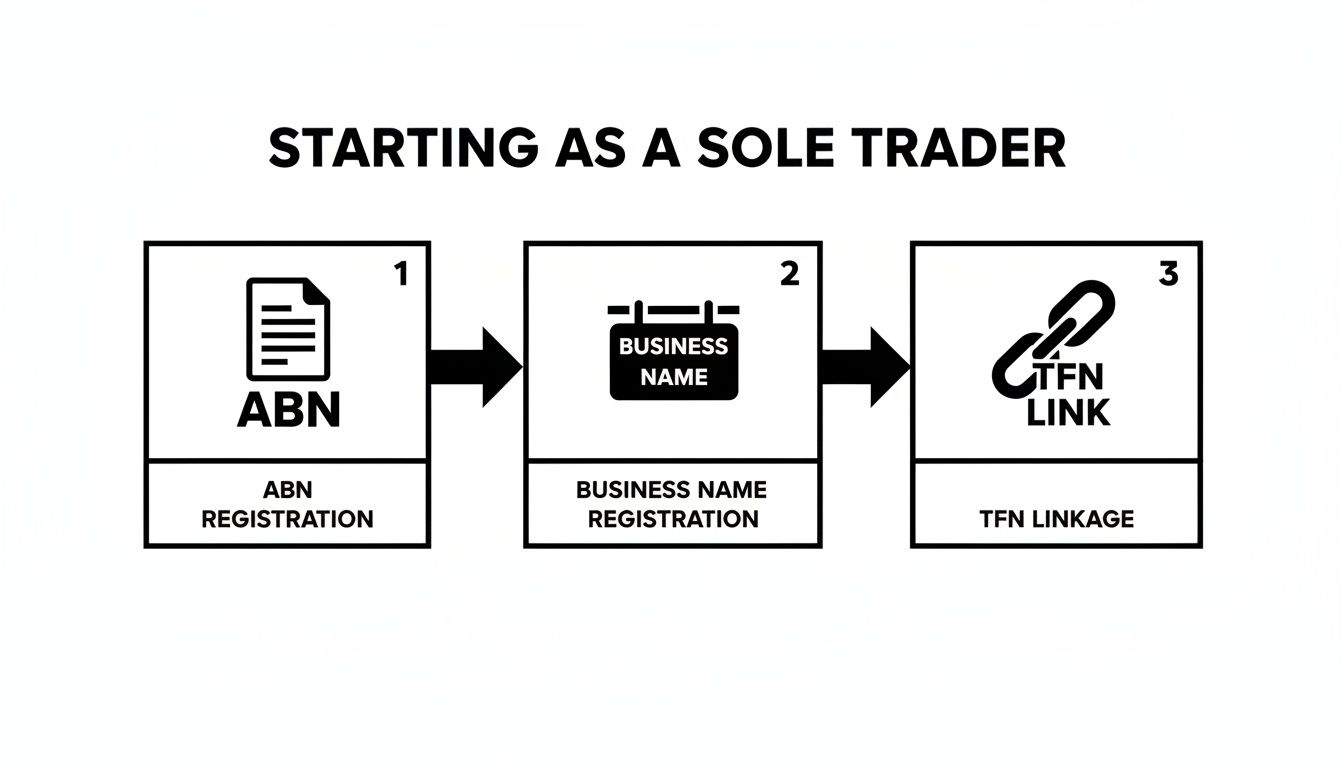
As you can see, the process connects your new business identity (your ABN and business name) directly to your personal tax obligations (your TFN).
This link is critical. As a sole trader, the law sees you and your business as a single entity. All your business income is legally your personal income, which simplifies your tax return but also means you're personally liable for any business debts. If you're looking for more guidance tailored for new businesses, you might find some great resources if you start right now.
It's a popular path to take. In August 2023 alone, Australia saw a record 104,784 new ABNs registered. Sole traders made up a massive 75,268 of those—that’s a 30% jump from the previous year, showing just how many Aussies are taking the plunge.
Expert Takeaway: Your ABN provides your business identity, your business name creates your brand, and linking it to your TFN ensures you're meeting your tax obligations under the A New Tax System (Australian Business Number) Act 1999. Ticking these three boxes is the foundational checklist for every new sole trader. Get expert guidance to ensure your setup is compliant from day one.
Getting a Handle On Your Tax and GST Obligations
Alright, your ABN is live. Now comes the part that often trips up new sole traders: tax. Don't worry, getting your head around GST and income tax payments is more straightforward than it sounds, and it's key to keeping your finances healthy and the ATO happy.
First up is the Goods and Services Tax (GST). Here’s the main rule: you must register for GST once your business turnover hits (or you expect it to hit) $75,000 in any 12-month period.
It’s important to remember that 'GST turnover' means your gross business income—the total amount you invoice—not your final profit.
The GST Threshold Explained
Working out your turnover is simple. Just add up the total value of all your sales, whether they’re paid in cash or on credit. Just make sure you exclude any GST you might have already included in your prices.
Let’s look at a practical example.
Imagine you're a self-employed graphic designer based in Belrose, and you're keeping a close eye on your invoices.
- January to June: Things are steady, and you invoice a total of $40,000.
- July to August: You land a big project, bringing in another $25,000.
- September: You sign a new contract, and you project it will earn you at least $15,000.
By September, your projected annual turnover is $80,000 ($40k + $25k + $15k). You’ve crossed the threshold. This means you have 21 days to register for GST. Once you're registered, you'll need to add 10% GST to your invoices and, on the plus side, you can start claiming back the GST you pay on your business purchases.
To make it even clearer, here's a quick reference table.
GST Registration At a Glance: When Do You Need It?
Use this quick reference table to determine if you need to register for GST based on your business activities and turnover.
| Scenario | Annual Turnover | GST Registration Required? | Key Consideration |
|---|---|---|---|
| Just starting out as a freelancer | Under $75,000 | No (Voluntary) | You can't claim GST credits if not registered. |
| Business is growing steadily | Nearing or at $75,000 | Yes | You must register within 21 days of crossing the threshold. |
| You operate a taxi or rideshare service | Any amount | Yes | This industry requires GST registration from the first dollar earned. |
| You run a non-profit organisation | Over $150,000 | Yes | The threshold is higher for non-profits. |
Ultimately, keeping an eye on your turnover is non-negotiable. Falling behind can cause major headaches down the track.
So, What Are Pay As You Go Instalments?
While GST is a tax on your sales, Pay As You Go (PAYG) instalments are all about pre-paying your income tax.
Because you don't have an employer taking tax out of your paycheque, the ATO gets you to pay your income tax in smaller chunks throughout the year. This is usually done quarterly and stops you from being hit with a giant, unexpected tax bill when you lodge your annual return. The ATO will typically place you into the PAYG instalment system automatically once your business income passes a certain point on a previous tax return.
Expert Tip: Get into the habit of setting aside a percentage of every single payment you receive. We see it time and time again—clients who do this are never caught short when their GST and PAYG payments are due. It's the simplest way to manage cash flow.
Tying It All Together with the BAS
This is where the Business Activity Statement (BAS) comes in. Think of it as your regular report to the ATO.
On your BAS form, you’ll report:
- The total GST you've collected from customers.
- The GST credits you want to claim back on business expenses.
- Your PAYG instalment for the period.
Most new businesses lodge their BAS quarterly, which is the most manageable frequency. Lodging your BAS accurately and on time isn't just good practice; it's a legal requirement under the Taxation Administration Act 1953. If you want to dive deeper into the nuts and bolts, we cover it all in our guide on how sole traders pay tax.
Getting these financial foundations right is a critical part of the journey when you register as a self employed sole trader. Working with an expert accountant from the start ensures your BAS lodgements are always spot-on, helping you claim everything you're entitled to while staying 100% compliant. Don't risk ATO penalties; ensure your BAS is correct by speaking with a professional.
Getting Your Business Ducks in a Row: Insurance, Licences, and Finances
Alright, so you’ve got your ABN sorted. But that’s just the starting line. Running a successful sole trader business is about more than just lodging forms with the ATO. It's about building a professional, resilient operation from day one.
Getting the right financial and legal structures in place isn't just 'good practice'—it's what protects you and your new venture from headaches down the track.
A non-negotiable first step is business insurance. Think of it less as an expense and more as a crucial safety net. It's often a mandatory requirement to even operate legally. To really get ahead of potential issues, adopting a structured approach like ISO 31000 risk management helps you spot and handle challenges before they become problems.
Getting the Right Insurance Cover
There's no such thing as a one-size-fits-all insurance policy. The cover you need depends entirely on what your business actually does, and getting this wrong can be a seriously expensive mistake.
- Public Liability Insurance: This is an absolute must-have if your work brings you into contact with the public or their property. Imagine you're a tradie working in the Inner West and you accidentally crack a client’s expensive marble countertop. This insurance is what covers the repair bill.
- Professional Indemnity Insurance: This one is vital for anyone giving advice or professional services. Let's say you're a marketing consultant on the Northern Beaches, and the advice you give leads to a financial loss for your client. This is the policy that protects you from potential legal claims.
Always, always check with your industry association. They often have specific requirements for the level of cover you need to hold.
Don't Forget Licences and Permits
Beyond insurance, heaps of industries require specific licences just to open your doors. This could be anything from a trade licence for an electrician to a food safety certificate for a mobile coffee van.
These aren't just bureaucratic red tape; they are legal requirements set by state or territory laws.
And then there's your local council. Depending on what you do, you might need permits for things like outdoor signage, running your business from a home office, or mobile trading. A quick look at your local council’s website is the best place to start.
Expert Insight: We often see new sole traders get tripped up by local council rules. A home-based business seems straightforward, but some councils have surprisingly strict regulations about client traffic or signage that can lead to fines if you're not careful. Always check first.
The Golden Rule: Separate Your Finances
If you take only one piece of advice from this guide, make it this one: completely separate your business and personal finances. This isn't just a suggestion—it's the bedrock of good business management.
As soon as that ABN comes through, open a dedicated business bank account.
All your business income goes into this account, and all your business expenses come out of it. It’s that simple. Doing this one thing solves a bunch of problems before they even start:
- Super-Simple Record-Keeping: It makes tracking what's coming in and going out incredibly easy.
- A Stress-Free Tax Time: You’ll have a clean, clear transaction history, making your BAS and tax return lodgements a breeze.
- Clear Financial Visibility: You can see exactly how your business is performing at a glance, which helps you make much smarter financial decisions.
Blurring the lines between your personal and business accounts just creates a massive administrative headache. It makes it almost impossible to know if your business is actually profitable.
Following these steps is your best defence against financial chaos as you register as a self employed sole trader. It establishes a professional foundation and sets you up for long-term success. Take the first step to financial clarity by opening a dedicated business bank account today.
Mastering Your Record Keeping and Expenses
Look, let’s be honest. Nobody starts a business because they love bookkeeping. But getting your record-keeping right from day one is non-negotiable. It’s your best defence against an ATO audit and the simplest way to legally lower your tax bill.
When you register as a self employed sole trader, building good financial habits isn't about becoming an accountant overnight. It's about creating a simple, repeatable system that stops small admin tasks from turning into massive headaches down the track.
If you think this is just busywork, think again. In 2024–25, there were 12,257 personal insolvencies in Australia. A huge 78.8% of the total debts were tied to business failures—mostly sole traders. A key reason? Poor financial management. You can see the full breakdown on the AFSA website.
What Records You Absolutely Must Keep
Under Australian law, you need to hold onto most business records for five years. The key is organisation. Think of it as creating a clear, easy-to-follow story of your business's money trail.
Here’s your essential checklist:
- Proof of Income: Every invoice you send, bank deposit slips, and transaction reports from platforms like Stripe or PayPal.
- Proof of Expenses: Every single receipt and tax invoice for things you buy for the business. Snapping a photo on a bookkeeping app is usually enough.
- Bank Records: This is why a separate business account is crucial. It gives you a clean list of every transaction.
- Vehicle Logbooks: If you use your personal car for work, a logbook is the only way the ATO will let you claim those running costs properly.
It's not just a suggestion. The Taxation Administration Act 1953 gives the ATO the power to hit you with serious penalties for poor record-keeping. If you can't prove a claim, you can't make it.
Simple Strategies for Staying Organised
You don't need a crazy-complex system here. A simple spreadsheet tracking money in and money out is a great start for many new sole traders. Consistency beats complexity every time.
If spreadsheets aren't your thing, consider apps like Xero or MYOB. They can link to your bank account, automatically categorise your spending, and make lodging your BAS so much easier.
Correctly Claiming Common Business Expenses
The golden rule is simple: you can only claim an expense if it's directly related to earning your income. And if you use something for both business and personal reasons (like your phone), you can only claim the business-use portion.
Let’s make this real with a few practical examples:
- A Tradie in Ashfield: Can claim their new power tools, hi-vis gear, ute registration, and public liability insurance.
- A Consultant in Belrose: Can claim their laptop, subscriptions to industry software, and a portion of their home internet and electricity bills for their home office.
- A Freelance Photographer: Can claim new camera gear, Adobe software, website hosting, and the travel costs to get to and from client shoots.
Getting this right is where you can make a real difference to your tax bill. For a deeper dive, check out our detailed guide on the essential record-keeping requirements for Australian businesses.
Building these habits from the start empowers you to make smarter decisions. And when you need an expert eye to make sure you’re claiming everything you’re entitled to (and staying compliant), the team at EndureGo Tax is here to help. Book a consultation now to optimise your expense claims.
When Do You Need to Call in a Tax Pro?
Look, handling your own books as a sole trader is a great start. But let’s be real—real growth isn’t about DIY bookkeeping. It’s about making smart, strategic moves.
Bringing a professional accountant into your corner isn't just about lodging your tax return once a year. It's about having a financial co-pilot who can steer you through the tricky stuff and help you protect what you’ve built.
Too many sole traders wait until there’s a problem. A scary letter from the ATO, a sudden cash flow crisis, you name it. But getting expert advice before things go wrong is where the magic happens. Setting yourself up properly from the moment you register as a self employed sole trader is one of the best investments you can make.
Moving Beyond a Simple Tax Return
As your business picks up steam, your finances get more complicated. Fast.
What happens when you sell a big piece of equipment? Suddenly, you’re dealing with Capital Gains Tax (CGT)—a minefield of rules, exemptions, and potential traps. A good accountant can help you structure that sale to legally minimise what you owe.
And what about modern income streams?
- Got some crypto on the side? If you're earning cryptocurrency alongside your main business income, the tax rules are completely different. You need to handle it correctly to stay on the ATO's good side.
- Working from home? Claiming a slice of your mortgage interest and rates sounds great, but it can come back to bite you. It could mess with your main residence exemption for CGT when you eventually sell your house.
An expert helps you weigh up the short-term tax win against the long-term pain. That’s a calculation that’s almost impossible to get right on your own.
The Hidden Value of a Registered ASIC Agent
Your obligations don't stop with the tax office. You’ve also got to keep your business name registration up to date with the Australian Securities and Investments Commission (ASIC).
Miss a renewal notice in your cluttered inbox, and you could lose the business name you've poured your heart and soul into. It happens more than you think.
A registered ASIC agent, like our team, takes care of all that admin for you. We handle your business name renewals and lodge any changes, so you can stop worrying about compliance paperwork and get back to serving your clients.
It's a tough world out there for sole operators. They make up a massive 63.6% of all actively trading businesses in Australia, but the odds can be stacked against them. Shockingly, the three-year survival rate is only 43.3%. Why? Often, it comes down to financial pressure and simple compliance mistakes. You can dig into the numbers yourself in the full Australian business statistics on ScaleSuite.com.au.
Our entire focus is on protecting sole traders from these exact pitfalls. From getting your BAS lodged on time to fighting a complex tax objection, we're the shield you need to not just survive, but actually thrive.
Ready to build a business that lasts, with an expert in your corner? Book a consultation with our team in Ashfield or Belrose today and get the peace of mind that comes with professional support.
Your Top Sole Trader Questions, Answered
Jumping into self-employment always brings up a few tricky questions, even with a solid plan. We get it. Getting straight answers when you first register as a self-employed sole trader is key to starting on the right foot and avoiding those classic rookie mistakes.
Let's clear up some of the most common queries we hear.
Can I Have an ABN Without a Registered Business Name?
Yes, you absolutely can. This is a big point of confusion for many new sole traders.
If you plan to trade under your own legal name—say, "John Citizen"—then all you need is an ABN. Simple.
However, the moment you want to operate under a different name, like "John's Handyman Services," you are legally required to register that business name with ASIC. Think of it this way: your ABN tells the ATO who you are, while a registered business name protects your unique brand identity, as outlined in the Business Names Registration Act 2011.
Do I Need to Pay Super for Myself?
Legally? No. As a sole trader, you’re not an employee, so there’s no requirement to pay yourself superannuation.
But should you? Absolutely.
Unlike a regular job, nobody else is stashing away money for your retirement. That responsibility is now 100% on you. Making personal super contributions is one of the smartest things you can do for your future self.
Plus, it's often a great tax-saving strategy. In most cases, your personal contributions are tax-deductible, which helps lower your taxable income at the end of the financial year.
Expert Tip: Don't just plan to do it. Set up a recurring automatic transfer from your business account to your super fund right now. Even a small, regular amount adds up massively over time and builds a real retirement nest egg.
What Happens If My Income Drops Below the GST Threshold?
So, your turnover has dipped below the $75,000 GST threshold. What now?
You have the option to cancel your GST registration, but you can only do this if you've been registered for at least 12 months.
Before you rush to do it, weigh up the pros and cons. If you cancel, you can no longer claim GST credits on your business purchases—that’s the 10% GST you pay on equipment, supplies, and services. If you expect your income to bounce back up, it might be far less hassle to simply stay registered and avoid the paperwork of re-registering down the track.
Can I Hire an Employee as a Sole Trader?
Yes, you certainly can. But be prepared—hiring staff opens up a whole new world of obligations.
Taking on an employee means you'll need to:
- Register for PAYG Withholding to withhold tax from their wages.
- Pay their superannuation guarantee contributions.
- Get sorted with workers' compensation insurance.
This isn't just a small step; it's a significant shift in your business complexity. In our experience, this is the exact moment when many sole traders decide it's time to get professional advice to make sure every box is ticked correctly.
Navigating these questions is all part of the journey. When you need clear, reliable advice that’s tailored to your unique situation, our team is here to help. We take the guesswork out of your tax and compliance so you can get back to what you do best—building your business.
Book a no-obligation consultation with your trusted local accountant today.
