


In Australia, the core principle for business records is straightforward: you must retain comprehensive documentation for a minimum of five years. These aren’t just dusty files; they are the definitive financial narrative of your business. To meet record-keeping requirements in Australia, they must be in English (or easily translatable), meticulously organised, and ready for scrutiny by the Australian Taxation Office (ATO) should they request them.
Understanding Your Core Record Keeping Obligations
Consider your business records as the official financial biography of your company. They transcend their role as mere backup for your tax return; they construct a verifiable story that details your income sources, justifies every deduction claimed, and proves your compliance with Australian law. Without this robust financial narrative, your business is exposed to significant ATO penalties and legal complications.
The ATO’s definition of a “business record” is deliberately broad. It encompasses any document that illuminates your company’s financial activities, extending far beyond simple sales invoices or expense receipts. A practical example is a café owner: their records would include not just daily till reports but also supplier invoices for coffee beans, staff timesheets, and even the lease agreement for the premises. Each document is a piece of the financial puzzle.
What Counts as a Business Record?
To remain compliant with Australian record-keeping legislation, you must retain every document that explains a financial transaction. This is not an exhaustive list, but it provides a clear framework of non-negotiable items:
- Sales and Income: Invoices, till receipts, EFTPOS terminal reports, and bank deposit slips that document every dollar your business has earned. For example, a freelance graphic designer must keep copies of all invoices sent to clients, along with the corresponding bank statements showing payment.
- Expenses and Purchases: Every receipt, supplier tax invoice, and bank or credit card statement detailing business expenditure. This is your primary evidence for claiming legitimate tax deductions.
- Year-End Records: Crucial documents like detailed stocktake figures, lists of debtors (who owe you money) and creditors (who you owe money to), and your asset register are fundamental for accurate end-of-year financial reporting.
- Employee and Contractor Records: This includes payslips, detailed records of superannuation contributions, Tax File Number (TFN) declarations, and any contractor agreements. These are vital for meeting both ATO and Fair Work obligations.
Ultimately, if a document helps explain a figure on your tax return or activity statement, it is a business record you are legally required to keep. Mastering the scope of these rules is the first step toward robust tax compliance, a topic we explore in our guide on why keeping clean books matters.
Why Do These Rules Even Exist?
At its core, the system of record-keeping requirements in Australia is designed to ensure a fair and transparent tax landscape. By mandating that businesses maintain detailed proof of their financial activities, the ATO can verify that all entities are contributing their correct share of tax. This system, grounded in the principle of “show, don’t just tell,” is legislated to ensure fairness. Meeting these obligations also aligns with broader workplace standards, as detailed in this practical guide to compliance at work.
For your business, this is a strategic advantage. Impeccable records are your strongest defence in an audit. They provide clear, irrefutable evidence to substantiate your claims and resolve potential disputes before they escalate. The Taxation Administration Act 1953 explicitly states this is not optional—it is a legal duty.
“Your business records must be sufficient to record and explain all transactions and other acts you engage in that are relevant for any taxation purpose.”
In essence, your records must be clear, accurate, and comprehensive. Failure to comply can result in severe penalties, making disciplined record-keeping an indispensable part of operating a successful business in Australia.
The table below offers a concise summary of these core requirements to help you maintain compliance.
Australian Record Keeping Requirements at a Glance
This table offers a quick summary of the essential record-keeping obligations for Australian businesses as mandated by the ATO and other regulatory bodies.
| Requirement | Key Details | Governing Body |
|---|---|---|
| Retention Period | All business records must be kept for a minimum of 5 years from the date of the transaction or the lodgement of the relevant tax return, whichever is later. | Australian Taxation Office (ATO) |
| Record Format | Records must be in English or easily converted to English. They can be stored in paper or electronic format, as long as they are secure and easily accessible. | ATO, ASIC |
| Accessibility | You must be able to produce your records easily for an audit or review when requested by the ATO or another authorised body. | ATO |
| Content of Records | Records must be complete and accurate, containing enough detail to explain the transaction without needing further information. This is detailed in ATO legislation like TR 2018/2. | ATO, Corporations Act 2001 |
| Employee Records | Specific records like wages, hours worked, leave, and superannuation must be kept for 7 years under the Fair Work Act 2009. | Fair Work Ombudsman (FWO) |
Ultimately, a clear and organised system is not just about compliance; it’s about intelligent business management that mitigates risk.
Don’t leave your compliance to chance. A disorganised system can cost you thousands in missed deductions or painful ATO penalties. If you are not 100% confident your system meets these essential record-keeping requirements in Australia, now is the time to act. Book a consultation with EndureGo Tax today and let our experts build a stress-free, compliant system tailored for your business.
The 5-Year Rule and Other Retention Timelines
How long must you retain that mountain of old receipts? It’s a fundamental question every business owner faces, and the answer is the bedrock of compliant record keeping in Australia.
Most are familiar with the five-year rule. However, its application is more nuanced than many realise.

Here is the critical detail: the clock does not start ticking from the transaction date. Under Australian law, you must keep most business records for a minimum of 5 years. For tax purposes, this five-year period officially begins from the date you lodge the relevant tax return.
Understanding this distinction is key to avoiding compliance breaches. The rule protects both you and the ATO, ensuring all necessary documentation is available for a reasonable period after your tax affairs for a specific year are finalised. For further official guidance, the business.gov.au guidelines on record keeping are an excellent resource.
When Does the 5-Year Clock Actually Start?
Let’s clarify with practical examples. The start date for the five-year countdown depends on the record itself.
- A Simple Expense: A plumber buys new tools on 15 August 2023. They lodge their 2023-24 tax return on 20 October 2024. The five-year clock for that tool receipt starts ticking from 20 October 2024. This means the receipt must be kept until at least 20 October 2029.
- An Income Record: An IT consultant issues an invoice to a client on 30 June 2023. They report this income in their 2022-23 tax return, which is lodged on 15 September 2023. The five-year retention period for that invoice starts on 15 September 2023.
This system prevents businesses from disposing of records before the ATO has had an opportunity to review the related tax return. It’s a crucial safeguard that can prevent significant issues during an ATO review. To understand what might trigger such a review, see our guide on understanding tax audits in Australia.
Beyond the Standard 5-Year Rule
While five years is the standard for most tax records, it is not a universal rule. Certain records and situations mandate much longer retention periods, and overlooking these exceptions can create serious compliance problems.
Key Takeaway: Treat the 5-year rule as your minimum obligation, not the final word. Always verify if other legislation specific to your industry or business structure requires you to keep records for a longer period.
For example, companies registered under the Corporations Act 2001 must adhere to a different timeline. They are required to keep financial records for 7 years after the completion of the relevant transactions. This also applies to minutes from company meetings and records of resolutions.
Here are other common exceptions:
- Employee Records: Documents related to your team—payslips, superannuation contributions, employment contracts—must generally be kept for 7 years under the Fair Work Act 2009.
- Depreciating Assets: If you purchase a major asset like a company vehicle or machinery, you must keep records for the entire period you claim depreciation, plus an additional five years from the date of your final claim.
- Capital Gains Tax (CGT) Assets: For assets like property or shares, records must be kept for five years after the financial year in which the CGT event (e.g., a sale) occurs. In practice, this could mean retaining purchase documents for many decades.
Creating a Record Disposal Schedule
The most effective way to manage these requirements without drowning in paperwork is to implement a record disposal schedule. This is a simple policy that outlines when different categories of records can be safely destroyed.
Start by categorising your documents—for example, general expenses, employee files, asset purchases—and assign a destruction date based on the correct retention period. This organised approach ensures compliance and prevents clutter.
Don’t let complex timelines put your business at risk. If you are struggling to manage your document retention policy or feel overwhelmed by the record-keeping requirements in Australia, expert assistance is a strategic investment. Contact EndureGo Tax for a professional assessment of your system and gain the peace of mind that comes with full compliance.
A Comprehensive Checklist of Must-Keep Records
Knowing how long to keep records is one part of the puzzle; knowing precisely what to keep is the other. A robust record-keeping system is your business’s financial memory, providing irrefutable proof for every transaction and claim. Without the correct documents, your financial structure is unstable and vulnerable to collapse under scrutiny.
To make your business audit-proof, you need a systematic approach. Organising documents into logical categories is essential to ensure nothing is missed. The core record-keeping requirements in Australia can be broken down into four key areas: financials, people, assets, and corporate documents.
What Documents Do You Actually Need to Keep?
Let’s detail what the Australian Taxation Office (ATO) and other regulators expect. A common misconception is that a bank statement suffices. It does not. You need the source document that explains the context behind each transaction.
For example, a bank statement showing a debit to “Office Supplies Co.” is not enough. You must also keep the corresponding tax invoice from that supplier. The invoice provides critical details—the supplier’s ABN, an itemised list of goods, and a GST breakdown—while the bank statement merely confirms payment. The two documents work in tandem to create a complete record.
To provide absolute clarity, here is a detailed checklist of essential business records, categorised for easy management.
Essential Business Records Checklist by Category
This table outlines the specific documents businesses must have to meet Australian compliance standards, categorised by their operational area.
| Record Category | Specific Documents to Keep | Primary Purpose |
|---|---|---|
| Core Financial Records | Sales invoices, customer receipts, cash register tapes, bank deposit slips, supplier tax invoices, bank statements, loan documents, P&L statements, balance sheets, lodged BAS, and tax returns. | Substantiating income and expenses for tax purposes; proving financial health. |
| Employee & Contractor Records | Payslips, superannuation contribution records, TFN declarations, employment contracts, contractor agreements, timesheets, and leave records. | Complying with Fair Work and ATO obligations; proving correct payment and entitlements. |
| Asset & Stock Records | Purchase invoices for assets, depreciation schedules, repair and improvement records, stocktake sheets, and asset disposal records. | Calculating depreciation, managing Capital Gains Tax (CGT), and verifying inventory levels. |
| Corporate & Legal Records | Company registration certificate, company constitution, minutes from director and shareholder meetings, and the shareholder register. | Meeting ASIC corporate governance requirements; maintaining a formal history of company decisions. |
Organising these documents is not just about compliance; it provides an evidence-based narrative of your business’s financial journey and position.
Diving Deeper into Each Category
Let’s explore these categories in more detail.
Employee and Contractor Records
Managing a team introduces a new layer of stringent record-keeping obligations enforced by both the ATO and the Fair Work Ombudsman. These records are your proof of compliance with laws regarding pay, superannuation, and tax.
A critical detail that often catches business owners: under the Fair Work Act 2009, most employee records must be retained for a minimum of 7 years. This is a significant exception to the standard five-year ATO rule.
Asset and Stock Records
Every significant physical item your business owns—from a company vehicle to specialised equipment—is an asset that must be tracked. The associated paperwork is vital for calculating depreciation and managing Capital Gains Tax (CGT) upon disposal.
For example, if a construction company buys a new excavator for $150,000, it must retain the original purchase invoice, any finance agreements, and a running depreciation schedule. This documentation justifies the annual depreciation claimed and establishes the ‘cost base’ for tax purposes if the asset is later sold, as required by the Income Tax Assessment Act 1997.
Corporate and Legal Records
If you operate as a company, the Australian Securities and Investments Commission (ASIC) imposes its own set of rules. You must maintain corporate governance records that create a formal history of the company’s major decisions and legal structure. This includes meeting minutes and the official shareholder register.
This checklist may seem extensive, but every item serves a specific, legally mandated purpose. A single gap can undermine your entire compliance framework.
Don’t wait for an ATO audit to discover a flaw in your system. A proactive review can save you significant stress and expense. If you are unsure whether your current practices meet these strict record-keeping requirements in Australia, book a consultation with EndureGo Tax. Our experts can perform a health check on your system and help you eliminate any compliance gaps.
Storing Your Records: Digital vs. Paper
Are you still navigating a sea of paper receipts and cumbersome filing cabinets? A key decision for modern business owners is whether to maintain traditional paper records or transition to a fully digital system. Fortunately, the Australian Taxation Office (ATO) fully supports digital record keeping, offering businesses the flexibility to choose the most suitable method.
The ATO’s stance is clear: electronic records are as valid as paper originals, provided they meet specific conditions. A digital copy is considered the “original” as long as it is a true and clear reproduction of the physical document. This means you can scan a receipt, save it securely, and then shred the paper copy with complete confidence in your compliance.

However, there are non-negotiable requirements. The ATO mandates that your digital records must be accurate, legible, and readily accessible for review. Simply dumping scanned files into a disorganised folder is not sufficient. You need a structured system that maintains its integrity and prevents alteration or accidental deletion.
The Rules of the Digital Road
Official ATO legislation, such as taxation ruling TR 2018/2, provides explicit guidance. It confirms that an electronic record is acceptable as long as it’s a “true and clear reproduction of the original.” Crucially, it must be stored in a format that the ATO can access and read for the entire retention period—typically five years.
This is not a trivial matter. An Australian National Audit Office (ANAO) official report previously highlighted the risks of improper digital record management, even within government agencies. The report noted a significant risk of records not being captured correctly or being disposed of prematurely as technology evolved. This serves as a powerful reminder of the importance of a robust system, regardless of business size.
Choosing Your Storage Solution
So, what is the optimal strategy for your business? The goal is to find a solution that is both compliant and efficient. Let’s compare the options.
Going Digital: The Good and The Bad
- Pros:
- Space Efficiency: Eliminates the need for physical storage.
- Remote Access: Access records from any device, anywhere.
- Rapid Retrieval: Find any document in seconds with a simple search.
- Enhanced Security: Cloud backups protect against physical loss from fire, flood, or theft.
- Cons:
- Cybersecurity Risks: Requires strong security protocols and passwords.
- Data Integrity: Files can become corrupted without proper management and backups.
- Technology Costs: May involve software subscriptions or hardware investments.
Keeping it Paper: The Old-School Approach
- Pros:
- Simplicity: No software to learn or passwords to manage.
- Low-Tech: Accessible to anyone without digital skills.
- Cons:
- Physical Vulnerability: Records are susceptible to fire, water damage, and pests.
- Space Intensive: Physical storage requirements grow over time.
- Highly Inefficient: Manual filing, retrieval, and sharing are time-consuming.
Expert Tip: If you adopt a digital system, implement a logical folder structure from day one. A practical approach is to organise by financial year, then create subfolders for ‘Income’ and ‘Expenses’. Use a consistent file naming convention, such as “2024-07-15_Bunnings_Materials_Inv-123.pdf,” to simplify retrieval.
Modern cloud accounting platforms like Xero and MYOB are designed to manage these ATO requirements for you. They integrate document storage with your accounting transactions, creating a powerful, audit-proof system. For a comparison, review our guide on the best accounting software for small businesses in Australia.
Ultimately, a well-managed digital system is superior to paper in terms of security and efficiency. The key is to select the right tools and establish clear, consistent processes from the outset.
Is your current record-keeping system a compliance risk? Whether you’re using a shoebox or outdated software, it’s time for an upgrade. Book a consultation with EndureGo Tax, and we’ll help you design a streamlined, compliant storage strategy that provides complete peace of mind.
Specialised Requirements for Regulated Industries
Meeting the Australian Taxation Office’s (ATO) standards is the foundation of good record keeping, but for many businesses, it is merely the starting point. If you operate in a regulated industry, you are subject to a separate and often far more stringent set of rules. A generic approach to your record-keeping requirements in Australia is not just inefficient; it’s a significant compliance risk.
These specialised obligations exist to protect consumers, ensure public safety, and maintain sector integrity. Many industries are governed by strict legal frameworks, such as the Australian Workplace Safety Standards, which mandate specific records and retention periods. Ignoring these sector-specific rules can result in severe penalties that dwarf those issued by the ATO.
Financial Services and AUSTRAC Obligations
The financial services sector faces some of the most rigorous record-keeping duties in the country, primarily dictated by the Australian Transaction Reports and Analysis Centre (AUSTRAC). These rules are central to Australia’s efforts to combat money laundering and terrorism financing.
If your business provides designated financial services, you are legally required to implement an Anti-Money Laundering and Counter-Terrorism Financing (AML/CTF) program. A core component of this program is meticulous record-keeping. For example, a financial advisory firm must not only track transactions but also maintain detailed proof of its customer identification procedures, known as “Know Your Customer” (KYC) checks.

AUSTRAC has explicit rules for any business covered by AML/CTF legislation. You must keep complete records of all transactions, customer identification processes, and the AML/CTF program itself. These records must be stored securely and be available for audit at a moment’s notice.
Other Key Industries with Unique Rules
It’s not just finance. Several other sectors have unique and non-negotiable record-keeping mandates. Failure to comply can lead to loss of accreditation, legal action, and severe reputational damage.
- Healthcare: Medical practices handle highly sensitive information and must maintain detailed patient health records in accordance with the Privacy Act 1988. These records must be kept secure to protect patient confidentiality, often for periods far exceeding the ATO’s five-year rule.
- Construction: A building company must maintain extensive documentation for each project, including safety reports, site inductions, building contracts, and proof of compliance with building codes. These documents are essential for managing liability and demonstrating adherence to safety regulations.
- Education: Registered Training Organisations (RTOs) must keep meticulous records of student enrolments, academic progress, and qualifications issued. This ensures the integrity of the national education framework and protects students.
The key principle is clear: industry-specific laws always introduce additional layers of complexity. You cannot assume that ATO compliance equates to full regulatory compliance.
Navigating these rules can be overwhelming, as they are often located in dense, industry-specific legislation. Do not risk your business’s future by overlooking these critical obligations.
If you operate in a regulated industry and are uncertain about your specific record-keeping duties, seek expert advice. Book a consultation with EndureGo Tax, and let our specialists ensure your business is compliant across all relevant regulatory bodies.
Building Your Bulletproof Record Keeping System
Understanding the rules is the first step, but implementing them is what protects your business. A robust record-keeping system isn’t about expensive software or endless filing cabinets; it’s about building simple, consistent habits that make compliance automatic, safeguarding you from the stress of audits and financial uncertainty.
The objective is to translate theory into action. A well-designed system ensures every transaction is tracked, stored correctly, and easily retrievable. This is not merely about fulfilling the record-keeping requirements in Australia; it’s about establishing a strong financial foundation for your business.
Choose the Right System
First, select your primary tool. While a paper ledger and a shoebox of receipts are technically possible, this method is inefficient and prone to error. Most modern businesses adopt one of two approaches:
- Cloud Accounting Software: Platforms like Xero or MYOB are purpose-built for this. They allow you to attach a photo of a receipt directly to its transaction, automate data entry, and generate reports instantly. For most businesses, this is the optimal solution.
- Manual Digital System: A simpler alternative involves using spreadsheets for tracking and organized cloud storage (like Google Drive or Dropbox) for scanned documents. This requires more discipline but can be effective for businesses with straightforward operations.
This infographic illustrates the fundamental workflow for maintaining compliance, regardless of your chosen system.
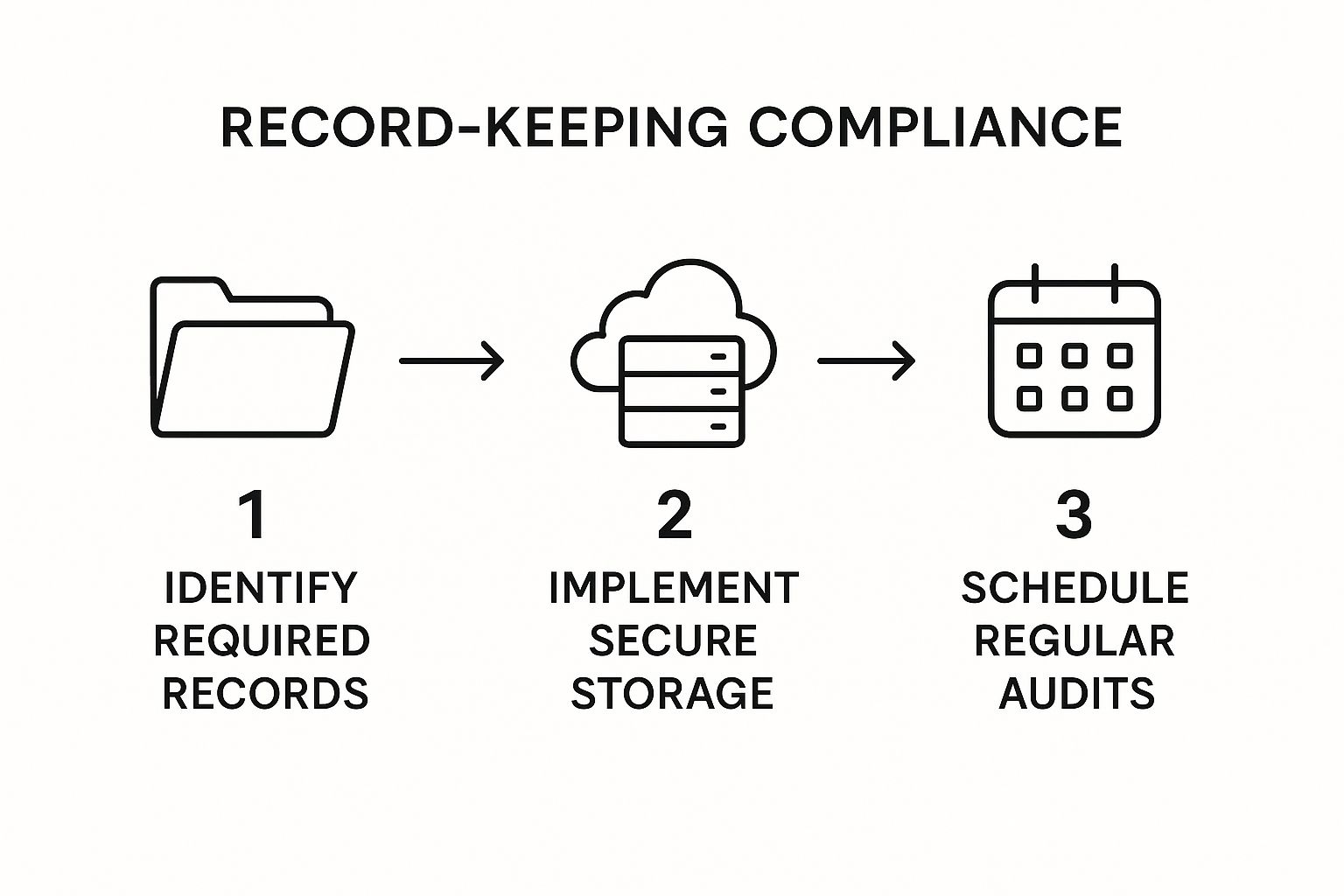
This is a continuous cycle: capture the record, store it correctly, and use it for reporting. This process keeps your books clean and organised.
Create Your Capture Routine
Consistency is the key to success. To prevent a backlog of paperwork, establish a routine for capturing every record as it is received. Make this a non-negotiable weekly task.
A Practical Tip: Dedicate 15 minutes every Friday to process the week’s paperwork. Use a receipt-scanning app on your phone to digitise paper dockets immediately. For example, after buying fuel for a work vehicle, snap a picture of the receipt before leaving the service station. This simple habit eliminates end-of-quarter panic.
Systemise Your Digital Storage
If you manage your own digital files, a logical folder structure is essential. A disorganised digital folder is as ineffective as an overflowing shoebox.
- Start with a master folder for each financial year (e.g., “FY2024”).
- Within that, create logical subfolders: “Income,” “Expenses,” “BAS Lodgements,” and “Payroll.”
- Adopt a consistent naming convention for every file, such as
YYYY-MM-DD_SupplierName_InvoiceNumber.pdf. This makes searching for documents effortless.
This structure allows you to locate any document in seconds—a critical advantage during an ATO audit. Remember, under legislation like the Taxation Administration Act 1953, your records must be easily accessible. A chaotic system is non-compliant.
Finally, schedule a quarterly check-in to review your records, identify any gaps, and ensure your system remains effective. These regular health checks maintain year-round compliance.
Don’t leave your business exposed. A weak record-keeping system can become a costly mistake. Book a consultation with EndureGo Tax today, and our experts will help you design a bulletproof, audit-ready system tailored to your business.
Common Questions About Australian Record Keeping
Navigating the complexities of these rules can be challenging. It’s natural to have questions. Here are clear, expert answers to the most common queries regarding record-keeping requirements in Australia.
What Are the ATO Penalties for Poor Record Keeping?
Failure to comply can have significant financial consequences. The Australian Taxation Office (ATO) imposes penalties for failing to keep or retain records as required by law.
Penalties are calculated using a base amount, which is then scaled according to the size of your business and the duration of non-compliance. For a small business, this could result in a fine ranging from a few hundred to several thousand dollars. However, the primary risk extends beyond the initial fine. Poor records often lead to incorrect tax assessments, which can snowball into a larger tax liability, interest charges, and even more severe penalties for making false or misleading statements.
Can I Just Use Bank Statements Instead of Keeping Receipts?
This is a common and dangerous misconception. The answer is unequivocally no; bank statements alone are not sufficient.
A bank statement proves that a transaction occurred, but it does not provide the necessary details to substantiate a business claim. A valid tax invoice or receipt contains the full story: the supplier’s ABN, a clear description of the goods or services purchased, and the amount of GST paid. Without this source document, you cannot legitimately claim a GST credit or a business deduction. This requirement is clearly defined in legislation such as the A New Tax System (Goods and Services Tax) Act 1999.
What Is the Best Way for a Sole Trader to Manage Records?
For sole traders, the optimal approach combines simplicity with consistency. The traditional shoebox full of crumpled receipts is an outdated and risky method. The modern, expert-recommended approach is to use a cloud accounting application on your smartphone.
Practical Tip: Develop the habit of using an app like Xero or MYOB to photograph every receipt at the moment of purchase. The software uses optical character recognition (OCR) to extract key data and automatically match the expense to your bank transactions. This transforms record keeping from a daunting quarterly task into a simple, two-second action you can perform on the go.
Feeling overwhelmed by the intricacies of Australian tax law? Don’t risk your business’s financial health. At EndureGo Tax, we provide expert, stress-free accounting and tax services for businesses and individuals in Ashfield and the Northern Beaches. From timely BAS lodgements to complex tax advice, we are committed to ensuring you remain compliant and achieve the best possible financial outcomes.
Take decisive action to secure your business’s compliance. Book your consultation today and experience the confidence that comes with having a trusted local expert on your team. Visit us at https://www.endurego.com.au to get started.
