


Let's get straight to it. 'Pty Ltd' stands for a Proprietary Limited company, and it's the go-to legal structure for most private businesses across Australia. If you're a local entrepreneur, tradie, or founder, think of it as building a legal fortress around your personal assets. It's a critical first step.
What Does Pty Ltd Actually Mean?
At first glance, the term can sound like a bit of legal jargon, but it's actually pretty straightforward when you break it down into its two parts: ‘Proprietary’ and ‘Limited’. Each word defines a key feature of how this type of business operates here in Australia.

The Two Core Components
- Proprietary (Pty): This simply means the company is privately held. You can't just offer its shares to the general public on the ASX. Ownership is capped at 50 non-employee shareholders, keeping it a tight-knit operation. For example, a family-run café in Belrose would be a proprietary company, owned exclusively by family members, not public investors.
- Limited (Ltd): This is the part that really matters to most business owners—it refers to limited liability. It creates a legal wall between your personal finances and the business's debts. This means your personal responsibility for company debts is generally restricted to the value of your shares. If you want to dive deeper into business lingo, a comprehensive business glossary can be a handy resource.
There's a reason this structure is so popular in Australia. A Pty Ltd company offers a powerful combination of asset protection and structural flexibility, making it the go-to choice for serious business owners aiming for growth while managing personal risk.
If you're running a business in Ashfield or Belrose and weighing up your options, understanding this distinction is the first step. To ensure this structure is the right move for your venture, book a no-obligation consultation with EndureGo Tax to discuss your specific needs.
Understanding the Power of Limited Liability
Ask any business owner why they chose a company structure, and you'll almost always hear the same two words: limited liability. It might sound like a bit of legal jargon, but in reality, it’s a powerful shield that protects what you’ve worked so hard to build. It's the whole point behind the Pty Ltd meaning.
Let’s put it into a real-world scenario. Imagine a local builder in Ashfield running their business as a sole trader. If a big project goes sideways and they end up with a mountain of debt, creditors can come after the builder’s personal assets. That means the family home, the car, even personal savings are all on the line. It's a scary thought.
Now, let's replay that scene with the builder operating as "Ashfield Constructions Pty Ltd". The business is now its own legal person, completely separate from the owner. If the company racks up debt, that debt belongs to the company, not the builder personally. This crucial separation is often called the 'corporate veil'.
The Corporate Veil Isn't Bulletproof
But—and this is a big but—that protection isn’t a get-out-of-jail-free card. The corporate veil can be pierced if a director acts irresponsibly or illegally. It’s absolutely critical to understand where the line is drawn to ensure your personal assets stay safe.
Here are a few key situations where a director can be held personally liable:
- Trading While Insolvent: If you keep taking on debts knowing the company can't pay its bills, you're breaking the law. This is one of the most serious breaches a director can commit.
- Providing Personal Guarantees: When you sign a personal guarantee for a business loan, you’re telling the bank, "If the company can't pay, I will." That makes your personal assets fair game if the business defaults.
- Director Penalty Notices: The ATO doesn’t mess around. They can make directors personally liable for the company's unpaid tax debts, like PAYG withholding for employees and superannuation contributions.
These rules aren’t there to trip you up; they exist to make sure directors run their companies with care and diligence. It’s all laid out in Australian law.
Under the Corporations Act 2001, directors have a legal duty to prevent insolvent trading. This reinforces that limited liability is a privilege you earn through responsible management, not an automatic right. You can dive into the details on the Australian government's legislation register.
For business owners in Belrose and across the Northern Beaches, understanding both the security a company offers and the responsibilities it demands is step one. Getting this structure right from the beginning can save you a world of pain down the track.
If you’re unsure how these rules apply to your business, don't guess. It pays to get expert advice. Book a consultation with EndureGo Tax today, and let's make sure your assets are properly protected from day one.
Pty Ltd Compared to Other Business Structures
Choosing the right business structure isn't just paperwork—it's one of the most important decisions you'll make. This choice sets the foundation for everything from your personal liability and tax obligations to how you can grow in the future.
What works for a tech startup gunning for investor funding won't be the right fit for a local café owner in Belrose. The best structure comes down to your unique business model, your appetite for risk, and where you see yourself in five years.
While the Pty Ltd structure is famous for its asset protection, it’s not the only game in town. Let's look at how it stacks up against the other common setups for Australian businesses.
The Simplicity of a Sole Trader vs. the Shield of a Company
When you're a sole trader, you are the business. It’s the simplest and cheapest structure to get off the ground, which is why so many people start here. But there's a catch, and it's a big one: you have zero asset protection. If the business racks up debt or gets into trouble, your personal assets—like your home and car—are on the line.
A partnership is where two or more people team up to run a business. It's great for pooling resources and skills, but it comes with unlimited liability for all partners. That means you’re personally on the hook not just for your own debts, but for those created by your business partners too. For many, that's a risk not worth taking.
This is where a company structure really shines. It creates what’s known as a ‘corporate veil’, a legal barrier that separates you from the business.
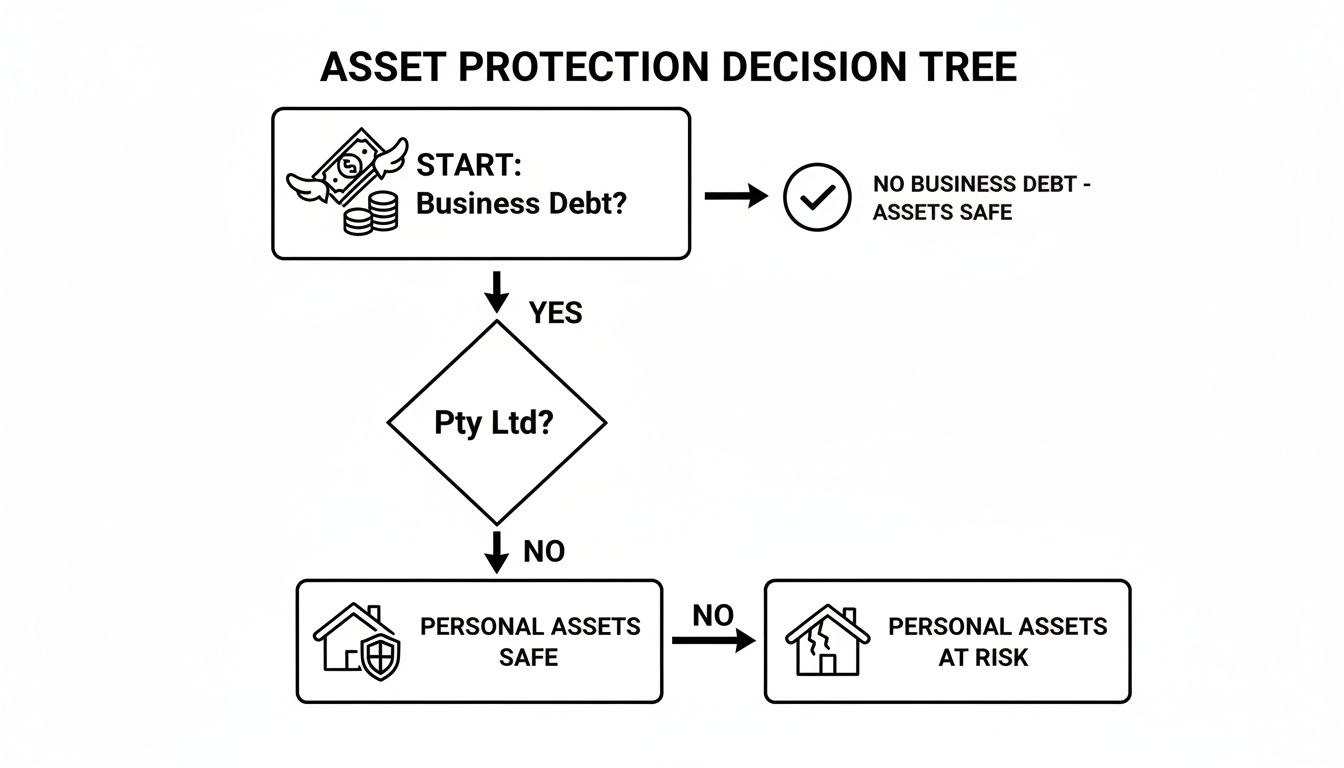
Simply put, this corporate veil is the most effective way to shield your personal wealth from any financial storms the business might face.
Business Structure Comparison: Pty Ltd vs Sole Trader vs Partnership
To make it even clearer, let's break down the key differences in a simple table. This side-by-side view really highlights what you gain—and what you give up—with each option.
| Feature | Pty Ltd Company | Sole Trader | Partnership |
|---|---|---|---|
| Asset Liability | Limited – Personal assets are generally protected. | Unlimited – Personal assets are at risk. | Unlimited – All partners are personally liable for debts. |
| Tax Rate | Fixed company rate (currently 25% for eligible businesses). | Taxed at your personal marginal income tax rates. | Each partner is taxed at their personal marginal rate. |
| Setup Complexity | More complex; requires ASIC registration and formal documents. | Simple; only requires an ABN for business activity. | Simple; an ABN and a partnership agreement are needed. |
| Ongoing Compliance | Higher; requires annual company tax returns and ASIC reviews. | Lower; reported as part of your personal tax return. | Moderate; requires a separate partnership tax return. |
| Business Succession | Easier to sell shares or transfer ownership. | Difficult; business ends when you stop trading. | Complex; partnership dissolves if a partner leaves. |
As you can see, while being a sole trader or partnership offers an easier start, a Pty Ltd company provides a much stronger, more formal structure built for growth and protection.
For a deeper dive, our guide on exploring business structures in Australia offers more detail on each of these.
This isn't a decision to make on a whim. If you're based in Ashfield or Belrose and are weighing up your options, book a consultation with EndureGo Tax. We'll sit down with you, understand your vision, and help you choose the structure that gives your business the best possible start.
Your Core Responsibilities as a Company Director
Stepping into the role of a company director is a huge achievement, but it’s not just a title—it comes with serious, legally binding responsibilities. This goes way beyond day-to-day management. It’s about solid governance and meeting the standards set by the Australian Securities and Investments Commission (ASIC). Really understanding the pty ltd meaning means getting your head around these crucial duties.

Your obligations are laid out in the Corporations Act 2001, and they aren't optional. At the end of the day, these duties boil down to acting with care, diligence, and always in the best interests of the company. Think of yourself as a guardian of the business, trusted to protect its value and make sure it operates both ethically and legally.
Key Director Duties You Must Know
Getting this wrong can have massive consequences, so you need to be crystal clear on what the law expects from you. These rules are in place to protect the company, its shareholders, and anyone it owes money to.
Here are the big ones you absolutely have to uphold:
- Act in good faith: Every single decision must be for the benefit of the company as a whole. No personal agendas allowed.
- Use care and diligence: You have to stay informed about the company's financial health and make sensible decisions that any reasonable director would in your shoes.
- Avoid conflicts of interest: You can’t use your position or inside knowledge to get a personal leg-up or do anything that could harm the business.
- Prevent insolvent trading: This one is critical. You must ensure the company can pay its bills as and when they're due. If you keep trading while the company is insolvent, the limited liability protection can disappear, and you could be held personally responsible.
“A director has a duty to prevent the company from incurring a debt if there are reasonable grounds for suspecting that the company is, or would become, insolvent.” – Corporations Act 2001, Section 588G
On top of these core duties, there's the ongoing compliance work, like lodging an annual statement with ASIC and letting them know about any major company changes. Ignoring these obligations can land you in hot water, so it's vital to understand what director penalties are and how to avoid them.
The role of a director demands a lot of personal commitment. Finding effective strategies for balancing personal and career growth is key to avoiding burnout on your entrepreneurial journey.
If you need a hand staying on top of your compliance, book a consultation with EndureGo Tax. As registered ASIC agents, we can take care of all the secretarial duties, freeing you up to focus on what you do best—running your business.
Financial and Reporting Obligations for a Pty Ltd Company
Right, so you’ve set up your Pty Ltd company. The benefits are huge, but it also means you’re officially playing in the big leagues when it comes to financial and reporting duties.
Getting your head around your obligations to the Australian Taxation Office (ATO) and the Australian Securities and Investments Commission (ASIC) isn’t just a good idea—it’s non-negotiable. This is what the pty ltd meaning translates to in the real world.
Think of it this way: your company is now its own person in the eyes of the law, and it gets taxed like one. Unlike a sole trader where your business and personal income are lumped together, your company pays tax at the corporate tax rate on its profits. This separation is fantastic for protecting your personal assets, but it demands sharp financial management.
Staying on the Right Side of the ATO and ASIC
You’ve now got two main regulators watching over you: the ATO and ASIC. They have very different jobs. The ATO is all about your taxes, while ASIC makes sure your company is run by the book. Drop the ball with either, and you could be facing some serious penalties.
Here’s a quick rundown of what’s on your plate:
- Lodge an Annual Company Tax Return: This is completely separate from your personal tax return. It’s where you’ll detail the company’s income, spell out its expenses, and figure out the tax it owes.
- Manage Your Business Activity Statements (BAS): If you’re registered for GST (and most businesses are), you’ll need to lodge a regular BAS. This is how you report and pay the GST you've collected and claim back any GST you've paid on business expenses.
- The ASIC Annual Review: Every year, ASIC will send you an annual statement. Your job is to check that all your company details are correct, pay the annual review fee, and give them the green light. It’s a health check to keep the public register up to date.
It’s easy to see why this structure is so popular. Australia's top proprietary businesses—most of them Pty Ltd companies—pulled in a staggering $396.3 billion in revenue. That shows you just how powerful and resilient this model is. You can dig deeper into these numbers in IBISWorld's research on Australia's top private companies.
Staying on top of these duties isn't just about dodging fines. It's about protecting the integrity of your company and making sure that limited liability shield you set it up for stays strong and secure.
For small business owners in Ashfield and Belrose, juggling these dual responsibilities can feel like a full-time job in itself. That’s where we come in. As registered tax and ASIC agents, EndureGo Tax can take all that compliance work off your hands, so you can get back to what you do best—growing your business.
Ready for some peace of mind? Book a consultation with us today.
Ready to Set Up Your Pty Ltd Company? Here’s How to Do It Right.
So, you’ve decided a Pty Ltd company is the right structure for your business. Fantastic. The next step is making it official, which means registering your company with the Australian Securities and Investments Commission (ASIC). This is the moment your business transforms from an idea into a distinct legal entity.
But this isn’t just a box-ticking exercise. The setup process involves several crucial steps, from picking a unique company name to appointing directors who will be legally on the hook for its governance. It might look like a simple checklist, but getting a small detail wrong now can lead to massive compliance headaches and legal dramas down the track.
The Key Registration Steps
Before you can legally trade, you need to lay the right foundations. Getting these steps right from the very beginning is your ticket to a much smoother journey ahead.
- Reserve a Unique Company Name: Your chosen name can’t be the same as an existing company or business name. A quick search on the ASIC register should be your first port of call to make sure your name is available.
- Appoint Directors and Shareholders: You’ll need to appoint at least one director who lives in Australia. You also need to issue shares to the shareholders, which officially defines who owns what slice of the company.
- Prepare Key Documents: This involves getting written consent from your directors and shareholders and either drafting a company constitution or choosing to use the standard 'replaceable rules' in the Corporations Act 2001.
Navigating shareholder agreements and dense legal documents on your own is a huge risk. A poorly structured company can easily lead to disputes between owners and expose you to personal liability—completely defeating the purpose of setting up a company in the first place.
This is exactly where getting professional guidance pays for itself. Instead of trying to decipher complex legal requirements by yourself, partnering with an expert ensures your company is built for success from day one. For a more detailed walkthrough, you can learn more about how to set up a company in Australia.
Don't leave your business's future to guesswork. Book a consultation with EndureGo Tax today. We'll handle the entire ASIC registration for you, making sure every detail is spot on. It gives you the peace of mind to focus on what you do best—running your business.
Common Pty Ltd Questions Answered
Once you get your head around the basics, a few practical questions always pop up. It’s one thing to understand the theory, but another to know how it works day-to-day. Here are some of the most common queries we get from business owners in Ashfield and Belrose.
Can I Be the Only Director and Shareholder?
Yes, you absolutely can. In Australia, it’s completely fine to set up a proprietary company with just one person who is both the sole director and the sole shareholder.
This is actually a very popular and practical setup for consultants, contractors, and solo entrepreneurs who want the protection of limited liability without the complexity of multiple partners.
How Do I Pay Myself From My Pty Ltd Company?
This is a big one, and getting it right is crucial for your tax position. You can’t just take money out of the company account whenever you like. There are two main ways to pay yourself:
- As an Employee (Salary or Wages): You can put yourself on the payroll and draw a regular salary. The company then has to withhold PAYG tax and pay super for you, just like any other employee.
- As a Shareholder (Dividends): You can receive a portion of the company's profits, which are paid out as dividends.
Often, the smartest strategy is a combination of both. It really depends on your personal financial situation, so it's something you should definitely discuss with a tax professional.
What Happens if I Want to Close My Company?
Winding up a company isn't as simple as just shutting the doors. If the business is solvent (meaning it can pay all its debts), you can apply for a voluntary deregistration with ASIC. It's a formal process that requires all the company members to agree.
But if the company is insolvent and can't pay its bills, you're looking at a more complex liquidation process, which is governed by the Corporations Act 2001. You can find the specific legislation on the official ATO website.
From setting up your company to navigating its growth and even planning an exit, expert guidance makes all the difference. As your trusted local accountant in Ashfield and Belrose, EndureGo Tax is here to give you that peace of mind.
Ready to get it right from the start? Book a chat with us today by visiting https://www.endurego.com.au.
