


You’ve got your ABN sorted. Maybe you’ve set up a company because someone told you it looks more professional. You’ve landed a solid contract in the Inner West or on the Northern Beaches, and you’re finally operating on your own terms.
Then someone mentions personal services income, and suddenly the whole setup feels shaky.
That reaction is normal. Personal services income catches plenty of capable tradies, contractors, consultants, and freelancers off guard because the business structure looks right on paper, but the ATO looks deeper. It asks a simpler question. Is the client paying your business for a genuine business operation, or are they mainly paying for you?
If you get that answer wrong, the tax consequences can be expensive. If you get it right early, you can structure your contracts, records, and invoicing properly and avoid a lot of stress later.
Starting Your Business Journey The PSI Hurdle
A common scenario goes like this. A chippy in Belrose decides to go out on his own, registers a company, opens a business bank account, buys insurance, and signs a major contract with one builder. On the surface, everything looks like a proper business.
Then tax time arrives, and the question isn’t whether he has a company. The question is whether the income is really his personal services income.

Why this trips people up early
New business owners often assume three things that don't always hold up:
- ABN means business income: It doesn’t automatically.
- Company means protection from PSI rules: It doesn’t by itself.
- One big contract is a great start: Commercially, yes. For PSI risk, sometimes no.
That’s why the issue usually appears right at the beginning of the business journey. The structure gets set up first, but the tax character of the income only becomes clear once the work, invoices, and client mix are reviewed.
If you’re still sorting the basics, a practical starting point is this ABN registration guide. It helps with setup, but setup alone won’t answer the PSI question.
Contracts matter more than most tradies realise
The wording in your contract often tells the complete story. If the contract says you’re effectively selling your labour by the hour or day, that’s a very different position from a contract that says you’re engaged to deliver a defined result, with your own tools, your own risk, and responsibility to rectify defects.
That’s one reason good paperwork matters before the first invoice goes out. If you need a starting point for cleaner engagement documents, these Contract Templates can help you think through scope, deliverables, and responsibility in a more business-like way.
Practical rule: If your paperwork reads like labour hire, the ATO may treat the income that way, even if you’ve traded through a company.
Understanding the issue
PSI isn’t a niche tax trap for corporate consultants. It shows up for electricians, plumbers, IT contractors, designers, engineers, and specialist trades. It’s especially relevant when one person’s skill, licence, experience, or effort is the main thing the client is paying for.
That’s why this matters in places like Ashfield, Belrose, and across Sydney. Plenty of good operators have built legitimate businesses, but their contracts, client mix, and records don’t always support the tax treatment they expect.
What Is Personal Services Income And Why Should You Care
Personal services income is income that mainly comes from an individual’s own labour, skills, or expertise. In Australia, personal services income is defined as income where more than 50% of the payment is for an individual's personal labour or skills. If this threshold is met, attribution rules mandate the income is taxed in the hands of the individual performer, limiting income splitting and deductions (MGI SQ explanation of PSI).

The easiest way to think about it
Ask one question.
What is the client really paying for?
If they’re paying mainly for your hands-on effort, judgement, trade knowledge, design skill, coding ability, or professional expertise, that points toward PSI. If they’re paying mainly for a business that delivers outcomes through equipment, systems, staff, premises, or saleable products, that points away from PSI.
A simple analogy helps.
| Situation | What the client mainly pays for | Likely PSI position |
|---|---|---|
| Painter engaged for labour-heavy work | Personal skill and time | More likely PSI |
| Business selling packaged materials or products | Goods or business assets | Less likely PSI |
| Consultant solving a technical problem personally | Expertise and effort | More likely PSI |
| Trade business using a team and business systems to deliver a project | Broader business operation | Less likely PSI |
Why tradies and contractors get caught
A lot of small business owners hear “I’ve got tools, a ute, insurance, and a company, so I’m clearly a business”. That may be commercially true, but PSI rules don’t stop there.
For tax purposes, the ATO looks at the underlying source of the income. A sole operator electrician might own expensive gear and still earn PSI if the contract value mainly reflects that electrician’s labour and skill rather than equipment or a broader business structure.
If your name, licence, experience, and effort are the main reason the client is paying, PSI needs to be considered before anything else.
Why you should care
The consequences aren’t just technical. They affect your cash flow and planning.
When income is treated as PSI, the ATO can look through a company or trust for that income and push it back to the individual who did the work. That changes how the income is taxed and restricts some deductions that people assume are available because they’re “in business”.
Many business owners feel blindsided by this. They’ve done what seemed sensible, only to find the structure doesn’t deliver the tax outcome they expected.
A practical example
Take a Northern Beaches contractor who bills a client for site supervision, project coordination, and specialist trade advice. The invoices may include some materials and incidental expenses, but if the bulk of the payment reflects the contractor’s own expertise and labour, that income can still be PSI.
The right response isn’t panic. It’s analysis.
Look at each contract. Break down what the client is paying for. Review invoice wording. Check whether the work is result-based or labour supplied through an entity.
That’s the point where PSI stops being abstract and becomes a real compliance issue.
The ATO Gateway Test Understanding The 80% Rule
The 80% rule is the first serious checkpoint. Once your income is personal services income, the next question is whether you’re heavily reliant on one client.
According to Oracle Accounting and Advisory’s PSI guide, if 80% or more of an entity’s PSI comes from a single client, PSI rules automatically apply. The same source says this leads to reattribution in approximately 60% of audited cases, often increasing effective tax rates by 15-25%.

Why this rule matters so much
This isn’t a minor technical threshold. It changes what options are open to you.
If one client provides that level of your PSI for the year, you don’t have the same flexibility to self-assess your way out of the rules. That’s why one major builder, one labour-hire arrangement, or one long-running consultancy engagement can create problems even if the work itself looks independent from day to day.
For many first-year contractors, this is exactly what happens. One big client feels like stability. From a PSI perspective, it can look like dependence.
What counts as a red flag
The pattern matters as much as the paperwork. These situations usually deserve a closer look:
- Single-client year: Most or all income comes from one builder, one agency, or one business group.
- Long placement: You work continuously for the same payer on similar terms.
- Invoice pattern: Bills are regular and labour-based, rather than tied to clear project milestones.
- Low market visibility: No website, no active quoting, no broader client acquisition effort.
None of those facts alone settles the issue. Together, they often point to a PSI review.
A practical Sydney example
A contractor in Ashfield sets up a Pty Ltd and takes a year-long engagement with one property group. He invoices monthly for project management and technical advice. He works independently, but almost all of the PSI comes from the one source.
That arrangement may still be commercially sound. The problem is that commercial logic and PSI treatment aren’t the same thing.
Heavy reliance on one client is where many otherwise well-run small businesses start to look exposed under the PSI rules.
What works and what doesn’t
A few patterns help. Others don’t.
| Approach | Usually helps | Usually doesn’t help |
|---|---|---|
| Building a broader client base | Yes | |
| Tying contracts to clear deliverables | Yes | |
| Invoicing through a company | Yes | |
| Calling yourself a contractor without changing the work model | Yes | |
| Keeping proof of market activity and separate negotiations | Yes |
The key trade-off is straightforward. One major client can make operations simpler, but it can also make your PSI position harder to defend. That doesn’t mean you should refuse good work. It means you should understand the tax cost of concentration before the year ends.
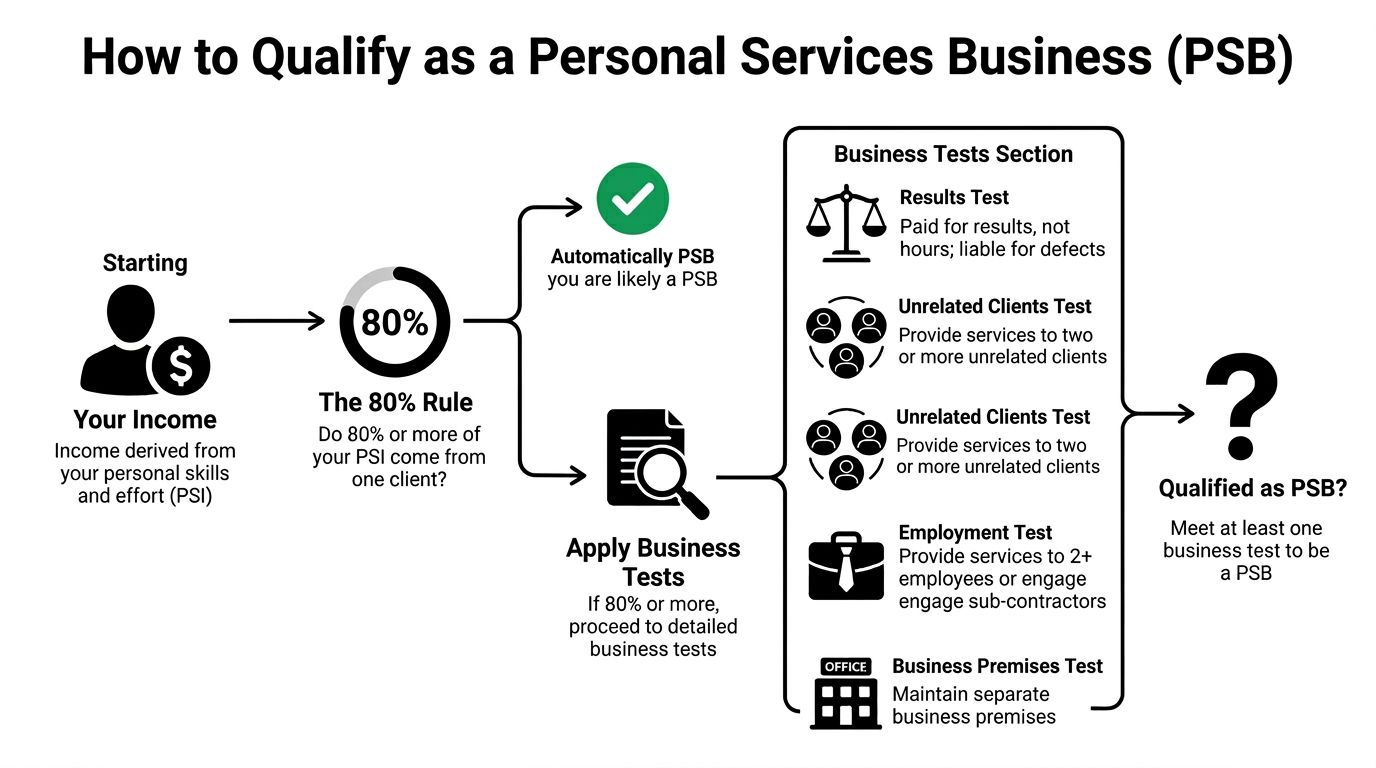
How To Qualify as a Personal Services Business PSB
A Personal Services Business, or PSB, is the position most contractors want if they’re earning PSI. You can still be earning personal services income and yet be treated as a genuine business for tax purposes if you satisfy the relevant tests.
That matters because PSB status is what separates a business operator from someone whose income gets pulled back into the restrictive PSI rules.
Start with the right sequence
Many people go wrong here. They jump straight to “I’ve got multiple clients” or “I use my own tools” without working through the tests in the right order.
The sensible sequence is:
- Work out whether the income is PSI
- Check whether one client dominates the year
- Assess whether a PSB test is satisfied
- Keep records that support the conclusion
That order matters because the tests aren’t interchangeable.
The results test
This is usually the strongest test, but it’s also the one people overestimate.
The usual practical markers are that you’re engaged to produce a specific result, you provide your own tools or equipment, and you’re responsible for fixing defects at your own cost. If your paperwork and conduct support those points, your position is stronger.
A tradie who quotes for a defined stage of work, supplies the key tools, and wears the cost of rectification is in a better position than someone who turns up and bills hours every week.
What doesn’t work is dressing up hourly labour as a “project” when there’s no real outcome-based arrangement behind it.
The unrelated clients test
This test is often relevant for consultants and smaller service operators in the Inner West.
The practical idea is that you’re getting work from different, unrelated clients and holding yourself out to the market. That means public visibility matters. A proper website, business listings, quotes, proposals, and independent client negotiations all help show you’re operating as a business rather than relying on a single payer.
A contractor with several unrelated clients, separate scopes, and active marketing usually has a stronger story than someone whose “multiple clients” are really all part of one chain of referrals under near-identical terms.
A strong PSB position usually shows up in the documents before it shows up in the tax return.
The employment test
Genuine scale becomes important here.
If other people perform part of the principal work, not just admin support, that can strengthen the position that the income comes from a business structure rather than one person’s effort alone. The substance matters here. Family admin help and bookkeeping support don’t prove the same thing as labour or technical work delivered by employees or subcontractors.
For a trade business, this may involve apprentices, qualified staff, or independent subcontractors doing meaningful project work. For a consulting business, it may mean delivery staff, analysts, or technical specialists supporting the core engagement.
The business premises test
This test tends to be overlooked because many small operators work from home, from site, or from a vehicle.
A dedicated business premises that is separate from home and used for business activities can support a PSB position. In practice, though, many tradies and contractors won’t rely on this test because their work model doesn’t naturally fit it.
That doesn’t mean they’re stuck. It just means they’ll usually need to rely more on the results test, unrelated clients test, or employment test.
What tends to work in the real world
These practical habits usually put business owners in a better position:
- Scope-based contracts: Clear deliverables beat vague labour supply wording.
- Separate quoting process: Quotes, approvals, and negotiated terms support business-like conduct.
- Visible marketing: Website, local directory presence, and documented lead generation all help.
- Team-based delivery: Having others perform real work strengthens the business case.
- Rectification clauses: Taking responsibility for defects is a business indicator.
What usually fails under review
The weak patterns are familiar:
- One person does everything: The structure exists, but there’s no business substance behind it.
- Invoices track hours only: That often looks like labour, not result-based work.
- No evidence of market activity: If no one can see how you win work, the unrelated clients argument is weaker.
- Entity without separation: A company with no operational difference from the individual rarely solves PSI by itself.
The trade-off to understand
Trying to “beat PSI” with paperwork alone usually fails. Building a genuine business model takes more effort, but it gives you a stronger tax position because the facts line up with the treatment.
If you want PSB treatment, the practical question isn’t “which box can I tick?”. It’s “does my business operate like a business?”.
Tax Treatment When The PSI Rules Apply
When the PSI rules apply and you don’t qualify as a PSB, the tax outcome becomes narrower and more personal.
The main effect is income attribution. The relevant net income is attributed to the individual who performed the work, rather than staying where many owners expect it to stay, such as inside a company or trust.
What that means in practice
If you’ve been operating through a company, you might assume the company keeps the profit and then decides how and when money is paid out. PSI treatment can cut across that assumption.
The ATO’s approach is aimed at stopping people from using an entity as a wrapper around one person’s labour. So the analysis shifts from “what entity received the money?” to “who earned it through their own effort?”.
For business owners, that affects several things at once:
- Who reports the income: The performer becomes the tax focal point.
- How deductions are viewed: The claim set can narrow.
- How payroll obligations are handled: PAYG and related obligations may need attention.
- How family planning works: Splitting opportunities become much more limited.
Deduction restrictions matter more than commonly expected
This is often where disappointment hits hardest. People usually focus on the entity and tax rate, but the deduction rules are just as important.
Once PSI treatment applies, the general position is that deductions are restricted toward what an employee could typically claim in a comparable situation. That means some claims people expect in a business structure may not be available in the way they thought.
A good practical discipline is to review every expense category and ask, “Would this still stand up if the income is attributed back to the individual?”
The common myth about family splitting
Plenty of articles oversimplify this area by saying PSI always blocks all splitting. The more accurate position is narrower.
According to Accountant Business on personal services income, recent ATO rulings, including TR 2023/1, permit limited splitting if the entity passes certain business-like tests, which challenges the idea that there is “no splitting ever”.
Don’t assume a company or trust gives you tax flexibility just because it exists. PSI can override the structure if the facts point back to one person’s effort.
A quick comparison
| Issue | PSI rules apply | PSB treatment applies |
|---|---|---|
| Income focus | Individual performer | Business entity treatment is more available |
| Deduction approach | More restricted | Broader business deductions may be available |
| Splitting flexibility | Limited | More room, subject to facts and compliance |
| Compliance pressure | Higher | Still important, but more conventional |
If you’re a sole trader and want a clearer grounding in how business income is generally taxed, this guide on how sole traders pay tax is a useful companion. PSI sits on top of those basics and can change the result.
What works best when PSI is likely
The best move is usually early recognition, not late defence.
If the facts point toward PSI, deal with it properly in the books, records, and return position. Trying to force a business treatment after the year is over is usually harder than structuring and documenting the work correctly from the start.
PSI in Practice Examples for Sydney Contractors
Generic PSI articles often miss the local reality. In Sydney, plenty of tradies and contractors work in ways that look independent on the surface but still create PSI risk underneath.
That’s especially true where one trade licence, one person’s expertise, and one dominant client drive most of the income.
Example one, the Belrose electrician
A Belrose electrician operates through a company and takes on a major builder as the main source of work. He supplies specialised tools, a van, testing gear, and consumables. He assumes that because he has equipment and insurances, the income sits safely in the company.
But the invoice breakdown tells a different story.
If the labour component is more than 50% of the value, the income can be PSI. That issue is especially important for tradies because gear alone doesn’t always change the character of the income. As noted in The Real Thiel’s article on personal services income, for tradies in areas like the Northern Beaches, PSI rules are nuanced. Even with significant personal tools, if invoices show labour is over 50% of the value, PSI applies. The same source says the ATO’s compliance focus on gig economy tradies via data-matching with Service NSW has increased audit risk in these areas.
That means the electrician’s strongest defence usually isn’t “I own tools”. It’s stronger contracts, a clearer result-based arrangement, and records that show a genuine business model.
Example two, the Ashfield IT consultant
An Ashfield consultant provides cyber security reviews, systems advice, and managed support to a mix of unrelated small business clients. She wins work through referrals, a public website, and direct proposals. Her contracts vary by project, and she’s not tied to one dominant payer.
Her income may still be personal services income because clients are engaging her expertise. But the risk profile is different from the single-client tradie example.
What helps here is the pattern of operation:
- Different clients
- Separate negotiations
- Public market presence
- Distinct scopes of work
That’s the sort of fact pattern that often looks more business-like.
Example three, the plumber using software properly
A plumber in the Inner West quotes jobs through estimating software, separates labour and materials clearly, and tracks margins by job rather than just sending rough invoices after the fact. That doesn’t solve PSI by itself, but it improves the quality of evidence.
Tools like Exayard construction estimating software can help tradies produce cleaner quotes and records, especially where the split between labour, materials, and project stages matters. Better records don’t change the law, but they can make the tax position much easier to defend.
Good software won’t turn PSI into non-PSI. What it does is give you clearer evidence of what you sold and how the job was priced.
Local red flags I’d take seriously
For contractors around the Northern Beaches and Inner West, these patterns deserve attention:
| Red flag | Why it matters |
|---|---|
| One builder or agency controls the year | High concentration often weakens the business argument |
| Invoices say “labour” without detail | Harder to prove a broader commercial arrangement |
| No website, no quote trail, no marketing | Unrelated client position becomes weaker |
| Spouse paid without clear role or market basis | Income splitting risk increases |
| Company exists but work is still one-person dependent | Entity alone won’t solve PSI |
What usually works better
The operators who handle PSI well usually do a few practical things consistently. They review contract wording before signing. They avoid vague labour-only billing where possible. They document market activity. They separate admin support from principal work. They keep job records that tell a coherent business story.
That’s what moves PSI analysis from guesswork to evidence.
Your PSI Compliance and Record-Keeping Checklist
The best PSI strategy is boring in the right way. Clear contracts. Clean invoicing. Consistent records. A position you can explain without scrambling at tax time.
The legal framework sits in Divisions 84 to 87 of the Income Tax Assessment Act 1997, which the ATO sets out in its ITAA 1997 PSI legislation reference.
Your working checklist
Use this as a practical review list each year.
- Check each contract: Identify whether the client mainly paid for your labour, skill, or expertise, or whether the engagement was broader than that.
- Review client concentration: Look at who paid you across the year and whether one payer dominates the picture.
- Match facts to the right test: Don’t pick a preferred answer first. Work from the contract terms, invoicing pattern, and delivery model.
- Keep support for your market activity: Save website screenshots, proposals, quote requests, directory listings, and emails showing separate negotiations.
- Document who did the work: If staff or subcontractors were involved in the principal work, keep evidence that shows their real contribution.
- Store premises and equipment records carefully: Lease documents, business-use evidence, and job records all matter if your position depends on them.
Record-keeping that helps
Messy records create PSI problems even where the underlying facts are not terrible.
The strongest files usually include:
- Signed contracts
- Detailed invoices
- Quote and acceptance trail
- Proof of advertising or public marketing
- Payroll or subcontractor records
- Notes explaining unusual arrangements
If your current systems are patchy, this guide to record-keeping requirements in Australia is a practical place to tighten things up.
When to get advice
Some PSI positions are straightforward. Many are not.
Get help if any of these apply:
- One major client drives the year
- You’ve set up a company or trust mainly for tax planning
- You want to pay family members from the business
- Your contract wording doesn’t match how the work is really done
- You’re unsure whether your deductions still stand if PSI applies
The best time to review personal services income is before lodgement, not after an ATO query lands.
A lot of stress can be avoided with one proper review of contracts, client mix, invoices, and deductions before the return goes in. That’s usually far cheaper than trying to unwind a bad position later.
If you want clear advice on personal services income, contractor tax, BAS, company structures, trust compliance, or audit-ready record keeping, speak with EndureGo Tax. As your trusted local accountant in Ashfield and Belrose Northern Beaches, EndureGo Tax helps tradies, consultants, and small business owners get the structure right, stay compliant, and move forward with peace of mind.
