


If your Australian business is juggling multiple software for sales, inventory, and accounting, you understand the operational friction. That disconnect isn’t just inefficient—it’s a significant barrier to growth. This is where Odoo Australia steps in, offering a powerful, all-in-one Enterprise Resource Planning (ERP) solution that acts as the central nervous system for your entire operation. It’s the strategic reason a growing number of Aussie SMEs are turning to Odoo to streamline processes and build a scalable foundation for the future.
Why Australian Businesses Are Strategically Adopting Odoo
Many businesses in Australia begin with a patchwork of software. You might use one tool for customer relationships (CRM), another for managing stock, and a separate one for bookkeeping. While functional initially, this approach inevitably creates data silos—critical information trapped within individual applications.
This separation leads to extensive manual, repetitive work. For example, your sales team closes a deal, then an administrator must manually key that same data into the inventory system to update stock levels. Following that, it’s entered again into the accounting software to generate an invoice. This isn’t just slow; it’s a prime recipe for costly human errors.
The Power of a Unified System
Odoo eliminates this systemic problem by integrating all business functions onto a single, unified platform, serving as the central hub for your entire company.
When a sale is recorded in the CRM module, your inventory is automatically updated, and the accounting ledger is instantly populated. There is no double-handling and no manual entry. This seamless information flow provides a real-time, 360-degree view of your business. You no longer need to waste hours compiling reports from disparate software to gain a clear picture of performance. With Odoo, every department operates from the same set of accurate, up-to-the-minute data.
The core value proposition of Odoo for Australian businesses is its ability to centralise and automate operations. It provides a direct solution for how to automate business processes to drive genuine efficiency and sustainable growth.
A Growing Market for Integrated Solutions
It’s no surprise that the demand for integrated systems is accelerating. The Australian ERP software market is valued at approximately USD 930.2 million in 2024 and is projected to reach USD 1170.6 million by 2030. Odoo’s flexible, modular architecture makes it a formidable contender in this expanding market, particularly for businesses requiring a solution that can scale with them.
Key Advantages for Australian SMEs
For small to medium-sized enterprises (SMEs), the benefits are substantial. Odoo offers a solution that grows with you. You can start with essential modules like Sales and Accounting and add others like Manufacturing or Project Management as your business evolves. This scalability ensures you are not overinvesting in features you don’t yet need.
Here are the key wins:
- Reduced Manual Data Entry: Automation eradicates repetitive tasks, freeing your team to focus on high-value activities.
- Enhanced Accuracy: With a single source of truth, the risk of errors from transferring data between systems is virtually eliminated.
- Informed Decision-Making: Access to real-time, comprehensive data empowers you to make sharper, more strategic decisions.
Is your business struggling with disconnected software and inefficient workflows? Analyse your current systems now. Identifying these pain points is the first step toward building a more streamlined and profitable operation with Odoo Australia. Take the next step by mapping your processes and scheduling a discovery call with an expert.
Understanding Odoo Modules for Australian Operations
Think of Odoo’s modules like LEGO bricks for your business. Each brick serves a specific function—sales, inventory, accounting—but when connected, they build a powerful, seamless system. This is the core strength of Odoo for Australian businesses: you select only the bricks you need.
Instead of being constrained by a rigid, one-size-fits-all software package, you construct a system that perfectly fits your operational model. For Australian SMEs, this flexibility is invaluable. It means you can adapt dynamically without paying for features you will never use.
Let’s examine how Odoo’s core modules integrate to provide a single, unified view of your entire business.
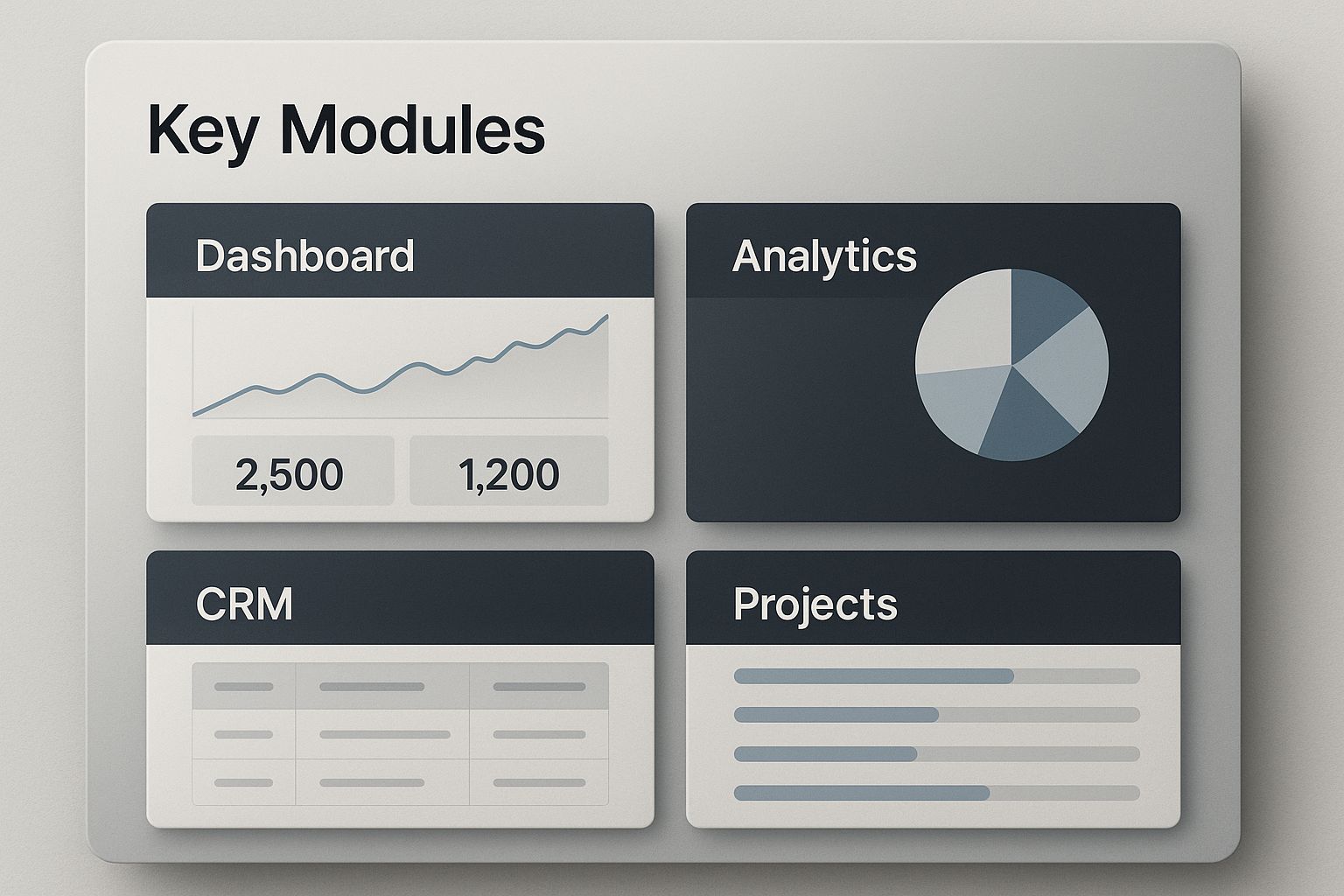
This image illustrates the concept perfectly. You have distinct software panels for each business function, but they all reside on one screen, sharing information seamlessly. The key takeaway is integration. Data from sales automatically informs your inventory, which in turn updates your accounting. No more double-handling.
Odoo Module Breakdown for Australian Business Functions
This table outlines how key Odoo modules solve specific challenges for Australian businesses, helping you pinpoint exactly what your operation needs to improve efficiency and drive growth.
| Module | Primary Business Function | Key Benefit for Australian SMEs |
|---|---|---|
| CRM | Lead & Opportunity Management | Tracks every customer interaction from first contact to final sale, creating a clear sales pipeline and improving conversion rates. |
| Sales | Quoting & Order Processing | Converts a lead into a sales order in a few clicks, automatically initiating the internal fulfilment process. |
| Inventory | Stock Control & Warehousing | Provides a real-time view of stock levels across all locations, preventing overselling and optimising stock turn. |
| Accounting | Financial Management & Compliance | Automates invoicing, bank reconciliation, and bookkeeping, ensuring ATO compliance and accurate financial reporting. |
| Project | Task & Project Management | Organises workloads, tracks deadlines, and allocates resources for service-based businesses to improve project profitability. |
| Manufacturing | Production Planning & Control | Manages bills of materials (BOMs), work orders, and production schedules for local manufacturers, increasing output. |
Ultimately, this modular setup ensures you’re investing in a solution that grows with you, not one that holds you back.
The Customer Journey Hub: CRM and Sales
Every sale originates with an interaction. Odoo’s Customer Relationship Management (CRM) module is where you track every engagement—from the initial phone call to follow-up emails. It provides your sales team with a clear pipeline, enabling accurate revenue forecasting and identifying at-risk deals.
Once a prospect agrees to purchase, the Sales module takes over. It converts the CRM opportunity into a formal sales order with a single click. This is where the power of integration becomes tangible.
Practical Example: Consider a wholesale distributor in Brisbane. A new lead for a large order is logged in the CRM. All communications are attached to the record. When the client approves the quote, the salesperson converts it to a sales order, which instantly triggers alerts in the warehouse and finance departments.
Real-Time Stock Control: Inventory
As soon as that sales order is confirmed, Odoo’s Inventory module acts. It checks stock levels in real-time, reserves the required products, and can even trigger an automatic purchase order to a supplier if stock falls below a predefined threshold. This prevents the common problem of selling stock you don’t have.
For Australian businesses with warehouses in multiple cities—say, Sydney and Perth—it provides a unified view of every item, regardless of location. This level of control is non-negotiable for running an efficient supply chain.
The Inventory module is the physical backbone of your business. It connects customer demand directly to the stock on your shelves, replacing guesswork with certainty and ensuring you can deliver what you promise, every time.
The Financial Core: Accounting
Every transaction in the Sales and Inventory modules has a financial impact, which Odoo’s Accounting module captures automatically. When the sales order is fulfilled and goods are dispatched, an invoice is generated without manual intervention from your bookkeeper.
This seamless data flow provides an accurate, up-to-the-minute view of your company’s financial health. It also simplifies tax compliance by ensuring every transaction is recorded correctly from the outset. Meeting Australian tax obligations is critical; for instance, payroll accuracy is fundamental. You can deepen your understanding of modern payroll systems with our guide on Single Touch Payroll compliance, an essential resource for any local employer.
How It All Connects
Let’s return to our Brisbane wholesale distributor to see this integrated workflow in action:
- Lead to Quote (CRM): An enquiry for 1,000 units is logged and tracked in the CRM.
- Quote to Sale (Sales): The quote is approved and converted into a sales order.
- Stock Allocation (Inventory): The Inventory module checks the Brisbane warehouse, sees 1,500 units are available, and reserves 1,000 for this order. The system now shows only 500 units are available to sell.
- Automated Invoicing (Accounting): Once delivery is confirmed, the Accounting module automatically generates an invoice for 1,000 units and emails it to the customer.
- Financial Reporting: The revenue from that sale instantly appears in your profit and loss statement, providing a live view of your performance.
This entire sequence occurs within a single system, eliminating repetitive data entry and dramatically reducing the risk of human error. This is the core purpose of an integrated system like Odoo Australia—it creates a single source of truth that helps you make smarter, faster decisions.
Mastering ATO Compliance with Odoo
Navigating Australian Taxation Office (ATO) regulations is a significant challenge for any business. From Goods and Services Tax (GST) to payroll, compliance errors can lead to serious penalties. A properly localised ERP like Odoo Australia transitions from being just a tool to becoming your most effective compliance safeguard.
Odoo has been specifically adapted for the Australian market, with built-in features designed to automate and simplify your most significant tax obligations, removing guesswork and ensuring compliance.
Effortless GST and BAS Reporting
Lodging a Business Activity Statement (BAS) is a recurring and often complex task for most Australian businesses. Odoo’s accounting module transforms this manual process into a simple, automated function.
Because Odoo integrates all your operations, every sale, purchase, and expense is automatically tagged with the correct GST code. When it’s time to lodge your BAS, the system aggregates this data instantly.
With just a few clicks, Odoo generates a complete BAS report that aligns with ATO requirements. This eliminates the risk of human error and ensures the figures you submit are accurate and derived directly from live company data.
This automated approach not only saves time but also creates a clear, auditable trail for every transaction, giving you full confidence in your reporting. According to the A New Tax System (Goods and Services Tax) Act 1999, accurate GST reporting is a legal requirement, and automation is the most effective way to ensure it.
Streamlining Single Touch Payroll
Single Touch Payroll (STP) revolutionised how Australian businesses handle payroll. You must now report employee salary, tax withheld, and superannuation information to the ATO each time you process payroll. Managing this manually is not only inefficient but also high-risk.
Odoo’s Payroll and HR modules are fully STP-compliant and automate the entire process:
- Process Pay Run: The system calculates wages, taxes, and superannuation based on your employee data.
- Generate STP Files: Odoo automatically creates the STP payload file in the precise format required by the ATO.
- Direct Submission: It then communicates directly with the ATO, lodging your payroll information securely and instantly after each pay run is finalised.
This direct integration ensures you meet your reporting deadlines consistently, without ever leaving the Odoo platform. For businesses aiming to uphold financial best practices, professional bodies like the Institute of Certified Bookkeepers provide valuable resources and guidance.
Future-Proofing with E-Invoicing and Peppol
The ATO is actively encouraging businesses to adopt e-invoicing through the Peppol network. This secure framework enables the direct electronic exchange of invoices between the accounting systems of suppliers and buyers, designed to reduce errors, combat invoice fraud, and accelerate payments.
Odoo is Peppol-ready, placing Australian businesses at the forefront of this digital transformation. You can send and receive e-invoices directly within Odoo, enhancing the efficiency of your accounts payable and receivable processes while complying with emerging ATO standards.
This forward-thinking approach is a key reason for Odoo’s rapid growth in Australia. Its partnership with Tyro Payments, Australia’s largest EFTPOS provider, has helped it capture more than 20% market share in the SaaS-based POS space. This integration embeds payment processing directly into Odoo, further simplifying operations.
By leveraging these built-in compliance tools, Odoo Australia delivers more than just efficiency—it provides peace of mind. You can operate with confidence, knowing your business is meeting its tax obligations accurately, freeing you to focus on strategic growth.
Choosing the Right Odoo Pricing Plan
Understanding Odoo’s pricing is the first step toward making a sound investment for your Australian business. Unlike much software with rigid, one-size-fits-all fees, Odoo’s cost structure is built on flexibility. This allows you to construct a system that precisely fits your business needs without paying for redundant features.
At its core, Odoo’s pricing for its paid plans follows a simple ‘per user, per app’ model. Your total cost depends on two factors: the number of team members requiring access and the specific modules (or apps) needed to run your operations.
Let’s break down the three main editions available to Australian businesses.
Odoo Community: The Free Starting Point
Odoo Community is the free, open-source version of the software. It is a powerful foundational engine but lacks the advanced features and plug-and-play convenience of cloud hosting managed by Odoo.
It’s an excellent option for startups or small businesses with in-house technical expertise that can manage their own hosting and updates. You gain access to a wide range of core apps but will miss the full accounting functionality and some of the more advanced automation tools found in the paid versions.
Odoo Online: The Cloud Solution
For most Australian SMEs, Odoo Online is the optimal choice. It’s a Software-as-a-Service (SaaS) model, meaning Odoo hosts everything for you on their cloud servers. This completely removes the burden of managing servers, security, and updates.
This plan is ideal for businesses that want a powerful ERP straight out of the box without requiring deep customisation. You simply select your apps, add your users, and begin. Its simplicity and scalability make it a strong contender for businesses seeking the best accounting software for small business in Australia that can also manage sales, inventory, and more.
Odoo.sh: The Developer’s Platform
For businesses with unique or complex workflows, Odoo.sh offers ultimate flexibility. It’s a Platform-as-a-Service (PaaS) designed specifically for custom development. This edition provides the full control of the open-source Community version combined with the convenience of a managed cloud platform.
With Odoo.sh, your implementation partner can install certified third-party apps, modify existing code, and build completely custom modules tailored to your business. This is the premier choice for manufacturing firms with unique production processes or service companies needing specialised project management tools.
To help you distinguish between them, here’s a quick comparison.
Comparison of Odoo Pricing Models in Australia
Choosing the right Odoo edition is a trade-off between convenience and control. Odoo Online offers maximum convenience, while Odoo.sh and Community provide maximum control. This table breaks down the practical differences.
| Feature | Odoo Community | Odoo Online (SaaS) | Odoo.sh (PaaS) |
|---|---|---|---|
| Hosting | Self-hosted | Odoo Cloud | Odoo Cloud |
| Cost | Free (software only) | Subscription-based | Subscription-based |
| Core Apps | Included | Included | Included |
| Full Accounting Module | No | Yes | Yes |
| Customisation | Full source code access | Limited (Studio app) | Full source code access |
| Third-Party Apps | Yes | No | Yes |
| Maintenance | Self-managed | Included | Included |
| Best For | Startups with technical teams | Most SMEs | Businesses needing deep customisation |
The right choice depends entirely on your business’s specific needs and technical resources.
Practical Example: A small e-commerce store in Adelaide could start with Odoo Online, using the Sales, Inventory, and Accounting apps for a small team. In contrast, a specialised mining services company in the Pilbara might require Odoo.sh to build a custom module for tracking equipment maintenance schedules and integrating with industry-specific geological software.
Selecting the right plan from the outset ensures you achieve the best return on investment. Before making a decision, map your essential business processes and identify any unique operational needs. This clarity will make it much easier to choose the Odoo Australia plan that not only solves today’s challenges but also scales with you for years to come. Act now by documenting your core processes and contacting an Odoo expert to discuss which plan fits your business.
Your Strategic Odoo Implementation Roadmap
Successfully launching an ERP is analogous to constructing a building. You wouldn’t begin laying foundations without a detailed blueprint. The same principle applies to implementing Odoo Australia. A successful outcome is built on a solid strategic plan, not just powerful software. This practical roadmap guides your Australian business through the essential phases to ensure your Odoo project succeeds from day one.
Proceeding without a clear plan invites common and avoidable pitfalls, such as scope creep—where project requirements expand uncontrollably—or poor user adoption. A structured approach is your best defence, keeping your project on track, on time, and on budget.
Phase 1: Discovery and Needs Analysis
Before selecting Odoo modules, you must conduct a thorough analysis of your business. This discovery phase is the absolute foundation of your project. The goal is to create a detailed map of your current workflows, identifying every bottleneck, inefficiency, and operational pain point.
This is a comprehensive investigation, not a brief discussion. You need to map processes from beginning to end. Practical Example: Trace how a purchase order flows from creation to supplier payment, or how you currently manage multi-location stock transfers. A certified Australian Odoo partner is invaluable here. Their expertise enables them to ask the right questions to uncover critical requirements you may not have considered.
A successful Odoo implementation is 10% technology and 90% understanding your business. Skipping this initial analysis is the single biggest mistake companies make, leading to a system that doesn’t solve the right problems.
Phase 2: Configuration and Data Migration
Once your blueprint is finalised, the build begins: configuring Odoo to match your specific business processes. Your Odoo partner translates your needs into a functional system, setting up the right modules, defining user permissions, and tailoring workflows.
Simultaneously, you must plan for data migration. This involves extracting clean, accurate data—such as customer lists, product catalogues, and supplier details—from your old systems and preparing it for Odoo. This step is critical. Starting with inaccurate or incomplete data will compromise your new system from the outset.
Use this checklist for this crucial phase:
- Finalise Module Selection: Lock in the exact Odoo apps needed to meet your documented requirements.
- Configure Workflows: Set up the system to mirror your ideal, future-state business processes.
- Define User Roles: Establish clear access levels so team members only see what is relevant to their role.
- Cleanse Your Data: Audit and scrub all legacy data before migration to ensure total accuracy from day one.
Phase 3: Training and Go-Live
With the system configured and data loaded, the focus shifts to your most important asset: your team. Effective user training is non-negotiable for a smooth transition. Your Odoo partner should conduct hands-on training sessions tailored to different roles, ensuring everyone feels confident and prepared.
The “Go-Live” is the moment you decommission the old systems and officially run your business on Odoo. This should be carefully planned—often over a weekend—to minimise disruption. Post-launch support is also vital; having your partner on standby is essential to quickly resolve any initial issues.
Odoo’s growth in Australia underscores its relevance. The company’s local expansion, including a new physical office in 2025, demonstrates a serious commitment to the market. Globally, Odoo holds around 15% of the ERP market share for SMEs, with projections to reach 25% by 2027. This momentum is driven by its adaptable ecosystem and focus on operational efficiency. To learn more, explore detailed insights on Odoo’s global growth.
Find Your Certified Odoo Australia Partner
Attempting to navigate this roadmap alone is a significant risk. A certified Australian Odoo partner offers more than just technical skill; they provide a deep understanding of local business challenges and compliance regulations. They act as your strategic guide, ensuring your implementation avoids common pitfalls and delivers a powerful return on investment.
Are you ready to build a system that will grow with your business? The first and most important step is to connect with an expert who can help you craft that perfect implementation blueprint.
Take action today. Contact a certified Odoo implementation specialist to schedule your initial discovery session and start building a more efficient future for your business.
Your Odoo Australia Questions, Answered
Implementing an ERP system like Odoo is a significant strategic decision. As a business owner in Australia, you need direct, expert answers to make an informed choice. Here are the most common queries, addressed with practical insights.
Can Odoo Really Replace Xero Or MYOB For My Business?
Yes, absolutely—but viewing it as a simple replacement understates its value. It is a comprehensive upgrade for your entire business. Odoo’s Accounting module capably handles all the core functions you expect from Xero or MYOB, including invoicing, bank reconciliation, and full ATO compliance for GST and BAS.
The key differentiator is that Odoo is a single, integrated platform. Your financial data is not isolated; it’s connected in real-time to every other part of your business—from sales and inventory to project management and manufacturing. This eliminates the need for clunky third-party connectors or manual data reconciliation. You gain one source of truth for your entire operation.
For a growing Australian SME, transitioning from standalone accounting software to an integrated system like Odoo is about building a scalable foundation for the future. You get a live, complete picture of your company’s financial health, directly tied to operational activities.
How Customisable Is Odoo For Niche Australian Industries?
Odoo’s flexibility is one of its greatest strengths, making it an excellent fit for Australian businesses with specific needs. Whether you operate in manufacturing, agriculture, professional services, or retail, you are not forced into a one-size-fits-all solution. Customisation extends far beyond cosmetic changes to reshaping the software to match your actual workflows.
Practical Example: A local wine producer in the Barossa Valley could use a custom-built Odoo module to track vineyard yields by block, manage barrel ageing times, and handle specific Wine Equalisation Tax (WET) calculations—all within their core ERP. The ERP adapts to the business, not the other way around.
This level of customisation is a game-changer for businesses that feel constrained by rigid, off-the-shelf software.
What Local Support Is Available For Odoo In Australia?
The support network for Odoo in Australia is robust and expanding rapidly. Odoo offers direct enterprise support packages, providing a safety net from the software developer that covers bug fixes, security updates, and platform upgrades.
More importantly, there is a certified network of local Odoo partners across Australia. These partners offer hands-on, strategic guidance that goes beyond basic technical support. Their services include:
- Strategic Consulting: Mapping your business processes to the Odoo framework.
- Implementation Services: Managing the entire setup, from data migration to go-live.
- Custom Development: Building unique features tailored to your industry.
- Ongoing Training and Support: Ensuring your team maximises the system’s potential long after launch.
Engaging a local partner is highly recommended. They bring an essential understanding of the Australian business landscape, ATO regulations, and industry-specific challenges, ensuring you achieve the maximum return on your Odoo investment.
Does Odoo Comply With Australian E-Invoicing Standards?
Yes, Odoo is fully compliant with Australian e-invoicing standards, specifically the Peppol network endorsed by the ATO. This is a critical feature for any modern Australian business looking to enhance financial security and efficiency.
E-invoicing allows you to send invoices securely and directly from your Odoo system to your customer’s accounting software. The process eliminates manual data entry, reduces the risk of human error, and helps protect against invoice fraud. According to the ATO, e-invoicing can reduce invoice processing costs by up to 70%. You can find official guidance and further details on the ATO’s eInvoicing page, referencing the Treasury Laws Amendment (2021 Measures No. 1) Act 2021 which supports its adoption.
By adopting a Peppol-ready platform like Odoo, you are not just keeping pace—you are future-proofing your business and aligning with the ATO’s digital strategy for faster payments and stronger financial controls.
Choosing the right ERP and implementation partner are critical decisions for your business. At EndureGo Tax, we provide the expert tax and accounting guidance Australian businesses need to thrive. While we focus on your compliance and financial strategy, we understand the vital role that robust systems play in supporting your growth.
Ready to ensure your financial foundations are rock-solid? Book a consultation with our expert accountants today.
