


Facing the reality of liquidating a company is one of the toughest challenges an Australian business owner can face. However, the law treats liquidation as a formal and structured process governed by the Corporations Act 2001. Specifically, this process allows you to wind up a company’s affairs in an orderly way, particularly when it can no longer meet its debt obligations.
Ultimately, liquidation aims to realise the company’s assets and distribute them fairly among creditors, ensuring the business reaches a compliant and definitive conclusion—even in difficult circumstances.
Knowing When It’s Time to Liquidate Your Company
No director wants to face the decision to liquidate a company. However, this moment usually arrives after intense and sustained commercial pressure—operating costs continue to rise, consumer spending pulls back, and the Australian Taxation Office (ATO) steps up its debt collection efforts with renewed force. If this sounds familiar, it’s important to recognise that you’re not alone.
In fact, the current economic climate has created a perfect storm for many Australian businesses. Rising material and labour costs, combined with households tightening their budgets, have squeezed profit margins to unsustainable levels. As a result, severe financial pressure is forcing a growing number of directors to confront the reality of insolvency.
The Economic Squeeze on Australian Businesses
Recent data paints a stark picture of the current landscape. Australian companies are entering external administration at a rate not seen in decades. One report highlighted a staggering 10,268 insolvency appointments in just the first half of a recent financial year—a 53% increase from the previous year. These figures surpass those seen during the Global Financial Crisis, with sectors like construction and hospitality being hit particularly hard. You can learn more about the current insolvency landscape to grasp the full extent of these trends.
Several key factors are driving this surge in corporate insolvencies:
- Persistent inflation is elevating the cost of goods and services.
- Reduced consumer spending as households contend with the rising cost of living.
- Aggressive ATO debt collection, including the issuance of Director Penalty Notices, following a period of post-COVID forbearance.
- Tighter credit conditions are making access to essential funding more challenging.
For many directors, liquidation is not a failure. It is a necessary and responsible action to prevent further debt accumulation and fulfil your legal duties under the Corporations Act 2001. Recognising the early warning signs of insolvency is the most critical first step toward an orderly and compliant wind-up.
Making the Right Decision
Navigating this complex process demands a clear strategy and expert guidance. First and foremost, you must fulfil your legal duties as a director, ensure all employee entitlements are paid, and safeguard your personal financial position from potential adverse actions. Importantly, when you frame liquidation as a structured conclusion to a business—rather than a personal failure—you place yourself in a far stronger position to manage the steps ahead with clarity and control.
If mounting debts and uncertainty are weighing on you, decisive action becomes critical. Don’t wait for the pressure to escalate. Book a confidential consultation with EndureGo Tax today to discuss your situation, understand your legal obligations, and identify the most secure path forward—for both you and your company.
Choosing Your Liquidation Path
Once you accept that your company can no longer continue trading, you must make the most critical decision of all: choosing the correct legal pathway to wind it up. In Australia, liquidation is not a one-size-fits-all process. Instead, everything depends on one vital question: Is your company solvent?
If you assess this incorrectly, the consequences go well beyond administrative issues. You could expose yourself, as a director, to serious personal liability. For this reason, it’s essential to clearly understand the three distinct types of liquidation, each designed to address a specific financial position.
Members’ Voluntary Liquidation for Solvent Companies
A Members’ Voluntary Liquidation (MVL) applies to a solvent company—one that can pay all its debts in full within 12 months. This process does not suit businesses on the brink of collapse. Instead, it provides a strategic and tax-effective way for shareholders to formally close a company and access its accumulated capital and profits.
Practical example: Consider a family-owned IT consultancy that has operated successfully for 20 years. The founders decide to retire, and the business holds significant retained earnings with no outstanding debts. Through an MVL, they can wind up the company in an orderly manner and distribute the accumulated wealth to themselves as shareholders—often with far more favourable tax outcomes than taking large dividends.
Directors initiate the process, and shareholders formally approve it. A registered liquidator then steps in to realise the company’s assets, settle any remaining liabilities, and distribute the surplus funds to the shareholders.
Creditors’ Voluntary Liquidation for Insolvent Companies
When a business faces serious financial distress, directors most commonly choose a Creditors’ Voluntary Liquidation (CVL). This pathway applies to an insolvent company—one that can no longer pay its debts as and when they fall due. Directors and shareholders initiate a CVL after determining that the business is no longer viable.
Practical example: A retail boutique suffers from declining foot traffic and rising rent. After exhausting personal funds to keep the business afloat, the owner can no longer pay suppliers or meet upcoming BAS obligations. By proactively entering a CVL, the director fulfils their legal duty to stop trading while insolvent and prevents further losses to creditors.
Once the process begins, a registered liquidator takes control of the company. The liquidator’s primary responsibility is to act in the best interests of all creditors. They realise the company’s assets and distribute any recovered funds in line with the strict priority rules set out in the Corporations Act 2001.
The flowchart below highlights common warning signs—such as ATO pressure or escalating costs—that often lead businesses down this path.
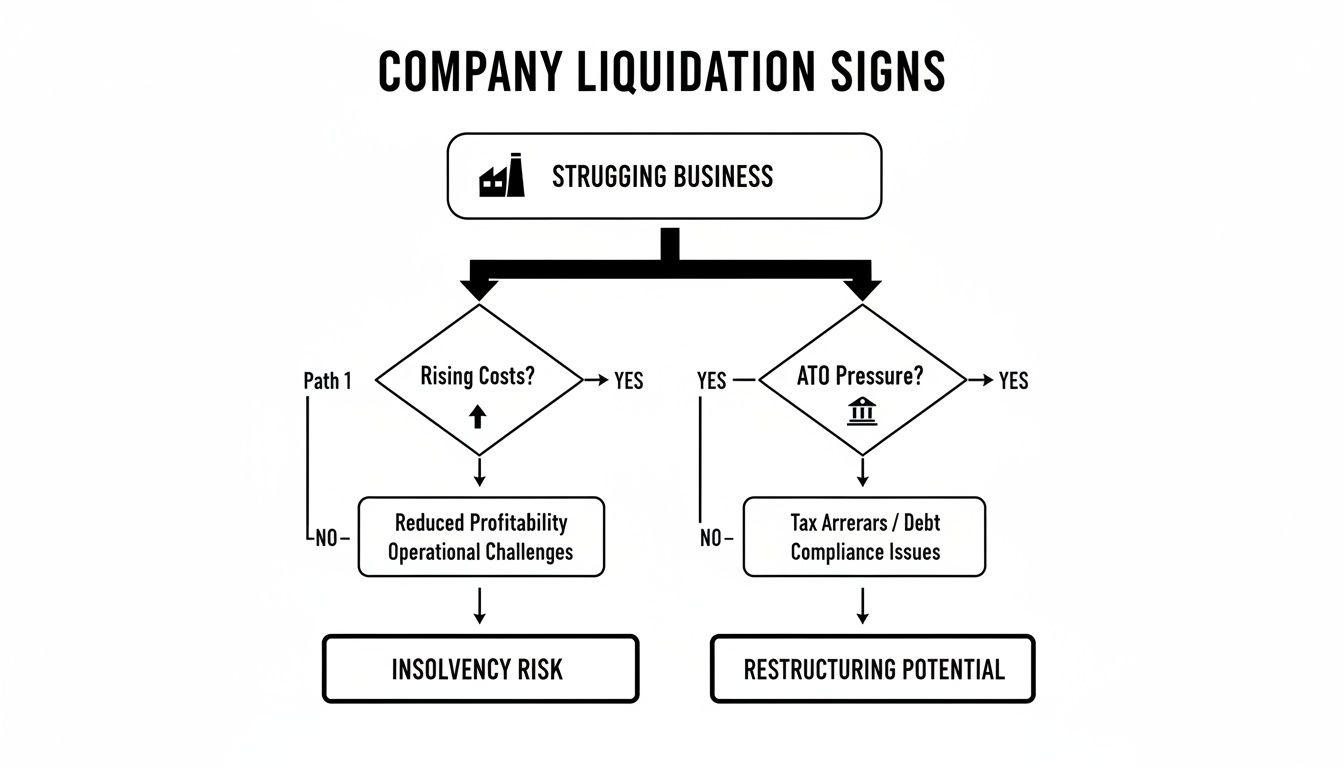
As shown, external pressures often compel a director to act, making a CVL the most responsible option to mitigate further debt.
Court-Ordered Liquidation When Creditors Force the Issue
A Court-Ordered Liquidation, also known as Compulsory Liquidation, is an involuntary process. It occurs when a creditor who is owed money—and has exhausted all other recovery options—applies to the court to wind up the company. In effect, this step represents a creditor’s final and decisive move to recover an outstanding debt.
Most commonly, the Australian Taxation Office (ATO) initiates this type of action. When a company accumulates a significant, overdue tax debt and fails to engage with the ATO’s recovery efforts, the ATO may first issue a statutory demand for payment. If the company does not comply, the ATO will often escalate the matter by applying to the court to appoint a liquidator.
To bring this together, the following summary outlines the three primary liquidation pathways and the circumstances in which each applies.
Australian Company Liquidation Pathways at a Glance
| Liquidation Type | Company Status | Who Initiates? | Primary Goal |
|---|---|---|---|
| Members’ Voluntary | Solvent | Directors & Shareholders | Tax-effective distribution of assets to shareholders. |
| Creditors’ Voluntary | Insolvent | Directors & Shareholders | Orderly wind-up for the benefit of creditors. |
| Court-Ordered | Insolvent | A Creditor (e.g., ATO) | Forcibly wind up the company to recover debts. |
Each path serves a distinct purpose, dictated by the company’s financial health and the initiating party.
Selecting the correct path is a director’s responsibility. An MVL is for solvent entities planning an orderly exit. A CVL is a proactive measure for insolvent companies. A Court-Ordered Liquidation is a forced outcome initiated by creditors.
The harsh reality is that a growing number of Australian businesses are now facing insolvency. Corporate insolvencies have surged sharply, with Victoria alone recording a 77% increase in a recent financial year. Meanwhile, New South Wales and Victoria together saw 8,094 insolvency appointments, highlighting the intense pressure confronting businesses across the country. These figures, which have reached record monthly highs, clearly signal why directors must seek professional advice early rather than wait until options disappear. Exploring broader insolvency data can also help put these challenges into perspective.
Against this backdrop, choosing the correct liquidation pathway becomes critical. That decision shapes the entire process, affects the costs involved, and determines how much control you retain as a director.
If your business is struggling and you are unsure which path applies, do not delay. Schedule a confidential discussion with EndureGo Tax to obtain a clear assessment of your company’s solvency and explore your options with an experienced ASIC agent and tax professional.
The Liquidation Process From Resolution to Finalisation
Initiating the formal process of liquidating a company can feel daunting, but the process follows a clear legal framework. Instead of treating it as a single overwhelming task, directors should approach it as a series of milestones—each bringing the company closer to finalisation and fulfilling its legal obligations. Understanding this journey—from the initial resolution to final deregistration—is essential for every director.
The process begins with a formal decision. In a Creditors’ Voluntary Liquidation (CVL), directors first acknowledge that the company is insolvent and cannot meet its financial obligations. They formalise this acknowledgement through a directors’ resolution proposing to wind up the company and appoint a registered liquidator.
Next, the directors present the resolution to the company’s shareholders. A members’ meeting is convened, often at short notice, where shareholders vote on a special resolution to officially place the company into liquidation. Once they pass this resolution, the liquidation process is formally underway.
The Formal Appointment and ASIC Lodgement
After securing resolutions from both directors and shareholders, the next critical step is to formally appoint the registered liquidator. This is a legal action that must be properly documented and lodged with the Australian Securities and Investments Commission (ASIC).
The liquidator and the company’s directors sign a consent to act, and the official documentation is submitted. For a CVL, this requires lodging Form 505: Notification of appointment or cessation of an external administrator with ASIC. Filing this form publicly records that the company is in liquidation and that control has officially transferred to the appointed liquidator.

Lodging these forms marks the point of no return. It legally transfers control of all company affairs—including bank accounts and assets—from the directors to the liquidator.
The Liquidator’s Role Unpacked
Upon appointment, the liquidator assumes full control of the company. From that point, directors lose the authority to make decisions or manage company property. The liquidator’s primary duty is to the creditors, and their actions are strictly regulated under the Corporations Act 2001.
Here’s a breakdown of the liquidator’s key responsibilities:
Securing and realising assets: The liquidator identifies, secures, and takes possession of all company assets. This can include selling property, plant, and equipment, as well as collecting outstanding debts owed to the company.
Investigating company affairs: They examine the company’s financial history and directors’ conduct, looking for potential breaches such as insolvent trading or unfair preference payments.
Communicating with creditors: The liquidator convenes the first creditors’ meeting, provides regular reports on the liquidation’s progress, and assesses all claims submitted.
Distributing funds: Funds recovered from asset realisation are distributed to creditors according to a strict priority order established by law. Employee entitlements rank highest, followed by secured creditors, and finally, unsecured creditors—such as suppliers and the ATO—receive any remaining funds.
Part of this process involves cleanly terminating all existing business commitments. A liquidator will spend time understanding the contract termination clause in every agreement to formally and legally dissolve those commercial relationships.
Expert Tip: An invaluable piece of advice for any director is to ensure all financial records are accurate and up-to-date before a liquidator is appointed. Well-maintained books, records, and employee files simplify and expedite the liquidator’s work. This can directly reduce their professional fees—which are paid from company assets—thereby potentially increasing the funds available for creditors.
The final stage involves the liquidator lodging a final account of their activities with ASIC and holding a final meeting. It is important to distinguish liquidation, which is the formal winding-up of a company’s affairs, from the simpler process of deregistration. For more on this, our guide on how to deregister a company in Australia may be useful.
Once all duties are completed and ASIC is satisfied, the company is finally deregistered, officially ceasing to exist three months after the process concludes.
The journey from resolution to finalisation is methodical. By understanding these key milestones, you can prepare for the process and ensure a compliant and orderly wind-up. If you are contemplating this path, having an expert guide you through the initial resolutions and paperwork is invaluable. Book a confidential consultation with EndureGo Tax today to ensure every step is handled correctly from the outset.
Managing Your Critical Tax and Employee Obligations
As a company approaches liquidation, its tax and employee obligations become the most critical—and personal—responsibilities for directors. This is the point where the “corporate veil” becomes thinnest, and mistakes can result in severe personal financial consequences that linger long after the company ceases to exist.
Before the liquidator is appointed, directors must ensure the company’s financial reporting is complete. This is not just good practice—it is a legal obligation. All outstanding Business Activity Statements (BAS) and income tax returns must be lodged with the ATO, providing a clear and accurate financial picture of the company for all stakeholders, especially the tax office.
The Dangers of Director Penalty Notices
One of the most significant personal risks for directors is the Director Penalty Notice (DPN). This is a powerful tool used by the ATO to hold you, the director, personally liable for two specific types of company tax debt:
- Pay As You Go (PAYG) Withholding: Tax deducted from employee wages that was not remitted to the ATO.
- Superannuation Guarantee Charge (SGC): Unpaid superannuation for employees, which becomes a debt owed to the ATO.
If your company has failed to report and pay these amounts on time, the ATO can issue a DPN, effectively transferring the company’s debt to you personally. This means they can legally pursue your personal assets—your home, savings, and other investments—to recover the outstanding amount. For further details on this topic, it is wise to understand unpaid entitlements and director loans and how they relate to your duties.
Prioritising Employee Entitlements
To be unequivocally clear: when a company is liquidated, employees must be paid first. The law, specifically the Corporations Act 2001, establishes a strict priority for who is paid from the proceeds of realised company assets, and your employees are at the top of this list. This is not negotiable.
The legal priority for payments is as follows:
- Outstanding Wages and Superannuation: All unpaid wages and superannuation contributions.
- Leave Entitlements: Payouts for accrued annual leave and long service leave.
- Redundancy Payments: Any redundancy entitlements owed to staff under their award or enterprise agreement.
Only after every dollar of these employee entitlements has been paid can the liquidator distribute funds to other creditors.
The ATO’s own legislative guidance, such as the provisions within the Taxation Administration Act 1953 concerning Director Penalty Notices, reinforces the gravity of these obligations.
This official stance highlights how seriously these duties are viewed. They are not suggestions; they are legally enforceable responsibilities.
Practical Scenario: A Small Construction Company
Imagine a small construction firm, “BuildRight Pty Ltd,” is forced into liquidation. It has $150,000 in its bank account. The company owes $80,000 in unpaid wages and entitlements to its five employees and $200,000 to various suppliers.
The liquidator’s first legal obligation is to use the available $150,000 to pay the staff. The full $80,000 owed to them must be paid before any other creditor receives a cent. The remaining $70,000 would then be distributed pro rata among the unsecured suppliers, who will, unfortunately, receive only a fraction of what they are owed.
The legal priority of employee payments is absolute. A liquidator is legally prohibited from paying a supplier, a landlord, or even the ATO for other tax debts before every dollar of employee wages, leave, and superannuation has been settled.
The Role of the Fair Entitlements Guarantee (FEG)
What happens if the company has insufficient funds to cover all employee entitlements? This is a common and distressing scenario, but it is where the Australian Government’s Fair Entitlements Guarantee (FEG) scheme can assist.
FEG acts as a safety net for employees of insolvent companies. Eligible employees can claim certain unpaid entitlements, including:
- Up to 13 weeks of unpaid wages.
- Unpaid annual leave and long service leave.
- Payment in lieu of notice.
- Up to 5 weeks of redundancy pay per year of service.
It is crucial to note that FEG does not cover unpaid superannuation. This remains a debt that the liquidator and the ATO will continue to pursue. Managing the employee transition smoothly is paramount, and you may find employee termination checklist template resources helpful to ensure all necessary steps are correctly followed.
Navigating your tax and employee duties is the highest-stakes aspect of liquidating a company. Mistakes in this area can have devastating personal consequences. If you are facing this situation and require clear, expert advice on meeting your obligations, book a confidential consultation with EndureGo Tax today. We can help ensure all tax affairs are finalised correctly and employee entitlements are managed precisely as the law demands.
Common Director Pitfalls and How to Avoid Them
Under the immense pressure of winding up a company, it is easy to make rushed or ill-informed decisions. From our extensive experience as accountants and registered ASIC agents, we have observed well-intentioned directors repeatedly fall into the same traps—often with severe personal financial repercussions.
Understanding these common pitfalls is not just about best practice; it is your most effective defence against being held personally liable for company debts.
The moment you suspect your company is in serious financial difficulty, your legal duties as a director shift dramatically. From that point forward, every decision must be made in the best interests of the company’s creditors. Unfortunately, this is precisely where many directors falter.
The Trap of Voidable Transactions
One of the most frequent errors is engaging in what is legally termed a voidable transaction. This occurs when a director authorises a payment or asset transfer in the lead-up to liquidation that unfairly benefits one creditor over others. A liquidator has the power under the Corporations Act 2001 to investigate these transactions and “claw back” the money or asset.
The classic example is an unfair preference payment.
Practical Example: Imagine your company owes money to ten different suppliers. You have a close personal relationship with one of them. Days before appointing a liquidator, you use the company’s last remaining cash to pay that supplier’s invoice in full, leaving nothing for the other nine.
A liquidator will almost certainly identify this as an unfair preference. They are legally obligated to reverse the payment, demand the money be returned by your contact, and distribute it fairly among all creditors, creating a legally and personally difficult situation.
Another common pitfall involves personal guarantees. If you have personally guaranteed a company loan, it is tempting to use company funds to pay down that specific debt to reduce your personal exposure. This is a critical error. A liquidator will view this as an unfair preference benefiting a director and will claw the funds back, leaving your personal guarantee intact.
Illegal Phoenix Activity and Insolvent Trading
A more serious breach is illegal phoenix activity. This is not an error but a deliberate act. It involves stripping assets from a failing company and transferring them to a new, similar company, leaving the debts behind with the original empty corporate shell. This is a serious criminal offence that can result in substantial fines, disqualification from managing corporations, and imprisonment.
However, the greatest personal risk for most directors is trading while insolvent.
If you continue to incur new debts—placing new stock orders, hiring staff, or taking out loans—when you know (or a reasonable person would have known) that the company could not pay its bills, you can be held personally liable for those debts. A liquidator will meticulously review the company’s records to determine the date it likely became insolvent. Any debts incurred after that date could become your personal liability. To better understand these risks, it is worthwhile to review what director penalties are and how they are applied.
The Safe and Compliant Way Forward
So, what is the correct course of action? The answer is straightforward, though its implementation requires discipline.
- Stop Incurring New Debt: The moment you suspect insolvency, all non-essential spending must cease. No new purchase orders, no new contracts, no new financial commitments.
- Seek Professional Advice Immediately: Do not delay. An experienced accountant or insolvency professional can outline a compliant path forward and protect you from critical missteps.
- Do Not Favour Certain Creditors: Treat all unsecured creditors equally. All payments must cease once the decision to liquidate has been made.
- Preserve Company Assets: Your duty is to protect the value of the remaining assets for the benefit of all creditors. Do not sell assets for less than market value or transfer them to yourself or a related party.
Navigating the final stages of a company’s existence is akin to traversing a field of legal tripwires. It demands a clear head and an unwavering focus on your legal duties.
If you are facing these difficult decisions, the single most important action you can take is to seek expert guidance immediately. Book a confidential consultation with EndureGo Tax today to discuss your situation and ensure you navigate this process correctly and safely.
Why Professional Guidance Is Your Best Defence

Successfully navigating the wind-up of a company involves much more than administrative compliance. It demands a specific blend of expertise to protect you, the director, from significant personal risks. The entire process is governed by complex legislation, most notably the Corporations Act 2001, and a single misstep can have lasting financial consequences.
Consider this: only a qualified accountant can ensure every final BAS and tax return is lodged correctly, thereby preventing future penalties from the ATO. Simultaneously, you require a registered ASIC agent, who is an expert in corporate compliance, to manage the intricate forms and deadlines, ensuring the company is properly deregistered without issue.
Adopting this dual-pronged approach is your most robust defence. It provides a level of security that cannot be achieved otherwise, knowing that both the taxation and corporate aspects of the liquidation are being managed flawlessly by professionals who specialise in this field.
Navigating a company liquidation is a challenging journey, and it should not be undertaken alone. As experienced accountants and registered ASIC agents, we can ensure your tax affairs are finalised correctly and all your obligations to ASIC are met.
Book a confidential chat today to understand your options and secure your financial future.
Your Top Questions About Company Liquidation, Answered
Even with a clear understanding of the steps, winding up a company generates many specific and urgent questions. It is a stressful period, and obtaining clear, accurate answers is crucial. Here are the most common queries we receive from Australian directors facing this difficult process.
Can I Still Act as a Director After Liquidation?
Generally, yes. Undergoing a standard Creditors’ Voluntary Liquidation does not automatically prohibit you from being a director of another company in the future.
However, if the liquidator’s investigation uncovers serious misconduct, such as illegal phoenix activity or insolvent trading, the situation changes significantly. In such cases, ASIC can initiate action to have you disqualified from managing any corporation for a specified period.
What Happens to Outstanding Employee Superannuation?
Unpaid superannuation is treated as a high-priority debt with serious consequences for directors.
Under the Superannuation Guarantee (Administration) Act 1992, directors can be held personally liable for the company’s unpaid Superannuation Guarantee Charge (SGC). This liability is typically enforced via a Director Penalty Notice (DPN) from the ATO.
It is also critical to understand that the government’s Fair Entitlements Guarantee (FEG) scheme does not cover unpaid superannuation. Consequently, the ATO and the liquidator will vigorously pursue the recovery of these funds.
How Long Does the Company Liquidation Process Take?
There is no definitive timeline, as the duration depends on the complexity of the company’s affairs.
A straightforward liquidation—for instance, one with few assets, no complex claims, and cooperative directors—might be concluded within 6 to 12 months.
Conversely, if the situation is complicated by significant assets requiring realisation, legal disputes, or in-depth investigations into director conduct, the process can easily extend to two years or more.
A common misconception is that liquidation is a rapid event. In reality, it is a methodical process governed by strict legal timelines for notifying creditors, realising assets, and completing statutory investigations.
Can I Just Deregister the Company Instead of Liquidating?
While many directors hope this is a viable alternative, it is rarely an option for a company with outstanding debts.
You can only apply for voluntary deregistration if the company meets stringent criteria set by ASIC. This includes having assets of less than $1,000 and, most importantly, having no outstanding liabilities.
If your company owes money to creditors, suppliers, or the ATO, you cannot simply deregister it to resolve the issue. For an insolvent company, liquidation is the legally mandated process.
Navigating the complexities of company liquidation demands a steady, expert hand to protect your personal financial position and ensure you meet all legal obligations. As trusted local accountants and registered ASIC agents, EndureGo Tax provides the specialised support required to manage this process correctly.
Book a confidential consultation with us today to identify the safest path forward and achieve peace of mind.
