


As expert tax accountants, one of the most frequent questions we encounter is, "Is income protection tax deductible?"
The definitive answer is yes, in most common scenarios, the premiums are tax-deductible. However, navigating the Australian Taxation Office (ATO) rules requires precision. For tradies, freelancers, and professionals across Australia, understanding these rules is crucial for maximising your tax return and ensuring compliance.
Your Expert Guide to Income Protection and Tax Deductions

The ATO permits you to claim the premiums paid for a personal income protection policy. The core principle is that you are incurring an expense to protect your ability to earn an income. Therefore, the cost of that protection is a legitimate deduction against your assessable income.
Before delving into the tax intricacies, let's clarify what income protection is. Often referred to as long-term disability insurance, this policy provides a financial safety net. If you are unable to work due to illness or injury, it pays a regular monthly benefit to help cover living expenses while you recover.
What the ATO Scrutinises
When reviewing your tax claim, the ATO focuses on several key factors. For your premium to be deductible, the policy's sole purpose must be to replace your personal income through periodic payments, not a lump-sum payout.
The critical determinants for deductibility are:
- Policy Ownership: Is the policy held in your personal name, within your superannuation fund, or paid for by your employer?
- Coverage Type: The policy must cover loss of income. This distinguishes it from life, trauma, or TPD insurance, which are generally not deductible when held personally.
- Employment Status: The application of the rules differs for PAYG employees versus sole traders or business owners.
As per the ATO, you can claim the cost of premiums you pay for insurance against the loss of your income. You must include any payment you receive under such a policy on your tax return. This establishes a direct link: the premium is deductible because the potential benefit is assessable income.
This guide will demystify the various scenarios to empower you to claim correctly. For expert advice tailored to your specific financial situation, we recommend speaking with the EndureGo Tax team.
Understanding the ATO Rules on Income Protection
The reason the ATO allows a deduction for income protection premiums is rooted in a fundamental tax principle.
The guiding rule is: if you incur an expense in the course of gaining or producing your assessable income, you can typically claim that expense as a deduction. The ATO views your capacity to earn an income as your primary asset. Protecting this asset is analogous to a carpenter insuring their tools or a photographer insuring their camera equipment.
Because your income protection policy safeguards your earnings, the premiums are considered a cost of earning that income. It's a straightforward and legislated provision.
This is also why the ATO draws a clear distinction. For premiums to be deductible, the policy must replace your regular income with periodic payments. It cannot be a policy that pays out a one-off capital lump sum.
The Link to Your Assessable Income
Here is the other side of the equation, and it is crucial to understand. Because you can claim a deduction for the premiums, any benefit paid out to you under that policy is considered taxable income.
In the ATO's view, these insurance payments replace the salary or wages you would have earned. Consequently, the benefit is treated as assessable income and taxed at your marginal tax rate.
Think of it as a two-way arrangement. You receive a tax concession for protecting your future income, and in return, if you need that protection, the payments are taxed as if they were your regular paycheque.
According to the ATO, "A deduction is allowed under section 8-1 of the Income Tax Assessment Act 1997 for the cost of insurance premiums paid to protect against the loss of income." This is not a loophole; it is a clear, government-endorsed strategy for Australian workers.
A Practical Example in Action
Let’s analyse a real-world scenario.
Consider a self-employed electrician in Ashfield earning $90,000 annually. To safeguard this income, she pays $2,800 per year for an income protection policy held in her personal name.
Because this policy is structured to replace her personal exertion income, the entire $2,800 premium is 100% tax-deductible.
The connection is clear: the expense (the $2,800 premium) is directly related to protecting her ability to earn her assessable income (the $90,000). When lodging her tax return, she can claim this full amount under Item D15 – Other work-related deductions.
Understanding this principle is your first step to confidently structuring your insurance and maximising your legitimate tax deductions.
How Policy Ownership Affects Your Tax Claim
When claiming a tax deduction for income protection, the ownership structure of the policy is paramount. This factor often dictates whether you, your superannuation fund, or your business can claim the deduction.
Establishing the correct structure from the outset is vital. Let’s examine the three most common ownership scenarios to clarify your position.
Policies Held Personally by an Individual
This is the most direct and common structure for claiming an income protection tax deduction. If you take out a policy in your own name and pay the premiums from your personal funds, you are generally entitled to claim the full cost of those premiums on your tax return.
Practical Example: A freelance marketing consultant from Belrose pays an annual premium of $3,000 for her income protection. Because the policy is in her name and protects her personal capacity to earn an income, she can claim the entire $3,000 as a deduction. This reduces her taxable income and, consequently, her tax liability.
The ATO's logic is clear, as this flowchart illustrates.
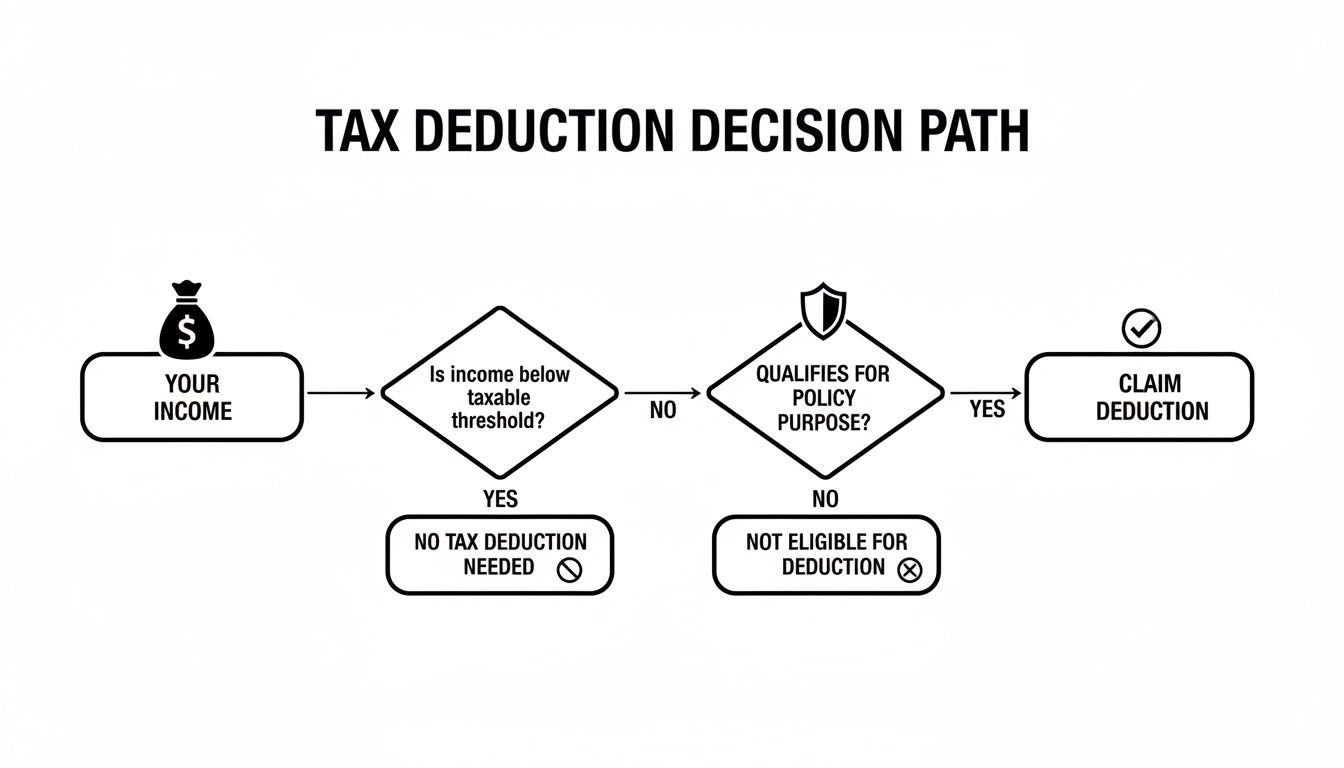
If the policy's purpose is exclusively to replace your regular income, the path leads directly to a tax deduction.
Policies Held Inside Superannuation
Many Australians hold their income protection insurance through their superannuation fund. While this can offer convenience and sometimes lower premiums, it fundamentally alters the tax treatment.
When your policy is held inside super, it is the super fund that claims the tax deduction, not you personally.
The fund claims this deduction at its concessional tax rate of 15%. For most individuals, this is significantly lower than their personal marginal tax rate, which can be as high as 45% (plus the Medicare levy). The net result is a much smaller overall tax saving.
Expert Takeaway: You will almost always achieve a superior tax outcome by holding your income protection policy outside of superannuation. While the convenience of cover within super is appealing, you personally forfeit the ability to claim the deduction. To determine the optimal strategy for your circumstances, professional advice is essential.
Policies Paid by a Business for an Employee
The third common scenario is when a business pays the income protection premiums for an employee as part of a salary package. Here, the tax implications are divided.
- For the Employer: The premium payment is a legitimate business expense, deductible for the company like any other employee benefit.
- For the Employee: You cannot claim a deduction. As you did not personally incur the expense, the ATO does not permit you to claim it.
Practical Example: An engineer in Inner West Sydney has income protection included in her remuneration package. Her employer pays the $2,500 premium and correctly claims it as a business deduction. The employee receives the security of the cover but cannot claim any deduction on her personal tax return.
The ATO rules are explicit: the deduction is available to the entity that incurs the expense to protect an income stream. If you need assistance determining the most tax-effective structure for your policy, contact our team at EndureGo Tax for an expert assessment.
What Insurance Costs Are Not Tax Deductible
While the income protection premium deduction is a valuable tool, it is equally critical to understand what you cannot claim. Misinterpreting these rules can lead to costly errors and ATO scrutiny.
The ATO's position, outlined in legislation such as the Income Tax Assessment Act 1997 (ITAA 1997), is clear and inflexible. The core principle is that if an insurance policy provides a capital lump sum payment rather than replacing regular income, its premiums are generally not tax-deductible. These are considered capital or private expenses.
Insurance Policies You Cannot Claim
To ensure compliance, you must not claim premiums for the following types of cover on your personal tax return:
- Life Insurance: Premiums for a life insurance policy are not deductible. The benefit is paid as a lump sum to your beneficiaries; it does not protect your income-earning capacity.
- Trauma (or Critical Illness) Insurance: This cover pays a lump sum upon diagnosis of a specified serious medical condition. As a capital payment, the premiums are not a deductible expense.
- Total and Permanent Disability (TPD) Insurance: For TPD insurance held outside of superannuation, premiums are generally not deductible if the policy pays out as a lump sum.
The ATO's logic is consistent: the expense must be directly related to gaining or producing your ongoing, assessable income. Lump-sum policies do not meet this criterion.
The Pitfall of Bundled Policies
A common trap is the 'bundled' or 'linked' policy, where an insurer packages income protection with other cover types like Life or TPD insurance. This may seem efficient but creates complexity at tax time.
You absolutely cannot claim the entire premium for a bundled policy.
Only the portion of the premium that is specifically for the income protection component is tax-deductible. Claiming the full premium is a compliance red flag for the ATO.
To avoid this error, you must obtain a policy statement from your insurer annually. This document should clearly itemise the cost for each type of cover within your bundle.
Practical Example: Your policy statement shows a total annual premium of $2,500. A closer look reveals the breakdown: $1,500 for income protection and $1,000 for life cover. In this case, you can only claim the $1,500 as a tax deduction.
If your statement is not itemised, it is your responsibility to contact your insurer for a detailed breakdown before lodging your tax return. Retaining this document is your primary evidence in case of an ATO query. If you are unsure how to interpret your policy statement, the team at EndureGo Tax can review it to ensure your claim is both accurate and maximised.
Calculating Your Potential Tax Savings
We have established that income protection premiums are tax-deductible. But what is the tangible, real-dollar impact on your finances? Understanding this calculation makes the value clear.
The calculation is straightforward, hinging on your annual premium and your marginal tax rate.
The Formula for Your Savings:
Annual Premium Cost x Your Marginal Tax Rate = Your Annual Tax Saving
The higher your income and corresponding tax bracket, the greater the financial benefit of the deduction. This effectively reduces the net cost of your insurance cover.
A Practical Example: A Self-Employed Designer
Let's examine a real-world scenario. Meet Sarah, a self-employed graphic designer based on the Northern Beaches.
- Annual Income: $95,000
- Annual Income Protection Premium: $2,800
- Marginal Tax Rate (2026): 30%
To calculate her tax saving, we apply the formula: $2,800 (Premium) x 0.30 (Tax Rate) = $840.
This is a direct $840 reduction in her annual tax liability. This means the true out-of-pocket cost of her essential insurance cover is not $2,800, but only $1,960 for the year—a significant difference.
Another Example: A High-Income Professional
Now, let's see how the savings scale with income. David is an IT consultant from Ashfield with a higher income.
- Annual Income: $190,000
- Annual Income Protection Premium: $4,500
- Marginal Tax Rate (2026): 45%
Applying the same formula for David: $4,500 (Premium) x 0.45 (Tax Rate) = $2,025.
Because David is in a higher tax bracket, his deduction delivers a substantial $2,025 back into his pocket annually. This makes his more comprehensive policy far more affordable and demonstrates how the benefit amplifies with income.
To help you estimate your own savings, here is a quick reference table based on a standard $2,000 annual premium.
Sample Tax Savings on Income Protection Premiums (2026)
| Annual Income Bracket | Marginal Tax Rate | Annual Premium | Potential Tax Saving |
|---|---|---|---|
| $45,001 – $120,000 | 30% | $2,000 | $600 |
| $120,001 – $180,000 | 37% | $2,000 | $740 |
| Over $180,000 | 45% | $2,000 | $900 |
As you can see, the higher your marginal tax rate, the more valuable this deduction becomes. It's a powerful strategy to reduce the net cost of protecting your most critical asset—your ability to earn.
This calculation, grounded in the Income Tax Assessment Act 1997, empowers you to understand the real financial impact of a correctly lodged claim. For a precise calculation, see our guide on how to calculate your tax return.
How to Claim Your Deduction on Your Tax Return
Knowing your premiums are deductible is only half the battle; correctly claiming them is the final, critical step to securing your tax saving.
The claim is made within the work-related expenses section of your tax return at Label D15, titled 'Other work-related deductions'.
This is the designated field where you must enter the total deductible portion of your income protection premiums for the financial year. Overlooking this field means forfeiting money that rightfully belongs in your pocket.
Meticulous Record-Keeping Is Non-Negotiable
With the Australian Taxation Office (ATO), the governing principle is: if you cannot substantiate it, you cannot claim it. To successfully claim this deduction, you must maintain impeccable records.
This includes:
- Your Policy Statement: This is your primary evidence, proving the type of cover you hold.
- Proof of Payment: Bank statements or receipts confirming you paid the premiums.
Crucial Note on Bundled Policies: If your insurance policy combines income protection with non-deductible cover like Life or TPD, you must have an itemised statement from your insurer. This statement needs to clearly segregate the cost of the income protection component. Without this breakdown, you cannot make an accurate claim and you risk an ATO adjustment.
Lodge It Yourself or Get a Pro to Help?
While lodging your own tax return is possible, the nuances of what constitutes a valid income protection tax deductible expense can be complex. An error could result in a reduced refund or, in a worst-case scenario, trigger an audit.
For complete confidence and to ensure you are maximising every legitimate claim, professional guidance is your best course of action. Our expert teams in Ashfield and Belrose can review your policy documents, ensure your claim is fully compliant, and help you correctly lodge your tax return.
Take action now. Contact EndureGo Tax today to book your tax planning session and ensure you receive every dollar you are entitled to.
Common Questions About Income Protection & Tax
Navigating the tax implications of income protection can be complex. Here are expert answers to the most common questions we receive from clients.
Are the Payouts Taxable?
Yes, unequivocally. The ATO's logic is consistent.
Because you are permitted to claim the insurance premiums as a tax deduction, any benefit you receive from that policy is treated as assessable income. The payout is designed to replace the salary you are not earning, and therefore must be declared on your tax return and will be taxed at your marginal tax rate. You can find more detail on the ATO’s page about income you must declare.
What if My Boss Pays for My Policy?
If your income protection is part of a salary package where your employer pays the premiums directly, you cannot personally claim a deduction. In this structure, your employer claims the premium as a business expense.
However, it is critical to note that if you make a claim, any benefit payments you receive are still considered your personal taxable income. As the recipient of the funds replacing your lost earnings, the tax liability rests with you.
Can I Claim the Deduction if My Policy Is Inside Super?
When your income protection policy is held within your superannuation fund, you personally cannot claim a tax deduction for the premiums.
The super fund itself pays the premiums and, in turn, claims a deduction at its own concessional tax rate of 15%.
This presents a strategic trade-off. While holding cover inside super offers convenience, it generally results in a smaller tax saving for you. Claiming the deduction personally at your higher marginal tax rate is typically more tax-effective, but requires you to fund the policy from your post-tax income.
Determining if your income protection is tax deductible depends on the specific details of your policy and its ownership structure. To ensure full compliance and maximise your tax position, personalised, expert advice is indispensable.
The specialists at EndureGo Tax are ready to assist. As your trusted local accountants in Ashfield and Belrose, we will provide the clarity and strategy you need to optimise your tax return. Book a consultation with us at https://www.endurego.com.au today to secure your financial advantage.
