


Before you buy your first bottle of cleaning spray, first let’s establish your foundation: your business plan. A profitable cleaning business isn’t built on supplies; rather, it’s built on a solid, actionable strategy. This is where you map out your niche, analyse the local competition, and create a lean blueprint that guides every decision you make, ensuring you know how to start a cleaning business for long-term success.
Building Your Business Blueprint
To begin with, every successful cleaning company I’ve seen started with a clear vision, not just a mop and bucket. Instead of writing a massive 50-page document nobody will ever read, focus on making smart, deliberate choices that set you up for success in Australia’s competitive cleaning industry.
Next, your first job is to nail down your niche. Trying to be a “we clean everything” service is a surefire way to get lost in the noise. On the other hand, the real money is in becoming the go-to expert for a specific type of client. By specialising, you can fine-tune everything—your services, your marketing, and your pricing—to hit the mark every single time.
Pinpointing Your Ideal Market
So, what’s your niche? This comes down to understanding what your local area needs and what you’re good at. For instance, are you going to focus on busy professionals who need a premium residential clean, or chase those steady, recurring commercial contracts? Each path demands a completely different game plan.
Here are a few profitable niches thriving in Australia right now, with practical examples:
Residential Cleaning: Think standard weekly cleans for dual-income families in suburban areas, or one-off bond cleans for the high-turnover rental market in inner-city suburbs. Example: “Sydney Bond Cleaners” focuses solely on end-of-lease services.
Commercial Cleaning: This is your bread and butter for stable income. We’re talking after-hours office cleaning for local accounting firms, daily cleans for a busy café, or sanitization for a medical centre. Example: A business could secure a contract to clean three local GP clinics twice a week.
Eco-Friendly Services: Moreover, there’s a growing wave of health-conscious clients willing to pay a premium for non-toxic, sustainable cleaning products. This can be a massive selling point. Example: Marketing your services to yoga studios or childcare centres that prioritise a chemical-free environment.
Specialised Services: Finally, these are often high-margin jobs. Think post-construction clean-ups for a local builder, commercial window washing for storefronts, or high-pressure cleaning for driveways. Example: Partnering with a local real estate agency to be their go-to for pre-sale property detailing.
Once you’ve got an idea, it’s time to do some real-world research. For example, jump on Google and search “office cleaning services in Ashfield” or “house cleaners Northern Beaches.” See who your local competitors are. What are they offering? How do they price their services? Ultimately, your goal is to find a gap. Maybe there are no reliable eco-friendly cleaners in your area, or perhaps local businesses are crying out for a quality after-hours office cleaner. That gap is your entry point.
Creating Your Lean Business Plan
With a niche in mind, you can start sketching out a simple business plan. The Australian government has fantastic free resources to help with this. A good plan just needs to answer the big questions about your business.
This screenshot from business.gov.au shows you exactly what to focus on.

It covers the core stuff—from your goals to your financial forecasts—giving you a clear picture of the road ahead.
And the demand is definitely there. The commercial cleaning sector in Australia is booming. The latest IBISWorld industry report shows 45,319 commercial cleaning businesses are operating down under, a number that shot up by 3.1% last year alone. That’s great news for demand, but it also means you need to stand out.
Expert Tip: Your business plan isn’t a “set and forget” document. Treat it as a dynamic roadmap. Review it quarterly to track progress against your financial goals and adapt your strategy based on client feedback and market trends.
This blueprint is your most important tool. It’s what turns your great idea into a real, profitable business and guides everything from your legal setup to your first marketing campaign.
Actionable Call to Action: Ready to make it official? Our team at EndureGo Tax provides expert advice on setting up as a sole trader or company, ensuring your financial foundations are as spotless as the homes you’ll be cleaning. Book a no-obligation consultation with our small business accountants today.
Nailing the Legal and Financial Setup
You’ve got your business plan sorted. Now, it’s time for the bit that can feel a little daunting: getting the official structure in place. Tackling the legal and financial setup from day one isn’t just about ticking boxes for the ATO; rather, it’s about protecting yourself, your clients, and the business you’re working so hard to build.
By doing this early, you’ll ensure you operate as a legitimate cleaning business and make financial management much smoother. In fact, you’ll thank yourself when tax time rolls around. So, let’s walk through the essential steps.
Choosing Your Business Structure
First, your big decision is how you’ll operate. For most new cleaning businesses in Australia, it boils down to two main paths: setting up as a sole trader or as a company. Each choice has real-world consequences for your personal liability, how you’re taxed, and the amount of admin you’ll be dealing with.
To start, a sole trader is the simplest and most common option. You and your business are the same in the eyes of the law. This gives you total control and keeps setup costs low, but it also means you’re personally on the hook for any business debts. Still, it’s a fantastic, low-risk way to get started.
On the other hand, a proprietary limited (Pty Ltd) company is a separate legal entity. This is a game-changer for asset protection—your house and personal savings are kept separate from the business. However, the trade-off is higher setup costs and more involved yearly reporting.
Expert Tip: Begin as a sole trader. It lets you test the market with minimal fuss and expense. Then, once your cleaning business generates consistent, solid revenue (e.g., over $100,000 annually), you can strategically transition to a company structure for enhanced asset protection.
Securing Your ABN and Understanding GST
Next, no matter which structure you choose, you absolutely need an Australian Business Number (ABN). This unique 11-digit number is your business’s official identifier. With it, you’ll be able to send professional invoices, claim tax credits, and deal with the Australian Taxation Office (ATO). You can even find direct legislation regarding ABNs in the A New Tax System (Australian Business Number) Act 1999.
After that, turn your attention to the Goods and Services Tax (GST). Here’s the key number to remember: $75,000. If your annual business turnover hits or is expected to hit $75,000, you are legally required to register for GST. If not, it’s optional, but you’ll need to keep monitoring this as you grow.
Finally, remember the ATO’s website is your best friend here, with plenty of resources to help you understand your obligations.

Make sure you bookmark the ATO’s business registration information – it’s the definitive source for up-to-date tax and super info.
Essential Business Insurance
I can’t stress this enough: operating without insurance is a risk you simply cannot afford to take. All it takes is one slip-up, one accident, and your entire business could be in jeopardy. Therefore, two types of insurance are absolutely non-negotiable for a cleaning business.
Public Liability Insurance
First and foremost, this is your shield. It protects you if your work accidentally causes injury to someone or damage to their property. For example, a client trips over your vacuum cord and breaks their arm, or you accidentally spill a chemical that ruins an expensive rug. In such cases, this insurance covers the legal and medical costs.
Workers’ Compensation Insurance
Secondly, the moment you hire your first employee—even a casual—this becomes mandatory in every state and territory. In other words, it’s designed to cover wages and medical bills if a team member gets injured on the job. Ultimately, it ensures you meet your legal obligations while protecting both your staff and your business.
To make sure you’re compliant and have clear safety rules from the get-go, it’s a great idea to use an Australian workplace safety policy template.
Setting Up a Dedicated Business Bank Account
Last but not least, open a separate bank account for your business. It may sound like a minor detail, yet it is absolutely crucial for clean bookkeeping and financial sanity.
Otherwise, mixing your personal and business finances is a recipe for disaster. It makes tracking expenses a nightmare, figuring out your profit nearly impossible, and turns tax time into a serious headache. By contrast, a dedicated account keeps everything simple and gives you a crystal-clear picture of your business’s financial health.
Actionable Call to Action: With these legal and financial foundations firmly in place, you’re ready to build a professional, resilient, and successful cleaning business. At this stage, our team of local accountants specializes in helping new businesses get it right. Book a consultation today to ensure your setup is perfect from day one.
Equipping Your Business for Professional Results
Moving forward, your tools aren’t just tools—they’re a direct reflection of your professionalism. Skimping on equipment is one of the fastest ways to look amateur and deliver subpar results. If your goal is to build a reputation for quality and efficiency, you need to invest strategically in the right gear from day one.
That said, it’s not about buying everything you see in a supplier’s catalogue. Instead, it’s about building a professional arsenal that helps you work smarter, not harder, while also supporting the growth of your cleaning company.
Sure, it’s tempting to grab a cheap vacuum and some cloths from a hardware store, but in reality, that’s a false economy. Domestic-grade gear isn’t built for the daily grind of professional cleaning. As a result, you’ll end up replacing it constantly, and the finish will never be as good. By contrast, professional equipment is an investment that pays for itself in durability and client satisfaction.
Core Essentials Versus Nice-to-Haves
When you’re starting out, your budget is usually tight. That’s why the key is knowing what you absolutely need to deliver a great service versus what you can add later as your business grows. On one hand, spending too much on fancy gadgets can sink you. On the other hand, cutting corners on core tools will hurt your quality.
To help you prioritise, here’s a practical guide:
Must-Have: A commercial-grade vacuum cleaner. Whether it’s a backpack model for speed or a powerful upright with HEPA filtration for air quality, this is your workhorse.
Must-Have: A colour-coded microfibre cloth system. This is non-negotiable. For example, use red for high-risk areas like toilets, blue for general surfaces like desks, green for kitchen areas, and yellow for windows/mirrors. This way, you prevent cross-contamination and show clients you take hygiene seriously.
Nice-to-Have: A steam cleaner. Steamers are brilliant for deep sanitisation without chemicals, especially on tiles and grout. However, it’s a specialised tool you can invest in once you start offering premium “deep clean” packages.
Expert Tip: A well-organised cleaning caddy is the mark of a true professional. It keeps your supplies tidy, saves you time searching for products on the job, and reinforces that polished, organised image your clients are paying for.
Essential Equipment Checklist: Starter vs Professional
Deciding what to buy can feel overwhelming. To make it easier, I’ve broken down the essential gear into a starter kit for residential jobs and a professional kit for when you’re ready to tackle commercial clients and scale up your cleaning services.
| Equipment Category | Starter Kit (Basic Residential) | Professional Kit (Commercial & Growth) |
|---|---|---|
| Vacuum Cleaner | Commercial-grade upright or backpack vacuum with HEPA filter. | Multiple vacuums: backpack for speed, wet/dry vac for spills, wide-area vacuum for large floors. |
| Mopping System | High-quality microfibre flat mop with a durable bucket and wringer. | Commercial-grade dual-chamber mop bucket system. Floor scrubber or polisher for larger contracts. |
| Cloths & Sponges | Colour-coded microfibre cloths (at least 4 colours). Assorted non-scratch scourers. | Bulk supply of colour-coded microfibre cloths. Speciality cloths (glass, polishing). Magic erasers. |
| Cleaning Solutions | All-purpose cleaner, glass cleaner, bathroom sanitiser (all commercial concentrate). | Full range of specialised concentrates: neutral floor cleaner, heavy-duty degreaser, disinfectant, and eco-friendly options. |
| Detailing Tools | Grout brush, window squeegee, duster with extension pole, and detail brushes. | Commercial window cleaning kit, high-duster kits, steam cleaner, carpet spotter. |
| Safety & Organisation | Reusable gloves, cleaning caddy, or tote bag. | Knee pads, safety goggles, “Wet Floor” signs, branded vehicle organisation system. |
This checklist gives you a solid foundation. Start with the basics and invest in the professional-grade tools as your client base and job complexity grow.
The Rise of Green Cleaning in Australia
One of the biggest shifts in the cleaning industry right now is the demand for eco-friendly services. Clients are more aware than ever about the impact of harsh chemicals on their health and the environment. This isn’t just a trend; it’s a powerful way to set your business apart.
The Australian commercial cleaning market, now valued at around USD 13.25 billion, is seeing huge growth in green cleaning as businesses look to boost their sustainability credentials. According to an in-depth market analysis from Expert Market Research, this is a major opportunity.
By marketing your business as an eco-friendly service, you can attract a premium clientele. Think about offering a “Healthy Home Package” using Aussie brands like Koala Eco or Ecostore. You’re no longer just a cleaner—you’re a provider of a healthier living environment.
Sourcing Supplies for Quality and Value
Building your kit doesn’t have to break the bank. It’s about buying smart.
- Buy in Bulk: For things you’ll burn through—microfibre cloths and your go-to cleaning solutions—find a commercial cleaning supplier. Buying in bulk is always cheaper.
- Use Concentrates: Professional cleaning chemicals almost always come in a concentrated form. The upfront cost is higher, but you dilute it to make dozens of litres of solution, dramatically lowering your cost per job.
- Invest in Durability: Spend the extra money on a sturdy mop bucket and a rock-solid vacuum. A cheap one will break, but a good one will be with you for years.
Actionable Call to Action: Ready to ensure your business finances are just as organised as your cleaning caddy? Let our expert accountants set you up for financial clarity and success. Contact us for a free consultation.
Pricing Your Services and Finding Your First Clients
Alright, you’ve got the legal side sorted and your gear is ready to go. Now for the exciting part: turning your cleaning venture into a real, money-making business. This all comes down to two things: nailing your pricing and finding those first crucial clients.
Getting the price right from day one is everything. It ensures you cover your costs, pay yourself properly, and stay competitive in the local market. Price too low, and you’ll attract difficult clients while barely scraping by. Go too high without a solid reputation, and your phone will stay silent. Let’s determine how to price for profit and then explore simple, effective ways to book your first cleaning job.
Nailing Your Pricing Strategy
The first question every new cleaning business owner asks is, “How much should I charge?” While there’s no single magic number, there are a couple of proven models you can adapt for your specific services and location in Australia.
Most cleaners start with one of two approaches: an hourly rate or a flat-fee package.
- Hourly Rate: This is the simplest way to start. It’s perfect for general residential cleans. In Australia, a good starting point is anywhere from $35 to $55+ per hour. Example: You quote $45/hour for a weekly 3-hour house clean, totalling $135.
- Flat-Fee Package: This is brilliant for standardised jobs like bond cleans or commercial contracts. Clients love knowing the exact cost upfront. Example: You charge a flat $450 for a standard two-bedroom, one-bathroom bond clean, regardless of whether it takes you 6 or 8 hours.
Before you set any prices, you absolutely must calculate all your costs. This isn’t just about cleaning supplies. You need to factor in your insurance, fuel, car maintenance, software subscriptions, and even the time you spend on admin. A classic rookie mistake is only thinking about the time spent on-site—that’s a fast track to losing money. Always add a healthy profit margin on top of your costs.
How to Get Your First Clients (Without a Big Budget)
You don’t need a massive marketing budget to start getting calls. For a local cleaning service, smart and targeted tactics are what really work. Your main goal is to get visible to people right in your neighbourhood.
Expert Tip: Your local reputation is your single greatest marketing tool. A happy client in your community is worth more than any fancy ad, generating the word-of-mouth referrals that will sustain your business.
One of the most powerful (and free) tools you have is your Google Business Profile. Setting this up is non-negotiable. It’s what gets you on Google Maps and helps you show up when someone nearby searches for “cleaner near me.” Gently encourage your first few customers to leave a review—those five-star ratings are gold for boosting your local search ranking. To really get noticed, diving into an ultimate guide to local SEO for small businesses is a great starting point.
Don’t overlook the power of community social media groups either. Getting involved in local Facebook groups for suburbs like Ashfield can be a goldmine. The key is to be helpful, not spammy. Example: Instead of posting “Cleaner available!”, share a useful tip like “Here’s a quick, non-toxic way to clean your microwave with just a lemon and some water.” This builds trust and positions you as an expert.
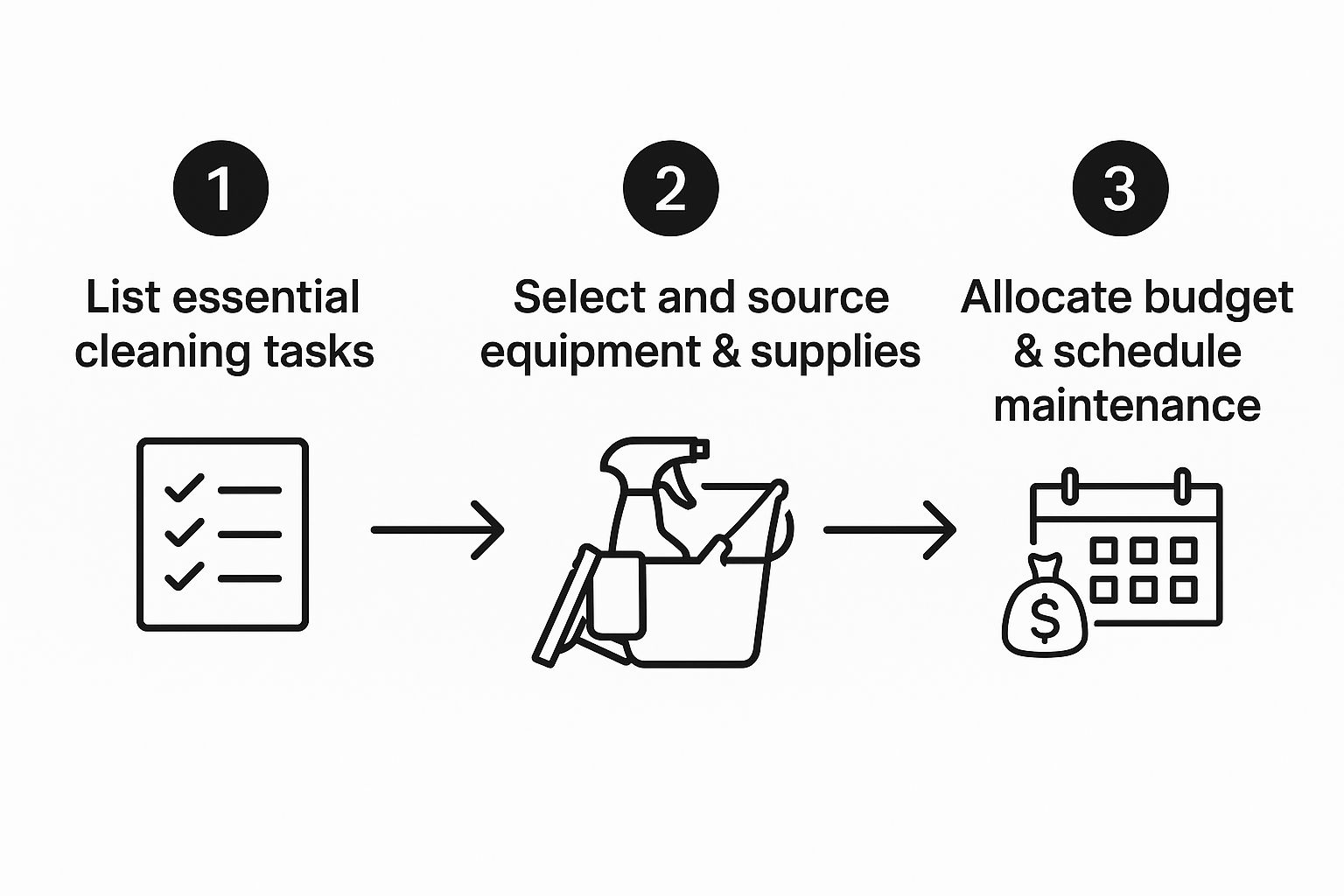
As this shows, having a clear plan for your tasks, tools, and budget is the foundation you need before you can effectively price your services and start marketing.
Finally, set up a simple referral program. Offer your existing clients a 10% discount on their next clean for every new customer they send your way. It’s a fantastic incentive that turns your happy clients into a volunteer sales team.
Common Cleaning Service Pricing Models
Deciding on your pricing model is one of the biggest decisions you’ll make early on. Each approach has its own benefits and drawbacks. Here’s a quick breakdown of the most common options to help you choose.
| Pricing Model | How It Works | Best For | Pros & Cons |
|---|---|---|---|
| Hourly Rate | You charge a set rate for each hour of work. Simple and transparent. | Initial residential cleans, jobs with unknown scope, or clients who prefer time-based billing. | Pro: Easy to quote and adjust. Con: Can penalise efficiency; slower work equals more pay. |
| Flat Rate / Per Job | A fixed price is quoted for the entire job, regardless of how long it takes. | Standardised services like bond cleans, commercial contracts, or small apartments. | Pro: Price certainty for clients; rewards speed and efficiency. Con: Risk of underquoting if the job is bigger than expected. |
| Per Square Metre | The price is calculated based on the floor area of the space being cleaned. | Larger commercial spaces, office cleaning, and construction clean-ups. | Pro: Scalable and easy to quote for large areas. Con: Doesn’t account for the level of dirtiness or clutter. |
| Per Room Rate | A set price is charged for each room (e.g., $40 per bedroom, $60 per bathroom). | Residential cleaning where the home layout is fairly standard. | Pro: Simple for clients to understand. Con: Room sizes can vary dramatically, making it hard to price accurately. |
Actionable Call to Action: Unsure how to price your services for maximum profit? Schedule a consultation with our business advisors to develop a profitable pricing strategy for your cleaning business.
Making Your Operations Run Smoothly
Once the bookings start rolling in, your ability to stay organised is the difference between controlled growth and pure chaos. This is where you graduate from being just a cleaner to a real business owner. Efficient systems are the backbone of a profitable cleaning business, letting you deliver consistent quality, manage your time, and scale up without burning out.
In the beginning, simple tools are your best friend. But as your client list grows, juggling schedules, client notes, and follow-ups becomes a massive headache. This is your cue to bring in proper business software.
Smart Systems for Scheduling and Client Management
Investing in the right tech early on will save you countless hours. For a cleaning business, using a specialised CRM for field service can be a game-changer. These platforms are built to handle everything in one spot.
Picture this practical example:
A new client calls. You enter their details directly into your system. You can schedule their first clean, set up a recurring fortnightly appointment, and add specific notes like “be careful of the antique vase” or “use hypoallergenic products.” The system then automatically sends a booking confirmation and a reminder email the day before. This simple workflow makes you look incredibly professional and cuts down the risk of mix-ups.
The Power of a Standardised Checklist
One of the most powerful tools in your kit is a standardised cleaning checklist. This isn’t just a to-do list; it’s your quality control guarantee. It ensures every client gets the same high level of service, every single time.
A good checklist breaks down each room into specific tasks. For a bathroom, it might include:
- Clean and disinfect the toilet, inside and out
- Scrub the shower screen and tiles
- Wipe down the vanity and sink
- Polish the mirror and taps
- Empty the bin and replace the liner
- Sweep and mop the floor
This methodical approach takes the guesswork out of the equation. When you eventually hire your first employee, this checklist becomes their training manual, empowering them to meet your high standards from day one.
Expert Tip: A detailed checklist is your promise of consistency to the client. It transforms your service from a variable task into a reliable, repeatable product they can count on, justifying premium pricing.
Professional Communication and Upselling
How you communicate with clients is a direct reflection of your brand. From the first enquiry to the follow-up, every interaction is a chance to build trust. Always respond to enquiries promptly and professionally.
After a clean, a quick follow-up email asking for feedback shows you genuinely care. This is also the perfect time to strategically upsell. Example: “We hope you love your sparkling clean home! We also offer a deep carpet cleaning service that could really bring that living room rug back to life. Let me know if you’d like a quote for your next appointment.”
Staying organised also has a direct impact on your bottom line. Our guide on https://www.endurego.com.au/small-business-cash-flow-management/ offers practical tips to keep your finances healthy as you expand.
Actionable Call to Action: Ready to streamline your operations for growth? Book a consultation with our accountants in Ashfield today to build a financially sound operational plan.
Frequently Asked Questions About Starting a Cleaning Business
Jumping into a new business venture always brings up a million questions. When it comes to starting a cleaning business, getting clear, practical advice from the get-go can make all the difference. Let’s tackle some of the most common questions from aspiring cleaning entrepreneurs in Australia.
How Much Do I Really Need to Start a Cleaning Business in Australia?
A cleaning business is one of the most accessible startups you can launch. For a solo operator, you can get everything up and running on a surprisingly lean budget, typically in the range of $1,000 to $2,500.
Here’s a practical breakdown of where that money goes:
- Business Registration: Registering your business name and ABN as a sole trader is highly affordable, usually costing less than $100.
- Public Liability Insurance: This is non-negotiable. A solid policy will set you back around $400 to $600 per year.
- Equipment & Supplies: Your starter kit, including a commercial-grade vacuum, a quality mopping system, and professional-grade cleaning chemicals, will typically cost between $500 and $1,500.
- Initial Marketing: You don’t need a massive ad budget. Professional business cards and some well-designed flyers can be printed for as little as $100.
Keeping a tight rein on these early costs is crucial. Understanding your financial obligations is a game-changer, which is why checking out some expert small business tax tips from day one is such a smart move.
Do I Need Any Special Licences or Certifications?
For general residential and commercial cleaning across Australia, you typically don’t need a specific “cleaning licence.” This low barrier to entry is what makes it such an attractive option.
However, this changes if you offer specialised services. If your business plan includes things like pest control, high-rise window cleaning, or cleaning on construction sites, you’ll definitely need specific certifications. For example, a White Card is mandatory to set foot on any construction site in Australia. Always check with your state’s SafeWork authority to ensure compliance.
Expert Tip: The Australian Taxation Office (ATO) is clear on one thing: any business providing services must have an ABN. This is a non-negotiable legal foundation for your business. For the official rundown, you can always refer to the ATO’s business registration information.
How Do I Find My First Cleaning Clients?
Landing those first few clients is all about targeted, local effort that builds trust in your own community.
Your first move should be tapping into your personal network. Let friends, family, and former colleagues know about your new cleaning venture.
Next, set up your Google Business Profile. It’s completely free and is the most powerful tool for getting found when someone in your suburb searches for a local cleaner.
Get active in your local community Facebook groups. Don’t just spam them with ads. Instead, be genuinely helpful. Example: Answer a question about removing a red wine stain by recommending a specific product and technique. This positions you as a knowledgeable local expert.
Finally, consider running an introductory offer for your first five clients in exchange for an honest online review. Building that social proof early on is gold and will help you attract more business faster than almost anything else.
Actionable Call to Action: Ready to turn these answers into action? The expert team at EndureGo Tax specialises in setting up small businesses for financial success. We’re your trusted local accountants, ready to help you handle everything from ABN registration to tax planning. Book a consultation today by visiting us at https://www.endurego.com.au and take the first step towards building your profitable cleaning business.
