


If you buy tools for your work, you've probably asked yourself, "Can I claim tools on tax?" As expert tax agents, it’s one of the most common questions we hear at EndureGo Tax.
The short answer is yes, absolutely. But to satisfy the Australian Taxation Office (ATO), you must follow three golden rules: you must have paid for the tools yourself and not been reimbursed, they must be used directly to earn your income, and you must have the records to prove it.
Your Quick Guide to Claiming Tools on Tax
Whether you're an employee, a sole trader, or running your own company, understanding your entitlements from the get-go is critical. The ATO provides clear pathways for these deductions, but the rules differ depending on your employment status and the cost of the tools.
This guide will cut through the tax jargon and provide you with the expert knowledge to claim what you're rightfully owed.
For many tradies and employees, the process is straightforward. However, for business owners in areas like Ashfield or across the Northern Beaches, claiming tools involves more detail, like GST credits and asset depreciation schedules.
The Three Golden Rules of Tool Deductions
Before you consider claiming a tool, the ATO enforces three non-negotiable rules. Treat them as essential checkpoints for every tool expense you intend to deduct.
- You must have spent the money yourself. This is crucial. If your employer reimbursed you or provided an allowance for the purchase, you cannot claim it.
- The tool must directly relate to earning your income. It has to be essential for performing your job. For example, a mechanic can claim a new socket set, but not a new gaming console.
- You must have a record to prove it. This is paramount. A tax invoice or receipt is your non-negotiable proof. Without it, you have no deduction.
Failure to meet any one of these rules means the ATO will deny the claim. It's that simple.
An expert's view: A deduction is only as strong as the proof you have to back it up. Meticulous record-keeping isn't just good practice; it’s your best defence in an ATO audit, ensuring you can confidently stand by every dollar claimed.
What This Means for You in Practice
Let’s apply this to a practical scenario. A self-employed carpenter buys a new circular saw for $450 to use on client projects. They can claim this expense because it ticks all three boxes: they paid for it, it's essential for their work, and they have the tax invoice.
However, if their boss had given them cash to buy that saw, they cannot "double-dip" and also claim it on their tax return.
Mastering this foundation is the first step. From here, we can delve into the specifics of how to claim—differentiating between immediate deductions for cheaper items and depreciation for high-value equipment.
Actionable Step: Unsure if your specific tool purchase is deductible? Contact the experts at EndureGo Tax for a personalised consultation to ensure you're compliant and maximising your return.
Choosing Your Claim Method: Immediate Deduction vs. Depreciation
So, you’ve confirmed your new tool is a legitimate work expense. What now? The next step is a big one: deciding how to claim it.
This choice directly impacts your tax return, and selecting the correct method is key to maximising your refund. The ATO offers two primary options: claim the full cost upfront (an immediate deduction) or claim its drop in value over several years (depreciation).
Your optimal path almost always depends on the tool's cost.
The Power of an Immediate Deduction
For smaller, less expensive tools, the immediate deduction is your best friend. It's the simplest and fastest method, allowing you to claim the full business-use portion of the cost in the same financial year you bought it.
If you’re an employee, the ATO has a clear rule: if a tool costs $300 or less, you can claim an immediate deduction for the full amount.
Practical Example: A mechanic who buys a new $250 torque wrench for work can claim the full $250 on their tax return, provided they have the receipt.
Small businesses receive a significant advantage with the instant asset write-off. For the 2024-25 financial year, eligible businesses can immediately deduct the full cost of assets costing less than $20,000. This is a massive win for tradies and sole traders investing in new gear without waiting years to claim it back.
This flowchart breaks down the essential questions you need to ask yourself before picking a claim method.
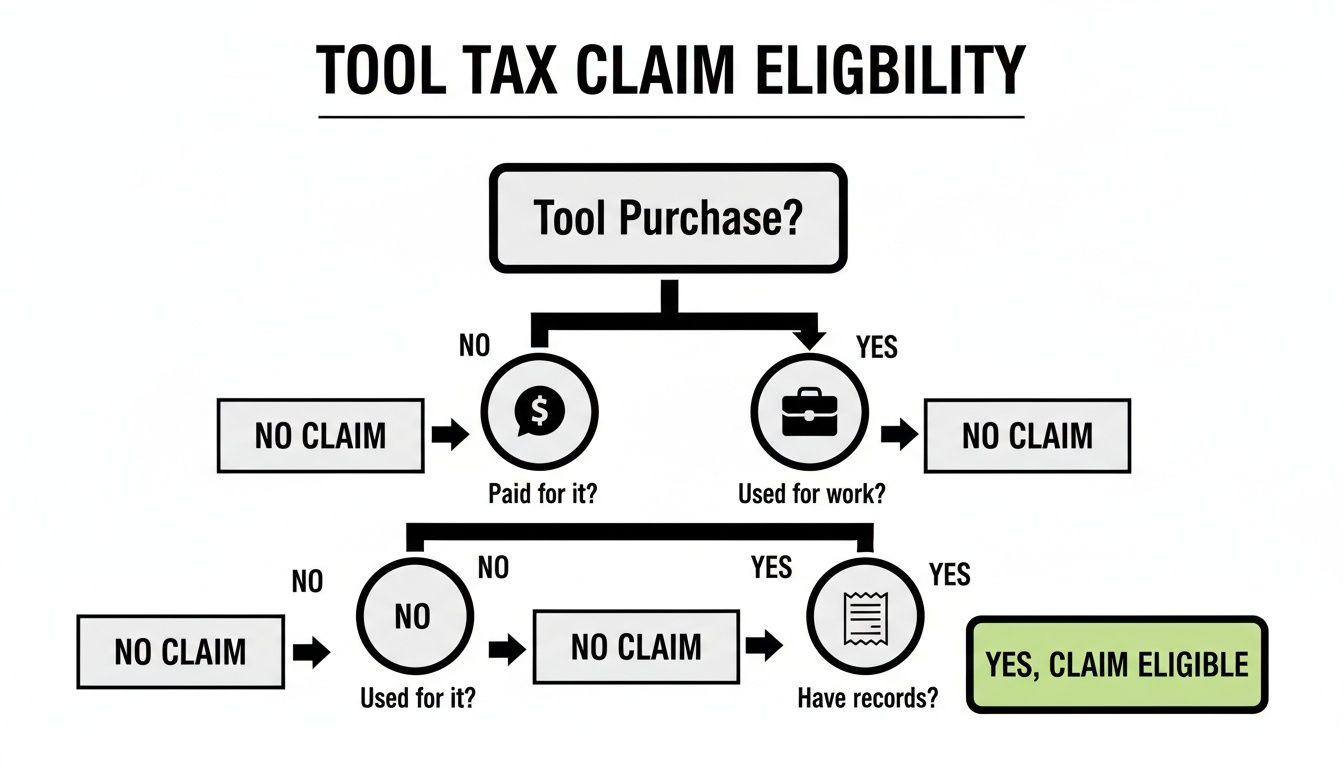
As you can see, your claim path depends on ticking those core ATO boxes—purchase, work use, and good records—before you even consider the price tag.
Claiming Depreciation for More Expensive Tools
But what happens if your new piece of equipment costs more than the immediate deduction threshold? For these larger-ticket items, you must claim depreciation. This is the ATO-approved method for deducting an asset's decline in value over time due to wear and tear. For context on how this works, it's worth understanding the typical equipment depreciation life.
Under tax law, specifically Division 40 of the Income Tax Assessment Act 1997, tools you use to earn income are considered depreciating assets. The ATO provides two methods to calculate this decline in value:
- Prime Cost (or straight-line): You claim a consistent percentage of the tool's cost each year over its "effective life."
- Diminishing Value: This method allows for a larger deduction in the initial years, with the claim amount decreasing over time.
Practical Example: A professional cleaner buys a new $2,500 commercial-grade pressure washer with an effective life of 5 years, according to the ATO's asset rulings.
- Under the prime cost method, they would claim $500 per year ($2,500 / 5 years) for five years.
- With the diminishing value method, the first-year claim would be $1,000 ($2,500 x (200% / 5 years)), providing double the immediate tax benefit.
Expert Tip: Most tradies and businesses prefer the diminishing value method. It provides greater tax relief sooner, which is a significant boost to your cash flow immediately following a major purchase.
Getting your head around these calculations can be tricky, but our guide on how to calculate depreciation can walk you through it.
The Instant Asset Write-Off for Small Businesses
For sole traders and small business owners, the instant asset write-off is one of the most valuable tax concessions available. It delivers a powerful boost to your cash flow by allowing you to deduct the full business-use cost of new tools and equipment in the same year of purchase, rather than depreciating them incrementally.
This isn't a tax loophole; it's a government measure designed to help small businesses invest and grow. The rules and thresholds can change, so it’s critical to have the latest information before making significant purchases.
The Magic Number: The $20,000 Threshold
If you’re running a small business with an aggregated turnover of less than $10 million, you are eligible. For the 2024–25 financial year, the ATO permits you to immediately write off eligible assets that cost less than $20,000 each.
This applies to assets you purchase and first use (or have installed ready for use) for a taxable purpose between 1 July 2024 and 30 June 2025. You can then claim the entire business portion as a deduction on your 2025 tax return. The ATO has its own official guidance on depreciating assets if you wish to explore the fine print.
Practical Example: A landscaper based in Belrose on Sydney's Northern Beaches buys a new commercial-grade lawn mower for $18,000 (excl. GST). Since it's under the $20,000 cap and used 100% for the business, they can claim the full $18,000 as a tax deduction in that same financial year.
But What About Assets Over $20,000?
What happens if the equipment you've been eyeing costs more? Any asset that exceeds the $20,000 threshold cannot be written off instantly. Instead, it must be allocated to your small business simplified depreciation pool.
Think of this pool as a single account for all your more expensive assets. The deductions work as follows:
- In the year you add the asset to the pool, you can claim 15% of its value.
- In subsequent years, you claim 30% of the pool's opening balance.
This pooling method simplifies your accounting. Instead of tracking the depreciation of every high-value item separately, you manage them as one group, streamlining your end-of-financial-year calculations.
Knowing these rules is key to smart financial planning. By timing your purchases, especially before the 30 June deadline, you can significantly impact your tax bill for the year. For a deeper look, check out our guide on small business tax concessions.
Actionable Step: Maximise your deductions and ensure compliance. If you need help with your depreciation pool or instant write-off claims, book a consultation with the EndureGo Tax team today.
What You Need to Prove Your Tool Claims to the ATO
A tax deduction is worthless without proof. This is a fundamental rule the Australian Taxation Office (ATO) enforces strictly. When you claim a tool, you are asserting it was a legitimate expense for earning your income, and you require the paperwork to substantiate that claim.
Without solid evidence, your claim will not withstand scrutiny if the tax office initiates an audit.

Think of your records as your defence. Good record-keeping isn’t just about stuffing receipts in a shoebox; it's about creating a clear, undeniable trail of your purchase and its necessity for your work.
What Does ATO-Compliant Evidence Look Like?
So, what does the ATO actually require? It's more than a faded docket from your ute's glovebox. To be audit-proof, your evidence must meet specific criteria.
Learning how to organize receipts for taxes properly is half the battle. A perfect record for a tool purchase includes:
- A full tax invoice: This must show the supplier's name and ABN, the date of purchase, a description of the item, and the cost.
- Proof of payment: A bank or credit card statement showing the transaction is the gold standard. It connects the invoice directly to your funds.
- A digital copy: It is best practice to take a photo of the receipt. Digital copies do not fade, unlike thermal paper receipts, and are easily stored.
These three elements together build an evidence trail that is difficult for the ATO to dispute.
Proving Your Business-Use Percentage
Here is where many taxpayers make errors. If you use a tool for work but also for personal projects, you can only claim the work-related portion. You must be able to justify your calculation of that split.
The ATO does not accept estimates. The onus is on you to prove your work-use calculation is reasonable and based on evidence, not a guess.
The most effective way to do this is by keeping a logbook or diary. This is not required indefinitely, but for a representative period—typically four consecutive weeks. During this time, you record each use of the tool, noting whether it was for a work task or personal use.
Practical Example: A chippy buys a new nail gun. Over a four-week period, they use it for a total of 80 hours. Their logbook shows 60 of those hours were on client sites, with 20 hours on a personal home project. This provides a defensible 75% business-use percentage. That logbook is their proof.
You are legally required to keep these records for five years from the date you lodge your tax return. For more detail, refer to our comprehensive guide on record-keeping requirements in Australia.
Actionable Step: Feeling overwhelmed by paperwork? Contact EndureGo Tax today. Our experts can ensure every claim you make is robust and audit-proof.
How to Lodge Your Tool Claims Correctly
Right, you’ve sorted out which tools you can claim. Now for the crucial question: where do you actually put these claims on your tax forms?
Getting this wrong is a classic mistake. It's not just about knowing what you can claim, but knowing where to claim it to satisfy the ATO. The process differs depending on whether you're an employee or a business operator.
For employees, it's relatively simple. Your tool expenses are recorded in the 'Work-related expenses' section of your individual tax return. If using myTax, you will find the section labelled D5 – Other work-related expenses. You simply tally your eligible costs for the year and enter the total figure there.
Lodging Claims as a Sole Trader or Business
If you're a sole trader, you follow different rules. The D5 section is for employees only. Your tool and equipment claims belong in the Business income and expenses section of your tax return. This is where you detail all the financial operations of your business.
This is also where depreciation calculations are reported. For more expensive gear, it is critical to get the decline in value calculation correct. The ATO provides helpful resources, and this step is crucial for claiming tools correctly.
We see this frequently: individuals either write off high-value items instantly when they shouldn't or forget to claim depreciation entirely. For tools under $300, you can claim them as an outright expense. However, items costing over the instant asset write-off threshold must be depreciated. Audits consistently find that a significant percentage of businesses under-claim because they misapply these rules. You can use the ATO's official calculator to understand how these calculations work.
Don't Forget the GST on Your Business Activity Statement (BAS)
For businesses registered for GST, there’s one more vital step: claiming the GST credit on your tool purchases.
This is done through your regular Business Activity Statement (BAS). You report the GST you paid on the tools at label 1B (GST on purchases).
This is a non-negotiable step to recover the GST component. For instance, if you buy new equipment for $2,200 (which includes $200 of GST), you claim that $200 back on your next BAS, effectively lowering the asset's real cost immediately.
Actionable Step: Navigating tax forms can be a minefield. One wrong entry can cause headaches or leave money on the table. If you are even slightly unsure, don't guess. Book a consultation with us today, and we’ll ensure every claim is lodged accurately so you can get back to business with confidence.
Your Top Questions on Tool Tax Claims Answered
Once you've mastered the basics, several complex questions often arise. Navigating the grey areas of tool claims can be confusing.
Let's address some of the most common scenarios our clients in Ashfield and the Northern Beaches ask us about.
Can I Claim a Tool I Bought on Afterpay or a Payment Plan?
Yes, you absolutely can. It is a common misconception that you must have paid for the tool in full before claiming it.
The ATO's focus is on when you first start using the tool for a work-related purpose, not your payment method. You can claim the full business-use portion of the cost in the financial year you acquire it and put it to work, even if you are still making payments via Afterpay, Zip Pay, or another finance arrangement.
If your business is registered for GST, you can also claim the full GST credit on your next Business Activity Statement (BAS), regardless of your payment schedule.
What Happens If I Sell a Tool I've Already Claimed?
This is a critical point. If you sell a tool that you have previously claimed a tax deduction for—either via an instant write-off or depreciation—you must declare the proceeds from the sale.
The ATO refers to this as a 'balancing adjustment'. As stipulated in the Income Tax Assessment Act 1997, any money you receive from selling the asset must be included as assessable income on your tax return for that year. This rule ensures the tax deduction you received accurately reflects the asset's actual decline in value during its time with you.
Practical Example: Let's say you used the instant asset write-off to claim a $1,500 generator two years ago. This year, you upgrade and sell the old one on Facebook Marketplace for $400. That $400 is considered income and you must declare it on your tax return.
Can I Claim the Travel Costs to Pick Up a New Tool?
Yes, you can. Any travel expenses incurred to purchase a work-related tool are considered part of the asset's cost and are deductible.
This includes motor vehicle expenses for the journey to the supplier and back. To ensure your claim is accepted by the ATO, you must keep a clear record. A logbook entry noting the date, purpose of the trip (e.g., "travel to Sydney Tools to purchase new drill"), and kilometres travelled provides the perfect evidence.
Getting these specific scenarios right is what elevates a good tax return to a great one. Don't risk leaving money on the table by guessing.
Actionable Step: Ready to ensure your tax return is 100% accurate and maximised? Book a consultation with us today and let our experts handle it for you.
