


Your Core Payroll Obligations in Australia
What are your non-negotiable duties as an employer? For many small business owners we work with, from tradies in Ashfield to café owners on the Northern Beaches, payroll is one of the most daunting operational tasks. However, it ultimately boils down to four key pillars.
Think of this as your essential checklist for every pay run. By mastering these, you not only meet your ATO obligations but also build a strong foundation of trust with your employees.

To provide a clear picture, here’s a professional summary of what you need to manage.
Australian Payroll Obligations at a Glance
| Obligation | What It Is | Who Manages It | Key Consideration |
|---|---|---|---|
| PAYG Withholding | Income tax is collected from employee wages. | Australian Taxation Office (ATO) | You are collecting this on behalf of the employee; it is not a business tax. |
| Superannuation Guarantee | Mandatory retirement savings contributions. | Employee’s Nominated Super Fund | Paid on top of wages, currently at 11% and set to rise. |
| State Payroll Tax | A state-level tax on your total wage bill. | State Revenue Offices (e.g., Revenue NSW) | Only applies once your total wages exceed a certain threshold. |
| Workers’ Compensation | Insurance for work-related employee injuries. | State-Regulated Insurers (e.g., icare NSW) | Premiums are based on your industry risk and total wages paid. |
These responsibilities are divided between the federal and state governments, each with its own specific rules and purpose. Let’s break them down with an expert eye.
The Four Pillars of Australian Payroll
Here’s a closer look at each of your core duties.
- Pay As You Go (PAYG) Withholding: This is the income tax you collect from your employees’ pay on behalf of the ATO. You act as a tax collector—it is not your money, but you are responsible for remitting it correctly. This system helps your team meet their annual income tax obligations progressively.
- Superannuation Guarantee (SG): This is the mandatory contribution you make to your team’s retirement savings. It is paid in addition to their salary and goes directly into their nominated super fund. It is a common error to think of this as part of their take-home pay.
- State-Based Payroll Tax: This tax often catches growing businesses by surprise. It is a tax levied by your state or territory government once your total annual wage bill surpasses a specific threshold. In NSW, for example, this is managed by Revenue NSW and applies once you pay over $1.2 million in wages.
- Workers’ Compensation Insurance: While technically an insurance policy, this is a critical, payroll-related cost that cannot be overlooked. It covers wage replacement and medical expenses for employees injured on the job. Your premiums are calculated based on your total wage bill and your industry’s risk profile.
A classic mistake we see new employers make is focusing solely on PAYG and super. They completely forget about state payroll tax thresholds or their workers’ compensation duties. As a business grows, this oversight can lead to significant unexpected bills and penalties.
Understanding these elements is vital, regardless of your industry. For service-based businesses like tutoring centres, precision is everything. This comprehensive Teacher Payroll Tutoring Business Guide offers valuable insights applicable across many sectors.
By familiarising yourself with each obligation, as detailed in legislation like the Taxation Administration Act 1953, you are building a robust foundation for accurate, stress-free payroll. The following sections will guide you on exactly how to calculate payroll taxes for each of these pillars.
Ensure your payroll system is compliant and efficient from the start. Contact EndureGo Tax today for an expert consultation.
Calculating PAYG Withholding Accurately
Correctly calculating Pay As You Go (PAYG) withholding sits at the core of your payroll obligations. In simple terms, you collect income tax from your employees’ pay on behalf of the Australian Taxation Office (ATO). Getting this calculation right goes beyond compliance; it plays a critical role in maintaining your employees’ trust.
Think of yourself as a temporary guardian of this money. You apply the amounts you withhold directly to your employee’s annual income tax liability. If you miscalculate, you can leave an employee facing an unexpected tax debt at year’s end. On the other hand, withholding too much can trigger cash flow issues for your business when you need to make corrections.

Finding the Right ATO Tax Table
Your primary tool for calculating PAYG will always be the official current tax tables from the ATO. These tables remove the guesswork by providing the exact amount to withhold based on an employee’s earnings and specific circumstances. Crucially, the ATO updates these schedules regularly, so ensure you are always using the latest version.
To select the correct table, you will need the following information from your employee’s TFN Declaration form:
- Pay Frequency: Are you paying them weekly, fortnightly, or monthly? There is a specific table for each pay cycle.
- Tax-Free Threshold: Has your employee claimed the tax-free threshold? For most individuals in their primary job, the answer is yes.
- Study and Training Support Loans: Does your employee have a HELP, VSL, or other student loan debt? This requires a different tax table to factor in the additional repayments.
For a more detailed analysis, review our comprehensive guide on navigating PAYG withholding.
A Practical PAYG Calculation Example
Let’s walk through a practical scenario. Imagine you have a full-time employee, Chloe, who is paid fortnightly.
- Gross Fortnightly Pay: $2,400
- Pay Frequency: Fortnightly
- Tax-Free Threshold Claimed: Yes
- HELP Debt: No
To determine Chloe’s tax, you would use the “Fortnightly tax table” (NAT 1006) from the ATO website.
- Locate Chloe’s gross pay of $2,400 in the ‘Earnings’ column.
- Look across to the corresponding amount in the ‘With tax-free threshold’ column.
- The table clearly indicates you must withhold $389 from her pay.
Therefore, Chloe’s net (take-home) pay for that fortnight is $2,011 ($2,400 – $389), before any other deductions.
These individual withholdings are a significant part of government revenue. For a local business with a $2 million wage bill, correct calculation is a serious compliance duty. Errors discovered during an audit can be incredibly costly.
What if an Employee Has a HELP Debt?
Now, let’s adjust the scenario. What if Chloe did have a HELP debt?
This is a common point of error for businesses. You would not use the standard table. Instead, you would need the “Fortnightly study and training support loans tax table” (NAT 3539).
For the same $2,400 gross pay, this table instructs you to withhold $509. This is because the calculation now includes both her standard income tax and her compulsory HELP repayment.
This detail is critical. Using the wrong table is one of the most common and avoidable PAYG mistakes. The responsibility for withholding the correct amount falls squarely on the employer, as outlined in the Taxation Administration Act 1953.
Handling PAYG accurately comes down to expert attention to detail. By consistently using the correct ATO tax tables and understanding how factors like the tax-free threshold and study loans affect the figures, you can manage your payroll with professional confidence.
Mastering Your Superannuation Guarantee Calculations
Beyond PAYG withholding, another non-negotiable payroll duty is the Superannuation Guarantee (SG). This compulsory contribution supports your employees’ retirement savings, and the Australian Taxation Office (ATO) allows very little room for error in this area.
Getting this right goes beyond avoiding costly penalties; it directly supports your team’s long-term financial well-being.
The entire process hinges on one crucial concept: Ordinary Time Earnings (OTE). You use this figure to calculate an employee’s super entitlement. OTE refers to what an employee earns for their normal, ordinary hours of work.
Unpacking Ordinary Time Earnings
This is where many business owners falter. Confusing an employee’s total gross pay with their OTE can lead to significant super underpayments. The definition is specific, and knowing what is included and excluded is fundamental.
What is typically included in OTE?
- Base Salary or Wages: The standard pay for their ordinary hours.
- Certain Allowances: Items like shift loading or casual loading are generally considered OTE.
- Commissions and Bonuses: Performance-based payments are also included.
- Paid Leave: Pay for annual leave, sick leave, and long service leave all count towards OTE.
Conversely, some payments are specifically excluded, the most common being overtime pay. As a general rule, payments for hours worked outside an employee’s ordinary hours are not part of OTE and do not attract super. For a complete breakdown, the ATO provides detailed guidance under the Superannuation Guarantee (Administration) Act 1992.
Calculating the Super Contribution
Once you have determined the OTE for a pay period, the calculation is straightforward. You simply multiply the OTE by the current Superannuation Guarantee rate.
The formula is: OTE x Current SG Rate = Super Contribution
Let’s apply this with a practical example. Imagine your employee, David, works in your Ashfield-based business.
- Payment Period: Monthly
- Monthly Salary (OTE): $5,000
- Overtime Paid: $500
- Current SG Rate: 11% (for the 2023-24 financial year)
First, you must isolate David’s OTE. In this instance, it is his base salary of $5,000. The $500 he earned in overtime is excluded from this calculation.
The calculation is: $5,000 (OTE) x 0.11 (SG Rate) = $550
You are required to contribute $550 into David’s chosen super fund for that month.
One of the most critical aspects of super is not just calculating it correctly but paying it on time. Contributions are due quarterly, and missing these deadlines will result in the Superannuation Guarantee Charge (SGC). This includes the super owed, plus interest and an administration fee. Critically, the SGC is not tax-deductible.
The Consequences of Getting It Wrong
Failing to pay super on time is a serious compliance breach. The ATO is incredibly strict on this as it directly impacts an individual’s retirement savings. Our guide on how to ensure timely super guarantee payments provides actionable steps to remain compliant.
Remember, super is paid on top of an employee’s salary—it is not deducted from their pay like PAYG tax. By mastering the OTE definition and adhering to quarterly deadlines, you can manage this vital part of your payroll with confidence.
If you are ever uncertain whether a particular payment constitutes OTE, seeking professional advice is the most prudent action. Book a consultation with EndureGo Tax to ensure your super calculations are always accurate.
Understanding NSW Payroll Tax
As your business grows, another tax obligation often emerges: state payroll tax. This is entirely separate from the PAYG withholding and superannuation you manage for the ATO. In New South Wales, this tax is administered by Revenue NSW, and it applies once your total Australian wages exceed a certain annual threshold.
For many expanding businesses, particularly in bustling areas like Inner West Sydney or the Northern Beaches, this can be an unexpected budgetary impact. Understanding your liability and how to calculate it is crucial for managing cash flow and remaining compliant as you scale.
The NSW Payroll Tax Threshold
First, you must determine if you are liable. Payroll tax only applies once your total taxable wages in Australia exceed the annual threshold.
For the 2024-25 financial year, the NSW payroll tax threshold is $1,200,000. If your annual wage bill is below this figure, you generally do not need to register or pay.
However, the moment your wages surpass the $1.2 million mark, you are required to register with Revenue NSW and begin lodging returns. The tax itself is only calculated on the portion of your wages that is above the threshold.
This threshold is a critical figure every growing business owner should monitor. A common error is failing to register upon crossing it, which can lead to backdated tax bills, plus interest and penalties. Diligently track your wage bill as it grows—it is non-negotiable.
How to Calculate Your NSW Payroll Tax Liability
Calculating your payroll tax is straightforward once you understand the formula. You take your total taxable wages, subtract the threshold, and apply the current tax rate.
The formula is: (Total Taxable Wages – Threshold) x Tax Rate = Payroll Tax Payable
This hinges on two key elements: what constitutes ‘taxable wages’ and the current tax rate.
What Are Taxable Wages in NSW?
This is where many businesses are caught out. ‘Taxable wages’ is a broad term that encompasses more than just regular salaries. Under the Payroll Tax Act 2007 (NSW), it includes a range of payments, such as:
- Salaries and wages
- Commissions, bonuses, and allowances
- Fringe benefits (using the grossed-up value)
- Superannuation contributions (both SG and salary sacrifice)
- Payments to certain contractors
The inclusion of superannuation and fringe benefits often pushes a business’s total wage bill over the threshold without them realising it.
Practical Calculation Scenario for a NSW Business
Let’s walk through a practical example.
Imagine you operate a thriving business in Belrose with an annual Australian wage bill of $1,500,000. For this scenario, we will assume you are not part of a ‘grouped’ entity.
The key figures are:
- Total Taxable Wages: $1,500,000
- Annual NSW Threshold: $1,200,000
- NSW Payroll Tax Rate: 5.45%
Here is a clear breakdown of the calculation process.
| Worked Example for NSW Payroll Tax Calculation |
| :— | :— | :— |
| Calculation Step | Description | Example Value |
| 1. Determine Taxable Wages | Sum of all wages, super, allowances, etc. | $1,500,000 |
| 2. Identify Excess Wages | Subtract the annual threshold from total wages. | $1,500,000 – $1,200,000 = $300,000 |
| 3. Apply the Tax Rate | Multiply the excess wages by the current rate (5.45%). | $300,000 x 0.0545 |
| 4. Calculate Final Liability | The result is your annual payroll tax payable. | $16,350 |
Your total annual payroll tax liability would be $16,350. This amount is typically paid to Revenue NSW through monthly returns, with an annual reconciliation.
In New South Wales, the payroll tax rate has been a flat 5.45% on taxable wages over the threshold since 1 July 2007. For 2024-25, that threshold remains $1,200,000. This is a crucial figure we help our local clients track to avoid audits, as ATO penalties have averaged $12,000 per error in recent years. You can review historical payroll tax rates to see how the legislation has evolved.
The Complication of Grouping Provisions
A further layer of complexity arises from the grouping provisions, one of the most intricate areas of payroll tax. If your business connects to another entity—for example, through common directors or shareholders—the law may group you for tax purposes.
When authorities group businesses, they share a single $1,200,000 threshold. This rule stops business owners from splitting operations across multiple entities to remain under the threshold. If you operate within a complex business structure, understanding these grouping rules becomes essential.
Navigating payroll tax demands requires close attention and accurate numbers. If your business is approaching the threshold or you feel entangled in your obligations, now is the right time to seek expert guidance.
Book a consultation with EndureGo Tax, and let’s ensure you are managing your state tax duties correctly.
Reporting and Lodging: Making Sure Your Hard Work Counts
You have mastered the calculations. Nevertheless, knowing how to calculate payroll taxes only solves part of the challenge. Indeed, the figures lose their value if you do not report them correctly and on time.
Next, you must lodge your data with the Australian Taxation Office (ATO), using the primary mechanism: Single Touch Payroll (STP).
STP directly transmits your payroll information—salaries, wages, PAYG withholding, and super liabilities—to the ATO every time you pay your team. Because this process occurs in real time with each pay run, accuracy becomes more critical than ever. Moreover, the data you send via STP informs the ATO of your liabilities and even pre-fills other essential documents, such as your Business Activity Statement (BAS).
The Role of Single Touch Payroll
Think of STP as a direct, digital link between your payroll software and the ATO. Each time you process pays, your software generates an STP report detailing the gross pay, tax withheld, and superannuation accrued for each employee.
When you finalise the pay run, the report is securely lodged. This gives the ATO immediate visibility over your obligations, making it easier for them to identify discrepancies early.
For an in-depth look, our guide on what Single Touch Payroll means for you covers all essential details.
How STP Connects to Your BAS
The figures you report through STP are used by the ATO to pre-fill the PAYG withholding labels (W1 and W2) on your BAS. While this is designed to simplify the process, it also means there is no room for error if your numbers do not align.
It is essential to reconcile the figures from your payroll software with the ATO’s pre-filled BAS data. If the PAYG withholding amounts do not match, you must investigate and correct the discrepancy immediately. Ignoring a mismatch is a significant red flag for the ATO and could trigger an audit.
State payroll taxes can also be a significant liability for growing businesses. In NSW, the rate has been a steadfast 5.45% since 2007, applying to businesses with annual wages over $1,200,000. For a typical Inner West Sydney business paying $1,500,000 in wages, that’s an additional $16,350 in state payroll tax to calculate and lodge annually. You can discover more insights about historical tax rates to see how things have evolved.
This visual illustrates the simple three-step process for calculating your NSW Payroll Tax liability.
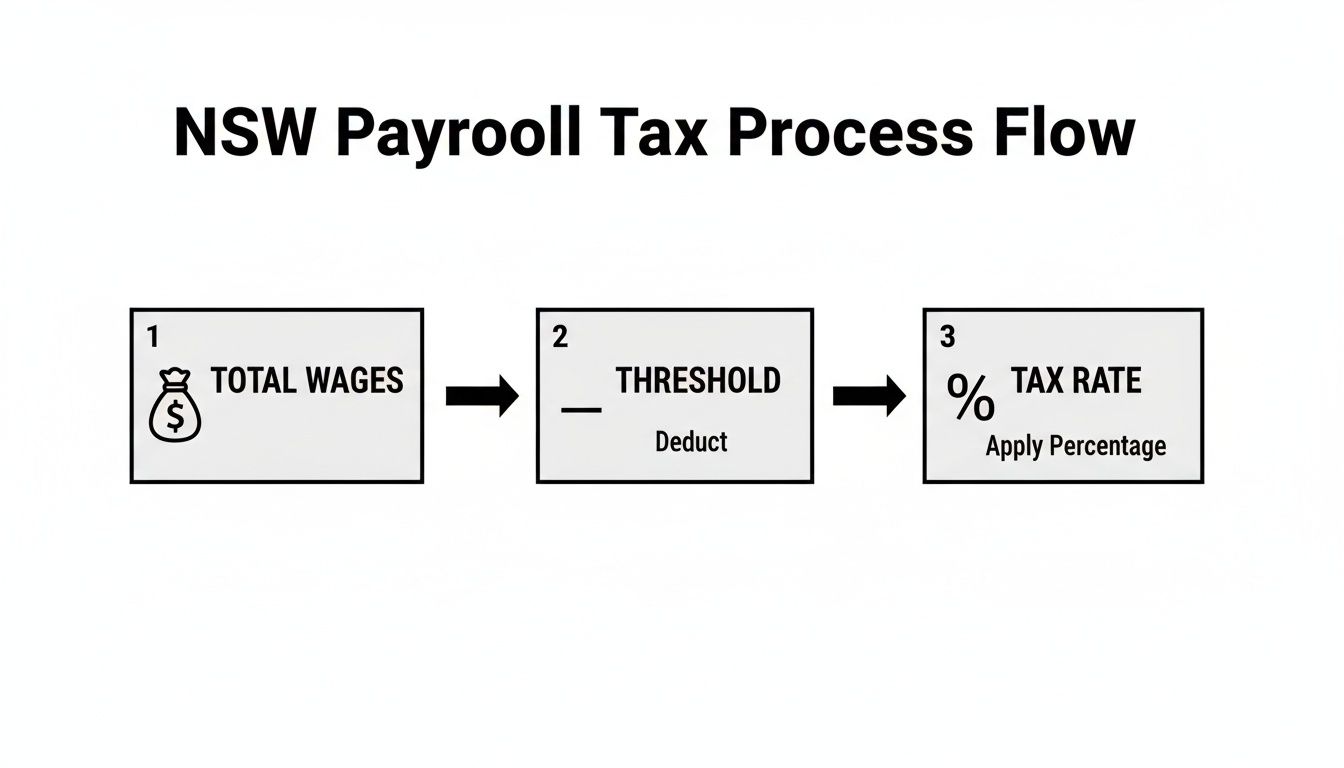
The key takeaway here is that payroll tax only applies to the wages exceeding the state’s threshold, not your entire wage bill.
Your Compliant Pay Run Checklist
The goal is to transform this complex process into a manageable routine. Following a consistent checklist for every pay run provides peace of mind that your reporting is correct and compliant with the Taxation Administration Act 1953.
Here’s an expert checklist to follow every time:
- Verify Employee Details: Before processing, double-check that TFNs, bank details, and super fund information are correct.
- Calculate Gross to Net Pay: Run calculations for PAYG withholding and superannuation based on Ordinary Time Earnings.
- Process the Pay Run: Pay your employees and distribute their payslips within one working day of payment.
- Lodge Your STP Report: Immediately after finalising the pay run in your software, submit the STP file to the ATO.
- Pay Super Contributions: Ensure super is paid into employee funds by the quarterly due date to avoid the Superannuation Guarantee Charge (SGC).
- Reconcile with BAS: When your BAS is due, cross-check the pre-filled PAYG figures against your payroll records before lodging.
By following these steps, you transform compliance from a source of stress into a standard business process. It’s about building a reliable system that protects your business, your employees, and your relationship with the ATO.
If you feel overwhelmed by your reporting and lodgement duties, you do not have to handle it alone. Book a consultation with EndureGo Tax today, and let our experts provide the peace of mind you deserve.
Common Payroll Tax Questions Answered
Even with the most robust systems, you will encounter payroll scenarios that require expert interpretation. Knowing how to calculate payroll tax obligations is one thing; knowing how to handle complex situations is another.
Here, we address some of the most common questions from business owners.
What Should I Do If I Make a Payroll Calculation Mistake?
First, do not panic. Discovering a payroll error is stressful, but ignoring it is the worst possible action.
If you have underpaid an employee’s PAYG withholding or superannuation, the standard practice is to correct it in their next scheduled pay run. For a significant error, you may need to make a standalone payment to the employee or their super fund to rectify it promptly.
Most importantly, you should lodge a voluntary disclosure with the Australian Taxation Office (ATO). The ATO is far more lenient when businesses proactively report mistakes rather than waiting for an audit. This can often lead to a significant reduction in penalties.
Do I Have to Pay Superannuation for Contractors?
This is a significant grey area and a common compliance trap. The answer depends on the actual working arrangement, not just the ABN on an invoice.
Under Australian law, a contractor may be deemed an ’employee’ for superannuation purposes if their contract is primarily for their personal labour and skills. The substance of the relationship is what matters. The ATO has a detailed checklist to help you determine your obligations.
A classic example is hiring a tradesperson for a long-term project. If they work exclusively for you, use your equipment, and are paid by the hour, they are very likely entitled to super—even if they issue an invoice. An incorrect assessment can result in a hefty Superannuation Guarantee Charge (SGC) bill from the ATO, plus penalties and interest.
How Does Annual Leave Loading Affect Tax Calculations?
Annual leave loading is a component that is often mishandled because it affects different taxes in different ways.
- Superannuation: In most cases, it is considered part of Ordinary Time Earnings (OTE), and you must pay super on it. An exception may apply if your award or agreement explicitly states the loading compensates for lost overtime opportunities.
- PAYG Withholding: This is not taxed like regular pay. You must refer to the specific ATO tax tables for lump sums (see ‘Schedule 5 – Tax table for back payments, commissions, bonuses and similar payments‘) to withhold the correct amount.
- State Payroll Tax: For jurisdictions like NSW, annual leave loading is almost always included in your total taxable wages for state payroll tax.
What Is the Difference Between PAYG Withholding and PAYG Instalments?
This distinction is crucial for business owners.
- PAYG Withholding is the tax you collect from your employees’ wages on behalf of the ATO. You are a collection agent for the government.
- PAYG Instalments are the regular payments you, as a business owner or sole trader, make towards your own expected income tax liability. It is a system to pre-pay your business or personal income tax throughout the year to avoid a large tax debt.
In simple terms, withholding is for your team; instalments are for you and your business.
Mastering these nuances is what separates a compliant, stress-free business from one facing constant ATO scrutiny.
Navigating the maze of payroll taxes requires time and genuine expertise. At EndureGo Tax, we provide business owners with the peace of mind that comes from knowing their payroll is managed correctly, every time. Whether you’re in Ashfield or anywhere across Sydney, our expert team is here to support you.
Ready to eliminate payroll stress for good? Book a consultation with EndureGo Tax today.
