


Before you can strategically calculate depreciation, you must grasp what it fundamentally means for your business’s financial health. This isn’t just another compliance task for your tax return; it’s a powerful tool for strategic financial planning and optimising your tax position.
Essentially, depreciation is the mechanism the Australian Taxation Office (ATO) provides to account for an asset’s decline in value over its useful life. That new work ute, high-performance computer, or specialised machinery won’t hold its purchase value forever. Claiming this reduction in value is an expert-level strategy for legally minimising your taxable income and boosting your business’s cash flow.
Understanding Depreciation for Smarter Tax Planning
Depreciation is a core financial concept for any Australian business owner. When you invest in a significant asset—be it a vehicle, heavy machinery, or office equipment—you cannot claim the entire cost as a one-off expense in the year of purchase.
Instead, the ATO mandates that you deduct a portion of its cost each year over the asset’s “effective life.” This process accurately reflects the reality that assets lose value through use, wear and tear, and obsolescence. By claiming depreciation, you are systematically matching the cost of the asset with the income it helps generate over its lifespan. This is not just accounting; it’s astute financial management.
The Two Core Depreciation Methods
In Australia, the ATO sanctions two primary methods for calculating asset depreciation. Your choice between these methods will directly impact your tax liabilities and cash flow, making it a critical strategic decision.
Prime Cost (Straight-Line) Method: This is the straightforward, consistent approach. You allocate the asset’s cost evenly over its effective life, resulting in a predictable and uniform deduction each year. This method is expertly suited for assets that decline in value at a steady rate, such as office furniture or basic building fixtures.
Diminishing Value Method: This method is engineered for acceleration. It allows you to claim larger deductions in the initial years of an asset’s life, with the deduction amount decreasing over time. This is a game-changer for assets that rapidly lose value, such as technology or vehicles, as it delivers a significant upfront cash flow advantage.
Expert Tip: Choosing the right method is a strategic financial decision, not a mere compliance task. The Diminishing Value method can immediately free up capital following a major purchase, precisely when cash flow is most critical. Conversely, the Prime Cost method provides stability and predictability, which is invaluable for long-term financial forecasting and planning.
Mastering your depreciation strategy is a cornerstone of effective tax optimisation. When you understand how to calculate depreciation using the optimal method for each asset, you can significantly lower your tax burden and reinvest those savings directly into business growth. For those aiming to elevate their financial operations, exploring automation tools like RPA for finance can further enhance efficiency and accuracy. It’s a key lever for making more intelligent financial decisions.
Calculating Depreciation With The Prime Cost Method
When predictability in your financial forecasting is paramount, the Prime Cost method is your most reliable tool. It is favoured by financial experts for its simplicity and is the definitive choice for assets that depreciate evenly over their lifespan, such as office furniture, fixtures, and certain types of industrial machinery.
This approach, also known as the “straight-line method,” is defined by its consistency. It guarantees you claim the identical deduction amount year after year, removing volatility from your long-term budgeting and tax planning. There are no surprises—only a steady, reliable figure for your financial models.
The Prime Cost Formula Explained
At its core, the Prime Cost method employs a logical formula that distributes an asset’s total cost evenly across its operational life. This provides a clear and direct path to calculating your annual tax deduction.
The official ATO formula is: (Asset’s Cost × Days Held) ÷ (Effective Life × 365)
However, for any asset you have held for the entire financial year, the formula simplifies to this actionable equation:
Asset’s Cost ÷ Effective Life = Annual Deduction
This entire calculation is contingent on two critical inputs: the asset’s total cost and its ATO-approved “effective life.” Secure these two figures, and your claim will be both compliant and precise.
Determining an Asset’s Cost and Effective Life
Before applying the formula, you must first establish the asset’s total cost. This extends beyond the sticker price to include all expenses necessary to bring the asset into commercial use.
Ensure your calculation includes:
- The original purchase price of the asset.
- Delivery and freight charges.
- Installation and assembly costs.
- Any other incidental costs directly related to the acquisition and setup.
Next, you must determine the asset’s effective life – the period it can be reasonably expected to generate income. The ATO provides extensive rulings on the effective life for thousands of assets, and leveraging these determinations is the most common and safest practice. Note that regulations for secondhand assets can differ; for a detailed analysis, consult our guide on changes in second-hand asset depreciation.
Practical Example: Commercial Printer
Let’s apply this to a real-world business scenario. Imagine your marketing agency acquires a new high-end commercial printer to produce client materials in-house.
- Asset Cost: The printer’s purchase price is $5,000. Delivery and professional installation add $500. Therefore, the total cost basis for depreciation is $5,500.
- Effective Life: As per the ATO’s taxation ruling, a commercial printer of this type has an effective life of 5 years.
Now, we input these figures into the simplified Prime Cost formula:
$5,500 (Asset Cost) ÷ 5 years (Effective Life) = $1,100 per year
It’s that straightforward. Your agency can now claim a $1,100 tax deduction for this printer annually for five consecutive years. This provides stable, predictable relief on your taxable income, making financial planning far more accurate.
If you manage your accounts in spreadsheets, mastering these calculations is a significant advantage. To sharpen your skills, consider a tutorial on mastering financial formulas in Excel.
Using the Diminishing Value Method to Accelerate Your Deductions
When your business invests in assets that rapidly lose value—such as cutting-edge technology or a new vehicle fleet—a slow, linear tax deduction is suboptimal. You need a depreciation method that accurately reflects this accelerated initial decline in value.
This is precisely the scenario where the Diminishing Value method excels. It is a powerful financial strategy that allows you to claim a larger portion of the depreciation upfront, aligning the tax benefit with the period when the asset is most productive.
By front-loading your deductions, you reduce your taxable income more substantially in the early years. This provides a crucial boost to your cash flow immediately following a significant capital expenditure. It is the expert choice for assets whose value is concentrated in their novelty and early performance.
Decoding the Diminishing Value Formula
Unlike the linear Prime Cost method, the Diminishing Value calculation is based on the asset’s written-down value each year. In practical terms, your deduction is calculated on the remaining value, not the original purchase price.
The formula provided by the ATO is:
Base Value × (Days Held ÷ 365) × (200% ÷ Asset’s Effective Life)
Let’s break this down for practical business application:
- Base Value: This is the asset’s cost in the first year. From the second year onwards, it is the opening adjustable value (cost minus depreciation already claimed).
- Days Held: This factor is for assets acquired or disposed of mid-year. If held for the full 365 days, this component simplifies to 1.
- 200% ÷ Asset’s Effective Life: This is the “accelerated” component. It effectively doubles the depreciation rate compared to a straight-line approach, yielding a much larger deduction in the initial years.
A Practical Example: The New Company Ute
Let’s apply this method to a common business purchase. Imagine your construction business acquires a new work ute for $60,000. You have held it for the entire financial year, and the ATO assigns it an effective life of 8 years.
Here is how you would calculate the depreciation for the first year using the Diminishing Value method:
$60,000 (Base Value) × (365 ÷ 365) × (200% ÷ 8 years) = $15,000
In year one, you can claim a $15,000 deduction. This substantial claim provides immediate financial relief and improves liquidity.
For the second year, the calculation adjusts based on the new written-down value. The new base value is now $60,000 – $15,000 = $45,000.
Your year two deduction would be: $45,000 × (200% ÷ 8) = $11,250. As demonstrated, the deduction is largest in the first year and systematically decreases thereafter.
This chart visualises how the annual depreciation expense diminishes over time with this accelerated method.
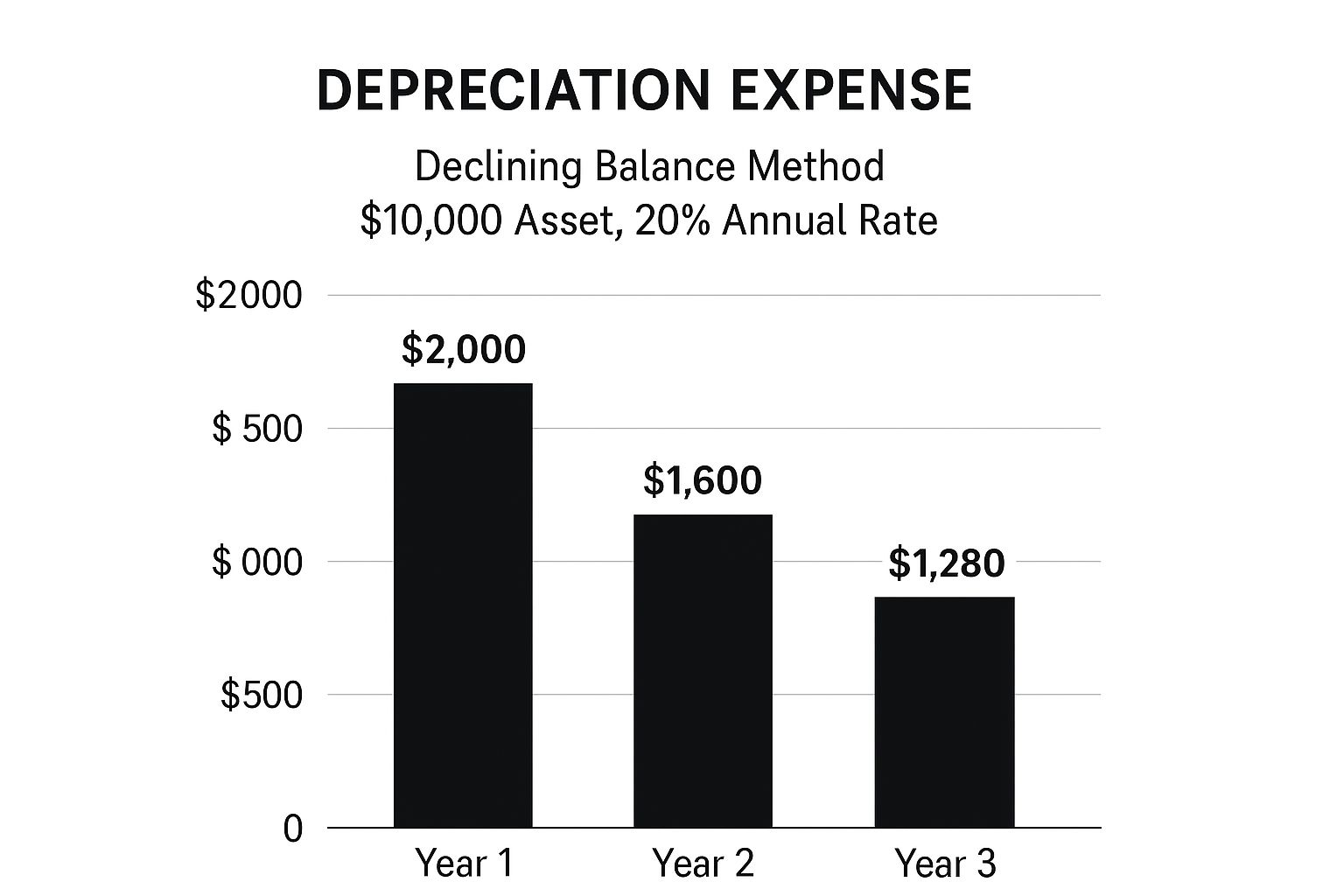
The chart unequivocally shows that this method is designed to maximize the tax benefit upfront.
Key Insight: The Diminishing Value method provides a significant cash flow advantage. The $15,000 first-year deduction for the ute is double the $7,500 you would have claimed under the Prime Cost method. This liberates capital when it is most needed after a major acquisition.
It is also critical to note that for eligible small businesses, other schemes may offer even faster tax relief. Always verify your eligibility for the government’s instant asset write-off extension, which could permit an immediate claim of the full asset cost.
Selecting the right depreciation strategy is a critical decision that requires balancing immediate tax advantages with the long-term value profile of your assets.
How to Choose the Right Method and Determine an Asset’s Effective Life
Deciding between the Prime Cost and Diminishing Value methods is not a simple administrative choice; it is a strategic financial decision with direct consequences for your tax liability and cash flow. Making the correct choice from the outset is fundamental to your business’s financial optimisation.
The optimal method is dictated by the nature of the asset itself. The guiding question should be: how does this specific asset lose its value in real-world use? Does it degrade steadily over time, or is its value heavily front-loaded, declining sharply after initial use?
Matching the Method to the Asset
For assets that depreciate rapidly, the Diminishing Value method is unequivocally the superior strategy. This applies particularly to items like company vehicles, which suffer from immediate value loss upon purchase, and technology hardware, which becomes obsolete quickly. This method provides larger tax deductions in the early years, delivering a crucial cash flow advantage after a significant capital outlay.
Conversely, the Prime Cost method is perfectly suited for assets with a longer, more predictable depreciation curve. This includes office furniture, commercial fit-outs, or certain types of durable machinery that provide consistent service over many years. These assets tend to lose value evenly. Opting for Prime Cost provides a stable, consistent deduction that can be reliably factored into long-term financial plans, simplifying budgeting and forecasting.
Expert Insight: You are not required—and in fact, it is often disadvantageous—to apply the same method to every asset your business owns. The expert approach is to select the optimal method for each individual asset to maximise your overall tax-effective outcome. Remember, the method you choose in the first year an asset is depreciated is locked in for its entire effective life.
Finding an Asset’s Correct Effective Life
Once you have selected a method, the next critical variable is the asset’s effective life. This is the ATO’s official estimate of how long an asset can be reasonably used to produce assessable income. To simplify this process, the Australian Taxation Office (ATO) issues comprehensive taxation rulings that list the standard effective lives for thousands of diverse assets.
Industry data confirms these lifespans vary significantly. For example, ATO guidelines typically set the effective life of a passenger vehicle at 8 years, whereas computers and peripheral electronics have much shorter lives of 2–4 years due to rapid technological advancement. You can explore the complete list by consulting the ATO’s guide to depreciating assets.
While most businesses adhere to the ATO’s determination for compliance and simplicity, you have an alternative.
- Using the ATO’s Determination: This is the most straightforward and risk-free path. You locate your asset in the official ruling and apply the specified life. It is simple and compliant.
- Self-Assessing Effective Life: If you have compelling evidence that your asset will wear out more quickly than the ATO standard—due to factors like intensive usage, harsh operating conditions, or planned obsolescence—you can self-assess a shorter effective life. This results in a larger annual deduction, but be prepared: you must have robust evidence, such as maintenance records, manufacturer specifications, or independent industry data, to substantiate your claim in the event of an ATO audit.
Correctly determining both the depreciation method and the effective life is the foundation of mastering how to calculate depreciation for maximum business benefit. If you are ever uncertain, consulting with a tax professional is the most effective way to ensure your claims are both compliant and financially optimised.
What to Do When an Asset’s Effective Life Changes
In the dynamic environment of business, asset management is rarely a “set and forget” activity. Business operations pivot, equipment is subjected to more intensive use than anticipated, or you may simply realize that an initial estimate of an asset’s lifespan was inaccurate.
This scenario frequently occurs with an asset’s effective life.
The good news is that an asset’s effective life is not immutable. The Australian Taxation Office (ATO) recognizes that circumstances change and has established provisions that allow you to adjust your depreciation calculations accordingly. If you make an estimate and subsequently find it to be incorrect, you are in fact required to recalculate.
When to Recalculate an Asset’s Effective Life
You cannot arbitrarily change an asset’s effective life. The ATO stipulates that a recalculation is only permissible when your original estimate is demonstrably no longer accurate due to changed circumstances.
Legitimate reasons for recalculation include:
- A change in the manner of use: A delivery van that is now covering double its projected weekly mileage, or a piece of machinery operating 24/7 instead of for a single shift. This increased usage will shorten its operational life.
- Asset modification: If you make a significant capital improvement that extends its income-producing capacity (e.g., a major engine rebuild), its effective life has been altered.
- Impact of external factors: The operating environment has changed—for example, the introduction of corrosive elements in a factory or extreme weather affecting outdoor equipment.
If any of these situations apply to your assets, you must adjust your depreciation calculations for the current and all future financial years. Implementing this correctly is one of the most practical small business tax tips for maintaining compliance with the ATO.
How to Recalculate Your Depreciation Claim
When you revise an asset’s effective life, you do not amend prior tax returns. The adjustment is prospective, applying from the current year forward. The objective is to allocate the asset’s remaining value over its new, recalculated lifespan.
The key figure you need is the opening adjustable value. This is the asset’s original cost less the cumulative depreciation claimed up to the beginning of the current financial year.
Formula for Recalculation (Prime Cost Method):
Opening Adjustable Value ÷ Remaining Effective Life = New Annual Deduction
This simple adjustment can significantly alter your tax deduction for the year.
Practical Example: Machinery Lifespan Adjustment
Imagine you purchased specialised machinery for $20,000 with an initial self-assessed effective life of 10 years, using the Prime Cost method. Your annual deduction is $2,000. After 3 years, you have claimed $6,000 in depreciation. The opening adjustable value at the start of year 4 is $14,000. Due to a new, high-volume contract, you realise the machinery will only last for another 4 years (a total of 7 years, not 10). The remaining effective life is now 4 years.
Your new annual deduction is: $14,000 ÷ 4 years = $3,500. Your deduction increases from $2,000 to $3,500 for the remaining life of the asset.
You can find the full technical details on the ATO’s page for recalculating effective life.
Mastering these adjustments is a core competency of intelligent, long-term asset management. If you are uncertain whether your circumstances warrant a recalculation, seeking expert advice is a prudent step to ensure compliance and optimal financial outcomes.
Common Questions on Calculating Depreciation
Even with a firm grasp of the Prime Cost and Diminishing Value methods, specific business scenarios can introduce complexity. Knowing the formulas is one thing; applying them correctly in real-world situations is another.
Obtaining clear, expert answers to these common questions is crucial for maintaining compliance and executing astute financial strategies. Let’s address some of the most frequent queries from Australian business owners.
Can I Claim the Full Cost of an Asset in One Year?
Yes, in many cases, you can leverage the instant asset write-off scheme. This valuable tax concession allows eligible businesses to claim an immediate deduction for the full cost of a qualifying asset in the same income year it is first used or installed ready for use.
However, there is a critical caveat: the eligibility rules and thresholds are subject to change. The turnover threshold for businesses and the maximum cost per asset are frequently updated by the government, often as part of the federal budget.
Crucial Tip: Before making a significant asset purchase, you must verify the current Australian Taxation Office (ATO) guidelines for the instant asset write-off. Relying on outdated information is a common and costly error that is easily avoidable with due diligence.
What Happens If I Sell a Depreciating Asset?
When you dispose of a depreciating asset, you must perform a “balancing adjustment.” This calculation reconciles the depreciation you have claimed with the asset’s final sale price (or termination value).
The outcome can be one of two scenarios:
- Assessable Income: If you sell the asset for more than its “adjustable value” (the original cost minus the total depreciation claimed), the difference is considered assessable income and must be included in your tax return for that year.
- A Further Deduction: Conversely, if the sale price is less than its adjustable value, you can claim the shortfall as an additional tax deduction.
This final calculation ensures that, over the asset’s entire holding period, your total depreciation claim precisely matches its actual decline in value.
Do I Have to Use the Same Method for All My Assets?
No, you do not. This is a prevalent misconception among business owners. You have the strategic flexibility to select the depreciation method that is most advantageous for each individual asset.
For example, an expert strategy would be to use the Diminishing Value method for a new vehicle to maximise upfront deductions and improve cash flow. Simultaneously, you could apply the Prime Cost method to a new office fit-out to achieve a stable and predictable deduction over its longer lifespan.
The single inviolable rule is this: once you select a method for a specific asset, you must continue to use that same method for that asset for its entire effective life.
Navigating the complexities of depreciation—from choosing the right method to performing balancing adjustments—can be a significant challenge. At EndureGo Tax, our expert accountants in Ashfield provide the clarity and strategic guidance you need. We ensure your depreciation claims are not only fully compliant but also structured to optimise your business’s financial position.
Ready to transform your tax strategy from a compliance task into a competitive advantage? Book a consultation with us today.
