


When it comes to understanding how to calculate Capital Gains Tax (CGT), the basic principle is straightforward: you subtract what the asset cost you from what you sold it for. That difference is your capital gain. However, the critical detail that many overlook is that CGT isn’t a separate tax—it’s a component of your income tax assessment for the year. Mastering this concept is the foundational step to an accurate calculation.
Understanding Capital Gains Tax in Australia

Before delving into the mechanics of how to calculate Capital Gains Tax, it is essential to understand what CGT signifies for your investments. While the core principle is simple, its application can become complex.
In essence, any profit realised from the disposal of an asset—such as shares, an investment property, or cryptocurrency—constitutes a capital gain.
This gain is not subject to a separate tax instrument. Instead, it is added to your other assessable income for the financial year, such as your salary. This can consequently shift you into a higher tax bracket, a factor for which you must be prepared. The tax payable on the gain is determined by your personal marginal tax rate. For a comprehensive overview of the fundamentals, refer to our guide on what is Capital Gains Tax.
The Role of Your Marginal Tax Rate
Australia does not impose a flat rate for CGT. Your capital gain is aggregated with your income and taxed at your marginal rate, which for the 2025 financial year ranges from 19% up to 47% (including the 2% Medicare Levy).
A pivotal element of CGT strategy is the 50% CGT discount. If you are an individual who has held an asset for at least 12 months, you are eligible to reduce your taxable capital gain by half. However, it is important to note that it only applies to non-foreign resident and who is a tax residence. This provides a significant advantage for long-term investors.
The most significant error investors make is underestimating how to calculate Capital Gains Tax correctly, especially in relation to their overall taxable income. It is not uncommon for a single asset sale to push an individual into the highest tax bracket, resulting in a significantly larger tax liability than anticipated.
While this guide focuses on the Australian framework, comparing it with international systems can offer a valuable perspective. You can review how Capital Gains Tax is calculated in the UK for an alternative approach.
What Is a CGT Event?
A ‘CGT event’ is the official ATO terminology for the specific occurrence that triggers a capital gain or loss. While a sale is the most common trigger, it is not the only one.
According to the Income Tax Assessment Act 1997 (ITAA 1997), a CGT event can also occur when you:
- Gift an asset to a family member or friend (CGT event A1).
- Lose an asset or it is destroyed (CGT event C1).
- Receive a compensation payment, such as an insurance payout, for a lost or destroyed asset.
The ATO mandates precise identification of the CGT event date, as this determines the financial year in which the gain or loss must be reported.
Unsure about how to calculate Capital Gains Tax for your situation? Book a professional consultation with EndureGo Tax. Our experts provide tailored guidance to ensure your compliance and maximise tax efficiency.
Calculating Your Asset’s True Cost Base
A comprehensive understanding of the ‘cost base’ is the most critical step in legally minimising your Capital Gains Tax (CGT) liability. Many investors mistakenly assume the cost base is merely the purchase price, thereby overpaying tax.
In reality, the cost base is a cumulative figure, and a higher cost base directly reduces your taxable gain.
An asset’s cost base represents the total expenditure incurred from acquisition to disposal. The Australian Taxation Office (ATO) defines this under five distinct elements as outlined in Division 110 of the ITAA 1997. Meticulous tracking of these expenses is paramount for an accurate CGT calculation.
The Five Elements of the Cost Base
Constructing your cost base involves documenting every legitimate expense incurred during your ownership of the asset. It extends far beyond the initial purchase price to include a range of essential, and often overlooked, expenditures.
Here are the five elements you must track:
- First element: The money or property value given to acquire the asset. This is the purchase price.
- Second element: All incidental costs related to the acquisition or disposal. This includes stamp duty, legal fees, valuer’s fees, accountant’s fees, and agent’s sales commissions.
- Third element: Non-deductible costs of ownership. This covers expenses like council rates, land tax, and insurance premiums for periods when an investment property was not generating rental income (and thus, you could not claim a tax deduction for these costs).
- Fourth element: Capital expenditure that enhances the asset’s value or its useful life. This refers to significant improvements, such as adding a new room, not routine repairs or maintenance. The improvement must be reflected in the asset at the time of sale.
- Fifth element: Capital costs to establish, preserve, or defend your title or rights to the asset, for example, legal fees to resolve a property boundary dispute.
This infographic illustrates the fundamental flow of a capital gain calculation. Subtracting the detailed cost base from your sale price is the critical second step.
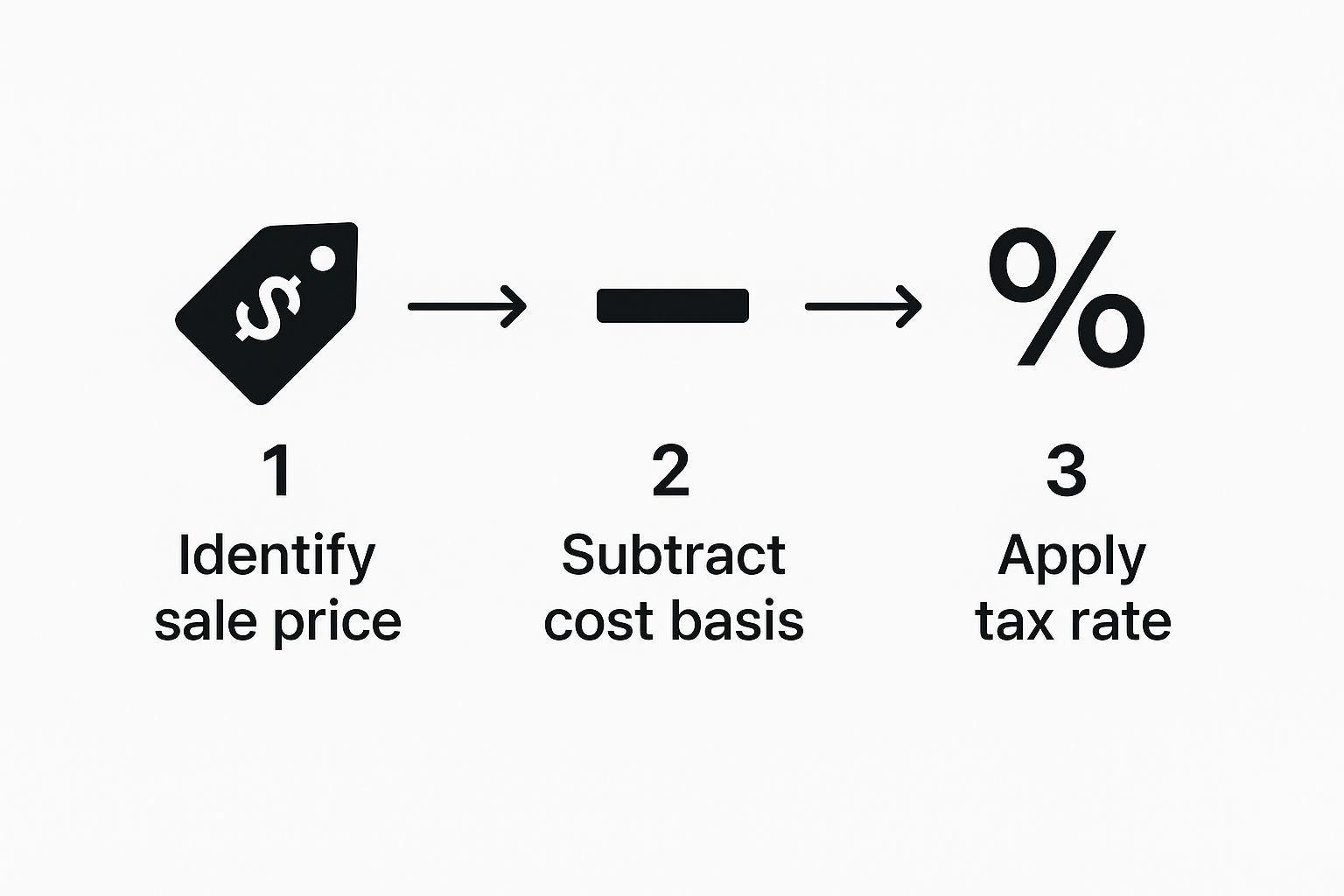
As the visual demonstrates, a higher cost base results in a smaller taxable gain. Thoroughness is fiscally prudent.
A Practical Example with an Investment Property
Let’s apply this with a practical scenario.
Assume you acquired an investment property for $500,000. Incidental acquisition costs included $15,000 in stamp duty and $1,200 in conveyancing fees. Years later, you sell it for $600,000, incurring $1,300 in legal fees and a $12,500 sales commission.
Instead of a simplistic calculation, you must aggregate all eligible costs.
Your total cost base is: $500,000 (purchase price) + $15,000 (stamp duty) + $1,200 (legal fees) + $1,300 (sale legal fees) + $12,500 (commission) = $530,000.
Your capital gain is therefore $70,000 ($600,000 sale price – $530,000 cost base).
You can find further details in the ATO’s guide on how to calculate your CGT.
Meticulous record-keeping is non-negotiable. Every receipt for stamp duty, invoice from a solicitor, and bill for a capital improvement adds to your cost base and reduces your tax liability. Store these documents digitally and securely from the day of acquisition.
Failure to track these costs is equivalent to voluntarily paying more tax than legally required.
Maximise your cost base and minimise your tax. Contact EndureGo Tax today for an expert review of your CGT position and ensure you are claiming every eligible expense.
Determining Your Capital Proceeds and CGT Event Date
Having established your asset’s cost base, the next step is to determine your ‘capital proceeds’ and the precise date of the CGT event. These elements are as crucial as the cost base for accurate tax reporting.
Capital proceeds are the total value you receive from a CGT event. While this is typically the cash from a sale, the ATO’s definition is broader. A clear understanding of how to calculate return on investment can provide a more holistic view of your asset’s financial performance.
It is vital to recognise that not all transactions involve cash. In cases of asset swaps or gifts, the capital proceeds are deemed to be the market value of the asset at the time of the CGT event.
Pinpointing the Correct CGT Event Date
The timing of the CGT event is a critical detail, as it dictates the financial year in which the tax liability arises. A common and costly error, particularly with real estate, is confusing the settlement date with the contract date.
For the sale of property, the CGT event occurs on the date the contract of sale is executed, not the settlement date when funds are transferred. This is a strict ATO rule.
Misinterpreting this can shift a significant tax liability into the wrong financial year, leading to an incorrect tax return and potential ATO penalties. The gain must be reported in the year the contract was signed, regardless of when the proceeds were received.
A Real-World Example of Proceeds and Dates
Let’s examine a practical example. Imagine you agree to sell an investment property. The contract is signed on 25 June 2024, with settlement occurring on 5 August 2024.
The correct tax treatment is as follows:
- CGT Event Date: 25 June 2024.
- Reporting Year: The capital gain must be reported in your 2023-2024 tax return.
- Capital Proceeds: The full sale price stipulated in the contract.
This is not a guideline but a legislative requirement under the Income Tax Assessment Act 1997. The same principle applies to other assets. For the sale of shares, the CGT event is the trade date (when you enter the contract to sell), not the settlement date (typically T+2).
Don’t risk costly errors with dates and proceeds. Contact EndureGo Tax for expert clarity. Our team will ensure your calculations are accurate and reported in the correct financial year, safeguarding you from compliance issues.
Applying Discounts and Exemptions to Reduce Your Tax
You have now calculated your gross capital gain. The next phase involves strategically applying all legally available provisions to reduce this amount.
A sophisticated understanding of the Australian tax system can yield significant savings. The legislation includes powerful discounts and exemptions designed to incentivise long-term investment and provide relief in specific circumstances, such as the disposal of a main residence. Correct application is a matter of financial prudence.
The 50% CGT Discount for Long-Term Investors
The most frequently utilised provision is the 50% CGT discount. This is a direct concession from the ATO for holding an asset over the long term. However, this only applies if you are non-foreign resident and who are also tax resident. If you have a capital gain please contact us on 1800 841 312.
If you are an individual Australian resident and have owned an asset for more than 12 months before its disposal, you can reduce your taxable capital gain by 50%. This simple rule has a powerful impact.
Practical Example: An investor realises a capital gain of $80,000 from shares held for 18 months. The 50% discount applies, reducing the assessable capital gain to just $40,000. Note that this discount is not available to companies.
Your Main Residence Exemption
For most Australians, the main residence exemption is the most significant CGT concession available.
Simply put, if you sell your primary home, any capital gain is generally tax-free. This is enshrined in Subdivision 118-B of the Income Tax Assessment Act 1997.
Key conditions include:
- The property must contain a dwelling that was genuinely your main residence.
- You cannot have treated another property as your main residence during the same period (with some exceptions).
- The land surrounding the dwelling must be 2 hectares or less.
- You must be a non-foreign resident and a tax resident.
A key provision is the ‘six-year absence rule’. This allows you to vacate your main residence, rent it out, and still claim the full exemption, provided you sell it within six years of first renting it out. If you move out but do not use the property to produce income, the exemption can apply indefinitely.
Navigating Other Key Exemptions
Beyond these two primary concessions, other specific circumstances can reduce or eliminate your CGT liability.
Inherited assets present a complex area. While no tax is payable upon inheritance, CGT is triggered upon subsequent sale. The cost base is typically reset to the market value at the date of death. However, if you inherit a main residence and sell it within two years, the sale may be entirely CGT-free, subject to certain conditions.
Another crucial area is the set of small business CGT concessions. These four powerful reliefs can help you reduce, defer, or completely disregard a capital gain from the sale of an active business asset. For a detailed analysis of these strategies, see our guide on how to reduce your capital gains tax correctly.
CGT Discounts and Exemptions Eligibility
| Discount/Exemption | Who Is Eligible | Key Condition to Meet |
|---|---|---|
| 50% CGT Discount | Individuals, eligible trusts, and super funds (Australian residents). Not companies. | Asset must be held for more than 12 months before the CGT event. |
| Main Residence Exemption | Individuals and some trusts. | The property sold must be your primary home. |
| Small Business Concessions | Small business owners meeting specific turnover and asset value tests. | Must be selling an ‘active asset’ used in the business. |
| Inherited Asset Exemption | Individuals who inherit an asset, typically a main residence. | Conditions vary, but often requires sale within two years of the date of death. |
This table provides a high-level summary. The specific legislative requirements for each concession are detailed and depend on individual circumstances.
Ensure you claim every entitlement. Contact EndureGo Tax for a professional assessment of your eligibility for CGT discounts and exemptions. Our experts will help you navigate the complexities and optimise your tax outcome.
Finalising Your CGT Calculation for Your Tax Return

We now proceed to the final stage: synthesising all elements to determine your net capital gain for inclusion in your tax return. This involves correctly applying capital losses before any discounts.
This final figure is the amount added to your assessable income for the year and directly impacts your overall tax liability.
Applying Capital Losses Correctly
Before applying the 50% CGT discount, there is a mandatory preceding step: you must first offset your capital gains with any current or carried-forward capital losses. This is a common point of error.
You must subtract any capital losses from your total capital gain. Only after this step can you apply any discounts to the remaining gain.
Let’s walk through an expert example.
Practical Example: Finalising Your Net Capital Gain
Assume you realised a $20,000 capital gain from shares held for over 12 months. You also have a $4,000 capital loss carried forward from a prior year.
The correct calculation sequence is:
- Start with your total capital gain: $20,000
- Subtract the capital loss FIRST: $20,000 – $4,000 = $16,000
- Now, apply the 50% discount to the remaining amount: 50% of $16,000 = $8,000
- Your final net capital gain is: $8,000
This $8,000 is your net capital gain. It is the amount you must add to your other assessable income when lodging your tax return.
Adding the Net Capital Gain to Your Taxable Income
Your net capital gain is not taxed separately. It is aggregated with your other income (e.g., salary) to determine your total taxable income for the year. This total figure determines your marginal tax rate.
For the 2024-2025 financial year, CGT is taxed at personal income tax rates, which range from 0% to 45% (plus the Medicare Levy).
If your salary was $90,000, your total taxable income becomes $98,000 ($90,000 + $8,000). You are then taxed on this higher amount. This interaction is explored further in our guide to capital gains tax property tax returns and negative gearing in Australia.
Accurate reporting on your tax return is essential. You must declare both the total capital gain and the final net capital gain at the designated labels. The ATO provides detailed instructions in its guide to completing the capital gains or losses section.
For investors in digital assets, it is also crucial to understand the simplified crypto tax reporting requirements.
Avoid errors and ensure compliance in your tax return. Contact EndureGo Tax today. Our tax experts can review your calculations and manage the lodgement process, providing you with confidence and peace of mind.
Got More CGT Questions? We’ve Got Answers
Understanding the core principles of CGT often leads to more specific questions. This section addresses the most common queries from discerning investors to help you avoid frequent pitfalls.
What Records Do I Actually Need to Keep for CGT?
Rigorous record-keeping is your most crucial compliance tool and your primary defence in the event of an ATO audit. You are legally required to retain records for at least five years after the lodgement of the tax return in which the CGT event is declared.
Essential documents include:
- Original purchase and sale contracts.
- Receipts for all costs forming your cost base, including stamp duty, legal fees, and capital improvement costs.
- Evidence of periods a property was used as a main residence versus being used to produce income.
The ATO’s official guide on record keeping for CGT provides further detail.
How Do Capital Losses Work?
Capital losses are valuable but must be applied correctly. A critical rule is that a capital loss cannot be deducted against other income, such as your salary. Losses can only be used to reduce capital gains.
If your capital losses in a year exceed your capital gains, you have a ‘net capital loss’. This loss can be carried forward indefinitely to offset capital gains in future income years.
The golden rule is absolute: Always apply capital losses against capital gains before applying the CGT discount. Reversing this order will result in a higher tax liability.
Do I Pay CGT if I Inherit an Asset?
The inheritance of an asset is not a CGT event. Tax is not payable at the time of inheritance. CGT is triggered only upon the subsequent disposal of that asset.
Generally, the asset’s cost base for the beneficiary is its market value on the date of the deceased’s passing.
Significant exemptions exist, particularly for an inherited main residence. For example, selling the deceased’s home within two years of death may result in a full CGT exemption, provided certain ATO conditions are met. The rules surrounding inherited assets are highly complex and necessitate professional advice.
Navigating how to calculate Capital Gains Tax can feel like traversing a legislative maze. EndureGo Tax provides expert clarity. As your trusted local accountant in the Ashfield Inner West Sydney area, we specialise in guiding investors through every step of the CGT process. From meticulously building your cost base to ensuring every applicable exemption is claimed, we manage the details with professional rigour. Book a consultation with EndureGo Tax today and ensure your tax obligations are managed with expert care and precision.
Disclaimer: The above information are general in nature, and is no an advice, please seek independent legal, financial and taxation advice.
