


If you’re consistently earning above that mark, the game shifts from avoiding the tax to minimising it. As expert tax advisors, we stress that the key isn’t some magic loophole; it’s smart, proactive planning around your income and super contributions—the very things the Australian Taxation Office (ATO) scrutinises.
What Is Division 293 Tax and Who Gets Hit With It?

Put simply, Division 293 tax is an extra 15% tax on the concessional super contributions of high-income earners. It effectively doubles the tax on a portion of your super, taking it from the usual 15% to 30%.
Why? Normally, concessional super contributions are taxed at a flat 15% inside your fund. This is a massive tax saving compared to paying your marginal income tax rate, which can be as high as 47% (including the Medicare levy). The government introduced Division 293 to reduce this tax concession for high earners, making sure the tax breaks on super aren’t overwhelmingly skewed towards the top end of town.
Understanding the Threshold
You’ll find yourself liable for Division 293 tax when your income (for Div 293 purposes) plus your concessional super contributions tip over $250,000 in a single financial year. A common mistake is thinking this is just about your salary. It’s not. The ATO’s calculation, outlined in the Income Tax Assessment Act 1997 under Division 293, is much broader.
To figure out your ‘Division 293 income’, the ATO starts with your taxable income and then adds back several items. Knowing what these are is the first step to managing your liability.
These add-backs include:
- Reportable Fringe Benefits: Think of that company ute you use for personal trips on the weekend.
- Net Financial Investment Losses: Losses from shares or other investments that you’ve claimed.
- Net Rental Property Losses: Any negative gearing losses from your investment properties.
- Certain other amounts, like specific superannuation lump sums.
Once all that is tallied up, the ATO adds your total concessional super contributions. If the final figure is north of $250,000, the tax applies. For a full rundown, check out our deep-dive into what makes up your Division 293 income.
How the Tax Is Calculated
Here’s the good news: the extra 15% isn’t applied to all your super contributions. It’s only charged on the lesser of two amounts:
- Your total concessional contributions for the year.
- The amount by which your combined income and contributions go over the $250,000 threshold.
This means you only pay the extra tax on the portion of your super linked to your income being over the threshold.
Expert Insight: The $250,000 threshold hasn’t budged since it was dropped from $300,000 back in the 2017-18 financial year. With wages on the rise, more and more Australians are getting caught by this tax every year—a classic case of ‘bracket creep’.
Practical Example: Let’s look at a skilled tradie running their own business out of Ashfield. You’ve had a great year, pulling in $240,000 in taxable income. You’ve also been smart and funnelled the maximum $27,500 into your super as a concessional contribution.
Your Div 293 income is $240,000, and your contributions are $27,500. Your total comes to $267,500.
Because you’ve crossed the $250,000 threshold by $17,500, that’s the amount the extra 15% tax applies to. This creates an unexpected tax bill of $2,625 ($17,500 x 15%).
Here’s a simple table to break it down.
Division 293 Tax Calculation At A Glance
This table shows how the key components come together to determine your Division 293 tax liability, using our tradie’s situation as a guide.
| Component | Description | Example Figure (Tradie) |
|---|---|---|
| Taxable Income | Your assessable income minus deductions. | $240,000 |
| Div 293 Super Contributions | Your concessional contributions (employer + salary sacrifice). | $27,500 |
| Div 293 Income Total | Sum of your income and contributions for the calculation. | $267,500 |
| Amount Over Threshold | The portion of your income that exceeds the $250,000 limit. | $17,500 |
| Taxable Contributions | The lesser of your contributions or the amount over the threshold. | $17,500 |
| Division 293 Tax Payable | The final tax bill (15% of the taxable contributions). | $2,625 |
Understanding these mechanics is crucial before you can start strategising. Knowing these basics is what empowers you to plan ahead and minimise the hit to your hard-earned money.
Mastering Your Income and Contribution Timing
One of the sharpest tools in the shed for managing your Division 293 tax is simply timing. It’s not about finding obscure loopholes; it’s about being smart with your calendar. For many professionals and business owners, especially those whose income isn't a neat, predictable salary, one big payment at the wrong time of year can be all it takes to tip you over the $250,000 threshold.
The key is to think about this all year, not just in a last-minute scramble before June 30.
If your income tends to arrive in chunks—think project completion fees, sales commissions, bonuses, or even capital gains from investments—then you have a strategic advantage. This "lumpiness" is your opportunity. By actively managing when that money lands in your bank account and when you pay for major expenses, you can smooth out your income across financial years and potentially stay under the Div 293 wire.
Time Your Income to Your Advantage
This is a classic, and highly effective, technique. It’s all about legally pushing income into the next financial year, particularly if you’re hovering near that $250,000 mark and a single payment is set to push you over.
Practical Example: Imagine you're a small business owner in Belrose on the Northern Beaches, drawing a salary of $210,000. In May, you’re told you’re getting a $50,000 discretionary bonus. You've also made concessional super contributions of $27,500. If you receive that bonus in June, your Division 293 income jumps to $287,500, and bang—you’re hit with the extra tax.
The smart play? Have a conversation. If you can negotiate for that bonus to be paid on July 1st instead, your income for the current financial year stays at $210,000, keeping you safely below the threshold. It’s a simple shift of a few weeks that makes a world of difference.
This works for investors, too. If you're sitting on an asset with a big capital gain, think twice before selling it in late June. Cashing it in then crystallises the gain in that financial year. By waiting until July, you push that tax event into the next year, giving you a full 12 months to plan around it.
Key Takeaway: We're not talking about tax evasion here; this is about tax-effective timing. Deferring income by just a few weeks can legally shift the liability into a different financial year where your income might be lower or you have more deductions to offset it.
Bring Forward Deductions to Lower Your Income
The other side of this coin is accelerating your deductions. This means bringing forward any tax-deductible expenses you were already planning to make into the current financial year. Every dollar you deduct lowers your taxable income, which in turn reduces your ‘Division 293 income’.
Here are a few actionable ways people do this:
- Prepay Investment Loan Interest: If you have loans for a share portfolio or investment property, you can often prepay up to 12 months of interest before June 30th. You get the full deduction now, not next year.
- Time Your Business Purchases: For sole traders and business owners, buying necessary equipment or assets before the end of the financial year can give you an immediate deduction, especially if instant asset write-off rules apply.
- Make Charitable Donations: Planning on making a significant donation? Do it before June 30th to claim the deduction a whole year earlier.
- Top Up Your Super: While it seems counterintuitive, making a personal concessional super contribution is a deduction strategy. It lowers your taxable income, which is a key part of the Div 293 calculation. You can learn more about how to manage these reportable superannuation contributions to your benefit.
Practical Example: A consultant we advise in Ashfield was expecting to land just over the threshold. In June, they prepaid $10,000 of interest on their investment portfolio. That one move was enough to pull their income back under the limit and keep them clear of the extra 15% tax.
It’s all about smart, legal planning. A chat with a tax professional can help you spot all the legitimate opportunities to bring those deductions forward and take control of your financial position.
Strategic Super Contributions to Minimise Division 293 Tax
When it comes to managing Division 293 tax, your superannuation contributions are often the most direct lever you can pull. But the answer isn’t as simple as just contributing less. As tax experts, we advocate for a smarter approach: fine-tuning your contributions so they work for you, not against you.
Managing your super effectively is a balancing act. You want to maximise your contributions to get the most out of super’s tax-friendly environment, but without accidentally tipping yourself over the $250,000 threshold and copping the extra tax.
Finding Your Contribution Sweet Spot
First things first: get precise. Instead of making arbitrary contributions, you need to calculate the exact amount that keeps you just under the Division 293 income limit. This lets you get as close to the concessional cap as possible without triggering that additional 15% tax.
Practical Example:
- Your taxable income is $230,000.
- The annual concessional contributions cap is $27,500.
If you maxed out your concessional contributions, your total income for Division 293 purposes would hit $257,500 ($230,000 + $27,500). That puts you $7,500 over the threshold, landing you a Division 293 tax bill of $1,125 (15% of $7,500).
A much better move? Cap your concessional contributions at $20,000 for the year. This brings your total right to the $250,000 mark, meaning you sidestep the Division 293 tax entirely while still making a hefty, tax-effective contribution to your retirement nest egg.
The Power of After-Tax Contributions
So, what do you do once you've hit that optimised concessional limit? This is where non-concessional (after-tax) contributions become your best friend. These are contributions you make from your take-home pay, and critically, they do not count towards your Division 293 income calculation.
Key Insight: Non-concessional contributions are a secret weapon for high-income earners. While you don’t get a tax deduction upfront, any investment earnings they generate inside your super fund are only taxed at 15%—far better than your marginal tax rate.
Using the example from before, after contributing your optimised $20,000 concessionally, you could then top up your super using your after-tax savings. This lets you keep building your retirement balance without triggering the Division 293 headache.
This infographic shows a simple decision-making flow for managing income, which is a core part of these strategies.
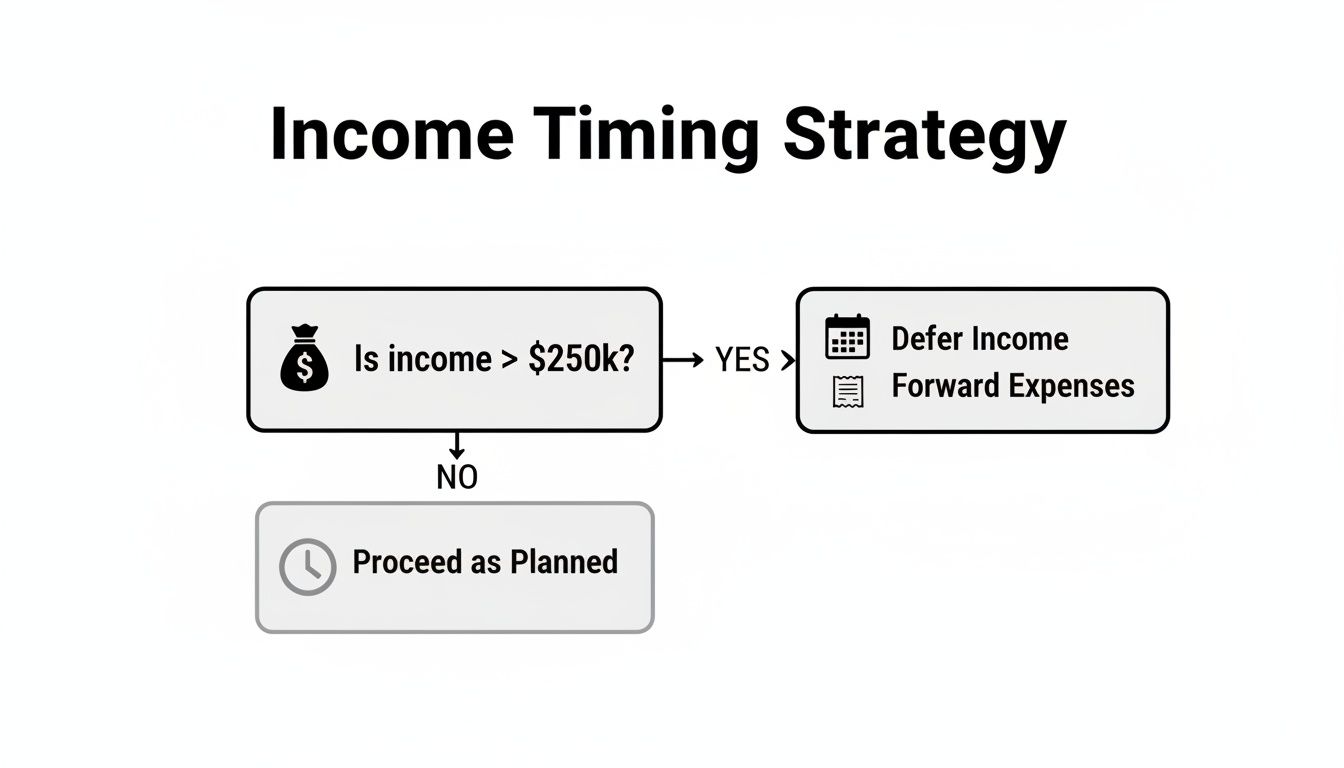
The key takeaway here is that when your income pushes you over the threshold, your main levers for control are proactively deferring income and bringing forward any available deductions.
Using Carry-Forward Contributions to Your Advantage
One of the most valuable but often overlooked strategies is the carry-forward rule. This allows you to use any of your unused concessional contributions cap from the previous five financial years. It’s perfect for people with lumpy or fluctuating incomes.
There’s one catch: your total superannuation balance must have been less than $500,000 on June 30 of the previous financial year to be eligible.
Practical Example:
Imagine a consultant whose income swings year to year.
- Year 1: Income is $210,000. They contribute $15,000 (leaving $12,500 of their cap unused).
- Year 2: Income is $220,000. They again contribute $15,000 (another $12,500 unused).
- Year 3: They land a massive project, and income jumps to $300,000. They know they’ll be paying Division 293 tax this year.
- Year 4: Their income drops back to a more normal $180,000.
In Year 4, with income well below the threshold, they can now strike. They can use the accumulated unused cap from Years 1 and 2 ($25,000) on top of the current year's cap ($27,500). This allows them to make a massive, tax-deductible contribution of up to $52,500 in a lower-income year, supercharging their retirement savings without triggering Division 293.
You can learn more about how the caps work in our detailed guide on superannuation contribution limits.
Splitting Contributions With Your Spouse
Spouse contribution splitting is another fantastic strategy, particularly where one partner earns significantly more than the other. It allows the high-income earner to transfer up to 85% of their concessional contributions from a financial year into their spouse's super account.
Now, this doesn't directly avoid the tax—the contribution is still assessed against the high-income earner for Division 293 purposes. However, it’s a brilliant move for balancing a couple's total retirement savings and can help the lower-income spouse's super balance grow much faster. Just be aware that the ATO has specific eligibility rules, so it's vital to check that both you and your spouse qualify.
Take Control of Your Super
Understanding these rules transforms your super from a passive savings account into an active tool for building wealth and managing tax.
Don't let Division 293 tax feel like an unavoidable penalty for your success. By finding your contribution sweet spot, using non-concessional contributions, leveraging carry-forward rules, and considering spouse strategies, you can build a far more effective plan. For personalised advice on your situation, your next best step is speaking with a tax expert who gets it.
Next-Level Tax Planning for Business Owners & Investors
If you’re a business owner or a seasoned investor, you know that basic income timing tricks only get you so far. When you start dealing with companies, trusts, or a Self-Managed Super Fund (SMSF), the game changes. You get access to a whole new toolkit for managing your 'Division 293 income' and legally sidestepping that extra tax hit.
This is about more than just delaying a bonus. It’s about strategically setting up your financial world so everything works together to lower your tax bill. It takes careful planning and the right advice, but believe me, the payoff is well worth it.
Use Your Business Structure to Your Advantage
One of the biggest levers you can pull to avoid Division 293 tax is your business structure. If you’re a sole trader or in a partnership, every dollar of profit lands directly in your personal income. It's a fast track to blasting past the $250,000 threshold.
But what if you could create a firewall between business profits and your personal bank account? You can. By restructuring to a company or a discretionary family trust, you change how and when you get paid.
- Thinking Like a Company: A company pays its own tax on profits, currently 25% for eligible small businesses. You then decide how much to pay yourself in wages or dividends. This gives you direct control to keep your personal income under the Div 293 line.
- The Flexibility of a Family Trust: A trust is even more powerful. It can distribute profits to multiple family members (beneficiaries) who are on lower tax brackets. By spreading the income around, you can dramatically reduce the amount that hits your personal tax return, which is exactly what the Div 293 calculation looks at.
Practical Example: We've seen countless small business clients in our Ashfield and Belrose offices slash their personal Div 293 exposure by moving from a sole trader setup to a trust or company. For a feel for how others approach this, you can explore personal finance insights from Morningstar.
At EndureGo Tax, this high-level advisory—from trust compliance and SMSF management to BAS and investor tax—is what we do all day, every day.
Beyond Salary Sacrifice: Smart Remuneration
Forget basic salary sacrificing for a moment. We're talking about looking at your entire remuneration package. While reportable fringe benefits are added back for the Div 293 calculation, you can be clever about the timing and type of benefits you receive.
For example, negotiating for benefits that have a lower taxable value can make a difference. So can arranging for a large bonus to be paid out across different financial years to smooth your income. This isn't something you can do reactively; it requires a proactive chat with your employer or some sharp planning within your own company.
Our Take: The real goal is to design a package where your taxable income, fringe benefits, and concessional super contributions are all managed in harmony. You can't just focus on one piece of the puzzle and ignore the others. It’s a holistic game.
Getting Clever with Your SMSF
If you’re running your own Self-Managed Super Fund, you have another incredibly powerful tool at your disposal. Income earned inside your SMSF—like rent from a commercial property or share dividends—is taxed at the flat super rate of 15%. Crucially, this income is kept separate from your personal Div 293 calculation.
This opens up some serious strategic doors.
For instance, holding high-growth or high-income assets inside your SMSF can be far more tax-effective than holding them in your own name. If you held them personally, the income would be taxed at your marginal rate and push you closer to the Div 293 threshold. Of course, any strategy must be compliant with your fund's investment rules and the ATO's regulations, like those laid out in the Superannuation Industry (Supervision) Act 1993.
What’s Your Next Move?
These strategies aren't something you "set and forget." They need ongoing attention and expert guidance to make sure you stay compliant and they continue to work for you. If you’re a business owner, an investor with capital gains tax headaches, or you just want to get your structure right, the next step is a full review of your financial situation.
Don't wait for the ATO tax notice to land in your letterbox. Book a consultation with us today and let's build a proactive plan to protect your wealth.
Got A Division 293 Notice? What Now?

It’s a feeling many high-income earners know all too well: the sight of a crisp, official-looking envelope from the ATO on your desk. Seeing a Division 293 tax assessment can feel like a penalty for a successful year, but it’s not a dead end. Think of it as an alert, a signal to take action.
The first step isn't to panic; it's to be methodical. You have clear options, but you need to act decisively. Let’s break down exactly what you need to do.
First, Verify. Then, Think About Paying.
Before you even consider how to pay, your first job is to confirm the ATO’s numbers are actually correct. The notice you receive will break down how they calculated your liability, listing your income components and super contributions. It's time to play detective.
- Grab your tax return and cross-reference the income figures.
- Pull up your superannuation statements to verify the concessional contributions they’ve listed.
- Double-check that any reportable fringe benefits or other add-backs are accurate.
Mistakes can and do happen. The ATO relies on data fed to them by employers and super funds, and sometimes, things get lost in translation. If you spot a number that doesn't add up, you have every right to question the assessment.
Your Two Payment Choices
Once you've confirmed the assessment is accurate, you’re at a crossroads: how should you settle the bill? The ATO gives you two distinct paths, and each one has real consequences for your long-term financial health.
Key Insight: The payment is due 21 days from the date on the notice, no matter which payment method you choose. If you elect to pay from super but the release takes longer, interest can start piling up. You need to act fast.
The ATO will send you a notice with an election form, giving you 60 days to tell them your decision. Your options are:
- Pay from your own pocket: Use your cash savings or investments to pay the tax bill directly.
- Pay from your super fund: Complete the election form to authorise your fund to release the money to the ATO on your behalf.
This isn't just a cash flow decision; it's a strategic one that impacts your retirement wealth.
Paying Your Division 293 Tax From Super Vs Out-Of-Pocket
Deciding whether to use your savings or dip into your retirement fund can be tricky. This table breaks down the core considerations to help you decide which path is right for your situation.
| Payment Method | Pros | Cons |
|---|---|---|
| Pay from Your Super Fund | Protects your immediate cash flow, so you don't need to find the funds from savings or sell investments. | Reduces your retirement nest egg. The money released can no longer benefit from compound growth inside the tax-friendly super environment. |
| Pay Out-of-Pocket | Preserves your superannuation balance, allowing your entire retirement fund to continue compounding and growing untouched. | Hits your immediate cash flow. You need to have liquid funds available to pay the debt within the 21-day timeframe. |
So, which is better? It all comes down to your personal circumstances. If you have plenty of cash reserves, paying out-of-pocket to protect your super's long-term growth is often the smarter move. But if cash is tight, using your super might be the only practical choice.
What If the Assessment Is Wrong?
If your fact-checking uncovers a mistake in the ATO's assessment, you have the right to object.
Under the Taxation Administration Act 1953, you generally have two years from the date of your assessment to lodge a formal objection. This must be done in writing, clearly explaining why you believe the assessment is incorrect and providing all the evidence to back up your claim.
Dealing with a tax notice is stressful, but with a clear plan, you're in control. Don't let that envelope sit on your desk while uncertainty costs you money or peace of mind.
If you're staring at a Division 293 notice or want to structure your finances to minimise future tax hits, it’s time for expert advice. Book a consultation with us today for a personalised strategy session.
Time to Partner With a Local Expert on Your Tax Plan?
Navigating the complexities of Division 293 tax isn't just about reading a guide; it’s about having a strategy that’s built for you. We’ve walked through some powerful techniques—from timing your income to fine-tuning your super contributions—but the best plan is always one tailored to your specific financial situation. You’ve seen how getting on the front foot makes a real difference.
But knowledge is only half the battle. The real key is putting it into action.
When it comes to managing your tax obligations and steering clear of that Division 293 notice, teaming up with a local expert who uses the right tools can make all the difference. In fact, the best software for tax professionals is what helps accountants like us stay ahead of constantly shifting rules.
Remember, the legislation around super and tax, like the rules buried in the Income Tax Assessment Act 1997, is notoriously tricky. A small misstep can easily lead to a big, unexpected tax bill from the ATO.
As your local tax accountants in Ashfield and across the Northern Beaches, we see it firsthand every day: a smart, well-structured plan is the best defence for your hard-earned money. Don't leave your finances to chance.
Take the next step towards a smarter tax strategy. Book a consultation with us today and get the peace of mind that comes from having an expert in your corner, dedicated to protecting your financial future.
Your Top Division 293 Questions, Answered
When it comes to Division 293 tax, we see a lot of confusion. It’s one of those rules that can feel like a penalty for doing well, but with the right strategy, it doesn’t have to be.
Here are the answers to the most common questions we hear from our clients in Ashfield and across the Northern Beaches.
What If I Only Cross the Threshold for One Year?
This is a big one. Let's say a one-off capital gain, a large bonus, or an eligible termination payment pushes you over the $250,000 income threshold for a single financial year. Are you stuck with the tax bill?
Not necessarily. This is exactly where some smart, forward-thinking planning makes a huge difference.
Practical Example: You could look at deferring some of that income to the next financial year or even bringing forward tax-deductible expenses to pull your income back below the line. It's about timing. Another nifty strategy, if your total super balance was under $500,000 on 30 June of the previous year, is using any unused carry-forward concessional contributions. This lets you make bigger top-ups in future, lower-income years without triggering the tax.
Does Div 293 Tax Hit My After-Tax Super Contributions?
Thankfully, no. This is a common point of confusion, but the answer is clear.
Division 293 tax is only ever levied on your concessional (before-tax) super contributions.
This is a critical distinction. For high-income earners, once you're getting close to that $250,000 income threshold, it can be much smarter to switch to making non-concessional (after-tax) contributions. While you miss out on the upfront tax deduction, the investment earnings on those funds still grow in the tax-friendly super environment—and completely sidestep any Div 293 tax.
How Does Division 293 Work for High-Income Couples?
The ATO assesses Division 293 tax on an individual basis, as laid out in the Income Tax Assessment Act 1997. Your partner's income has zero direct impact on whether you have to pay it.
Key Strategy: For couples, this is all about optimising your household's overall position. If one partner is well over the threshold and the other is under, it might be a good move for the higher earner to scale back their concessional contributions (to minimise the Div 293 hit) while the other partner maximises theirs. You can also explore spouse contribution splitting to help balance super accounts, though remember, this doesn't dodge the initial Div 293 assessment for the person who made the contribution.
Don't let complex tax rules dictate your financial future. With a solid, personalised plan, you're the one in control.
Book a consultation with us today and get the peace of mind that comes from knowing your tax strategy is working for you, not against you.
