


Ever wondered how a trust really works in Australia? We hear the term thrown around by accountants and lawyers, but what does it actually mean for your assets, your business, or your family?
At its core, a trust is a powerful legal arrangement where one person or company (the trustee) holds assets for the benefit of other people (the beneficiaries). Think of it as separating the legal ownership of an asset from the person who gets to enjoy it. This split is the secret sauce that makes trusts so useful for asset protection and smart tax planning. This structure is governed by both state-based Trustee Acts and federal legislation like the Income Tax Assessment Act 1936, which you can review on the ATO Legal Database.
What Is a Trust and How Does It Work?
Imagine a trust is like a secure safe for your valuable assets—your investment property, business shares, or inheritance. Instead of holding the title to these things in your own name (where they’re exposed to business or personal creditors), you place them inside this "safe."
You then appoint a trusted manager to look after everything. This manager is the trustee, and they have a strict legal duty to manage the assets according to a rulebook, known as the trust deed. The people who get to enjoy what’s inside the safe are the beneficiaries.
This separation is the key. The trustee has legal control, but they don't personally own the assets. The beneficiaries have a right to the benefits, but they don't have direct day-to-day control. It's this fundamental concept in Australian law that provides such a powerful layer of protection. If you'd like another perspective, this guide on What Is a Trust Fund and How Does It Work offers a solid overview.
The Three Key Roles
Every single trust, no matter how simple or complex, is built on three essential roles. Getting these right isn't just important—it's critical for the trust to be legally valid and do its job properly.
To make it crystal clear, here's a quick breakdown of who's who in the zoo.
The Three Key Roles in an Australian Trust
| Role | Who They Are | Primary Responsibility |
|---|---|---|
| The Settlor | The person who kicks things off. | Their job is usually brief but vital: they provide the initial asset (often a symbolic $10) to officially create the trust and bring it to life. |
| The Trustee | The legal owner and manager. | The trustee makes all the decisions—managing investments, paying bills, and distributing income—all while following the trust deed rules. |
| The Beneficiary | The people who get the benefit. | These are the individuals or companies entitled to receive the income and/or capital from the trust. In a family trust, this is usually you and your family members. |
Getting your head around these roles is the first real step to understanding how a trust can work for you. It's a structure that can be a game-changer for a tradie in the Inner West wanting to protect their family home from business risks, or an investor on the Northern Beaches looking to manage capital gains more effectively.
A common mistake is mixing up the trustee and the beneficiary. The trustee manages the assets with a strict legal duty. The beneficiary receives the benefits.
But here’s the thing: while the concept is straightforward, the execution has to be perfect. Setting up a trust isn't a DIY job. To make sure your structure is built to last and tailored to your specific goals, it's always best to speak with a local accountant. We can help ensure it's set up for success from day one.
Getting to Know the Key Players in a Trust
To really get your head around how a trust works, you first need to understand the people involved. These aren't just job titles; they are legally defined roles with some pretty serious responsibilities attached. Nailing this structure is the difference between a trust that protects your assets and one that falls apart when you need it most.

So, let's go beyond the textbook definitions and look at what the Settlor, the Trustee, and the Beneficiaries actually do. Each one is a crucial piece of the puzzle, and how they interact is all laid out in the trust deed and governed by Australian law.
The Settlor: The One Who Kicks It All Off
The Settlor is the person who officially creates the trust. Think of them as the person who lights the fuse. Their role is brief but absolutely essential to bring the trust into existence.
The Settlor’s main job is to provide the initial asset, known as the "settled sum." This is usually just a token amount, often $10, which they hand over to the trustee to hold for the beneficiaries. Once that's done, the Settlor's job is over. They step back and have no further control over the trust or its assets.
Here's a critical rule: The Settlor can't also be a beneficiary. This separation is vital to prove the trust is legitimate. If the creator also benefits from it, the Australian Taxation Office (ATO) could see the whole structure as a sham and rule it invalid.
The Trustee: The Manager and Legal Guardian
The Trustee is the legal owner and day-to-day manager of the trust's assets. This is the role with the most responsibility, carrying significant legal obligations known as fiduciary duties. A trustee doesn't own the assets for themselves; they hold them on behalf of the beneficiaries.
Their core duty is to manage the trust property wisely and always act in the best interests of all beneficiaries. This is all dictated by the trust deed and laws like the various state-based Trustee Acts. This means making investment decisions, paying any bills, and distributing income.
Individual vs. Corporate Trustee
When you set up a trust, you have a big decision to make: will the trustee be a person (an individual) or a company (a corporate trustee)? This choice has huge implications for asset protection.
- Individual Trustee: This can be one or more people. It’s a bit simpler to set up, but if the trust gets into debt, the individual trustee is personally on the hook. That means their own assets, like the family home, could be at risk.
- Corporate Trustee: This is a proprietary limited (Pty Ltd) company created specifically to be the trustee. Its biggest advantage is limited liability. If the trust runs into legal trouble or debt, the liability is generally contained within the assets held by the company, protecting the personal wealth of the directors.
For a tradie in Ashfield or a property investor on the Northern Beaches, using a corporate trustee is a no-brainer. It builds a strong firewall between business or investment risks and your personal nest egg.
The Beneficiaries: The People Who Benefit
The Beneficiaries are the individuals or entities the trust was set up to help. They don't legally own the assets, but they have what's called an "equitable interest," which is a fancy way of saying they have the right to benefit from them.
In a typical family trust, beneficiaries are often split into different groups:
- Primary Beneficiaries: These are usually the main people the trust is meant to support, like you and your partner.
- General Beneficiaries: This is a much wider group of potential recipients, which can include children, grandchildren, and even related family companies or other trusts.
This flexibility is the secret sauce of a discretionary trust, allowing the trustee to distribute income and capital each year in the most tax-effective way possible.
Practical Example: A plumber in the Inner West runs his business through a company. He sets up a family trust (with a corporate trustee) to own the shares in his business. His family home is in his and his partner's personal names. If the business ever gets sued, the family home is safe because the trust's liability stops at the corporate trustee. The beneficiaries—his family—can still get profits from the business, but their personal assets are shielded.
Getting these roles right is the foundation of a solid trust. If you're thinking about this powerful structure, it's crucial to get the setup right from day one. Book a consultation with our expert accountants at EndureGo Tax to make sure your trust is built to protect you and achieve your goals.
The Main Types of Trusts in Australia: Which One Is Right for You?
Not all trusts are built the same. Trying to pick one without knowing the difference is like a builder trying to frame a house with a screwdriver—you need the right tool for the job. The perfect trust structure depends entirely on what you want to achieve, whether that's protecting family assets, running a business with partners, or mapping out your estate plan.
In Australia, a few key types of trusts pop up again and again for business owners, tradies, and investors. Each has a specific purpose and its own set of rules. Getting your head around these is the critical first step before you even think about setting one up.
The Discretionary Trust: The Family Favourite
When you hear someone talk about a "family trust," they’re almost always talking about a Discretionary Trust. This is, hands down, the most popular structure for families and small businesses in Australia for asset protection and tax planning.
Why? One word: flexibility.
In a discretionary trust, the trustee has the complete "discretion" to decide which beneficiaries get income or capital from the trust, and how much they receive each year. This makes it an incredibly powerful tool for tax planning. For a deeper look, check out our simple guide on what is a discretionary trust.
Practical Example:
Imagine a family-run café in Belrose owned through a discretionary trust. In a bumper year, the trustee (let's say, a parent) can distribute the profits strategically. They might send a larger chunk to their adult child at university who has a very low personal income, making full use of their low marginal tax rate. This simple move means the family as a whole pays far less tax than if the parents had taken all the profits themselves.
The Unit Trust: The Go-To for Business Partnerships
A discretionary trust is brilliant for a single family unit, but it’s a terrible fit for unrelated business partners who want to invest together. That’s where the Unit Trust steps in for clear ownership entitlements.
Think of a unit trust like a company with shareholders. The trust's assets are divided into a fixed number of "units," and each investor holds units that represent their slice of the pie. A beneficiary’s right to income and capital is locked in by how many units they hold—there’s no trustee discretion here.
This clean, defined ownership makes it the perfect structure for joint ventures.
- Practical Example (Property): Two mates buying a commercial property in Ashfield would use a unit trust to clearly define their 50/50 ownership and entitlements.
- Practical Example (Business): Unrelated business partners can use it to make sure their stake is fixed, easily valued, and can be sold if one partner decides to exit.
To help you decide, here’s a quick comparison of the two most common structures for business owners and investors.
Discretionary Trust vs Unit Trust Key Differences
| Feature | Discretionary (Family) Trust | Unit Trust |
|---|---|---|
| Income Distribution | Flexible. Trustee decides who gets what each year. | Fixed. Based on the number of units held. |
| Best For | Single families, asset protection, and tax planning. | Unrelated parties, joint ventures, property syndicates. |
| Ownership | Beneficiaries have no fixed entitlement. | Unitholders have a fixed, defined ownership stake. |
| Asset Protection | Generally strong, as assets are separate from beneficiaries. | Weaker. A unitholder's units are considered an asset. |
| Adding/Removing People | Easy. New beneficiaries can be added or removed by the trustee. | More complex. Units must be formally bought or sold. |
Ultimately, the choice comes down to control and relationships. If you need flexibility within a family, a discretionary trust is your best bet. If you're teaming up with others and need clear-cut ownership, a unit trust is the way to go.
The Testamentary Trust: The Estate Planning Powerhouse
A Testamentary Trust is a different beast altogether—it only springs into existence after someone passes away. It's created through instructions left in their will, rather than being set up during their lifetime.
This structure is a cornerstone of modern estate planning, offering incredible asset protection and tax benefits for the people you leave behind. Instead of your beneficiaries getting their inheritance in one big lump sum, the assets are moved into the testamentary trust and managed by a trustee on their behalf.
This provides a powerful shield. If a beneficiary later goes through a divorce or bankruptcy, the assets held in the trust are generally protected from being included in any legal settlement. It’s a way to ensure your legacy stays with your intended heirs, no matter what life throws at them.
While the laws differ between jurisdictions, understanding the basic types of trusts is helpful anywhere. But for us here in Australia, picking the right structure is a decision with huge long-term consequences. The wrong choice can lead to tax headaches, messy admin, and even legal fights down the track.
Unsure which trust structure lines up with your financial goals? Book a chat with EndureGo Tax today. We’ll help you navigate the options and build a solid foundation for your business or investment strategy.
How Trusts Handle Income, Distributions, and Tax
Sure, asset protection is a huge plus, but the real magic of a trust happens at tax time. This is where a well-structured trust goes from being a simple safety net to a seriously effective tool for managing your tax bill. To really get your head around how a trust works in Australia, you need to understand the mechanics of how it handles money.
The core idea is beautifully simple: a trust itself doesn't usually pay tax on its income. Instead, that income "flows through" to the beneficiaries. They're the ones who pay tax on their slice, at their own individual marginal tax rates. This is where the strategy comes in.
This little flowchart can help you see which type of trust might be the right fit for your initial goals.
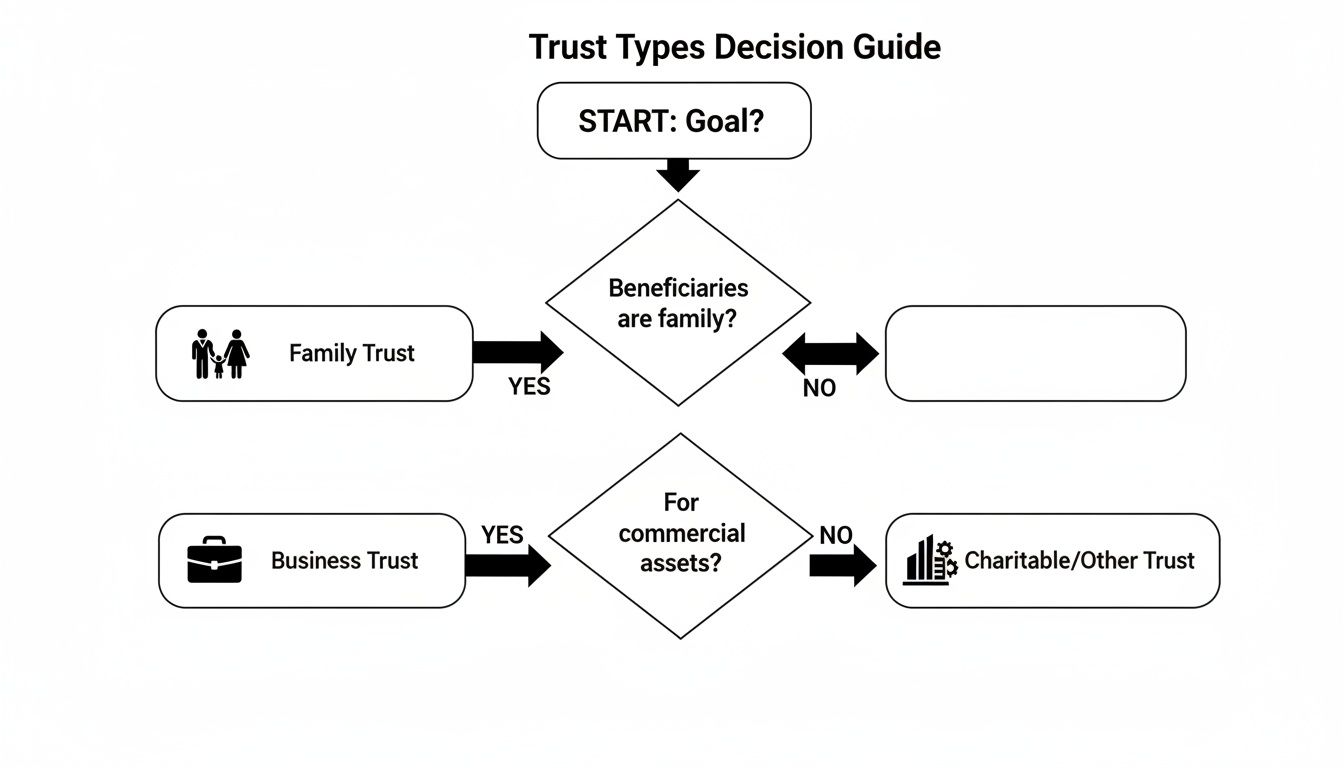
As you can see, what you're trying to achieve—whether it's protecting family assets or running a business with partners—is the first big question that points you toward the right setup.
Streaming: Directing Income for Maximum Tax-Effectiveness
The concept of streaming is where the clever tax planning kicks in. It allows the trustee to direct different types of income (like rent or capital gains) to specific beneficiaries. In a discretionary trust, this is incredibly powerful, as the trustee can make fresh decisions every single financial year.
Practical Example: Let’s say a trust earns rental income and also makes a capital gain from selling some shares. The trustee can choose to "stream" the capital gain to a beneficiary who has some capital losses they can use to wipe it out. Meanwhile, the rental income can be sent to another family member who’s in a much lower tax bracket. It’s all about allocating income in the smartest way possible for the family as a whole.
And this isn't just some obscure loophole; it's a mainstream strategy. Trusts are a cornerstone of financial planning for small businesses and investors all over Australia, especially for tradies and property owners from Ashfield to the Northern Beaches. According to the Australian Taxation Office (ATO), for the 2021-22 financial year, there were over 978,000 trust entities lodged. You can read more about the growing importance of trusts on the Australian government's data site.
The Absolute Must-Do: The Trustee Resolution
Here’s the catch: this tax-effective distribution doesn't happen by itself. It needs a formal, legally binding decision from the trustee, and it absolutely must be done before the end of the financial year on 30 June. This decision is officially recorded in a document called a Trustee Resolution.
A Trustee Resolution is a minute that formally records the trustee's decision on how the trust's income and capital gains for the year will be distributed among the beneficiaries. Without this signed resolution, the distributions are not legally effective in the eyes of the ATO.
Failing to get this done before the deadline is a disaster. If income isn't properly distributed, it gets trapped in the trust. Under Australian tax law (specifically, Section 99A of the Income Tax Assessment Act 1936), this undistributed income gets slugged with tax at the highest individual marginal rate—currently 45% plus levies. It's a hugely expensive mistake that wipes out any tax benefit of having the trust in the first place.
Practical Example: A Trustee Resolution in Action
Imagine a family trust run by a carpenter in Belrose earns $100,000 in net income for the year. The beneficiaries are the carpenter (a high-income earner), his partner (who works part-time), and their 19-year-old son who's at uni with no other income.
- Before 30 June, the trustee signs a resolution to split the income like this:
- $20,000 to the carpenter.
- $40,000 to his partner.
- $40,000 to their son.
By doing this, a huge chunk of the trust's income gets taxed at much lower marginal rates—or is even tax-free if it's below the threshold. The family saves thousands. But if they'd missed that deadline? The whole $100,000 would be taxed at the top rate, landing them with a tax bill over $47,000. Ouch.
Managing trust distributions isn't a "set and forget" job. It demands sharp planning and perfect execution every single year.
Don't leave it to chance. Contact EndureGo Tax today to ensure your trust is managed correctly and you're taking full advantage of its powerful tax-saving potential.
Getting Your Trust Set Up and Managed Correctly
Let's be clear: setting up a trust isn't like opening a bank account online. It's a formal legal process that demands you get things right from day one. Understanding how a trust works is one thing, but actually building one that's legally solid and can stand up to ATO scrutiny means following a strict set of steps.
Getting the setup right isn't just a suggestion—it's non-negotiable if you want to protect your assets and hit your financial goals.

The entire structure is built on one crucial document: the Trust Deed. Think of it as the constitution for your trust. It's a legally binding rulebook, drafted by a solicitor, that lays out everything from the trustee's powers to the beneficiaries' rights. A poorly drafted deed can make the whole structure fall over before it even starts.
Once that deed is signed and stamped, the trust needs to be formally "settled." This is the moment it comes to life, when the settlor hands over the initial sum (often a symbolic $10) to the trustee.
The Essential Setup Checklist
With the trust legally created, the next stage is to get it properly plugged into Australia’s financial and tax systems. These aren’t optional extras; they're legal requirements to operate above board and stay out of trouble with the Australian Taxation Office (ATO).
Here are the immediate, practical steps every new trustee has to take:
- Apply for a Tax File Number (TFN): The trust is its own entity for tax purposes, so it absolutely needs its own TFN. Every dollar of income, every expense, and every distribution will be tracked under this number.
- Apply for an Australian Business Number (ABN): If your trust is going to be running a business, investing in property, or carrying on any kind of enterprise, it will also need an ABN.
- Open a Dedicated Bank Account: This is a huge one. You must open a separate bank account in the trust's name. Never, ever mix trust money with your personal or business funds. That's a massive red flag for the ATO and can completely destroy your asset protection.
Nailing these foundational steps ensures your trust is recognised by the ATO and is ready for action. For a more detailed walkthrough, you might want to check out our complete guide on how to set up a trust in Australia.
Ongoing Management and Compliance Obligations
Okay, so you’ve set up the trust. The work isn't over—it's just beginning. The real heavy lifting is the ongoing, careful management required to keep it compliant and effective. This is where a lot of people drop the ball, leaving themselves wide open to risk.
According to the Income Tax Assessment Act 1997, trustees are legally on the hook for managing the trust's tax affairs. This means keeping proper records, lodging annual returns, and making sure all tax liabilities are paid. Dropping the ball here can lead to some pretty severe penalties.
Your annual duties as a trustee are clear and can't be ignored:
- Keep Meticulous Financial Records: Every single transaction—income coming in, expenses going out—must be recorded with pinpoint accuracy.
- Prepare Annual Financial Accounts: This involves putting together a balance sheet and a profit and loss statement for the trust each year.
- Lodge the Annual Trust Tax Return: This return tells the ATO about the trust's total income and exactly how it has been distributed to the beneficiaries.
- Manage BAS and GST Obligations: If the trust's turnover means it needs to be registered for GST, then Business Activity Statements must be lodged on time.
- Document Trustee Resolutions: Like we've mentioned, this is the crucial annual minute that records your income distribution decisions. It must be signed and dated before 30 June each year.
Properly managing a trust takes time, know-how, and a sharp eye for detail. These admin tasks are what keep your structure compliant and audit-proof for the long haul.
Feeling a bit overwhelmed by the compliance checklist? Give our team at EndureGo Tax a call. We're experts in handling all your trust administration and tax obligations.
Common Pitfalls and When to Seek Expert Advice
Understanding how a trust works is one thing, but navigating its complexities without a steady hand can lead to some seriously expensive mistakes. Trusts are powerful tools, but they’re definitely not a ‘set and forget’ solution. A few common slip-ups can easily unravel all your hard work on asset protection and tax planning, turning a brilliant strategy into a major headache.
This isn’t about scaring you off; it’s about making sure you’re ready to manage your trust properly. From a dodgy Trust Deed to simple admin oversights, the consequences can be severe – and they have a funny way of catching the Australian Taxation Office's (ATO) attention. Knowing the traps is the best way to protect your financial future.
The Dangers of a DIY Approach
One of the biggest mistakes we see is people treating a trust like an off-the-shelf product from Bunnings. A generic or poorly written Trust Deed is a ticking time bomb. It might not give the trustee the specific powers they need to act, or it could hide clauses that create massive tax problems years down the road. Think of this document as the constitution for your trust; any grey area is an open invitation for a legal dispute or a query from the ATO.
Another classic blunder is failing to make timely trust distribution resolutions. As we covered, this decision has to be locked in and documented before 30 June each year. Miss that deadline, and any income the trust earned can be taxed at the highest marginal rate, currently a painful 47% (including the Medicare levy). It's a completely avoidable and very costly mistake.
A trust is only as strong as its administration. Meticulous record-keeping, including minutes of trustee decisions and annual resolutions, is your primary defence in an audit. It proves the trust is being managed correctly and is not a sham arrangement.
Navigating Complex Tax Legislation
Beyond the basic paperwork, trustees need to be on top of some complex anti-avoidance rules the ATO uses to stop people from gaming the system. These are especially critical for small business owners and tradies.
Here are a few big ones to watch out for:
- Division 7A: This stops private company owners from pulling money out of the company tax-free by calling it a "loan" to a trust or shareholder. If a company with profits makes a payment or loan to the trust, the ATO can treat it as an unfranked dividend and tax it at your personal rate unless a proper, compliant loan agreement is in place.
- Personal Services Income (PSI) Rules: This is a big one for tradies, consultants, and contractors. If your income is basically a reward for your personal skills or effort, the PSI rules can block you from distributing it to family members on lower tax brackets. If you try, the ATO can attribute all that income straight back to you and slap on penalties for good measure.
- Section 100A: This is a huge focus for the ATO right now. It targets situations where trust income is distributed to a low-tax-rate beneficiary on paper, but someone else (like the high-income parents) actually gets the benefit of the money. To get across the details, check out our in-depth guide covering how to prevent issues with Section 100A and family trusts.
Getting professional advice isn't just another cost—it's an essential investment in the security of your assets and your peace of mind. An expert can make sure your trust is set up correctly from day one and managed properly year after year, shielding it from these common but dangerous pitfalls.
Don't risk your financial security. Book a consultation with the expert accountants at EndureGo Tax to fortify your trust structure today.
Common Questions We Hear About Trusts in Australia
When you start digging into trusts, a lot of questions pop up. It's only natural. We've put together some straight-up answers to the queries we get most often from business owners, tradies, and investors across Australia. Think of this as the practical, no-fluff guide you've been looking for.
Can a Trust Own Property in Its Own Name?
No, it can't, and this is a point that trips a lot of people up. A trust isn't a legal person like you or a company; it's more like a legal agreement. Because of this, assets like property, vehicles, or shares have to be held by the trustee, who is legally responsible for managing them for the trust.
So, on a property title deed, you'd see something like "John Smith as trustee for the Smith Family Trust." This wording makes it crystal clear that while John Smith holds the legal title, the real benefit belongs to the beneficiaries of the trust.
Is My Family Home Safe in a Trust?
Putting your investment properties or your business into a trust can be a brilliant way to shield your personal assets, like the family home you own in your own name. If the business, run through that trust, gets into hot water with creditors, they generally can't come after assets that aren't owned by the trust.
But here’s the crucial part: this protection only works if the trust is set up and managed properly from day one. Using a corporate trustee is hands-down the best way to create a strong, clear separation between business risks and your personal wealth.
How Much Does It Cost to Set Up a Trust?
The cost really depends on how complex you need your trust deed to be and which professionals you get to help. A solid, solicitor-drafted discretionary trust deed will likely set you back a few thousand dollars. You’ll also have extra fees for setting up a corporate trustee with ASIC.
You'll see cheap DIY trust kits online, but be warned: a badly written deed can cause absolute chaos down the track with tax and legal problems. Spending the money upfront for proper legal and accounting advice isn't just a good idea—it's essential. This initial investment could easily save you tens of thousands of dollars and countless headaches in the future.
Trying to get your head around trust compliance and strategy on your own is tough. As your local accountant in Ashfield and the Northern Beaches, EndureGo Tax gives you the confidence and peace of mind to run your trust the right way. Book a consultation with us today and let's get it sorted.
