


At its simplest, a trust works by splitting the legal ownership of an asset from its real benefit. It’s a sophisticated legal arrangement involving three key players: a Settlor who initiates the trust, a Trustee who legally manages it, and Beneficiaries who enjoy the rewards. Understanding how a trust operates is fundamental for effective asset protection and tax planning in Australia.
The Core Structure of an Australian Trust

To truly grasp how a trust operates, you must understand the three essential roles. For a practical example, think of it like planning a family holiday. One person contributes the initial money for the trip fund, another is in charge of driving, booking hotels, and paying for everything, while the rest of the family gets to enjoy the holiday itself. In a trust, these roles are formalised and legally binding.
This structure is a cornerstone of wealth management and business operations in Australia. Their popularity has soared, with the Australian Taxation Office (ATO) now tracking over 1.1 million discretionary trusts, a significant increase from 950,000 just five years ago. This growth is driven by families and investors seeking smarter ways to manage assets and distribute income. You can find more detail on public trust trends and financial management in Australia.
The Three Key Players
Each person (or company) involved has a distinct and critical job. If one of these roles is missing, the entire structure fails.
The Settlor: This is the person or entity that officially establishes the trust. They do this by providing the initial asset, known as the "settled sum," which is often a nominal amount like $10. Once this is done, their role is complete, and they step away.
The Trustee: This is the legal owner and day-to-day manager of the trust's assets. The trustee makes all major decisions—from investments to distributing profits—but they must adhere to the rules in the trust deed and always act in the best interests of the beneficiaries. A trustee can be an individual or, more commonly, a company.
The Beneficiaries: These are the people or entities the trust was created to benefit. They are the ones who can receive income or capital from the trust, but they have no control over the assets themselves.
The absolute key is that the trustee holds the assets 'on trust'. They have a strict legal obligation, known as a fiduciary duty, to act solely in the best interests of the beneficiaries. It's a significant responsibility.
To break it down further, here's a summary of who does what.
The Key Players in a Trust at a Glance
| Role | Who They Are | Primary Responsibility |
|---|---|---|
| The Settlor | The founder of the trust. | Provides the initial asset (e.g., $10) to officially create the trust, then steps back. |
| The Trustee | The legal owner and manager of the trust assets. Can be a person or a company. | Manages assets, makes investment decisions, and distributes income/capital according to the trust deed. |
| The Beneficiaries | The people or entities who benefit from the trust. | Receives the income or capital from the trust as determined by the trustee. |
Understanding these roles is the first and most crucial step in leveraging a trust for asset protection and strategic tax planning.
If you are considering how a trust could operate for your business or investment portfolio, getting these fundamentals right is non-negotiable. For expert advice on how this structure could be tailored to your needs, Book a consultation with EndureGo Tax today.
The Trust Deed: Your Asset Rulebook

If a trust is the secure vault for your assets, then the trust deed is the legally binding instruction manual that governs its operation.
Think of it as the constitution for your trust. This document is the single most important part of the structure, as it dictates every rule the trustee must follow. It governs everything, from how investments are made to how profits are distributed.
A well-drafted deed provides clarity and flexibility, empowering the trustee to manage assets effectively. Conversely, a poorly written or outdated deed can create enormous problems, leading to family disputes, limited financial options, and unwanted attention from the Australian Taxation Office (ATO). It is not a document to be created from a generic template.
What’s Inside a Trust Deed?
The trust deed meticulously outlines the powers, duties, and limitations of the trustee. It’s a detailed blueprint that must be followed precisely to ensure the trust remains valid and compliant.
Here are key elements you'll find in a professionally prepared trust deed:
- Objectives of the Trust: This clearly states why the trust was created—whether to hold business assets, manage family investments, or protect wealth for future generations.
- Trustee Powers: It specifies exactly what the trustee can and cannot do. This includes the power to buy and sell assets, borrow money, and run a business. These powers are crucial for adapting to changing financial landscapes.
- Identification of Beneficiaries: This defines who can potentially benefit from the trust. In a family trust, this is often a wide class of family members and related entities to provide maximum flexibility.
- Rules for Distribution: This sets out the process for distributing the trust's income and capital to beneficiaries. Getting this section right is fundamental to the trust's tax-effectiveness.
One of the most critical clauses in any trust deed is the vesting date. This is the date the trust must end, which under Australian law is typically a maximum of 80 years from its establishment. Failure to manage the trust's assets correctly before this date can trigger significant and unwelcome tax consequences.
Why a Professional Deed Matters So Much
Using a cheap, off-the-shelf trust deed may seem like a cost-saving measure, but it is often a costly mistake in the long run.
A generic document may not allow for modern strategies like streaming different types of income (e.g., capital gains or dividends) to specific beneficiaries, or making a Family Trust Election. These limitations can severely hamstring your tax planning capabilities.
For a practical example, imagine a tradesperson sets up a family trust for their business. A professionally drafted deed allows the trustee to distribute profits flexibly each year—giving more to a low-income spouse in a good year and retaining profits in a tough one. A basic deed might lack these specific powers, forcing distributions that result in a much larger tax bill. As outlined in the Income Tax Assessment Act 1936, the specific wording of a trust deed has direct legal and tax implications.
The rules for how your trust operates are set in stone by its deed. Ensuring this document is professionally drafted and tailored to your specific goals is the most important investment you can make in your asset protection strategy.
Need to review your current trust deed or establish a new one correctly? Contact the experts at EndureGo Tax for a confidential discussion and ensure your structure is built on a solid legal foundation.
Discretionary vs. Unit Trusts: Choosing Your Structure
When you decide to set up a trust, choosing the right structure is like selecting the right tool for a job – the wrong choice can create significant problems.
The two most common structures in Australia are Discretionary Trusts (often called Family Trusts) and Unit Trusts. They may sound similar, but they operate in fundamentally different ways. Understanding this difference is key to having an informed discussion with your accountant about how a trust should operate for you.
The Flexible Family Trust
A Discretionary Trust is defined by one word: flexibility.
In this setup, the trustee holds complete discretion to decide which beneficiaries receive income or capital, and how much, each financial year. No beneficiary has a fixed entitlement to any of the trust's assets or income until the trustee makes that decision.
This makes it an ideal vehicle for family businesses and investors whose financial circumstances fluctuate.
- Practical Example: Imagine a family-run café operating through a discretionary trust. One year, the business has a record profit. The trustee (e.g., a parent) can decide to distribute more income to a university-aged child with a low income, effectively minimising the family's overall tax liability. The next year, if profits are lower, the distributions can be adjusted accordingly.
Learn more about how a discretionary trust works in our detailed guide.
The Rigid Unit Trust
In contrast, a Unit Trust operates on a fixed, rigid structure.
Think of it like a company with shares. The trust's ownership is divided into "units," and each unitholder's entitlement to income and capital is determined by the number of units they hold. The trustee has no discretion to alter this.
If you own 25% of the units, you are entitled to 25% of the income and capital. This fixed nature provides certainty, which is why unit trusts are preferred by unrelated business partners or investors who want each party's share clearly defined from the outset.
Choosing between these structures depends on your objectives. For a family seeking asset protection and agile tax planning, a discretionary trust is almost always the superior choice. For unrelated parties in a joint venture, the certainty of a unit trust is far more appropriate.
Discretionary Trust vs Unit Trust: Key Differences
This comparison highlights which trust structure may be right for your situation.
| Feature | Discretionary (Family) Trust | Unit Trust |
|---|---|---|
| Flexibility | High. Trustee decides who gets what each year. | Low. Entitlements are fixed by unit holdings. |
| Best For | Family businesses, asset protection, and tax planning. | Unrelated business partners, joint ventures, investors. |
| Distributions | At the trustee's discretion. | Fixed based on the number of units held. |
| Asset Protection | Strong. Beneficiaries have no fixed claim on assets. | Weaker. A unitholder's units are an asset they own. |
| Complexity | Can be more complex to manage distributions annually. | Simpler to administer as entitlements are pre-defined. |
Ultimately, the right choice depends on who is involved and what you aim to achieve. One offers unmatched flexibility, while the other provides rigid certainty.
Ready to determine the optimal structure for your business or investments? Book a consultation with EndureGo Tax and receive expert guidance on your specific needs.
How a Trust Manages Income and Tax
This is where the strategic power of a trust becomes apparent. A common misconception is that a trust pays tax itself. In most cases, it does not. Instead, it acts as a conduit, channelling income to the beneficiaries, who then pay tax at their individual marginal rates.
This "flow-through" mechanism is what makes a trust such a potent tool for tax planning. It empowers the trustee to strategically distribute income to beneficiaries in lower tax brackets, which can significantly reduce the overall tax paid on the trust's earnings.
The Art of Streaming Income
A sophisticated strategy available to a trustee is income streaming. This involves more than just splitting total profit; it is about separating different types of income and directing each to the beneficiary best positioned to handle it from a tax perspective.
For instance, a family trust might generate a mix of income:
- Business Profits: Standard income from operations.
- Franked Dividends: Income from Australian company shares, which come with attached tax credits (franking credits).
- Capital Gains: Profit from selling an asset like a property or shares, potentially eligible for a 50% discount.
Through streaming, the trustee can strategically allocate these income types. For example, they could direct a capital gain to a beneficiary with minimal other income, allowing them to utilise the CGT discount and their tax-free threshold. Meanwhile, franked dividends could be distributed to a middle-income parent who can best use the franking credits to offset their tax.
This targeted approach demonstrates how a trust operates to legally minimise tax.
The diagram below visually contrasts the flexibility of a discretionary trust with the fixed nature of a unit trust, a key factor in these distribution strategies.
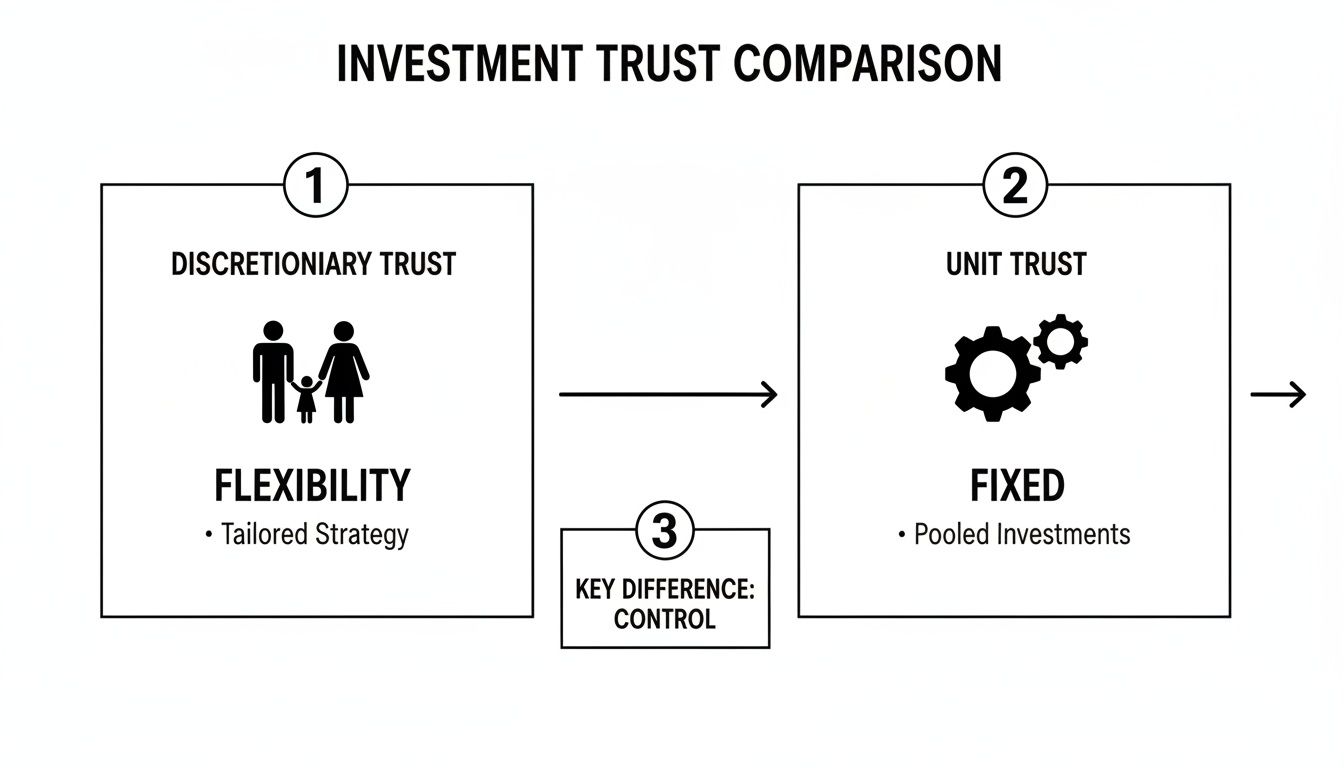
As shown, the discretionary trust's flexibility is what enables effective income streaming. A unit trust, with its rigid structure, offers far less scope for such tax planning.
The Unmissable 30 June Deadline
This meticulous planning depends on one non-negotiable step: the trustee's annual resolution. Before midnight on 30 June each year, the trustee must formally document and sign off on exactly how that year's income will be distributed among the beneficiaries.
This is not a suggestion; it is a strict legal requirement. If this deadline is missed or a valid resolution is not made, the trust’s income is deemed "undistributed." Consequently, the trustee is liable for tax at the highest marginal tax rate, currently 47%.
This underscores the critical importance of diligent record-keeping and timely decisions. The Australian Taxation Office (ATO) is unequivocal on this. An annual trust tax return must be lodged detailing the income and its distribution. The penalties for non-compliance are severe, reinforcing the importance of this annual task.
You can learn more in our detailed guide about how a family trust can save you tax.
Getting this right is paramount. If you are uncertain about drafting a trustee resolution or meeting your tax obligations, seeking professional advice is essential to protect your assets and ensure the trust operates for you, not against you.
Trustee Duties and Annual Compliance Checklist

Understanding how a trust works in theory is one thing; operating one is another.
Being a trustee is not a passive, ‘set and forget’ role. It is an active position with serious, legally binding responsibilities. Failure to meet these obligations can result in severe financial and legal consequences.
At the core of these responsibilities is the trustee's fiduciary duty. This is a legal commitment to act solely in the best interests of all beneficiaries. It means prioritising their needs, avoiding conflicts of interest, and prudently managing the trust’s assets. This duty is the bedrock of trust law in Australia.
Core Fiduciary Duties Explained
These duties are not vague concepts; they are strict rules that guide every decision a trustee makes. While some tasks may vary—such as managing a deceased estate, which involves specific trustee responsibilities after death—the core obligations remain constant.
Your key duties include:
- Acting in Good Faith: You must always be honest and act with integrity for the benefit of the beneficiaries.
- Avoiding Conflicts of Interest: You cannot personally profit from your trustee role or place your interests ahead of the beneficiaries'.
- Maintaining Impartiality: You must treat all beneficiaries fairly and equitably, unless the trust deed explicitly allows otherwise.
- Keeping Meticulous Records: This is critical. You must maintain detailed accounts of all assets, liabilities, income, and expenses.
If you use a company as your trustee, the operational dynamics change slightly. Get the full details in our guide on what is a corporate trustee.
Your Annual Compliance Checklist
In addition to these overarching duties, there is an annual cycle of tasks you must complete to keep the trust compliant with the ATO. Missing these deadlines is a costly error.
The most critical annual deadline is 30 June. If you fail to properly document the trust's income distribution with a signed resolution before this date, any undistributed income can be taxed at the highest marginal rate of 47%.
Here’s your essential yearly to-do list:
- Prepare Financial Statements: Compile all financial data to create the trust’s balance sheet and profit and loss statement for the financial year.
- Draft and Sign the Trustee Resolution: Before 30 June, you must formally decide and document how the trust's income will be allocated among the beneficiaries. This resolution must be in writing and signed.
- Lodge the Trust Tax Return: Complete and file the annual trust tax return with the ATO by the required deadline.
- Distribute Income to Beneficiaries: Make payments or credit the amounts to the beneficiaries exactly as specified in your resolution.
Staying on top of these duties is not optional. It is what ensures your trust remains a powerful and secure vehicle for asset protection and wealth management.
If this checklist seems daunting, you are not alone. Book a consultation with EndureGo Tax today to ensure your trust is fully compliant and operating effectively.
Putting Trusts to Work: Real-World Scenarios
Theory is one thing, but seeing how a trust operates in practice makes everything clearer. Let's examine how these structures deliver tangible results for asset protection and tax planning in Australia.
These simplified scenarios demonstrate the powerful financial advantages of a properly managed trust.
Scenario 1: The Small Business Owner
Meet Dave, a plumber from Ashfield. He runs his successful business through a discretionary (family) trust. His wife, Sarah, works part-time handling the administration. Their family home is held in their personal names, completely separate from the business.
This financial year, the plumbing business generates a net profit of $180,000. If this income were solely in Dave's name, he would face a substantial tax bill at a high marginal rate. The trust provides a much smarter approach.
- The Distribution: Before 30 June, Dave, as director of the trustee company, resolves to allocate $90,000 to himself and $90,000 to Sarah.
- The Tax Outcome: Both Dave and Sarah are taxed on their individual incomes of $90,000. This simple act keeps them both in a lower tax bracket than if Dave received the full $180,000, saving the family a significant amount in tax.
- The Asset Protection: A few months later, a major worksite issue leads to a lawsuit against Dave's business. Because the trust owns the business, the claim is against the trust's assets only. Their family home is legally separate and fully protected from business creditors, acting as a firewall for their personal wealth.
Scenario 2: The Savvy Investors
Now, consider Mark and Chloe from Belrose, who hold their share portfolio within a trust. After a strong year in the market, they sell a parcel of shares held for over 18 months, realising a capital gain of $60,000.
Mark is a high-income earner, while Chloe works part-time and has a much lower income.
A key benefit of a trust is the flexibility it provides the trustee to direct income or capital gains to the beneficiary who can best utilise tax concessions. This is a classic strategy for legally minimising tax on investment returns.
The trustee resolves to distribute the entire $60,000 capital gain to Chloe. Because the shares were held for more than 12 months, the trust is eligible for the 50% CGT discount. This means only $30,000 is added to Chloe’s taxable income, which is then taxed at her lower marginal rate. This single decision saves them thousands compared to adding the gain to Mark's high income.
Trusts are also central to effective estate planning, where factors like inheritance tax become critical. Understanding Inheritance Tax is essential reading if you are serious about protecting your wealth for the next generation.
As you can see, a trust is far more than a legal document—it’s a dynamic tool for protecting what you’ve built and intelligently managing your tax obligations.
To see how a trust structure could be put into action for your specific business or investment goals, book a consultation with the EndureGo Tax team today.
Frequently Asked Questions About How Trusts Operate
Let's address some of the most common questions that arise when exploring how trusts work.
The Key Players: Who’s Who in a Trust?
What’s the difference between a Trustee and an Appointor?
Think of it this way: the Trustee is the manager. They handle the day-to-day operations, making decisions about investments, expenses, and distributions according to the rules of the trust deed.
The Appointor (or Principal) is the ultimate controller. They have the supreme power to hire and, crucially, fire the Trustee. This role holds the ultimate control over who runs the trust.
Can a trust run a business and hire people?
Absolutely. A trust is a powerful structure for operating a business. It can have its own ABN, register for GST, and employ staff, just like a company. The key distinction is that the trustee is legally responsible for all business operations, including signing contracts and managing employees on behalf of the trust.
Asset Protection and Trust Continuity
How does a trust protect my personal assets?
This is a primary reason for establishing a trust. It creates a distinct legal barrier between the assets held within the trust (like a business or investment properties) and your personal assets (like your family home). If the business incurs debt or faces legal action, creditors can generally only make a claim against the assets held by the trust. Your personal wealth remains shielded.
What happens if the trustee passes away?
The trust itself does not cease to exist. A well-drafted trust deed will include clear succession provisions. Typically, the Appointor will appoint a new trustee to take over. This ensures the trust’s assets continue to be managed seamlessly for the beneficiaries. The rules governing this are outlined in tax legislation, such as Division 6 of the Income Tax Assessment Act 1936.
Understanding how a trust operates is the first step towards using it effectively for asset protection and strategic tax planning. For guidance tailored to your specific financial goals, the expert team at EndureGo Tax is here to help. Book a consultation today.
