


Here’s the gist: if you work from home, you can choose between two ATO-approved home office rate methods under ATO legislation: the cents-per-hour rate (67c for 2023–24) or the actual cost method. Choosing the right option can boost your work-from-home deduction and keep your claim compliant.
Practical example: Emma works 30 hours a week from her study. Using the cents-per-hour rate, she claims 30 × 0.67 = $20.10 weekly without needing to gather bills.
Ready to optimise your home office expenses? Book a consultation today at EndureGo Tax for expert guidance.
How Home Office Rate Works For You

When claiming home office running expenses, the ATO offers two clear methods:
- Cents-Per-Hour Method: Claim a set rate per work hour—no need to trawl through every bill.
- Actual Cost Method: Calculate your share of utilities, depreciation and other overheads based on real receipts.
Both demand solid record-keeping but suit different working styles and claim goals.
Summary of Home Office Rate Methods
| Method | Rate/Application | Record Keeping | Suitable For |
|---|---|---|---|
| Cents-Per-Hour | 67c per hour | 4-week logbook of work hours | Occasional remote days |
| Actual Cost | Percentage | Utility bills, receipts, depreciation | Permanent work area |
Use this snapshot to decide which path aligns with your work pattern and paperwork habits.
Eligibility And Records
To claim either method, you’ll need:
- A dedicated space used solely for work activities—no TV lounges.
- Evidence of extra costs due to that space.
Ensure you:
- Align with the ATO’s home office definition under ATO guidelines.
- Keep a four-week diary if you pick cents-per-hour.
- Retain utility bills, receipts and depreciation schedules if you choose actual cost.
What You Will Learn
You’ll discover:
- How shifts in remote work have influenced ATO guidance.
- The nuts and bolts behind both claiming methods.
- A decision framework to pick the right option.
- Real-world calculations and free calculators.
- Common traps to sidestep and latest ATO updates.
Next, we’ll walk through worked examples and handy tools to take the guesswork out of your claim.
If you need tailored advice in Ashfield or Belrose, the team at EndureGo Tax can ensure you capture every deduction. Book now at EndureGo Tax.
Evolution Of Home Office Work In Australia
Back in the 1970s, most Australians travelled to centralised offices, and only rigid nine-to-five claims counted. By the early 2000s, home-based work was a fringe perk without clear ATO guidance. Then 2020 flipped our routines: dining tables became desks, and remote work surged.
Suddenly, the home office rate and work-from-home deduction became mainstream. Even tradies and small businesses embraced Zoom calls and digital collaboration.
Home Office Adoption Trends
The Australian Bureau of Statistics reports that by August 2025, 36% of employed people usually worked from home—up from under 5% pre-2020. Explore the full report on the ABS site.
Key takeaways:
- Pre-2020 remote work under 5%
- Peaked at 40% during 2021 lockdowns
- Stabilised around 36% in 2024–25
ATO Response To Changing Work Patterns
Under the Income Tax Assessment Act, the ATO now offers:
- Clear definition of a dedicated workspace.
- Annual cents-per-hour rates covering electricity, internet and depreciation.
- Simple record-keeping: logbooks or itemised bills.
This two-option framework reflects both office-centric and remote work realities.
Implications For Home Office Rate
Your working style drives your deduction. Log five hours a day at 67c per hour and claim $3.35 daily. But if your heater runs all day or you’ve invested in high-end gear, the actual cost method may yield a larger deduction.
For expert help picking the right home office rate, contact EndureGo Tax in Ashfield & Belrose today.
Core Concept Of Home Office Rate Explained
The ATO hands you two claiming methods:
- A simple cents-per-hour shortcut.
- A detailed actual-cost approach.
Think of the cents-per-hour rate as a day-pass: multiply your desk hours by 67c per hour. It covers electricity, internet and wear-and-tear without fuss.
The actual-cost method is like itemising every taxi fare: you keep receipts for electricity, internet and equipment depreciation, then apportion the work-use percentage.
You can claim:
- Electricity for lighting, heating or cooling your workspace
- Internet fees directly tied to your duties
- Decline in value on office furniture and tech
Only include the work-related slice, with a dedicated home office zone.
How Cents-Per-Hour Rate Works
For 2023–24 it’s 67c per hour. Perfect if your hours are consistent and you prefer minimal paperwork.
In 2023, 37% of Aussies worked from home—a 5% jump on pre-pandemic levels—and 36.3% in 2024. See RedSearch for details.
“Choosing the right home office rate method can boost your deduction significantly,” says our senior tax adviser.
When Actual Cost Method Applies
Ideal if your bills vary or you’ve invested in ergonomic gear:
- Total each expense (electricity, internet, equipment)
- Calculate the percentage that’s work-related
- Apply that ratio to your full bills
| Expense Type | Shortcut Rate | Actual Cost |
|---|---|---|
| Electricity | 67c per hour | Percentage of bill |
| Internet | 67c per hour | Percentage of bill |
| Depreciation | 67c per hour | Percentage of cost |
Keep all invoices and statements. See the ATO legislation for details.
Policy Rationale Behind Rates
The cents-per-hour shortcut and actual-cost calculation reflect the ATO’s fair-play policy, catering to both occasional and full-time remote workers.
“This dual-method approach balances simplicity with accuracy,” notes tax consultant Jane Smith.
Quick Decision Guide
- Choose cents-per-hour if hours are predictable and you dislike paperwork.
- Opt for actual cost when bills fluctuate or you invest heavily in equipment.
- Reassess each year—your best option can change.
Example Calculation Scenario
Sarah works five days a week from her study. She logs 38 hours and claims $25.46 for that week:
38 × 0.67 = $25.46
She keeps a digital logbook and skips itemising receipts.
Ready to get every dollar back? Book a consultation with EndureGo Tax in Ashfield & Belrose today.
Choosing The Right Home Office Rate Method
Deciding which ATO-approved method to use depends on your work pattern and how much paperwork you’re prepared to handle.
- Cents-Per-Hour at 67c per hour using a logbook.
- Actual Cost with utility bills, internet statements and depreciation schedules.
Eligibility Checklist
Ensure your home office meets ATO criteria: a dedicated workspace used solely for income-earning.
For cents-per-hour:
- A four-week diary of work hours.
- No non-work activity in that area.
- Proof of extra running costs.
For actual cost:
- Invoices for electricity, internet and furniture.
- Depreciation schedules for high-value items.
- A clear apportionment formula.
Record Keeping Must-Haves
Maintain:
- A logbook with start and finish times.
- Utility bills showing total consumption.
- Internet and phone invoices with business use.
- Purchase receipts and depreciation schedules.
ATO Approved Claiming Methods Comparison
| Aspect | Cents-Per-Hour Method | Actual Cost Method |
|---|---|---|
| Calculation | Hours × $0.67 per hour | Sum of apportioned expenses |
| Paperwork | Logbook of work hours | All invoices and statements |
| Best For | Consistent hours | Fluctuating bills or high costs |
| Audit Risk | Lower if log is accurate | Higher if apportionment unclear |
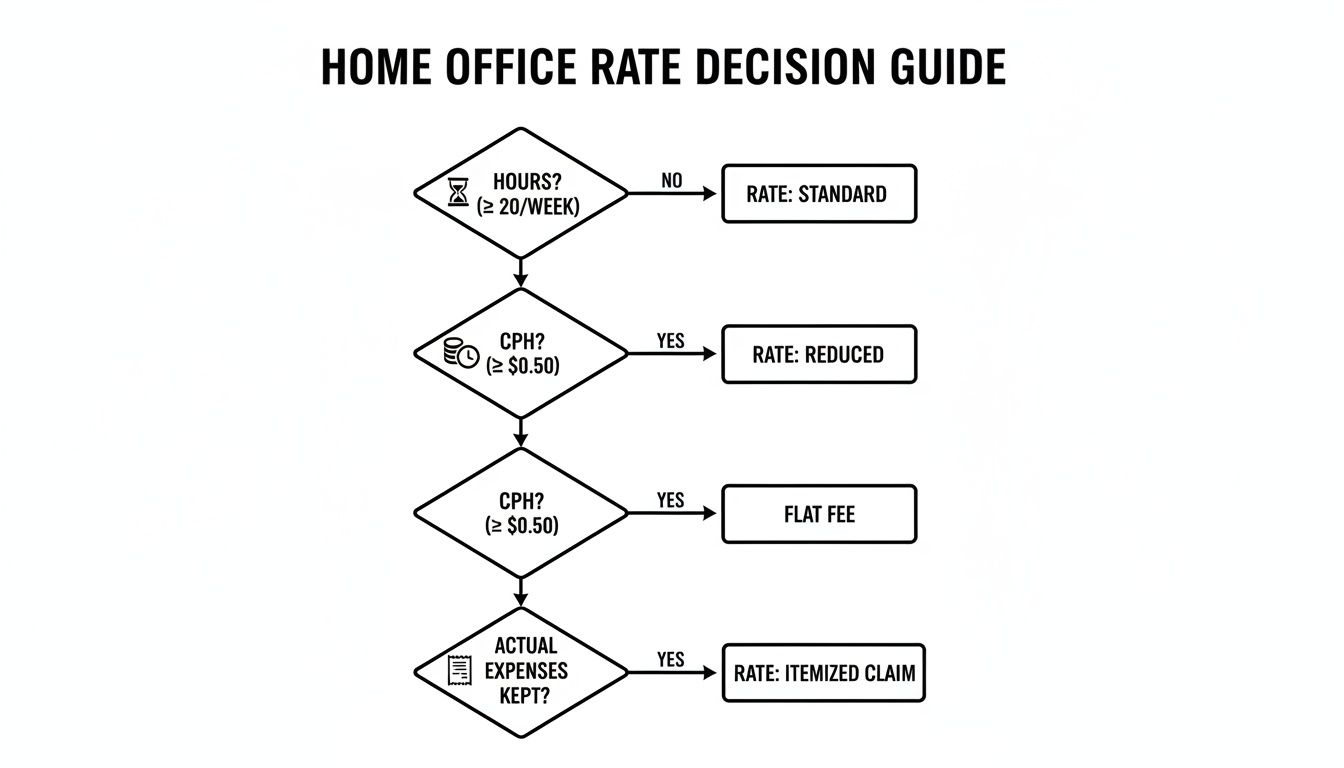
Working under 32 hours a week often favours cents-per-hour. Above that, actual cost can pay off.
Step By Step Instructions
- Select the method matching your hours and expenses.
- Gather logs or bills for the financial year.
- Use a spreadsheet or the ATO’s calculator.
- Cross-check against section 8-1 of the ITAA 1997.
- Report the figure under Home Office Expenses in your tax return.
Dive deeper in our guide on home office deductions for detailed examples.
Case Study Example
Lisa works 30 hours per week from home using cents-per-hour:
30 × 5 days × 48 weeks = 7,200 hours
7,200 × 0.67 = $4,824 annual deduction.
Mark tallies actual costs:
- $2,000 electricity
- $1,200 internet
- $800 furniture depreciation
50% work-use ⇒ $2,000 claimed.
“Choosing correctly can save you hundreds each year,” says EndureGo Tax principal accountant.
For tailored advice, book a consultation with EndureGo Tax in Ashfield & Belrose.
Best Practices You Need To Know
- Review your method each financial year.
- Store digital records in the cloud.
- Use a timer or app to track hours.
- Align apportionment with ATO definitions.
- Refer to the ATO home office rate calculator for consistency.
Follow these steps to maximise your home office rate and stay audit-ready.
Practical Examples And Calculator Tools
A few real-world scenarios clarify how each method affects your bottom line.
Example Using Cents-Per-Hour Method
Jane logs 40-hour weeks at her kitchen table and chooses 67c per hour:
- 40 hours × $0.67 = $26.80 weekly
“Cents-per-hour keeps paperwork minimal,” shares our senior tax adviser.
Example Using Actual Cost Method
Mark itemises over four weeks:
- Electricity $160; work use 40% → $64
- Internet $100; work use 50% → $50
- Furniture depreciation $240; work use 100% → $240
| Expense Type | Total Cost | Work Use % | Deduction Amount |
|---|---|---|---|
| Electricity | $160 | 40% | $64 |
| Internet | $100 | 50% | $50 |
| Furniture | $240 | 100% | $240 |
| Total | $354 |
Calculator Tools And Resources
- ATO Home Office Expenses Calculator
- TrackMyExpenses Home Office Calculator
- HomeTaxCalc Interactive Tool
For maximisation tips, see maximising your tax refund using the correct home office running expense.
“A quick calculator run reduces errors,” notes our senior tax adviser.
Refer to section 8-1 of the ITAA 1997 for legal context.
Tips For Accurate Inputs
- Use a time-tracking app.
- Scan and tag receipts immediately.
- Log daily heating or cooling usage.
- Maintain a depreciation schedule.
- Run a four-week diary to support cents-per-hour claims.
Consistent records ensure a robust audit trail and smooth ATO review.
Ready to secure your claim? Gather logs, run those calculators and choose the right method. For personalised support, book a consultation with EndureGo Tax in Ashfield & Belrose today—no dollar left unclaimed.
Common Mistakes When Claiming Home Office Rate
Small errors can sting at tax time. The usual culprits: misapplying the cents-per-hour rate, mixing personal and work use, or ignoring depreciation.

Quick Checklist
- Keep a 4-week diary with exact hours.
- Depreciate only on actual work days.
- Split internet and electricity into personal vs work.
- Retain invoices for furniture, software and stationery.
Sarah claimed a full week at cents-per-hour but missed half a day, shaving off 12.5% of her deduction.
“A clear diary is your best defence,” says EndureGo Tax senior adviser.
For records guidance, see the importance of a diary for work-from-home expenses.
If you’re in Ashfield or Belrose, our EndureGo Tax team will review your logs and lodge a bulletproof claim. Book a consultation now.
Recent ATO Changes And Local Expert Guidance
Late 2024 brought updates affecting your home office rate claims: rate adjustments, tightened documentation and mixed-use asset rules. By June 2025, 46% of Australians logged some hours from home. Dive into Roy Morgan for deeper stats.
Key changes:
- Rate Adjustment to reflect higher running costs
- Tightened Documentation for detailed logbook declarations
- Mixed-Use Asset Rules on precise apportionment
You now need a signed declaration confirming sole work use, plus actual-hours-based apportionment for internet and power—no more rough estimates.
Updated Cents-Per-Hour Rate
For 2024–25, the ATO raised the rate to 69c per hour, still covering power, data and wear-and-tear.
| Item | 2023–24 Rate | 2024–25 Rate |
|---|---|---|
| Cents-Per-Hour | 67c | 69c |
| Coverage | Power, data, furniture | Power, data, furniture |
Adjusting Your Claim Process
- Update your four-week diary with exact hours.
- Attach a signed declaration under ATO legislation.
- Recalculate mixed-use percentages.
- Store logbooks, bills and asset registers in the cloud.
“Staying current with ATO updates keeps your claim maximised and audit-ready,” says an EndureGo Tax principal.
Our Ashfield & Belrose team will keep your records ship-shape and help you sidestep audit headaches. Contact EndureGo Tax in Ashfield & Belrose for expert guidance on home office rate claims. Book your consultation online at EndureGo Tax.
