


When you’re weighing up a family trust vs company, the decision boils down to your primary objective. If your main goal is achieving flexibility in income distribution and robust asset protection, a discretionary trust is often the superior choice. On the other hand, a proprietary limited company provides a structured, separate legal entity that’s ideal for running an active business and limiting your liability. The right path depends entirely on whether your priority is safeguarding family wealth for generations or building a scalable business.
Choosing Your Business Structure: An Overview
Selecting the right structure for your venture is one of the most critical decisions you’ll make as an Australian entrepreneur or investor. The choice between a family trust and a company isn’t merely administrative; it carries significant legal, tax, and operational implications that will shape your financial future. It’s crucial to understand these distinctions from the outset.
A proprietary limited company is its own legal “person” under the law. This is a game-changer because it means the company can own assets, incur debt, and enter contracts entirely separate from its owners (the shareholders). While directors manage the day-to-day operations, that “corporate veil” is designed to protect the personal assets of shareholders from the business’s liabilities.
A family trust operates differently. It’s not a separate entity but a legal relationship defined by a trust deed. In this arrangement, a trustee (which can be an individual or, more commonly, a company) holds assets on behalf of a group of family members, known as the beneficiaries.
This infographic provides a quick visual rundown of how they compare.
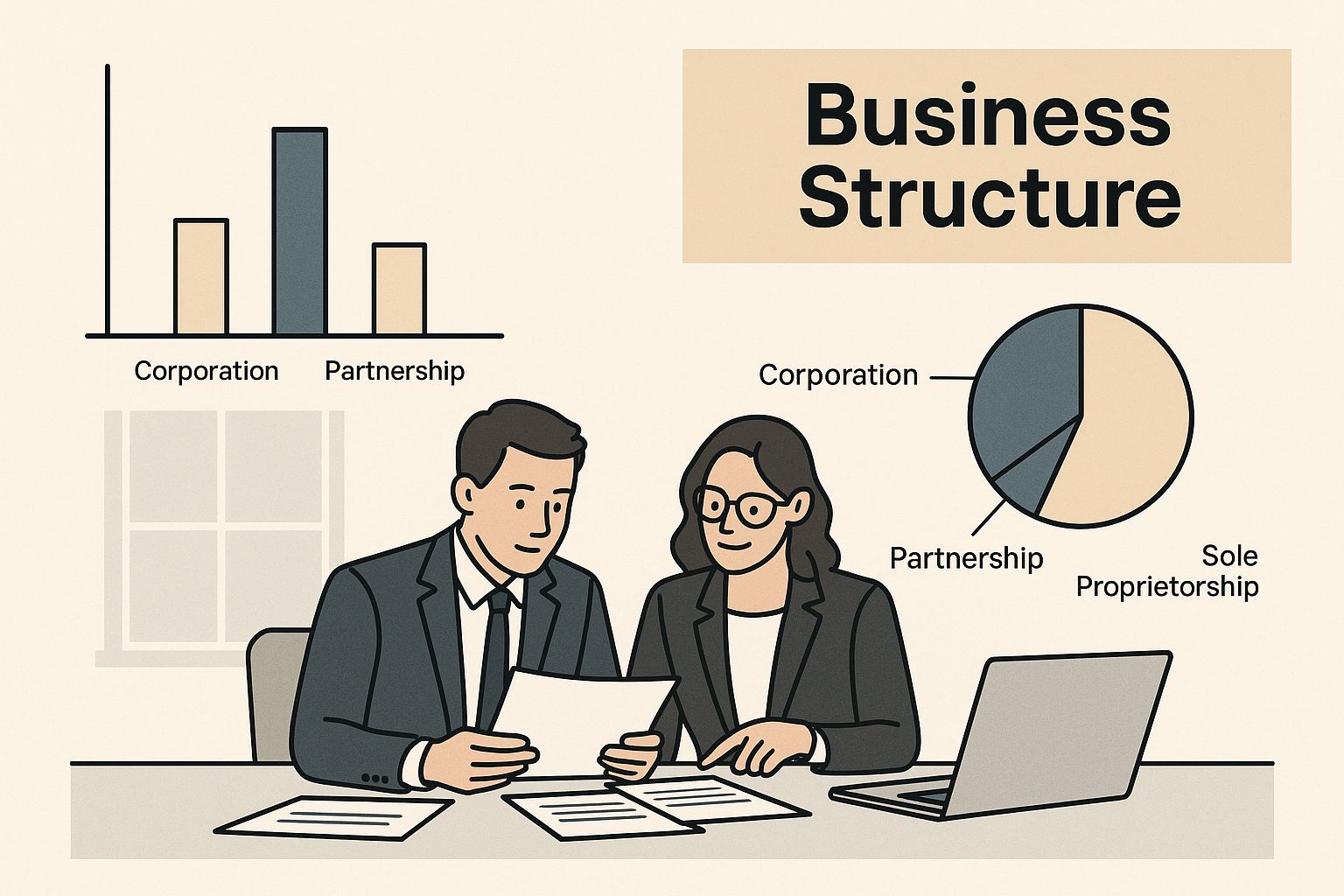
As you can see, companies draw a clear line between your personal and business affairs, while trusts create a framework specifically designed for managing and passing on wealth within a family. For a deeper dive, you can read our guide on exploring business structures in Australia.
Key Structural Differences At A Glance
To cut through the complexity of the family trust vs company decision, the table below offers a straightforward comparison of their core features. Think of it as a cheat sheet to quickly see how each one handles critical aspects like ownership, liability, and governance.
Quick Comparison: Family Trust vs Company
| Feature | Family Trust | Company (Pty Ltd) |
|---|---|---|
| Legal Status | A legal relationship, not a separate entity. | A separate and distinct legal entity. |
| Asset Ownership | Assets are legally owned by the trustee. | Assets are owned directly by the company. |
| Liability | The trustee is liable (a corporate trustee is used to limit this). | Liability is limited for shareholders (subject to exceptions). |
| Profit Distribution | Highly flexible, distributed to beneficiaries annually. | Profits are paid to shareholders as dividends. |
| Regulatory Body | Governed by the trust deed and state-based trust law. | Regulated by the Australian Securities and Investments Commission (ASIC). |
| Tax Rate | Income is taxed at beneficiaries’ individual marginal rates. | Pays a fixed corporate tax rate (25% or 30%) on profits. |
This table highlights the fundamental trade-offs. You’re essentially choosing between the strict, regulated structure of a company and the adaptable, private nature of a trust.
The fundamental distinction is control versus flexibility. A company offers rigid control and clear ownership through shares, whereas a discretionary trust provides immense flexibility in how income and capital are distributed each year.
If you’re leaning towards a company, you’ll be dealing with formal documents like the Memorandum of Association, which sets out the company’s constitution. This formality is a key point of difference from the more private trust deed that governs a family trust.
Getting this choice right from the start has long-lasting consequences. For expert advice tailored to your specific situation, your next actionable step is to contact our team of expert accountants in Ashfield and Belrose. We can help you establish a structure optimised for asset protection, tax efficiency, and your future growth plans.
Analysing The Tax Implications
When you’re weighing up a family trust versus a company, the Australian tax landscape is arguably the most critical consideration. The way each structure is taxed is fundamentally different, and that difference can have a profound impact on your financial outcomes, particularly when distributing profits and selling assets. Mastering these distinctions is non-negotiable for effective wealth management.
A company is quite straightforward from a tax perspective. As its own legal entity, it pays tax on its profits at a fixed corporate rate—currently 25% for most small businesses (base rate entities) or 30% for larger ones, as stipulated by the ATO. After the company pays its tax, it can then distribute the remaining profits to its shareholders as dividends.
Those dividends can be ‘franked’, a crucial concept in Australian tax law. It means they come with a tax credit (a franking credit) attached, representing the tax the company has already paid. This clever system prevents the same dollar of profit from being taxed twice, a cornerstone of Australia’s dividend imputation system.
A family trust, on the other hand, operates completely differently. It generally does not pay tax on its own income. Think of it more as a conduit—it channels its pre-tax income through to its beneficiaries. The critical rule is that the trustee must resolve to distribute all the income by 30 June each year. If they fail to do so, any income retained in the trust is taxed at the highest marginal rate, a punitive outcome to be avoided.
How Income Distribution Impacts Your Tax Bill
The primary tax advantage of a family trust is its unparalleled flexibility in distributing income. The trustee has the discretion to strategically stream profits among various family members, taking full advantage of their individual marginal tax rates.
Practical Example: Imagine a family trust with beneficiaries including two parents (high-income earners) and their 19-year-old child who is a full-time university student with no other income. The trust can distribute profits up to the tax-free threshold (currently $18,200) to the student, making that portion of the trust’s income completely tax-free for the family unit. A company structure offers no such capability.
The core tax difference is this: a company is taxed first, then distributes what’s left. A trust distributes pre-tax income, which is then taxed in the hands of the beneficiaries. Understanding this is key to the ‘family trust vs company’ decision.
Let’s Look at a Real-World Scenario: Annual Profit Distribution
Imagine your small business generates a profit of $100,000.
- Company Structure: The company pays $25,000 in tax (25% rate). The remaining $75,000 can be paid to you as a fully franked dividend. On your personal tax return, you declare $100,000 of income (the $75,000 cash plus the $25,000 franking credit) and pay tax at your marginal rate, but you receive a $25,000 credit for the tax the company already paid.
- Family Trust Structure: The trustee can distribute the entire $100,000 profit. They might resolve to give $50,000 to you (Spouse A) and $50,000 to your partner (Spouse B). Each of you would then pay tax on $50,000 at your individual marginal rates. This almost always results in a lower overall tax bill for the family compared to one person receiving the full $100,000.
This flexibility is an incredibly powerful tool for tax planning. To see more on how this works, take a look at our detailed guide on how a family trust can save you tax.
The Decisive Capital Gains Tax Discount

Here’s where the comparison becomes even more stark. One of the most significant advantages a family trust has over a company is access to the 50% Capital Gains Tax (CGT) discount. As per Division 115 of the Income Tax Assessment Act 1997, if a trust holds an asset for over 12 months, any capital gain from its sale can be halved before it’s distributed to beneficiaries.
Companies receive no such discount. They must pay tax on 100% of any capital gain at their corporate tax rate. This is a massive distinction, particularly if your strategy involves holding assets that will appreciate in value, like property or shares.
Let’s See It in Action: Selling an Investment Property
Say you sell an investment property and realise a $200,000 capital gain.
- Held in a Company: The company would add the full $200,000 to its taxable income. At a 25% tax rate, that’s a $50,000 tax bill, straight up.
- Held in a Family Trust: The trust can immediately apply the 50% CGT discount, reducing the taxable gain to just $100,000. This smaller amount is then distributed among the beneficiaries, who pay tax at their personal rates, resulting in a significantly lower overall tax impost.
This one factor often makes a family trust the clear winner for holding long-term growth assets. To ensure your structure is set up for maximum tax efficiency, your next actionable step is to Book a consultation with our expert accountants in Ashfield or Belrose today. We provide professional advice tailored to your unique financial situation.
Evaluating Asset Protection and Liability
When you’re running a business or managing family wealth, a critical question is: “How safe are my assets?” Protecting what you’ve built from creditors and legal claims is non-negotiable. This is where the family trust vs company debate intensifies, as each structure offers a very different level of protection.
Choosing the right one can mean the difference between keeping your family home and losing it if your business encounters financial difficulty.
A company is often the first structure considered, primarily due to the concept of limited liability. Under the Corporations Act 2001, a company is a separate legal entity. This creates a “corporate veil” between the business’s debts and the personal assets of its shareholders. In principle, if the company fails, creditors can only pursue the company’s assets, not your personal savings or family home.
However, this corporate veil is not as impenetrable as many believe.
When The Corporate Veil Fails
While the limited liability a company offers is a strong starting point, directors must be acutely aware of its limitations. There are several common business scenarios where that protective barrier can be pierced, leaving you personally liable.
- Director’s Personal Guarantees: This is the most common vulnerability. When applying for business loans, leases, or significant trade credit, banks and suppliers almost always require a director’s personal guarantee. The moment you sign that document, you have personally agreed to cover the debt if the company defaults, effectively making the corporate veil irrelevant for that specific liability.
- Insolvent Trading: This is a serious breach of directors’ duties. If you continue to incur new debts when you know (or reasonably should have known) the company is insolvent, you can be held personally liable for those debts. ASIC pursues these cases vigorously.
- Director Penalty Notices (DPN): The Australian Taxation Office (ATO) holds significant power. Under specific ATO legislation, a DPN can make directors personally liable for the company’s unpaid Pay As You Go (PAYG) withholding and superannuation guarantee charge (SGC) obligations.
While a company creates a clear legal separation on paper, the practical realities of doing business, especially the need for personal guarantees, often weaken its asset protection. This is a critical point to weigh up in the family trust vs company decision.
The Unique Protection of a Family Trust
A discretionary family trust provides a completely different, and arguably stronger, form of asset protection. The key lies in its legal structure: the trustee legally owns the assets, but they hold them for the benefit of the beneficiaries.
Because beneficiaries do not have a fixed entitlement or legal ownership of the trust’s assets—they only have a right to be considered for a distribution—their personal creditors cannot touch what’s inside the trust.

This structure is exceptionally effective for segregating family wealth from individual risks, whether that’s a business failure, a personal bankruptcy, or even a relationship breakdown.
A Practical Example: Personal Bankruptcy
Let’s say one of your adult children is a beneficiary of your family trust, which holds a share portfolio and an investment property. If they unfortunately face personal bankruptcy, their creditors have no claim over those trust assets. Why? Because your child does not legally own them. If those same assets were held in their personal name, they would almost certainly be seized and sold to pay off their debts.
Using a Corporate Trustee For Maximum Security
So, how do you take the powerful protection of a trust and make it even more robust? You use a corporate trustee. This is a hybrid approach where you establish a company with the sole purpose of acting as the trustee for your family trust.
This move gives you the best of both worlds. It adds another layer of separation, limiting the trustee’s liability to the assets of that specific company (which is usually nothing more than its paid-up share capital). It creates a formidable barrier, neatly separating the control of the trust assets from any personal or business liabilities. If you’re wondering about the mechanics, our guide on how to set up a family trust breaks down the steps involved.
Ultimately, your choice depends entirely on your risk profile. For an active trading business with significant operational debt, a company structure provides a clear and effective baseline of protection. However, if your primary objective is to hold and protect long-term family wealth for future generations, the discretionary trust is an incredibly powerful tool.
Crunching the Numbers: Setup and Compliance Costs
When you’re deciding between a family trust and a company, it’s easy to get caught up in the big-picture benefits like tax savings and asset protection. But the day-to-day reality of setup fees and ongoing compliance costs can have a real impact on your cash flow and administrative burden.
Many people assume one structure is simply cheaper than the other, but it’s not that straightforward. The costs are just different. Companies tend to have higher government fees, while trusts often demand more specialised legal and accounting expertise, particularly at the establishment phase.
Getting Off the Ground: Initial Setup Costs
Setting up a proprietary limited company is a fairly standardised, regulated process. You’ll need to reserve a business name and then formally register the company with the Australian Securities and Investments Commission (ASIC).
A family trust, by contrast, is a legal creation. It all starts with a professionally drafted trust deed. This document is the constitution for your trust—it lays out all the rules of operation. Getting this right from the beginning is absolutely critical. While cheap, off-the-shelf deeds exist, a solicitor-drafted document tailored to your family’s specific needs and future goals is a wise investment.
What Does Setup Actually Cost? A Real-World Look
- Company: The primary fee is for ASIC registration, which currently sits at $576 (as of 2024). If you engage an accountant or lawyer to handle the paperwork, you can expect to add a few hundred dollars for their professional time.
- Family Trust: A quality trust deed from a solicitor can cost anywhere from $500 to over $2,000, depending on its complexity. If you choose to have a company act as the trustee (which is highly recommended for asset protection), you’ll also have to pay the $576 ASIC company registration fee on top of the deed cost.
This highlights the core difference: setting up a company is primarily an administrative task, while setting up a trust is a legal one.
The Long Haul: Ongoing Compliance and Running Costs
Once you establish the structure, the annual compliance obligations quickly create very different cost profiles for each option. These recurring expenses play a major role in the overall family trust vs company financial equation.
Companies shoulder mandatory annual reporting duties to ASIC. They must pay an annual review fee—currently $310 for a standard proprietary company. In addition, they must maintain detailed financial records, lodge a company tax return, and keep company registers up to date. As a result, most businesses hire an accountant and a registered ASIC agent to handle these requirements efficiently.
On the other hand, family trusts avoid the ASIC annual review fee (unless a corporate trustee is involved). However, their compliance workload remains substantial. The trustee must maintain precise records of all transactions, prepare a full set of annual financial statements, and lodge a trust tax return each year.
The single most important annual task for a trust is the trustee distribution resolution. This document must be legally executed before 30 June to effectively stream income to your beneficiaries. A failure here can be disastrous—the ATO can tax the trust’s entire profit at the highest marginal rate. It’s a very expensive mistake to make.
The table below breaks down the typical costs and tasks to give you a clearer picture.
Estimated Cost And Compliance Comparison
When you line them up, the financial and administrative differences become much clearer. Here’s a side-by-side look at what you can generally expect.
| Cost/Compliance Item | Family Trust | Company (Pty Ltd) |
|---|---|---|
| Initial Setup Cost | Deed drafting ($500 – $2,000+) plus corporate trustee registration if used ($576). | ASIC registration fee ($576) plus professional fees. |
| Annual ASIC Fee | $0 (unless using a corporate trustee, which has its own fee). | $310 annual review fee (current rate). |
| Key Annual Task | Preparing and signing trustee distribution resolutions before 30 June. | Lodging an annual company statement with ASIC. |
| Accounting Fees | Typically higher due to tracking beneficiary accounts and complex distributions. | Generally more standardised for tax returns and financial statements. |
As you can see, the true cost extends well beyond the initial price tag. To properly understand the financial implications for your specific situation and ensure your structure is managed correctly from day one, your next actionable step is to get expert advice.
Schedule a consultation with our expert accountants in Ashfield or Belrose. We’ll help you navigate the costs and obligations with confidence.
When to Choose a Trust vs. a Company
Understanding the textbook differences between a trust and a company is one thing, but applying that knowledge to your unique circumstances is another. This decision depends on your goals, the assets you hold, and your long-term financial vision.
Moreover, trusts are popular in Australia for good reason. In the 2022–23 financial year, the Australian Taxation Office (ATO) reported more than 1.02 million registered trusts that collectively generated nearly $489.5 billion in total business income. This figure highlights their vital role in the Australian economy, particularly among family businesses and investment portfolios. You can learn more about the role of trusts in Australia on InvestSmart.
Now, let’s shift from theory to practice and explore a few common real-world scenarios.
Scenario One: A Family Enterprise Holding Capital Assets
Imagine a family that has built a portfolio of investment properties and shares over many years. Their primary objectives are to protect that wealth from personal liability, minimise their annual tax bill, and eventually transition the assets to their children seamlessly.
- Recommendation: A discretionary family trust is almost always the optimal structure here.
- Why it works: The trust excels in this situation for two key reasons. First, the asset protection is superior. If a beneficiary encounters personal financial difficulty, the assets held within the trust are generally shielded from their creditors. Second, and crucially, trusts can access the 50% Capital Gains Tax (CGT) discount for assets held over 12 months. A company misses out on this entirely, paying tax on 100% of any capital gain. This is a game-changing difference outlined in Division 115 of the Income Tax Assessment Act 1997.
Scenario Two: A Growing Service Business with Unrelated Partners
Now, consider two friends—a graphic designer and a web developer—teaming up to launch a digital agency. They are not related. Their strategy is to reinvest profits back into the business, hire employees, and potentially bring on more partners in the future.
- Recommendation: A company structure is the only practical choice.
- Why it works: A family trust is designed for a family. It simply isn’t built to accommodate unrelated business partners. A company, on the other hand, provides a clean, well-defined ownership structure through shares. It’s straightforward to issue new shares to bring in new partners or investors, and the limited liability means each owner’s personal assets are shielded from the business’s debts.
The moment your business involves non-family members as owners, a company becomes the default choice. Its rigid share structure provides the legal certainty and clarity that unrelated parties require, which a discretionary trust cannot offer.
Scenario Three: A Startup Seeking External Investment
Let’s analyse a tech startup with a groundbreaking idea. The founders need to raise significant capital from venture capitalists and angel investors to launch their business and scale rapidly. The ultimate goal might be a future sale or even an initial public offering (IPO).
- Recommendation: It has to be a company. There is no alternative.
- Why it works: No sophisticated investor will inject capital into a discretionary trust. They require a clear, quantifiable stake in the business, which means owning shares in a company. The corporate structure is understood globally, designed for growth, and provides the proper governance (like a board of directors and shareholder rights) that investors demand to protect their investment.
Scenario Four: An Individual Building a Share Portfolio for Their Children
Finally, think of a parent wanting to establish a long-term share portfolio specifically for their children’s future. The intention is that the income and growth will one day fund their university education or a deposit on a home.
- Recommendation: A family trust is the perfect vehicle for this goal.
- Why it works: This setup allows the parent, as trustee, to manage the investments with full control. Once the children turn 18 and are in a low tax bracket, income from the portfolio can be distributed to them in a highly tax-effective manner. Furthermore, the strong asset protection ensures the portfolio is safe from any future personal or business claims against the parent or the children. A company would be far too cumbersome and tax-inefficient for this kind of personal wealth-building strategy.
Getting the structure right from the beginning is fundamental to your financial success. To ensure your structure is perfectly aligned with your goals, your next actionable step is to book a consultation with our expert accountants in Ashfield or Belrose today. We’ll provide clear, actionable advice to set you up for success.
So, Which One Is Right for You?
Choosing between a family trust and a company requires careful consideration. We’ve already examined the key differences in tax, asset protection, and costs, so now it’s time to bring everything together. Ultimately, the best structure is the one that aligns with your long-term goals and supports your financial vision. This decision goes beyond setting up a business—it lays the foundation for your financial future.
To make the right choice, step back from the technical details and focus on your purpose. Consider what you want this structure to achieve—not just in the short term, but over the next decade. Are you building an active trading business that aims for growth, or are you establishing a secure vehicle to preserve wealth for future generations?
A Practical Checklist to Guide Your Decision
Before you proceed, honestly answer these questions. Your responses will provide significant clarity in the family trust vs company debate.
- What is the ultimate goal? If you’re building a business you intend to sell or bring external investors into, a company is the clear winner. Its straightforward share structure is what buyers and investors require. Conversely, if you are holding assets like property for long-term growth to eventually pass to your children, a family trust is almost always the superior choice.
- What type of assets are involved? Are your assets primarily generating active income, such as from a consulting business? Or are they passive assets you expect to appreciate in value over time, like shares and real estate? The 50% CGT discount available to trusts (as laid out in the Income Tax Assessment Act 1997) makes them a powerhouse for holding capital growth assets.
- Who are the stakeholders? Is this purely a family affair, with ownership and control remaining within the immediate family? A trust offers unmatched flexibility here. But if you have business partners who are not family, or you plan to introduce them later, a company is the only practical vehicle.
- What is your primary risk? Are you more concerned about business debts and operational liabilities? A company creates a “corporate veil” to shield your personal assets. Or is your main concern protecting the family’s wealth from a beneficiary’s potential personal financial troubles? This is where a trust truly excels, ring-fencing assets from personal creditors.
This guide offers a comprehensive educational overview, but it cannot replace tailored professional advice. Establishing the wrong structure can have serious and long-lasting financial consequences, from unnecessarily high tax bills to discovering your asset protection is not as robust as you believed.
This is one of those critical decisions where getting it right from the start can save you a fortune and significant stress down the track.
Ready to move forward with clarity and confidence? Book a consultation with our expert accountants in Ashfield or Belrose today. We’ll provide personalised, practical advice to ensure your structure is perfectly set up to achieve your goals.
Frequently Asked Questions
When you’re weighing up a family trust vs a company, a lot of specific questions tend to pop up. Let’s tackle some of the most common ones we hear from Aussie business owners and investors.
Can You Change From a Company to a Trust Later?
You can technically restructure from a company to a trust later, but doing so usually becomes a costly and complex process. This transition requires transferring assets from one legal entity to another, which the Australian Taxation Office classifies as a disposal.
As a result, the transfer almost always triggers Capital Gains Tax (CGT) and may also incur stamp duty on assets such as real estate. Therefore, choosing the right structure from the start can save you significant money, time, and administrative stress in the future.
What Is a Corporate Trustee and Is It Necessary?
A corporate trustee operates as a company created solely to serve as the trustee of your family trust. Although the law does not require it—since an individual can act as trustee—most experienced accountants and lawyers strongly recommend using a corporate trustee for better asset protection.
Furthermore, this setup offers a major advantage: it builds a strong barrier between the trust’s liabilities and your personal assets. Any liability the trustee incurs remains within the trustee company, which typically holds no significant assets of its own. As a result, your personal wealth stays protected.
In addition, a corporate trustee simplifies succession planning. Changing the directors of a company is far easier than replacing the trustee named in the trust deed, allowing for a smoother and more efficient transition of control.
Which Structure Is Better for Attracting Investors?
If your strategic plan includes raising capital from outside investors, choose a company structure—it’s the only viable option. Venture capitalists, angel investors, and other sophisticated investors need a clear and straightforward way to own part of the business.
A company issues different classes of shares, creating a familiar and legally robust framework that defines ownership percentages, voting rights, and dividend entitlements. A discretionary family trust cannot offer this level of clarity and governance, making it unsuitable for any business seeking external investment.
Choosing the right structure shapes your business for years to come. For expert, tailored advice, talk to the team at EndureGo Tax. We’ll help you make the right decision from day one, setting you up for better tax outcomes and strong asset protection.
Book your consultation at https://www.endurego.com.au today.
