


Choosing between a partnership and a company is one of the most consequential decisions you’ll make in business. This choice has significant flow-on effects for your personal liability, tax obligations, and the administrative burden you will carry. Therefore, understanding the difference between a partnership and a company is critical for long-term success.
At its core, a partnership is an agreement between people to run a business together and share the profits. A proprietary limited (Pty Ltd) company, on the other hand, is a completely separate legal entity from its owners. This isn’t just a bit of legal jargon—it fundamentally changes how your personal assets are protected from business risks.
Partnership or Company: What’s the Real Difference?
Deciding on the right business structure isn’t merely about filling out forms. In effect, it’s about building a legal framework that aligns with your strategic goals, risk appetite, and growth plans. For many Aussie business owners, especially tradies and small operators, the choice between a simple partnership and a more formal company structure can feel overwhelming.

The distinction goes far deeper than the name on your business card. In Australia, your structure dictates how your business is taxed, how you report to the government, and how much personal risk you’re taking on.
For instance, a partnership is a ‘flow-through’ structure. The business itself doesn’t pay income tax; instead, the profit (or loss) is distributed among the partners, who then report it on their individual tax returns.
Conversely, a company is a different beast entirely. It’s a separate legal ‘person’ under Australian law. It pays tax at the corporate tax rate on its profits. Then, if it distributes those profits to shareholders as dividends, the shareholders may pay further tax on that income, offset by any franking credits.
To give you a clear, at-a-glance overview, here’s a table summarising the key differences.
Quick Comparison: Partnership vs Company in Australia
This table provides a high-level summary of the fundamental differences between running your business as a partnership versus a company in Australia.
| Feature | Partnership | Company (Pty Ltd) |
|---|---|---|
| Legal Status | An agreement between partners; not a separate legal entity. | A separate legal entity, distinct from its owners (shareholders). |
| Personal Liability | Unlimited. Partners are personally liable for all business debts. | Limited. Liability is generally restricted to the value of shares. |
| Taxation | Profits/losses ‘pass through’ to partners and are taxed at individual rates. | Pays tax at the company rate. Shareholders taxed on dividends. |
| Setup Cost | Generally low. Often requires only an ABN and a partnership agreement. | Higher. Involves ASIC registration fees and a more formal process. |
| Compliance | Simpler. Requires lodging an annual partnership tax return. | More complex. Strict obligations under the Corporations Act 2001. |
Grasping these core concepts is the first step. As your local accountants, we possess the expertise to help you make a smart, informed decision that protects your financial future.
Ready to discuss which structure is right for your business? Book a consultation with our expert team in Ashfield or Belrose Northern Beaches today
How Each Structure Impacts Your Personal Liability
When setting up a business, one of the most critical decisions you’ll make is how to structure it. This is not just paperwork; it is a fundamental choice about how much personal risk you are willing to accept. Ultimately, the difference between a partnership and a company really comes down to protecting your personal assets.
Let’s break down what that means for you and your family.

Unlimited Liability in a Partnership
In a general partnership, there’s no legal separation between you and the business. You are the business. Consequently, you and your partners are jointly and severally liable for all business debts. If the business cannot pay its bills, creditors can legally pursue your personal assets—your family home, your car, your savings.
Practical Example: Imagine you and your mate start a carpentry business. If an accident on-site causes major damage and your insurance doesn’t cover it all, both of you could be sued personally. Even worse, you’re also on the hook for debts your partner incurs for the business, even if you had no idea.
The term “jointly and severally liable” is critical to understand. It means a creditor could pursue just one partner for the entire business debt, leaving that person to try and recover the money from the others. This represents a substantial personal risk.
Limited Liability in a Company
This is where a company structure provides a clear advantage. A proprietary limited (Pty Ltd) company is treated as a separate legal entity under Australian law. If you want to dive deeper into this, our article on the Pty Ltd meaning in Australia is an excellent resource.
This separation creates what’s known as a “corporate veil,” which shields your personal finances from the business’s liabilities. This protection is called limited liability.
As a director or shareholder, your liability is generally limited to the value of your shares or any personal guarantees you’ve signed. So, if the company fails and owes money, creditors can typically only claim against the company’s assets, not yours.
This protection is precisely why so many tradies and small business owners operate as a company, especially when they plan to hire staff, take on debt, or sign large contracts. It is a foundational piece of your risk management puzzle.
How the ATO Taxes Partnerships vs. Companies
When you’re weighing up the difference between a partnership and a company, tax is where the financial implications become most apparent. How the Australian Taxation Office (ATO) treats your business structure directly shapes your tax bill, your compliance workload, and even your cash flow.
These are not minor details to be figured out later. For tradies and small business owners, getting this right from the outset can save thousands of dollars and significant stress at tax time.
Let’s break down how the ATO views each structure and what it actually means for your bank account.
Partnership Taxation: The ‘Pass-Through’ Model
A partnership utilises a ‘pass-through’ tax structure. This is a simple but vital concept: the business itself does not pay income tax on its profits.
Instead, the partnership lodges its own tax return each year to report its total income and expenses. The net profit (or loss) is then split between the partners according to their agreement. From there, each partner adds their share of the profit to their personal tax return and pays tax on it at their individual marginal rate.
If you need a deeper look at the lodgement process, we’ve got a guide on preparing a partnership tax return.
Practical Example: Let’s say a plumbing partnership with two mates, Bill and Ben, makes a net profit of $180,000 for the year.
- The partnership lodges a tax return showing the $180,000 profit, but the tax payable by the business is $0.
- Bill’s 50% share is $90,000. He adds this to his other personal income and pays tax on it at his marginal rate.
- Ben does exactly the same with his $90,000 share.
While this model is straightforward, it can become tax-inefficient. As the business grows, partners can find themselves pushed into higher personal tax brackets, meaning a larger portion of their profit goes to the taxman.
Company Taxation: The Two-Tier System
A company is a whole different ball game from a tax perspective. It’s treated as a completely separate legal and tax entity from its owners, which creates a two-tiered tax system.
First, the company itself pays income tax on its net profits at the corporate tax rate. For the 2025-26 financial year, this is 25% for most small businesses (base rate entities). The company pays this tax directly to the ATO.
Second, if the company distributes its after-tax profits to the owners (shareholders) as dividends, those shareholders must declare that income on their personal tax returns. At first glance, it seems like you’re being taxed twice—once in the company, and again in your own hands.
To prevent double taxation, Australia uses a system of franking credits (also known as imputation credits). When a company pays you a dividend, it passes on a credit for the tax it has already paid. You can then use this franking credit to reduce your personal tax bill, a mechanism outlined in the Income Tax Assessment Act 1997.
This two-tiered structure is highly effective for growth. It allows you to retain profits within the company for reinvestment, where they are taxed at a flat rate that is often much lower than the top personal tax rates.
Understanding these tax differences is crucial. As expert accountants for tradies and small businesses across Ashfield and the Northern Beaches, we help clients map out their tax obligations and implement legal strategies to maximise their retained earnings.
Actionable Step: Unsure if your business structure is tax-effective? Contact EndureGo Tax today for a strategic review to ensure you’re not paying more tax than necessary.
Costs, Paperwork, and ASIC: What’s the Real-World Difference?
Beyond the legal theory and tax rates, the day-to-day reality of running your business comes down to costs and paperwork. This is where the practical difference between a partnership and a company really hits home.
From the moment you start, the financial and administrative burdens are worlds apart.
For many startups and tradie collaborations, a partnership is the go-to choice because it’s cheaper and easier to get off the ground. In most cases, you only need a solid partnership agreement and an Australian Business Number (ABN). Your initial costs are minimal, allowing you to invest your capital directly into the business.
Conversely, setting up a company is a more formal and expensive process. You must reserve a company name and then formally register it with the Australian Securities and Investments Commission (ASIC), which involves a significant registration fee. Furthermore, companies must pay an annual review fee to ASIC just to remain registered—a recurring cost that partnerships do not have.
The Ongoing Weight of Compliance
Once operational, the administrative load diverges even more. While both structures require you to keep good records for tax, a company’s compliance duties are far more stringent and legally enforced.
This is because companies are governed by the Corporations Act 2001. This is not a set of friendly suggestions; it’s complex legislation with strict rules on how you must operate.
A partnership is built on the agreement between partners, but it usually leaves them personally liable for business debts. A company, however, is its own legal entity, meaning its owners generally aren’t liable for company debts beyond their investment. That legal separation is a game-changer as a business grows, allowing ownership to be split into shares and management to be formalised through directors. For many Aussie operators, that’s the real trade-off: partnerships offer flexibility, but companies provide stronger protection and a clear path for growth. You can dive deeper into how these structures are viewed legally by reviewing insights on corporate versus partnership models.
A company director has legally enforceable duties. This includes acting in good faith, preventing the company from trading while insolvent, and keeping accurate financial records. Breaching these director’s duties can lead to severe consequences, including massive fines and disqualification from managing a company.
Lifting the Administrative Burden
The ongoing ASIC obligations for a company are significant. You must:
- Maintain a registered office and a principal place of business.
- Keep detailed financial records that properly explain your transactions and financial position.
- Notify ASIC of any key changes—like a new director, a change of address, or an update to your share structure—usually within 28 days.
- Pass a solvency resolution each year, confirming the company can pay its debts as they fall due.
This is where engaging a registered ASIC agent proves invaluable. As your local accountants and registered ASIC agents, we can take this entire compliance headache off your plate. We manage your annual reviews, lodge all necessary forms, and ensure you meet every deadline, so you can focus on running your business.
Actionable Step: Drowning in ASIC paperwork? Contact EndureGo Tax today and let our registered agents handle your company compliance. Free yourself up to focus on what truly matters.
Choosing the Right Structure for Your Business Goals
You now understand the theory. But how do you decide which structure is actually right for your business? The optimal choice isn’t just about the difference between a partnership and a company on paper; it’s about matching the structure to your real-world goals, your risk tolerance, and your five-year vision.
Let’s walk through a few practical scenarios we see all the time with Australian business owners.
Scenario 1: The Tradie Mates
Let’s say two qualified electricians, Dave and Steve, decide to team up. They have a ute, their tools, and a handful of loyal clients. Their main goal is simple: work for themselves, keep overheads low, and split the profits down the middle.
For Dave and Steve, a partnership is the clear winner to start. It is cheap and easy to set up, meaning they can get on the tools faster. Their starting capital can go towards a new trailer or local advertising, not ASIC registration fees.
The major trade-off here is liability. As partners, their personal assets are not separate from the business. If something goes wrong, their family homes could be at risk. However, for a two-person team with good public liability insurance, it’s often a calculated risk they’re willing to take for simplicity.
Scenario 2: The High-Growth Agency
Now, picture a digital marketing agency started by two ambitious founders. They don’t just want to freelance; they want to hire a team of ten, land large corporate contracts, and perhaps even attract investors down the track.
For this type of business, a company (Pty Ltd) structure is non-negotiable. Limited liability is the primary reason—it protects their personal assets when signing high-value contracts or a commercial lease. A company structure also allows them to issue shares, which is vital for raising capital or offering equity to key employees. The extra compliance paperwork is simply the cost of building a scalable and sellable asset.
Scenario 3: The Family-Run Shop
Finally, what about a family-run retail shop? It might start as a simple partnership between a husband and wife to test their idea and keep costs down while building their brand.
But once the business starts to grow—hiring casual staff and signing a long-term lease on a larger storefront—the risk profile changes completely. This is the perfect time to convert from a partnership to a company. Incorporating shields the family home from business debts and liabilities, which grow significantly with employees and major lease commitments.
The infographic below breaks down the cost and admin differences that a business like this would weigh up when making the change.
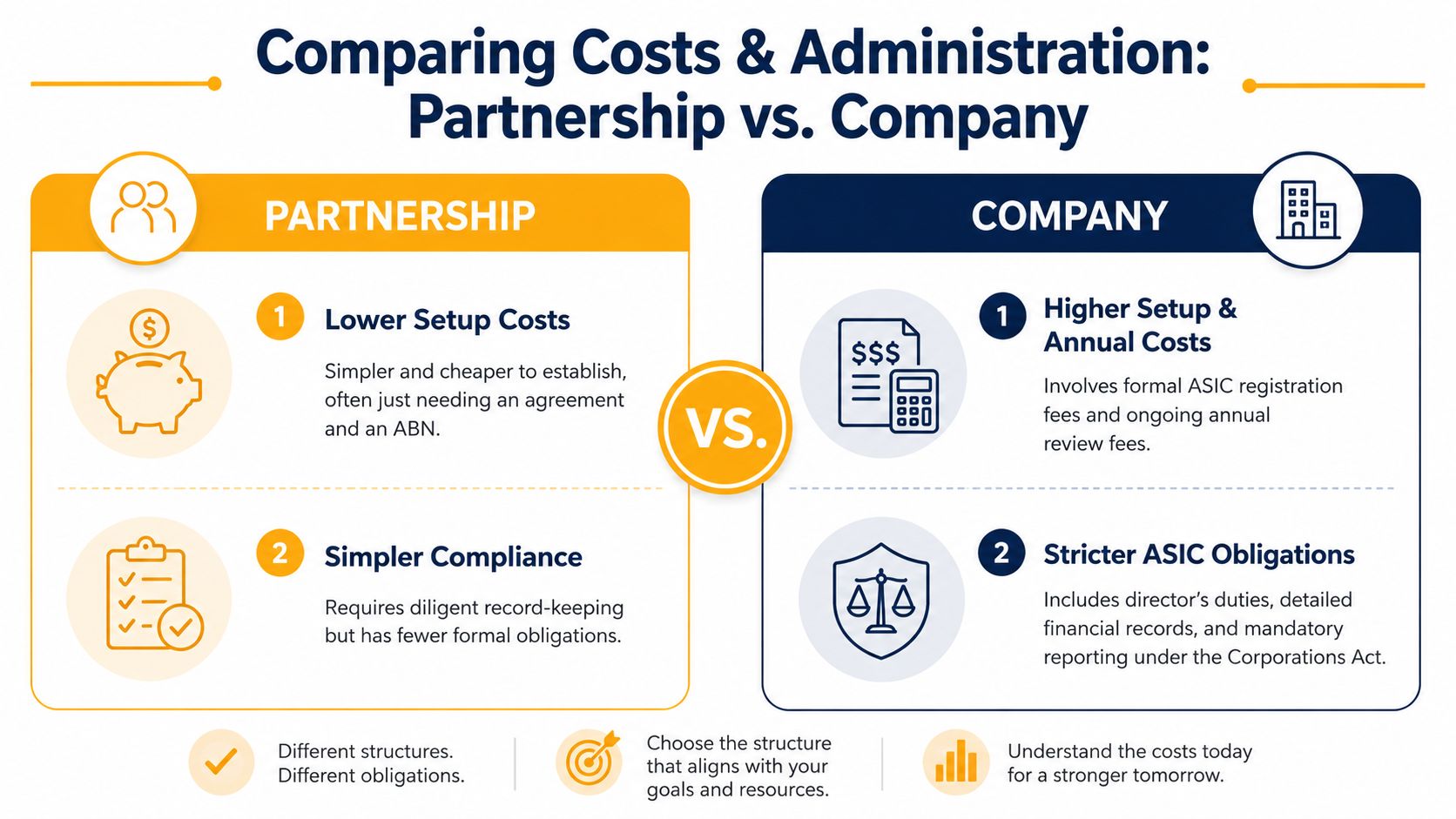
As you can see, a partnership is simpler upfront, but a company’s formal obligations are what provide that rock-solid asset protection and a clear path for growth. Making the right choice is crucial, and while our examples are Australian, similar logic applies in other countries, like when selecting a UK business structure.
These scenarios demonstrate there is no single “best” answer. The right structure is the one that fits your specific journey.
Actionable Step: Unsure which path fits your vision? Let our expert accountants in Ashfield or Belrose Northern Beaches help you map out a strategy that works for you. Book a no-obligation consultation today.
When to Upgrade: Moving From Partnership to Company
As your business grows, the structure that got you started might not be the one that gets you to the next level. A common crossroads for successful tradies and small business owners is deciding when to transition from a partnership to a company.
Knowing the right time to make this switch is crucial. It’s not just about paperwork; it’s about protecting your personal assets and positioning your business for long-term growth.
Often, the trigger is when the risks increase. You might be hiring your first employees, signing a major commercial lease, or taking on a significant business loan. Suddenly, the unlimited liability of a partnership feels like a tangible threat to your family home and personal savings. That’s when the “corporate veil” of a company structure becomes a necessity, not just a “nice-to-have.” The core issues of managing risk and growth are universal, a fact that’s clear even in guides for choosing a business structure in Connecticut.
The Key Steps to Make the Switch
Changing from a partnership to a company isn’t a simple flick of a switch. It’s a formal legal and financial process that must be managed carefully to avoid costly mistakes. While every business is different, here’s the general game plan.
- Wrap Up the Partnership: First, you must formally dissolve the old partnership. This involves finalising the accounts up to the day it ceases trading and lodging a final partnership tax return with the ATO.
- Register the New Company: Next, you will need to register your new proprietary limited (Pty Ltd) company with ASIC. This act creates the new, separate legal entity that will operate the business moving forward.
- Transfer the Business Assets: This step is critical. Everything the partnership owned—tools, vehicles, customer lists, and even goodwill—must be legally transferred to the new company. This is typically done through a formal sale agreement between the old partnership and the new company.
Be warned: transferring assets like this can trigger a Capital Gains Tax (CGT) event. The good news is that several small business CGT concessions are available under Australian tax law that can dramatically reduce, or even eliminate, the tax bill if you meet the specific conditions.
Getting Through the Tax and Compliance Maze
This is precisely where seeking expert advice is non-negotiable. One wrong move when transferring assets can leave you with a massive, unexpected tax bill.
An experienced accountant will help you correctly apply for a new Australian Business Number (ABN), transfer your business name, and, most importantly, structure the entire changeover to legally access those valuable CGT concessions under ATO rules like the Income Tax Assessment Act 1997.
Attempting to DIY this process is a huge risk. The difference between a partnership and a company becomes crystal clear during this transition, where legal, tax, and administrative rules all collide. Getting it wrong can undo years of your hard work.
At EndureGo Tax, we specialise in helping businesses like yours transition from one structure to another. Our team of expert accountants and registered ASIC agents manages the entire process, ensuring the change is seamless, tax-effective, and protects what you’ve built.
Don’t gamble with your financial future. Book a consultation with our expert team in Ashfield or Belrose Northern Beaches today and let’s ensure your business is structured for success.
